
🌟 Introduction: The Dawn of Brain-Computer Interfaces (BCIs)
Imagine sending a message, moving a robotic arm, or even composing music—just by thinking about it.
This is no longer a science fiction dream, but the reality of Brain-Computer Interfaces (BCIs).
BCIs bridge the gap between our biological brains and digital systems, enabling seamless communication without speech, typing, or gestures. With rapid advances in AI, machine learning, and neuroscience, BCIs are now transforming multiple industries and unlocking a new frontier of human potential.
This blog takes you through 10 powerful applications of BCIs, each explained with real-life examples, case studies, and future potential.
Table of Contents
🚀 What is a Brain-Computer Interface?
A Brain-Computer Interface (BCI) is a system that directly connects brain activity with an external device.
It bypasses traditional pathways like muscles or speech and instead uses brain signals to control machines.
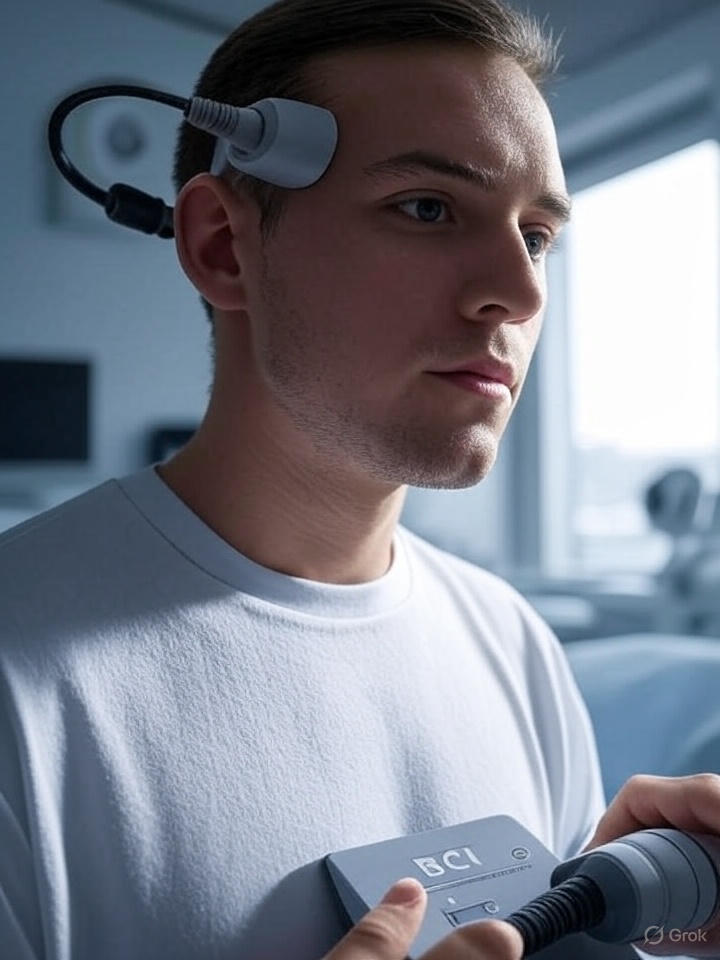
🧠 How BCIs Work:
- Brain Signals Generated – Neurons fire electrical impulses.
- Signal Capture – Electrodes (non-invasive or invasive) detect brain activity.
- Signal Processing – AI and algorithms translate signals into commands.
- Action Execution – The computer or machine carries out the action.
💡 Example: A paralyzed patient controlling a robotic arm to drink water just by thinking about the movement.
🔑 Types of Brain-Computer Interfaces
1. Invasive BCIs
- Electrodes implanted in brain tissue.
- Provide highly accurate signals.
- Example: Neuralink implants.
2. Non-Invasive BCIs
- External devices like EEG headsets.
- Safer but less precise.
- Example: Emotiv EEG for gaming and stress management.
3. Semi-Invasive BCIs
- Electrodes placed beneath the skull, not inside the brain tissue.
- Balance between precision and safety.
👉 Internal Link: Explore how digital twins are integrating with AI and healthcare for future medical solutions.
🌍 10 Powerful Applications of Brain-Computer Interfaces
1. 🏥 Healthcare & Neuro-Rehabilitation
Healthcare is the most transformative field for BCI applications. Millions of people suffer from paralysis, stroke, or motor neuron diseases like ALS. BCIs give them a second chance at independence.
🔬 Applications in Healthcare:
- Motor Rehabilitation: Stroke patients regain mobility through brain-controlled exoskeletons.
- Prosthetics: Robotic arms and legs controlled by brain signals.
- Speech Restoration: BCIs enable patients with speech loss to communicate.
📌 Case Study:
Stanford researchers developed a BCI where a paralyzed man typed 90 characters per minute by imagining handwriting. This is faster than most smartphone typing speeds!
💡 Example: Patients with ALS (like Stephen Hawking) are already benefiting from BCI-powered communication devices.
2. 🗣️ Assistive Communication Devices
For individuals with locked-in syndrome or severe paralysis, communication is impossible without assistance. BCIs offer thought-to-text and thought-to-speech solutions.
🔬 Breakthroughs:
- BCIs convert neural activity into real-time speech.
- Facebook Reality Labs is testing systems that translate thoughts into text.
💡 Example: ALS patients are now able to “speak” again using wearable BCI headsets.
📌 Case Study:
A patient in Germany, completely paralyzed, communicated with his family by spelling out words via BCI signals.
3. 🎮 Gaming & Entertainment
The gaming industry is set to explode with BCI integration. Imagine playing a video game where your mind is the controller.
🔬 Developments:
- Immersive VR Games: Players control avatars with thoughts.
- Emotion-Driven Gameplay: Games adapt based on stress, focus, or excitement levels.
- Metaverse Integration: Future BCIs may allow direct brain-to-virtual-world experiences.
💡 Example: Neurable created the first BCI-powered VR game, where players move objects by thinking.
📌 Case Study:
Gamers using EEG-based BCIs showed faster reaction times than traditional controllers.
4. 🧘 Mental Health & Stress Monitoring
BCIs are revolutionizing mental health treatment.
They monitor brain activity in real-time and detect stress, depression, or anxiety.
🔬 Key Uses:
- Neurofeedback Therapy: Patients learn to regulate emotions.
- Stress Detection: Devices warn when stress levels rise.
- Sleep Improvement: BCIs track sleep patterns and optimize relaxation.
📌 Case Study:
A startup created a BCI headset that reduces anxiety by guiding meditation through brain activity monitoring.
💡 Example: Students use BCI headsets to enhance focus during study sessions.
5. 🏠 Smart Home & IoT Control
Imagine turning off the lights, opening doors, or making coffee—all with your thoughts.
🔬 Real-World Use:
- BCIs integrated with smart assistants (Alexa, Google Home).
- Quadriplegic patients use BCIs to operate household appliances.
📌 Case Study:
A pilot project in Spain allowed paralyzed individuals to control TVs, fans, and wheelchairs via non-invasive BCIs.
💡 Example: Brain signals used to unlock smart doors hands-free.
🌍 Applications of Brain-Computer Interfaces (Continued)
6. 🪖 Military & Defense
The military has always been an early adopter of cutting-edge technologies, and BCIs are no exception. Imagine soldiers controlling drones, exoskeletons, or communication systems just by thinking.
🔬 Military Uses of BCIs
- Drone Control: Soldiers can guide unmanned aerial vehicles (UAVs) without joysticks.
- Exoskeletons: BCIs enhance soldiers’ strength and endurance with robotic suits.
- Silent Communication: Teams exchange commands brain-to-brain, avoiding detection.
- Stress Monitoring: BCIs monitor cognitive load, preventing fatigue-related mistakes.
📌 Case Study:
DARPA (U.S. Defense Advanced Research Projects Agency) has invested heavily in neural engineering programs. In one project, pilots successfully controlled multiple drones simultaneously through neural signals.
💡 Example: Imagine a special forces unit navigating dangerous terrain—without radios, but with brain-synced communication systems powered by BCIs.
7. 📚 Education & Skill Enhancement
Education is another field that will undergo a revolution with BCIs. Learning is often slowed down by distractions, fatigue, or one-size-fits-all teaching methods. BCIs change that by offering personalized, adaptive education.
🔬 Applications in Education
- Focus Training: BCIs monitor students’ attention levels and adjust teaching pace.
- Skill Acceleration: BCIs boost language learning and memory retention through neurofeedback.
- Accessibility: Students with disabilities gain full participation in classrooms.
- Exams & Preparation: BCIs detect cognitive stress and recommend study breaks.
📌 Case Study:
A school in China tested EEG headbands in classrooms to track student focus. Teachers received real-time dashboards on attention levels, enabling personalized teaching.
💡 Example: Students learning foreign languages can use BCI-powered VR environments to think in new languages faster.
8. 🏭 Workplace Productivity
In today’s high-pressure work culture, concentration and mental health are as important as technical skills. BCIs can transform workplaces by optimizing focus, safety, and collaboration.
🔬 Workplace Applications
- Fatigue Monitoring: Prevents accidents in industries like mining, trucking, or aviation.
- Cognitive Load Tracking: Detects overload in knowledge workers.
- Employee Wellness: Real-time stress feedback to prevent burnout.
- Hands-Free Operations: Workers control machinery in hazardous environments via BCIs.
📌 Case Study:
In Japan, companies tested BCI headbands to monitor truck drivers’ fatigue. Results showed a 40% reduction in accidents when early-warning systems were used.
💡 Example: Office employees may use BCI-powered focus apps that mute notifications automatically when brain signals show deep concentration.
9. 🚀 Space Exploration
In space missions, astronauts face extreme isolation, stress, and cognitive strain. BCIs offer a lifeline by supporting mental health, robotics, and communication.
🔬 BCI in Space Applications
- Remote Robotics: Astronauts control robotic arms or rovers without manual input.
- Cognitive Monitoring: Tracks stress levels during long missions.
- Telepathy-Style Communication: Thought-to-thought communication in deep space.
- Human-AI Symbiosis: Astronauts and onboard AI systems sync seamlessly via BCIs.
📌 Case Study:
NASA has been experimenting with EEG-based BCIs for astronauts to monitor stress during long-duration missions on the ISS.
💡 Example: On a future Mars mission, astronauts could control drones to scout terrain while focusing on survival tasks—all through thought commands.
10. 🤖 Merging Humans with AI (Future Vision)
Perhaps the most futuristic and ambitious use of BCIs is their ability to merge human intelligence with artificial intelligence.
🔬 Future Applications
- Superhuman Cognition: Accessing internet databases directly through thought.
- Enhanced Creativity: Co-creating with AI by sharing mental blueprints.
- Memory Expansion: External memory storage for the brain.
- Human-AI Integration: BCIs serve as the interface where biology meets machine learning.
📌 Case Study:
Neuralink demonstrated a monkey playing Pong purely with brain signals. Though basic, it hints at a future where humans may collaborate with AI more intuitively.
💡 Example: Imagine writing an article by simply thinking the words—and AI instantly formatting it into a polished blog post.
📊 Advantages of Brain-Computer Interfaces
✅ Independence: Gives mobility and communication back to patients.
✅ Speed: Faster than typing, touching, or speaking.
✅ Accessibility: Levels the playing field for disabled communities.
✅ Innovation: Opens doors to AI-human collaboration.
✅ Productivity: Enhances focus and safety in workplaces.
⚠️ Challenges & Ethical Considerations
Despite their promise, BCIs bring serious challenges that must be addressed.
1. Privacy Concerns
Brain data is the most personal form of data. Who owns it? Who can access it?
2. Cybersecurity Risks
Hackers could potentially manipulate or steal neural data.
👉 Internal Link: See our blog on Cybersecurity Threats to learn how neural data can be protected.
3. Ethical Dilemmas
- Should employers monitor employee focus with BCIs?
- Should military BCIs be weaponized?
4. Medical Risks
- Invasive BCIs carry risks of infection or brain damage.
- Long-term effects of implants are still unknown.
📌 Real-Life Success Stories
🐒 Neuralink Monkey Playing Pong
In 2021, Neuralink released a video of a monkey playing Pong using only brain signals. This proved BCIs can enable thought-based gaming.
🧑🦼 BrainGate Trials
BrainGate researchers helped paralyzed patients control robotic arms, restoring independence in daily activities.
🧠 Thought-to-Text Breakthrough
Stanford’s handwriting BCI allowed a paralyzed man to type 90 characters per minute—a new world record.
🔮 The Future of Brain-Computer Interfaces (BCIs)
As we look ahead, BCIs hold the potential to reshape human life in the next decade. Their growth will depend on technology, ethics, accessibility, and regulation.
🌐 Future Trends in BCI (2030 and Beyond)
- Mass Adoption of Non-Invasive BCIs
- Headband-style BCIs will become as common as wearing headphones.
- Affordable consumer BCIs for gaming, meditation, and productivity.
- BCI-Powered Internet Browsing
- Browsing websites with your mind.
- Typing URLs and searching Google by thinking keywords.
- Integration with the Metaverse
- BCIs will create true immersive VR/AR worlds.
- Users interact with digital avatars and environments without controllers.
👉 Backlink : Read our detailed guide on Digital Twins to understand how BCIs will sync with future virtual worlds.
- Medical Revolution
- Cure for blindness via visual cortex BCIs.
- BCIs reversing paralysis through neural bypass systems.
- Cognitive Enhancement
- Boosting memory and creativity.
- Students may “download” skills directly into the brain, similar to sci-fi movies.
- Brain-to-Brain Communication
- Telepathic-style messaging.
- Thought-sharing between two or more people in real-time.
- AI + Human Superintelligence
- Seamless collaboration between human cognition and AI computing.
- Workers, researchers, and artists may create 10x faster with BCI-AI hybrids.
❓ Extended FAQ on Brain-Computer Interfaces
1. What is a brain-computer interface (BCI)?
A BCI is a system that enables direct communication between the brain and external devices. It translates brain signals into commands, allowing control of computers, machines, or prosthetics.
2. How do brain-computer interfaces work?
BCIs detect brain activity using sensors (EEG, implants, fNIRS) and convert it into digital signals. AI algorithms then interpret those signals into actions like moving a cursor, typing text, or controlling a robotic arm.
3. What are the main types of BCIs?
- Invasive BCIs: Implanted electrodes in the brain.
- Non-invasive BCIs: External devices like EEG headbands.
- Partially invasive BCIs: Sensors placed inside the skull but outside the brain tissue.
4. Who invented brain-computer interfaces?
The concept originated in the 1970s, with early experiments at UCLA and Stanford. Today, companies like Neuralink, OpenBCI, and Emotiv are advancing commercial BCIs.
5. Are brain-computer interfaces safe?
Non-invasive BCIs are safe, but invasive implants carry risks like infection or brain tissue damage. Long-term studies are still ongoing.
6. Can BCIs read thoughts?
Currently, BCIs can detect patterns of intent and motor imagery, not full complex thoughts. Future improvements may expand their accuracy.
7. How expensive are BCIs?
Consumer-grade non-invasive BCIs cost $300–$1,500.
Medical or research-grade systems can exceed $50,000.
8. Will BCIs replace smartphones?
Possibly in the long run. Instead of typing or touching screens, users might think commands to open apps, call contacts, or browse online.
9. Can BCIs cure paralysis?
Yes, BCIs are already helping paralyzed patients control robotic arms, wheelchairs, and communication systems—offering new independence.
10. What industries will benefit most from BCIs?
- Healthcare
- Gaming & Entertainment
- Education
- Military & Defense
- Space Exploration
- Corporate Productivity
11. Are BCIs ethical?
Ethics remain debated. Concerns include privacy, brain data ownership, and potential misuse in surveillance or military applications.
12. What is the future of BCIs?
By 2035, experts predict BCIs will move from labs to everyday life—powering human-AI collaboration, medical miracles, and even thought-based internet browsing.
🏆 Conclusion: Why Brain-Computer Interfaces Are the Future
Brain-Computer Interfaces are no longer science fiction. From restoring mobility to the paralyzed, to controlling drones, enhancing education, and enabling space exploration—BCIs are rewriting human history.
While ethical and security challenges remain, the benefits are too powerful to ignore. With leaders like Neuralink, OpenBCI, and BrainGate pushing the frontier, BCIs could soon become the smartphones of the brain age.
👉 If you want to explore related emerging technologies, check out our in-depth blog on Nanotechnology for another game-changing innovation.