
Table of Contents
Introduction: Why Psychology of Student Matters More Than Ever
psychology of Student life is one of the most formative phases in a person’s journey. It’s the stage where dreams are built, habits are formed, and personality begins to solidify. But behind the grades, assignments, and report cards lies something far deeper — the psychology of students.
Understanding how students think, feel, and behave isn’t just an academic exercise — it’s essential for building effective teaching methods, supporting emotional health, and ensuring long-term success. From early childhood curiosity to the complex identity struggles of late adolescence, psychology shapes every aspect of a student’s learning journey.
In today’s fast-paced, tech-driven world, the pressures on students are greater than ever. Academic competition, peer pressure, social media influence, and family expectations all interact with a student’s mental framework, shaping their confidence, learning ability, and overall well-being.
In this blog, we’ll explore every key aspect of student psychology — from motivation and learning styles to mental health challenges and resilience — and provide practical, research-backed insights for parents, teachers, and students themselves.
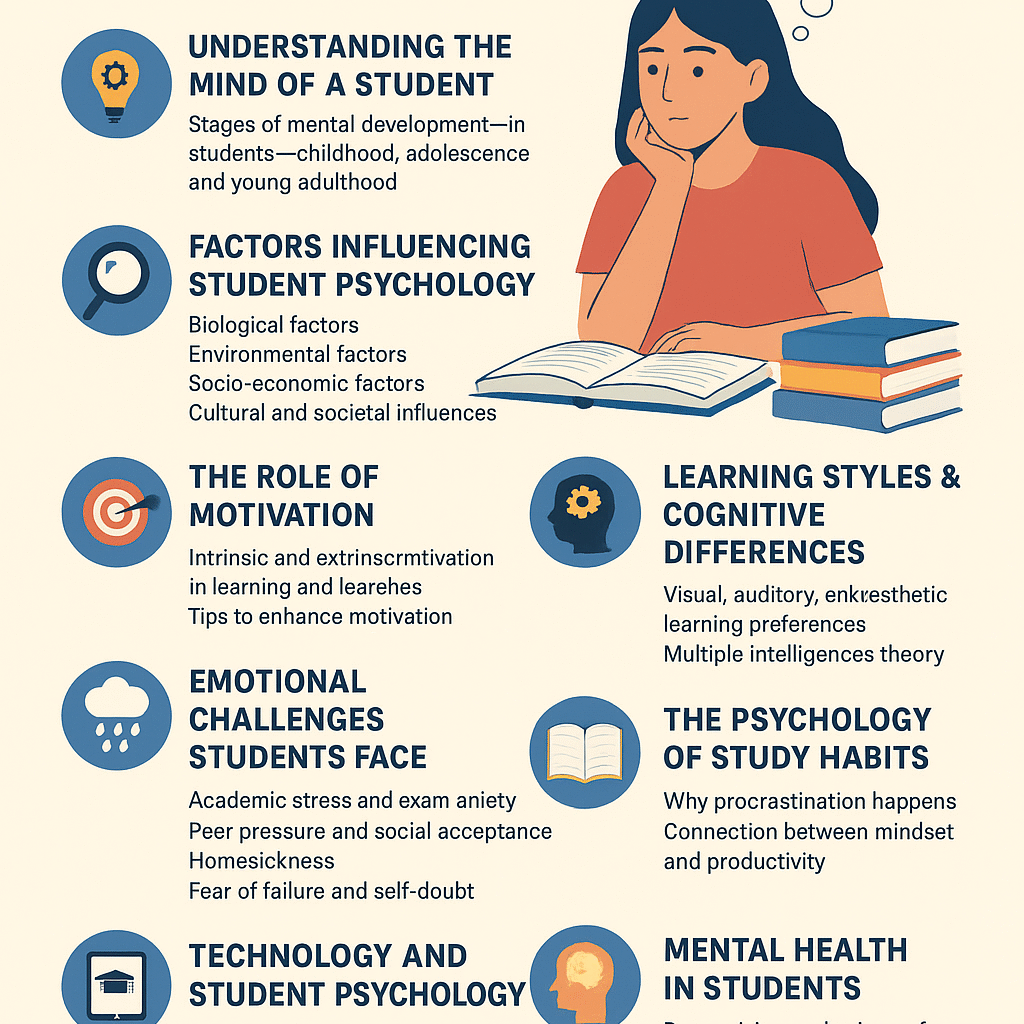
1. Understanding the Mind of a Student
The mind of a student is like a sponge — constantly absorbing, filtering, and interpreting information. But it’s also like a seed — needing the right conditions to grow and flourish, hence the psychology of student.
Stages of Mental Development in Students
- Childhood (5–12 years): Curiosity is high, attention spans are shorter, and play-based learning works best.
- Adolescence (13–18 years): The brain undergoes rapid changes, emotional highs and lows occur frequently, and social acceptance becomes a major motivator.
- Young Adulthood (18+ years): Self-identity formation peaks, critical thinking develops, and long-term career choices take shape.
2. Factors Influencing Student Psychology
Several factors interact to shape psychology of student,their mindset and behavior.
Biological Factors
- Brain development (especially the prefrontal cortex, responsible for decision-making) continues until around age 25.
- Hormonal changes influence mood, energy levels, and focus.
Environmental Factors
- A supportive family and healthy school environment foster confidence.
- Negative environments can lead to stress, anxiety, or disengagement.
Socio-economic Factors
- Financial stability affects access to resources like tutoring, technology, and extracurricular opportunities.
- Economic struggles can cause distractions and mental strain.
Cultural & Societal Influences
- In collectivist cultures, family honor may drive academic pressure.
- In individualist cultures, personal goals and self-expression may take precedence.
3. The Role of Motivation in Student Psychology
Motivation is the fuel that drives learning and psychology of student.
Intrinsic Motivation
Learning for the sake of curiosity or personal growth.
Example: A student learning coding because they enjoy problem-solving.
Extrinsic Motivation
Learning for rewards or recognition.
Example: Studying hard to win a scholarship or gain parental approval.
Tip for Parents & Teachers: Balance both types — extrinsic motivators help in the short term, but intrinsic motivation builds lifelong learners.
4. Learning Styles and Cognitive Differences
Not all students learn the same way.So psychology of student needs the following learnings.
- Visual Learners: Learn best through images, diagrams, and charts.
- Auditory Learners: Absorb information through lectures, discussions, and audio materials.
- Kinesthetic Learners: Need hands-on experiences and physical activity to grasp concepts.
Multiple Intelligences Theory (Howard Gardner)
Includes linguistic, logical-mathematical, spatial, musical, bodily-kinesthetic, interpersonal, intrapersonal, and naturalistic intelligence.
Classroom Application: A math problem could be taught through diagrams (visual), songs (auditory), or real-life experiments (kinesthetic).
5. Emotional Challenges Students Face
Academic Stress
Heavy workloads and exam pressure can cause burnout.
Peer Pressure
The need to “fit in” can influence choices, from study habits to lifestyle decisions.
Fear of Failure
Fear often causes procrastination or avoidance.
Example: A bright student avoiding math tests because they fear proving themselves “not good enough.”
6. The Psychology of Study Habits
Why Procrastination Happens
It’s often a fear-based avoidance or a result of poor time perception.
Effective Study Techniques
- Pomodoro Technique: Work in 25-minute bursts with short breaks.
- Spaced Repetition: Revisiting material at increasing intervals improves memory.
- Active Recall: Testing yourself instead of passively re-reading notes.
7. Technology and Student Psychology
Benefits
- Access to diverse learning resources.
- Opportunities for interactive learning.
Risks
- Reduced attention span from constant notifications.
- Social media comparisons harming self-esteem.
Tip: Encourage “digital hygiene” — setting time limits, avoiding devices before bed, and using technology purposefully.
8. Mental Health in Students
Common Issues
- Anxiety, depression, burnout.
- Sleep disturbances.
Solutions
- School counseling programs.
- Promoting open conversations about mental health.
- Mindfulness and breathing exercises.
9. Role of Teachers and Parents
For Teachers
- Use positive reinforcement.
- Adapt teaching methods to different learning styles.
For Parents
- Show empathy, not just authority.
- Avoid unrealistic expectations.
- Praise effort, not just results.
10. Peer Influence and Group Dynamics
Friendships can be a strong motivator — or a distraction. Group study can improve understanding but also risk time-wasting if not managed.
11. Building Resilience
Teaching students to bounce back from failures builds long-term success.
Strategies include goal-setting, positive self-talk, and reframing challenges as opportunities.
12. Self-Esteem & Identity Formation
Adolescence is a period of self-discovery. Achievements boost self-esteem, while repeated failures without support can harm it.
13. Cultural Differences in Student Psychology
Students from different cultural backgrounds may face language barriers, different learning styles, and identity struggles.
14. Future of Student Psychology
With AI-driven personalized learning, mental health awareness, and holistic education trends, the future holds promise for more student-centered approaches.Therefore psychology of student must be nurtured very minutely.
Conclusion
Understanding the psychology of students isn’t just for psychologists — it’s a responsibility for everyone involved in education. By recognizing the mental, emotional, and social aspects of a student’s journey, we can create environments that inspire not just academic success but personal growth and lifelong resilience.
Your point of view caught my eye and was very interesting. Thanks. I have a question for you.