

Introduction: Why 2026 Is Your Breakthrough Year
Every January, millions of people set resolutions. By mid-February, 80% have abandoned them. But here’s what separates the high performers from the rest: they don’t set vague resolutions. They architect their success.
2026 isn’t just another year—it’s your opportunity to establish systems that compound over twelve months. The difference between ordinary workers and those who achieve remarkable productivity goals comes down to one thing: planning aligned with proven frameworks. Recent workforce research shows that 39% of employees report noticeable productivity gains from structured goal-setting methodologies, with the highest impact concentrated among those who combine psychology-backed techniques with modern tools.
This isn’t about working harder. It’s about working smarter, with clear objectives, measurable milestones, and accountability systems that keep you on track when motivation fades. If you’re serious about transforming your productivity in 2026, this guide breaks down exactly how to set, track, and achieve the goals that matter most.
Table of Contents
The Science of Goal-Setting That Actually Sticks
Before diving into frameworks, let’s address the elephant in the room: why most people fail at achieving goals. The answer isn’t laziness—it’s strategy.
The Psychology Behind Success
Psychologists Edwin Locke and Gary Latham, pioneers in goal-setting theory, discovered that realistic, hard, and specific goals produce better performance than easy or ambiguous ones. But specificity alone isn’t enough. The magic happens when goals are vivid, concrete, and actionable. Research shows that those who create detailed implementation intentions—the “if X happens, then I will do Y” framework—are three times more likely to achieve their goals.
This means instead of saying “I want to be more productive,” a high-performer says: “If I complete my deep work block by 11 AM, then I’ll allow myself to check emails for 15 minutes before lunch.” That’s concrete. That’s actionable.
The second critical insight: self-monitoring is transformative. People who regularly track their progress are 2.5 times more likely to attain their goals. Yet only a fraction of goal-setters actually establish monitoring systems. In 2026, this becomes your unfair advantage.
Why Range Goals Beat Fixed Targets
Here’s a counterintuitive finding from behavioural science: fixed goals often create psychological pressure. Instead, set goal ranges. Rather than “Exercise 5 days per week,” try “Exercise 3-5 days per week.” If you hit three days, you’ve succeeded. You don’t feel like you’ve failed. This flexibility, backed by research, significantly increases follow-through.
Title
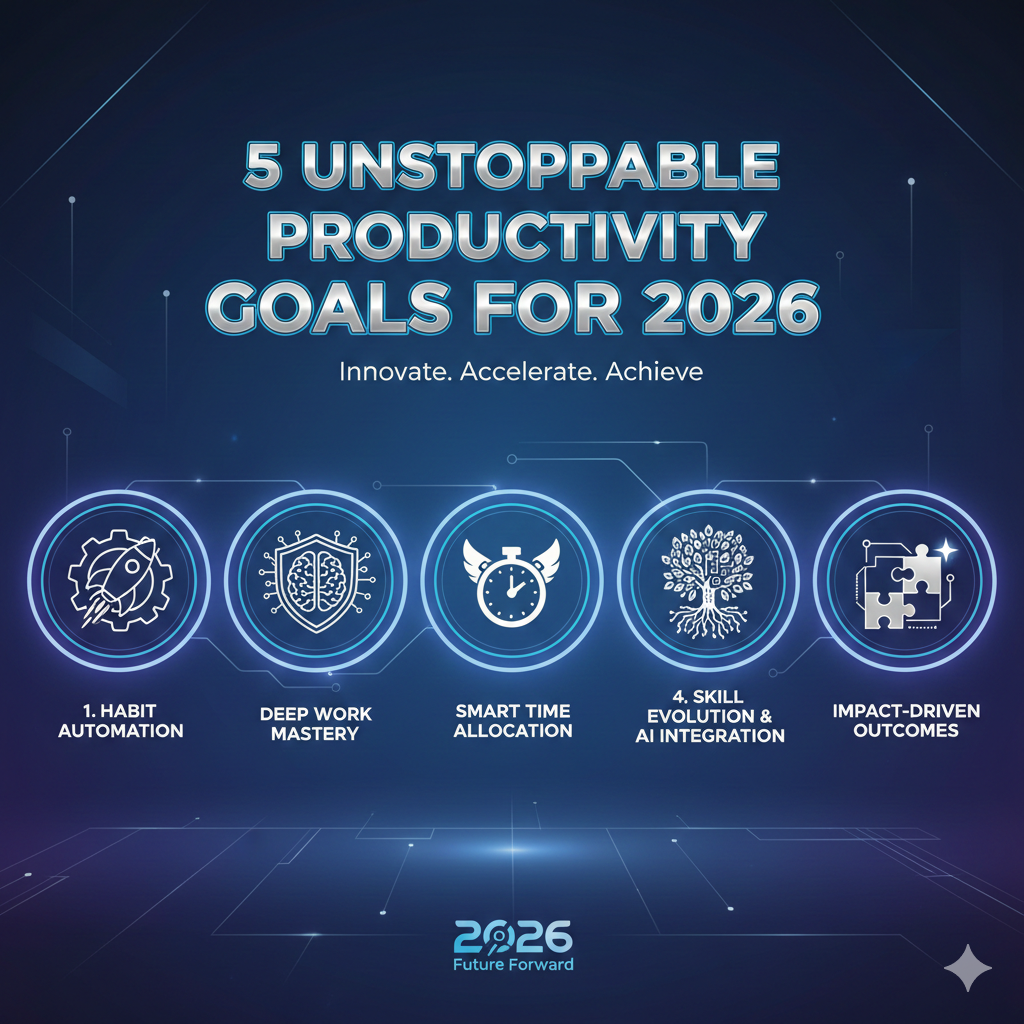
Future Forward: 5 Unstoppable Productivity Goals for 2026
Caption
The future of work isn’t just about doing more—it’s about doing what matters with precision. 🚀 2026 is the year we move beyond “busy” and into high-impact, AI-integrated mastery. These 5 pillars are designed to help you automate the mundane, master your focus, and scale your potential. Ready to make next year your most efficient yet? 🛠️✨ #Productivity2026 #FutureOfWork #DeepWork
Framework #1: The SMART Goals Foundation
The SMART framework has endured for a reason—it works. But most people implement it superficially. Let’s go deeper.
Specific: Define exactly what you want. “Improve productivity” is vague. “Complete two client projects per week while maintaining quality scores above 95%” is specific. The specificity creates clarity in your brain about what success looks like.
Measurable: Attach numbers or clear indicators. You need quantifiable milestones to track progress and celebrate wins. Include monthly benchmarks, not just annual targets. If your goal is to grow your business revenue by 40% in 2026, what does that mean monthly? Quarterly?
Achievable: This isn’t about mediocrity—it’s about realism. Ambitious goals motivate; impossible ones demoralise. If your current capacity is three projects per month, jumping to ten might cause burnout rather than a breakthrough. The sweet spot is ambitious but realistic.
Relevant: Does this goal align with your bigger vision? Your personal values? If you’re setting a goal just because it sounds impressive, it won’t sustain you through tough months. Alignment with what you actually care about creates intrinsic motivation.
Time-bound: “By June 30, 2026” beats “sometime this year.” Deadlines create urgency and prevent perpetual postponement. They also make accountability tangible.
Implementation: Write your top three SMART goals on paper this week. Post them where you see them daily. Share them with an accountability partner. The act of writing and sharing increases commitment by 65%.
Framework #2: OKRs for Goal-Setters Who Want Advanced Results
If SMART goals are your foundation, OKRs are your skyscraper. Objectives and Key Results, popularised by Google and Intel, operate differently from SMART goals and are particularly powerful for high performers.
How OKRs Work
An Objective is an ambitious, inspirational goal—something that excites you. It’s directional, not a checkbox. For example: “Become a recognised expert in my niche by 2026.”
Key Results are the measurable outcomes that prove you’ve achieved the objective. Each objective needs three to five key results. Using the example above:
- Key Result 1: Publish 24 original pieces of content (two per month)
- Key Result 2: Grow audience by 10,000 engaged followers
- Key Result 3: Secure three high-profile speaking opportunities or media features
The OKR Scoring System
Here’s what separates dilettantes from professionals: Google scores OKRs on a scale of 0.0 to 1.0. The target for aspirational goals is 0.7—meaning you achieved 70%. If you’re consistently hitting 1.0, your goals aren’t ambitious enough. If you’re averaging 0.4, they’re unrealistic.
This framework eliminates the all-or-nothing mentality that sabotages most goal-setters. You can make significant progress without perfection.
Framework #3: Implementation Intentions (The Secret Sauce)
This might sound academic, but it’s the highest-ROI strategy in goal achievement. Implementation intentions are if-then statements that remove decision-making from the equation.
How They Work
Rather than relying on willpower—which is finite and depletable—you create automatic triggers. Here are real examples:
- If it’s 7 AM, then I put on my running shoes before coffee (rather than deciding whether to exercise)
- If I finish my most important task, then I allow a 10-minute break (rather than negotiating with myself)
- If I sit at my desk, then I turn off my phone and close my email (rather than disciplining myself in the moment)
The neuroscience here is fascinating: implementation intentions bypass the prefrontal cortex (where willpower lives) and create automatic behavioural pathways. You’re literally rewiring your brain for success.
Creating Your Implementation Intentions
Spend 30 minutes this week writing five if-then statements for your 2026 goals. Make them specific to your environment and daily triggers. Then post them—on your mirror, your desk, your phone—and review them weekly.
Building Your Daily High-Performance Habit Stack
Frameworks are elegant. But daily habits are what determine outcomes. Let’s talk about the habits that separate the productive from the exceptional.
The Morning Routine: Your Competitive Advantage
Every high performer has a non-negotiable morning routine. Not because it’s trendy, but because the first 60 minutes of your day set the neurological tone for the next 12 hours.
Here’s what the research shows: A structured morning that includes movement (even a 10-minute walk), mindfulness (meditation, breathing, or journaling), and goal review creates measurable improvements in focus, stress resilience, and productivity throughout the day.
Implement this: Tomorrow morning, before checking your phone, spend 30 minutes on: five minutes of movement, five minutes of breathing or meditation, and twenty minutes reviewing your daily goals and most important tasks.
Time Blocking: The Architect’s Approach
Time blocking is how you move from being busy to being effective. Rather than a to-do list, you schedule specific blocks of time for specific activities.
Example schedule:
- 6-7 AM: Morning routine
- 7-9 AM: Deep work (your most important task)
- 9-9:30 AM: Emails and messages
- 9:30-12:30 PM: Secondary projects
- 12:30-1:30 PM: Lunch and recovery
- 1:30-4 PM: Meetings, collaboration
- 4-5 PM: Planning for tomorrow
This structure is revolutionary because it eliminates context switching. Your brain enters deep focus, knowing you have protected time. Research shows deep work sessions of 90 minutes followed by 15-minute breaks optimise cognitive performance.
The Pomodoro Technique for Sustainable Focus
Twenty-five minutes of focused work, five-minute break. After four cycles, take a longer 15-30 minute break. This method works because it aligns with your natural attention rhythms and prevents burnout.
Use a timer—physical or app-based. When the timer rings, stop. This psychological contract with yourself builds trust in your own systems.
Single-Tasking Beats Multitasking by 40%
Multitasking reduces productivity by 40% and increases errors. Yet it’s glorified in modern culture. High performers in 2026 are deliberately choosing single-tasking.
During deep work blocks, you have one task. Not three. Not checking Slack. One. Your brain’s focus is a muscle—and this is how you exercise it.
Accountability and Progress Tracking Systems
Here’s the uncomfortable truth: you will not maintain momentum on productivity goals without external accountability and visible progress tracking.
The Daily Progress Log
Spend five minutes each evening documenting: What did I accomplish today? What’s one win? What’s one obstacle? This isn’t journaling—it’s data collection. Over weeks, you’ll see patterns. You’ll identify your peak productivity windows. You’ll know what derails you.
Weekly Reset Ritual
Every Sunday (or your chosen day), spend 15 minutes reviewing the past week and planning the next. Ask: Did I hit my key results benchmarks? What’s one thing to adjust? What’s non-negotiable next week?
This 15-minute investment prevents drift. It keeps you on course toward your annual goals.
Accountability Partners and Public Commitment
Research is unambiguous: public commitment increases follow-through. Tell someone your goals. Check in weekly. Share progress and obstacles. The social pressure is real, and in this context, it’s productive.
Many high performers use forums, Slack groups, or paid accountability coaches. The investment in external accountability typically returns 10x.
Tools That Transform Your Productivity Goals
Framework + habits require infrastructure. Here are the tools reshaping how productive people work in 2026.
Asana for Project Management
Asana excels at breaking down goals into projects, projects into tasks, and tasks into subtasks. Its clean interface makes it ideal for tracking key results and dependencies. Link your OKRs directly into Asana, and suddenly your big-picture goals inform daily work.
Notion as Your Operating System
Notion is where many creators build their complete system—goal databases linked to habit trackers, project dashboards, and progress reviews. It’s customizable to your workflow. The downside: setup requires time. The upside: once built, it’s your personalised productivity infrastructure.
Monday.com for Visual Team Collaboration
If you work with a team, Monday.com’s visual interface and automation capabilities make it easier to align everyone around shared goals. Custom automations can reduce manual updates.
Toggl for Time Awareness
You can’t manage what you don’t measure. Toggl tracks where your time actually goes. Most high performers are shocked by the gaps between intended time allocation and actual allocation. This data becomes actionable intelligence for 2026.
Answering Your Burning Questions: Productivity Goals FAQ
Q: How many goals should I set for 2026?
A: Fewer than you think. Aim for three to five major goals across different life areas—professional, personal, and health. More than that dilutes focus. Quality over quantity.
Q: What if I miss a milestone in February? Do I restart?
A: No. You adjust. If a goal isn’t hitting the way you expected, ask why. Is it actually valuable? Is the strategy wrong? Is the timeline unrealistic? Adjust and recommit. Rigidity creates failure; flexibility enables learning.
Q: How do I stay motivated if progress is slow?
A: Track leading indicators, not just outcomes. If your goal is “Grow my audience by 10,000,” celebrate weekly gains of 150 followers. Break big goals into smaller milestones you can celebrate monthly.
Q: Should I share my goals publicly?
A: Yes, with strategically chosen people. Research shows public commitment increases achievement. But be selective—share with supporters, not critics. Your accountability circle should be encouraging but honest.
Q: What’s the best time to review my goals?
A: Weekly (15 minutes, every Sunday) and monthly (one hour, first Sunday of each month). Quarterly reviews are important too—step back, reassess, adjust if needed.
The 2026 Productivity Challenge: Your Action Plan
We’ve covered frameworks, habits, tools, and psychology. Now comes the part where most people stumble: implementation.
This Week: Foundation
- Write three SMART goals in your preferred tool (Notion, Asana, or even a notebook)
- Identify five if-then implementation intentions
- Design your ideal morning routine (30 minutes maximum)
- Schedule your first weekly reset ritual
Next Week: Architecture
- Build your time-blocking schedule in a calendar tool
- Set up your progress tracking system
- Identify your accountability partner(s) or community
- Create your first set of OKRs if you want to go deeper
Month One of 2026: Establish
- Maintain your morning routine for 21 days (creates neural pathways)
- Do your weekly resets without fail
- Track daily progress logs
- Check in with accountability partners
By February, your systems will be automatic. By March, they’ll be identity. By December, you’ll have built the most productive year of your life.
When Is the 2026 Productivity Challenge Happening?
We are launching the structured 2026 Productivity Accelerator Challenge on January 6, 2026, running for 12 weeks. This isn’t optional busy work—it’s a cohort-based program where you’ll:
- Receive weekly strategy deep-dives
- Get live Q&A on goal-setting psychology and tool implementation
- Join a community of 500+ high performers committed to the same vision
- Access templates for SMART goals, OKRs, and daily trackers
- Participate in accountability check-ins
The challenge aligns with the science already discussed—structured support, community accountability, expert guidance, and proven frameworks.
Registration Details
Challenge Details:
- Start Date: January 6, 2026
- Duration: 12 weeks (through March 27, 2026)
- Time Commitment: 3-5 hours per week (flexible, asynchronous learning)
- Format: Pre-recorded modules + live weekly office hours (Thursdays, 6-7 PM IST)
- Access: Lifetime access to all materials after the challenge ends
Investment & Registration:
Standard Registration: ₹2,999 (limited to first 200 participants)
Early Bird (through January 3, 2026): ₹1,999
Click here to register: [Your registration link]
Money-Back Guarantee: If you don’t see measurable progress on your key results by Week 4, we’ll refund 100%. No questions asked.
What’s Included:
✓ 12 video modules on goal-setting frameworks
✓ Downloadable templates for Asana, Notion, and Google Workspace
✓ Weekly strategy calls with productivity expert (recorded, available anytime)
✓ Private Slack community with 500+ goal-setters
✓ Daily accountability check-in system
✓ Bonus: One-on-one goal clarity session (₹5,000 value)
Your Next Step: Start Now, Not January 1
One final insight from behavioural psychology: the planning effect. People who commit to specific plans before their goal date are significantly more likely to succeed.
Don’t wait until January 1 to think about 2026. This week, write down three goals. Design one implementation intention. Schedule your first 30-minute morning routine. Join the community.
The year you build in December determines the year you live in 2026. The frameworks are proven. The science is solid. The only question is: are you ready to architect your breakthrough?
Final Word
2026 will be busy regardless. The question is: will it be busy with progress toward meaningful goals, or will it be consumed by distractions? The high performers you admire didn’t get there by accident or luck. They achieved this by setting clear productivity goals, establishing accountability systems, and taking consistent action.
This guide gives you the exact frameworks they use. Now it’s your turn.
Start with these three actions this week:
- Write your top three SMART goals for 2026
- Create five if-then implementation intentions
- Register for the 2026 Productivity Accelerator Challenge (or simply join the free community)
Your breakthrough year is waiting. The only question is: will you answer?
1 thought on “5 Unstoppable Productivity Goals for 2026: Master Your Year Before It Begins”