
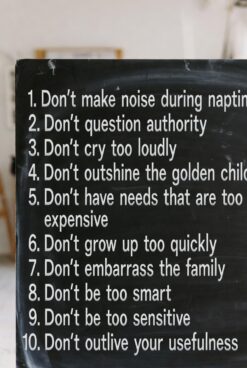
Rules: It’s 11:14 PM on a Tuesday. You’re staring at an email that requires a simple “no,” but your heart is hammering against your ribs like you’re defusing a bomb.
Or maybe you’re on vacation, finally sitting by a pool you worked three years to afford, and instead of relaxing, you feel a gnawing, itchy sense of guilt. You feel “wasteful.” You feel like you should be checking your Slack notifications.
You tell yourself this is just “who you are.” You’re a “perfectionist,” an “over-achiever,” or just “someone who cares too much.”
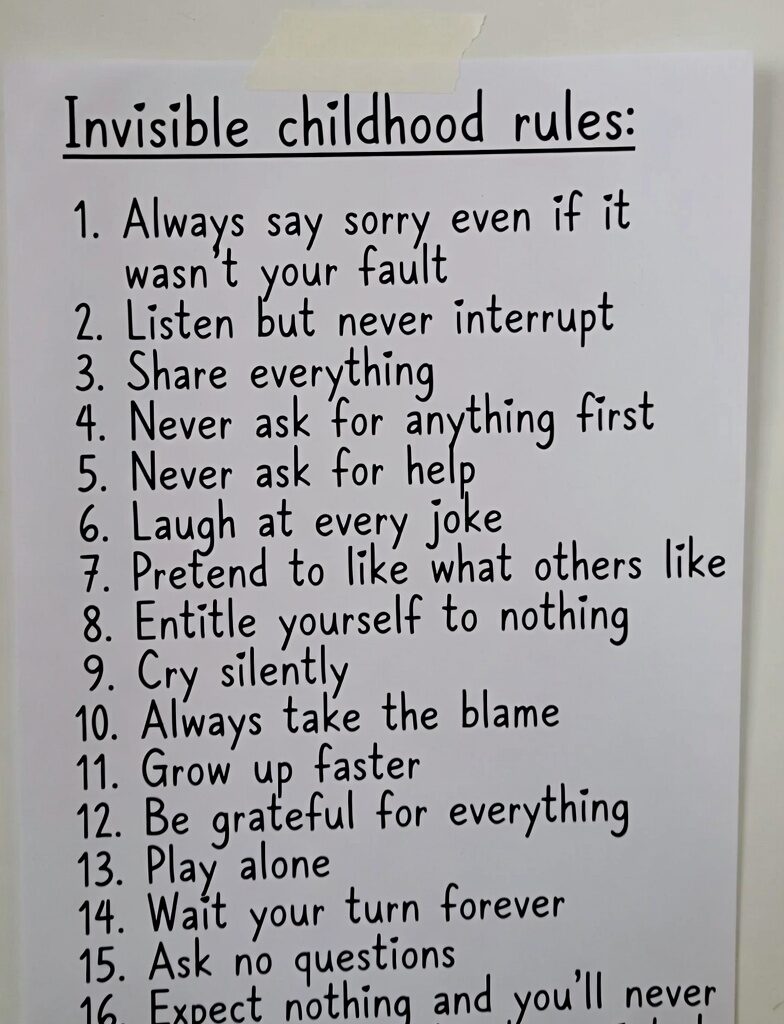
But it isn’t personality. It’s a script. You are living by a set of invisible rules written for a house you no longer live in, by people who were just as scared as you are.
The Ghost in the Room
Most of us think of our childhood “rules” as the ones that were shouted: Don’t track mud on the carpet. Finish your peas. But the rules that actually run your adult life were never spoken aloud. They were whispered in the silence after a door slammed. They were taught in the way your father’s eyes glazed over when you got too excited, or how your mother only seemed truly “present” when you were achieving something.
These are Invisible Rules. They are the subconscious survival strategies you adopted when you were too small to change your environment. Back then, following them kept you safe, kept you loved, or at least kept the peace.
The problem? You grew up, but the rules didn’t. You’re still playing a game where the goal is to avoid a reaction that hasn’t happened in twenty years.
The Origin of the Script
We learn the architecture of the world long before we have the vocabulary to describe it.
- If a parent was volatile, you learned the rule, “Monitor the room.” Now, as an executive, you spend more energy tracking your boss’s micro-expressions than you do on your actual strategy.
- If love were conditional on grades or behavior: You learned the rule, “Worth is earned, never owned.” Now, you can’t enjoy a Sunday afternoon because if you aren’t producing, you feel like you’re disappearing.
- If your needs were “too much” for a stressed caregiver, you learned the rule, “Don’t be a burden.” Now, you’d rather drown in a project than ask a colleague for five minutes of help.
We mistake these survival patterns for our “character.” We say, “I’m just a private person,” when the rule is actually: “If they see the real me, they’ll leave.” We say, “I have a high work ethic,” when the rule is actually: “If I slow down, I am useless.”
Why Success Doesn’t Solve It
I see this most often in high-functioning, incredibly “successful” adults. On paper, they have won. But inside, they feel like an imposter or a weary marathon runner who has forgotten why they started running.
Intelligence doesn’t protect you from these rules because they aren’t stored in your logic. They are stored in your nervous system.
When you try to break an invisible rule—like setting a boundary or resting without an excuse—your brain doesn’t see “growth.” It sees “danger.” This is why you feel that unexplained spike of anxiety when you do something objectively good for yourself. Your body remembers a time when “speaking up” meant “exile.”
You aren’t weak; you are simply trying to override decades of deep-sea programming with a few minutes of “positive thinking.” It’s like trying to uninstall an operating system while the computer is still running.
The Body Remembers
The rules show up in the physical body long before they hit the mind.
- The tightness in your throat when you want to say “no.”
- The shallow breath when someone asks, “How are you really doing?”
- The sudden, crushing fatigue that hits the moment you finally have a day off.
This is your body enforcing the old laws. It’s the “Identity Fusion” at work. You have spent so long being the “Reliable One” or the “Quiet One”, or the “Strong One” that the idea of being anything else feels like a death. You aren’t afraid of the change; you’re afraid of losing the only version of yourself that you know is “allowed” to exist.
A Gentle Awakening
It is tempting to look back and want to find someone to blame. But usually, the people who gave you these rules were just handing down the heavy, rusted tools they were given by their own parents. They were teaching you how to survive a world they perceived as dangerous.
The goal isn’t to litigate the past, but to acknowledge that the lease on these rules has expired.
The house is no longer on fire. You don’t have to keep standing by the exit.
How to Start Rewriting
You don’t break these rules with a sledgehammer; you dissolve them with curiosity.
- Identify the “Should” Ghosts: Next time you feel that familiar prickle of guilt or anxiety, ask: “Whose rule am I breaking?” Is it yours? Or is it a rule from 1994?
- Test the Gravity: Pick a tiny, low-stakes rule to break. Don’t clear the table immediately. Send a three-sentence email instead of a paragraph. Watch what happens. Notice that the world doesn’t end.
- Offer New Terms: When you feel the urge to over-explain or apologise for existing, try saying to yourself: “I am allowed to be inconvenient.” It will feel “wrong” at first. That “wrongness” is actually the feeling of a new muscle growing.
The Final Reveal
The most profound realisation you will ever have is this: The person you have been all these years—the one who is always “on,” always helping, always performing—is not the whole you. That person is a protector. They did a magnificent job. They got you here. They kept you safe when you were small.
But you are allowed to tell that protector they can take a break now. You are allowed to be messy, to be still, and to be “too much.” The rules that kept you safe in the nursery are the very things keeping you from your life.
It’s okay to put them down. The world is much bigger than the room you were raised in.