
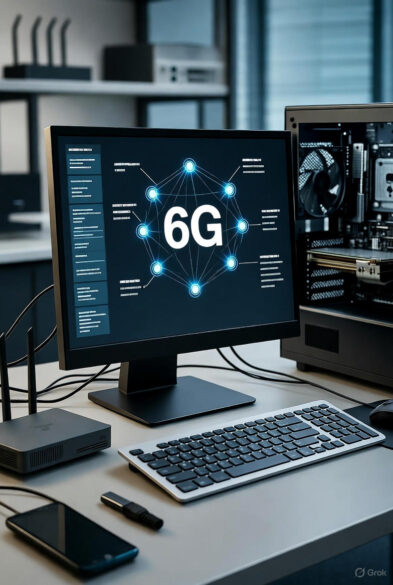
Imagine a world where the digital and physical realms blend so perfectly that they become indistinguishable. A world where your smart devices not only respond to your commands but anticipate your needs, where remote surgery is flawlessly performed from another continent, and where entire cities breathe and pulse with intelligent, real-time data. This isn’t the script of a sci-fi movie; this is the breathtaking future being unlocked by the dawn of 6G technology.
While 5G is still rolling out, the brilliant minds at leading global institutions are already architecting the next wireless revolution. This journey into 6G and beyond promises to transform our reality, creating a fabric of hyper-connected intelligent networks that will redefine human potential. Let’s dive into this exciting future together.
6G
The Road to Hyper-Connectivity: A Quick Journey from 1G to 5G
To truly appreciate the quantum leap that 6G represents, it’s helpful to see how far we’ve come. The evolution of wireless communication is a story of relentless innovation.
-
1G – The Voice Era: The 1980s gave us the first generation—bulky phones for analog voice calls. It was revolutionary, but with poor security and quality.
-
2G – The Text Era: The 1990s introduced digital encryption and the game-changer: SMS. We could now text!
-
3G – The Mobile Data Era: The early 2000s brought the internet to our palms. Email, basic web browsing, and the first smartphones became a reality.
-
4G – The Broadband Era: Around 2010, 4G LTE unleashed the app economy. Streaming HD video, ride-sharing, and sophisticated mobile gaming became seamless.
-
5G – The Connected World Era: Today’s frontier, 5G networks, offers ultra-reliable low latency, enhanced mobile broadband, and massive machine-type communications, powering the Internet of Things (IoT) and faster downloads.
Each generation was a step change. But 6G? It’s a leap into a completely new dimension.
What Exactly is 6G? The Dawn of a Sensory Internet
So, what is 6G? In simple terms, if 5G is about connecting people and things, 6G technology is about fusing the physical, digital, and human worlds into a cohesive, intelligent system. It’s the foundation for a sensory internet that will incorporate not just data, but context, intelligence, and even touch.
The future of wireless communication with 6G isn’t just about being faster—it’s about being smarter, more efficient, and pervasive. It aims to provide instant, unlimited wireless connectivity, making the network an invisible, intelligent utility like electricity.
The Core Architecture of 6G: Building an Intelligent Web
The next-generation network architecture of 6G will be a radical departure from its predecessors. It’s being designed as a unified platform that integrates several groundbreaking technologies.
-
Blistering Speed and Non-Existent Latency
While 5G speeds are impressive, 6G is expected to be 100 times faster, potentially reaching peak data rates of 1 Terabyte per second. This means downloading hundreds of HD movies in a single second. More crucially, latency in wireless communication will drop to sub-millisecond levels (less than 1 ms), making delays utterly imperceptible to humans and machines. This is critical for real-time control applications. -
The Spectrum Leap: Terahertz Waves and AI-Native Design
6G will operate in entirely new frequency bands, including the Terahertz (THz) spectrum. This high-frequency band offers massive bandwidth but has shorter range, necessitating a hyper-dense network of tiny cells. Furthermore, artificial intelligence and machine learning will be baked into the very core of the network, making it self-optimizing, self-healing, and incredibly efficient. This is what we call an AI-native network. -
A Unified Fabric: Connecting Everything, Everywhere
6G will seamlessly integrate satellite, aerial, and terrestrial networks. Imagine your device effortlessly switching between a ground-based cell, a drone-provided hotspot, and a low-earth orbit satellite for flawless connectivity in a remote area or mid-ocean. This is the promise of a truly integrated air-ground network.
The Game-Changing Applications: Where 6G Will Transform Our Lives
The theoretical specs are astounding, but the real magic lies in the applications. 6G technology applications will disrupt every industry.
-
The Symbiosis of AI and 6G
6G and artificial intelligence are a match made in tech heaven. The network will provide the real-time data, and AI will provide the decision-making brain. This synergy will enable advanced distributed AI models where intelligence is spread across the network edge, leading to smarter cities and factories. -
The Internet of Senses and Digital Twins
With 6G, the Internet of Things (IoT) will evolve into the Internet of Everything (IoE). We’re talking about billions of connected sensors creating a high-fidelity, real-time digital replica of the physical world, known as a digital twin. This will allow us to simulate, predict, and optimize complex systems like entire power grids or traffic flows in a smart city infrastructure. Furthermore, holographic communication and the metaverse and 6G will become mainstream, allowing for immersive, multi-sensory interactions that feel real. -
Revolutionizing Healthcare, Transport, and Industry
In healthcare, tactile internet enabled by 6G’s near-zero latency will allow surgeons to perform remote procedures with haptic feedback, as if their hands were inside the patient. In transportation, it will be the backbone for fully autonomous vehicle swarms, communicating with each other and the infrastructure to eliminate accidents and congestion. This is the core of intelligent transportation systems.
The Global Race and The Path Ahead
The development of 6G is a global endeavor. Countries like the USA, China, South Korea, Japan, and the European Union have launched major research initiatives. For instance, the University of Oulu in Finland has a dedicated 6G Flagship program, and the Next G Alliance in North America is working to advance leadership in the field. According to a report by the Alliance for Telecommunications Industry Solutions (ATIS), a roadmap for North American 6G innovation is already being charted.
Standardization discussions are expected to begin at the International Telecommunication Union (ITU) around 2025, with the first commercial deployments anticipated around 2030.
Benefits and Challenges: The Double-Edged Sword
The benefits of 6G networks are profound:
-
Unprecedented economic growth and new business models.
-
Radical advancements in sustainability and resource management.
-
Revolutionary improvements in healthcare, safety, and quality of life.
However, the challenges for 6G implementation are equally significant:
-
The Technological Hurdles: Developing hardware for the Terahertz spectrum and managing hyper-dense networks is immensely complex.
-
The Energy Efficiency Question: With such power, how do we ensure sustainable and green technology? The goal is to make 6G networks far more energy-efficient per bit transmitted than 5G.
-
The Security and Privacy Imperative: A network this pervasive must be inherently secure. Security in next-gen networks and data privacy will be paramount, requiring new frameworks for cyber-physical systems security.
Peering Beyond the Horizon: What Comes After 6G?
Even as we dream of 6G, visionaries are already contemplating the future beyond 6G. We are entering the realm of science fiction made real. Think about cognitive networks that are self-aware, or the use of quantum communication for un-hackable security. Some researchers are even exploring the concept of wireless brain-computer interfaces,
where the network connects directly with our neural pathways. The journey of innovation, it seems, is infinite.
Conclusion: A Hyper-Connected, Intelligent Future Awaits
The path from 1G to 6G and beyond is a stunning testament to human ingenuity. 6G technology is not merely an upgrade; it is the key that will unlock a new era of collective intelligence and capability. It promises a future where technology fades into the background, seamlessly enhancing our lives, protecting our planet, and expanding the boundaries of human experience.
The work being done today in labs around the world is laying the foundation for a hyper-connected world that is smarter, safer, and more sustainable. The future is intelligent, and it’s being built on the backbone of 6G.
Frequently Asked Questions (FAQs)
1. What is the main difference between 5G and 6G?
While 5G connects people and machines with high speed and low latency, 6G aims to fuse the physical, digital, and human worlds. It will be 100x faster, have near-zero latency, and be intelligently managed by AI, enabling applications like the tactile internet and high-fidelity digital twins.
2. When can we expect 6G to be commercially available?
Most experts and global roadmaps, including those from the Next G Alliance, point to the year 2030 for the first commercial deployments of 6G networks.
3. What are Terahertz (THz) waves, and why are they important for 6G?
Terahertz waves are a band of the electromagnetic spectrum between microwaves and infrared light. They offer enormous bandwidth, which is essential for achieving the terabit-per-second speeds envisioned for 6G, though they have a shorter range than lower-frequency waves.
4. Will 6G be safe for human health?
This is a critical area of ongoing research. Like previous generations, 6G will be subject to strict international safety guidelines and regulations set by bodies like the International Commission on Non-Ionizing Radiation Protection (ICNIRP). All technology will be designed and tested to comply with these safe exposure limits.
5. How will 6G impact the environment?
6G has a dual potential. Its hyper-efficiency could lead to significant energy savings per unit of data. Furthermore, it will enable smarter energy grids, precision agriculture, and enhanced environmental monitoring, contributing to global sustainability goals. However, the energy consumption of the entire network infrastructure remains a key focus for researchers.
6. What is the “tactile internet”?
The tactile internet is a future internet capability that will enable real-time transmission of touch and haptic feedback (the sense of motion). Combined with 6G’s ultra-low latency, it will allow users to remotely control machinery or perform tasks with a real-time sense of touch.
7. How will 6G make smart cities better?
6G will connect a massive number of sensors and devices seamlessly, allowing a city’s systems—traffic lights, power grids, water networks, public transport—to communicate and optimize in real-time. This will reduce congestion, save energy, and improve public safety and services.
8. Can 6G work in remote areas?
Yes, a key goal of 6G architecture is to integrate satellite, aerial (drones), and terrestrial networks. This will provide seamless coverage in oceans, deserts, and mountains, effectively bridging the digital divide.
9. What role will AI play in 6G networks?
AI will be fundamental, making the network “AI-native.” It will manage traffic, allocate resources dynamically, predict and fix failures, and optimize security, creating a self-sustaining and intelligent network ecosystem.
10. Where can I learn more about the latest 6G research?
You can follow the publications of leading research institutions like the University of Oulu’s 6G Flagship program and industry alliances like the Next G Alliance for the most current and credible information.
Thank you for your sharing. I am worried that I lack creative ideas. It is your article that makes me full of hope. Thank you. But, I have a question, can you help me?
Thank you for your sharing. I am worried that I lack creative ideas. It is your article that makes me full of hope. Thank you. But, I have a question, can you help me? https://accounts.binance.com/hu/register?ref=IQY5TET4