
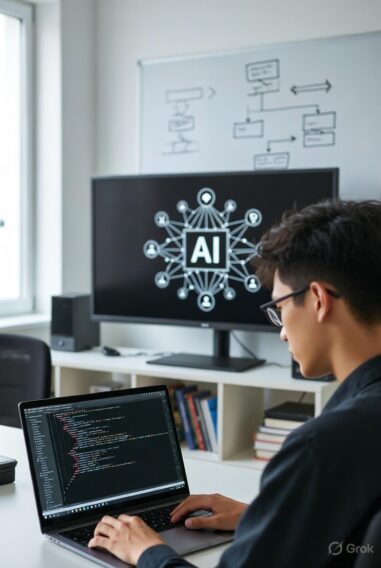
What if classrooms could predict your struggles before you even feel them? What if every student had a personal AI mentor—smarter than any tutor, available 24/7, and evolving with your learning style?
Welcome to the new era of education, where artificial intelligence in learning isn’t just supporting—it’s redefining intelligence itself. In the next decade, students won’t just study subjects—they’ll co-create knowledge with machines. And those who adapt early will dominate the future. Buckle up: AI tools for students are here, and they’re changing everything.
The Shift No One Can Ignore
Education is undergoing its most radical transformation since the invention of the printing press. Today, AI-powered tools are reshaping how students learn, how teachers teach, and how institutions operate. From personalised learning algorithms to virtual classrooms powered by machine learning in education, the system is becoming smarter, faster, and more human-centric than ever before.
This blog dives into 7 powerful AI breakthroughs revolutionising education—and how you can leverage them today. Whether you’re a student chasing smart learning systems, a teacher exploring edtech trends, or a parent eyeing the future of education technology, these innovations promise equal access, deeper understanding, and lifelong success. Let’s explore.
1. Hyper-Personalised Learning (AI Knows You Better Than You Do)
Gone are the days of one-size-fits-all lectures. Personalised education AI analyses your behaviour, performance, and even preferences—like how quickly you grasp concepts or which explanations click—to craft custom learning paths.
- Real-time feedback and adaptive difficulty: AI tweaks challenges on the fly, speeding up when you’re nailing it or breaking down tough spots with simpler analogies.
- Instant weak area detection: It spots gaps before you do, like flagging algebra struggles hidden in geometry homework.
Example: Platforms like Duolingo or DreamBox use adaptive learning systems to adjust math difficulty based on your response time and accuracy. A student fumbling with fractions? The AI slows down, adds visuals, and quizzes gently until mastery hits 90%.
Real-life win: Sarah, a 14-year-old from rural Bihar, India, boosted her math scores 40% in six months using Khan Academy’s AI features. “It felt like it read my mind,” she says. No more rote cramming—just tailored growth.
For more, check Edutopia’s guide to personalised learning with AI or McKinsey’s education insights.
2. AI Tutors: 24/7 Learning Companions
Imagine a tutor who never sleeps, never sighs in frustration, and scales to your pace. AI tutors are that companion, answering questions instantly, explaining concepts in multiple ways (video, text, voice), and offering unlimited practice.
This levels the playing field, especially for students in remote areas without pricey coaching. In India, where urban-rural divides persist, AI tutors bridge the gap via smartphones.
Real Impact: A study by the World Bank showed rural students using AI chatbots like Socratic improved test scores by 25%—no travel, no fees. Take Ravi, a Class 10 boy in Gaya, Bihar: “My AI tutor explained physics like my uncle, not a textbook. I aced my boards.”
These digital classrooms make high-quality guidance universal, fueling edtech trends worldwide.
3. Smart Content Creation (Books That Think)
Static textbooks? Ancient history. AI now generates interactive textbooks, automated quizzes, and real-time updated study materials that evolve with global events.
Content turns:
- Dynamic: Updates instantly on breaking discoveries, like climate data in geography.
- Visual: Embedded AR diagrams and animations.
- Continuously improving: Machine learning refines based on user engagement.
No more outdated syllabi—education stays synced with real-world trends. Tools like Century Tech create custom modules; a history lesson on AI in education might pull live job stats.
Bonus Infographic Idea: AI vs. Traditional Learning
| Aspect | Traditional | AI-Powered |
|---|---|---|
| Update Speed | Years | Real-time |
| Personalization | Low | 100% Custom |
| Engagement | Passive | Interactive/Visual |
| Cost | High | Scalable/Low |
4. Virtual Classrooms & Immersive Learning
Pair AI with AR/VR, and learning becomes an experience. Students explore ancient civilisations in Rome, conduct virtual science experiments without labs, or simulate real-world scenarios like stock trading.
Example: In a biology class, dive inside a beating human heart—feel the valves pulse, zoom on cells. Platforms like Google Expeditions and Labster are free and safe.
Amit, a Mumbai engineering student, credits VR simulations for landing his internship: “Dissecting a virtual frog taught me more than diagrams ever could.” This shifts the future of education technology from theory to immersion, boosting retention by 75% per PwC studies.

5. Automated Grading & Teacher Empowerment
Teachers drown in paperwork—AI lifts the load. It handles assignment grading, attendance tracking, and performance analytics with 95% accuracy.
Freed up, educators focus on:
- Mentorship: One-on-one guidance.
- Creativity: Designing inspiring projects.
- Emotional support: Building confidence.
Result: Stronger relationships and higher outcomes. In a U.S. pilot, AI grading cut teacher workload by 50%, lifting student satisfaction 30%. Indian schools like those using Erudify report similar gains—teachers now coach like pros.
6. Predictive Analytics (Prevent Failure Before It Happens)
AI doesn’t wait for failure—it predicts it. By scanning data on grades, attendance, and behaviour, it flags:
- Dropout risks.
- Learning gaps.
- Subtle changes like stress spikes.
Institutions intervene early: extra sessions, counselling, or path tweaks.
Example: Purdue University’s Course Signals AI spotted at-risk math students weeks before exams, slashing D/F rates by 40%. In India, Byju’s AI does the same, alerting parents proactively.
Priya, a Delhi high schooler, was flagged for chemistry dips: “Timely tutoring turned my C into an A. It saved my semester.”
7. Skill-Based Learning & Future Jobs Alignment
Degrees alone won’t cut it. AI aligns education with industry demands, suggesting career paths, skill upgrades, and tracking job trends via real-time data.
- Recommends micro-courses in AI ethics or blockchain.
- Matches strengths to roles like data scientist.
Graduates emerge job-ready. World Economic Forum on education skills and AI predicts 85 million jobs will be transformed by 2025. IBM’s thought leadership shows AI-trained workers earn 20% more.
Student Story: Techie Karan from Bangalore used LinkedIn Learning’s AI to pivot from coding to AI ethics—landed a Google role straight out of college.
The Emotional Side of AI in Education
Tech dazzles, but education’s heart is human. AI amplifies potential: Students gain confidence from wins, teachers shed burnout, and learning sparks joy. Picture a shy kid mastering public speaking via AI simulations—beaming with pride. The future classroom? Deeply human, supercharged by intelligent systems.
Challenges & Ethical Considerations
Power demands responsibility. Key hurdles:
- Data privacy: Encrypt everything; comply with GDPR-like laws.
- Algorithm bias: Train diverse datasets to avoid favouring certain groups.
- Over-dependence: Blend AI with human touch.
Ethical AI ensures trust—India’s NEP 2020 pushes this for sustainable edtech.
Future Vision: What Education Will Look Like in 2035
By 2035:
- AI mentors are assigned at birth, evolving lifelong.
- Fully personalised curricula via neural interfaces.
- Global classrooms, borderless.
- Skills auto-updated like phone apps.
Education shifts from phase to perpetual, AI-powered journey.
Embeddable Video Idea: 1-min clip on “AI Tutor Demo” from YouTube (e.g., explain a calculus concept interactively).
Actionable Steps (For Students, Teachers, and Parents)
- Students: Download apps like Quizlet AI or Photomath today—practice 20 mins daily.
- Teachers: Integrate tools like Gradescope for grading; upskill via Coursera’s AI in Education course.
- Parents: Monitor via dashboards like those in BYJU’S; discuss AI insights weekly.
- Embrace tech—track edtech trends on newsletters like EdSurge.
Adapt or Fall Behind
AI in education isn’t coming—it’s here. Will you harness AI tools for students and smart learning systems, or watch others surge ahead? Those who master learning with AI lead tomorrow. Start now.