

GIGS: It’s 6:30 PM. The janitor’s keys are jingling in the hallway, and you’re still at your desk, illuminated by the glow of a laptop and a half-empty bag of pretzels you bought for a student who forgot their lunch. You’re looking at a stack of essays and then at your bank account, calculating if you can swing both the car repair and the $40 worth of cardstock you just ordered for next week’s unit.
It’s a heavy, quiet realisation: you love the “lightbulb moments,” but those moments don’t pay the mortgage. You’re tired of the “martyr complex” that suggests wanting financial security somehow makes you a less dedicated educator.
Teaching shapes futures—but rarely pays for peace.
If you’re looking for a way to breathe a little easier without sacrificing your remaining ounce of sanity, this isn’t about “grinding.” It’s about leveraging the massive value you already provide.
Why We’re Looking Elsewhere (And Why That’s Okay)
There is a specific kind of guilt reserved for teachers who want to make more money. We’re told it’s a “calling,” as if landlords accept “passion” as a form of currency. Moving toward a side income isn’t a betrayal of your students; it’s an act of self-preservation. When you aren’t stressed about your phone bill, you’re actually a better, more present teacher.
The “Teacher-Friendly” Litmus Test
Most side-hustle advice is written by 22-year-olds with zero responsibilities. For us, a gig has to meet three strict criteria:
- Low Emotional Tax: It cannot require the same “performer energy” as a 5th-period history class.
- Predictable Hours: It can’t have “emergency” deadlines that clash with parent-teacher conferences.
- High Lever: It should use the skills you already have (curriculum design, explaining complex ideas, organisation) so you aren’t starting from zero.
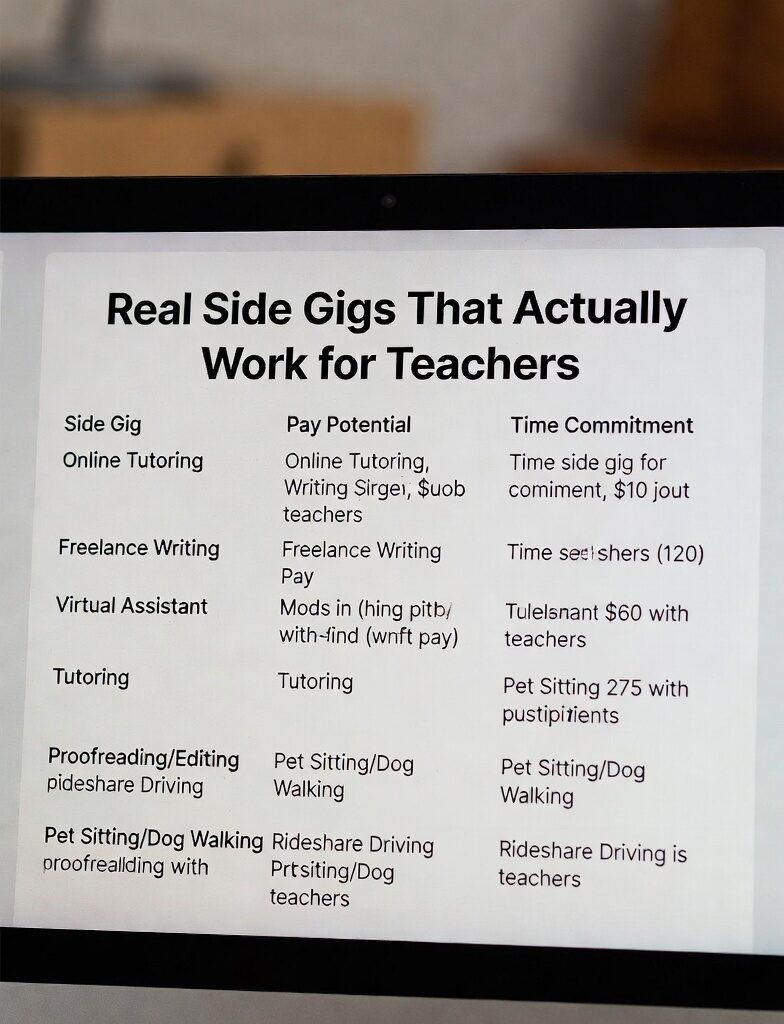
7 Realistic Streams for Educators
1. The “Niche” Curriculum Architect
Forget trying to build an entire storefront overnight. Focus on the “gap” resources—the things you spent three hours making because the district-provided textbook was useless. Maybe it’s specialised IEP data trackers or science labs for schools with zero budget.
- Why it works: You’ve already done the work for your own classroom.
- The Reality: It takes time to format and upload, but once it’s live, it earns while you’re sleeping (or grading).
2. High-Value Subject Tutoring (The “Specialist” Route)
General tutoring is a race to the bottom on price. Instead, pivot to high-stakes niches: SAT/ACT prep, AP Exam reviews, or executive function coaching for students with ADHD.
- The Reality: 2–4 hours a week on a Sunday afternoon can often bring in more than a part-time retail job ever could, with 90% less physical exhaustion.
3. Educational Copy Editing & Fact-Checking
EdTech companies and textbook publishers are constantly churning out content that needs a “teacher’s eye.” They need people to ensure the tone is age-appropriate and the facts are solid.
- Why it works: It’s quiet, solitary work. No “managing” anyone—just you, a red pen (metaphorically), and a cup of tea.
4. Micro-Consulting for EdTech Startups
Ever used a new classroom app and thought, “This was clearly designed by someone who has never met a middle schooler”? Startups will pay for your feedback.
- The Reality: This usually involves 30-minute Zoom calls to “stress-test” new features. It’s low commitment and highly validating to finally tell a developer why their “gamified” quiz doesn’t actually work.
5. Adult Education “Bridge” Courses
Think about the skills you have that aren’t strictly academic. Can you teach “Public Speaking for Introverts” or “Organisation for Chaotic Homes”? Local community centres or platforms like Maven allow you to teach adults who want to be there.
- Why it works: No behaviour management. Read that again. No behaviour management.
6. Professional Organising for Small Businesses
Teachers are the undisputed masters of systems and logistics. Small business owners are often drowning in paper and disorganised digital files.
- The Reality: Helping a local HVAC company or law firm set up a filing system or a digital workflow is second nature to someone who manages 150 students a day.
7. Ghostwriting for Educational Leadership
Many principals and superintendents want to publish articles or newsletters but lack the time. If you have a knack for writing, you can ghostwrite their “Thought Leadership” pieces.
- Why it works: You already know the “language” of education, making you 10x faster than a generic freelance writer.
Gigs to Avoid: The Burnout Traps
Steer clear of anything that requires “on-demand” physical presence or high-stress environments.
- Ride-sharing/Delivery: The wear and tear on your car and your spirit usually result in sub-minimum wage after expenses.
- MLMs: Anything that asks you to “recruit your friends” is not a business; it’s a social tax you can’t afford to pay.
- General Virtual Assistant Work: Often involves “urgent” tasks that don’t respect your 8-to-4 blackout hours.
Financial Peace is a Form of Self-Respect
We’ve been conditioned to think that wanting more is a sign of failure. It’s not. Making $500 or $1,000 extra a month doesn’t make you a “corporate sell-out”—it makes you a person with a savings account and lower blood pressure.
Every teacher needs to realise that their skills are highly tradable in the real world. You are a project manager, a public speaker, and a data analyst rolled into one. It’s okay to start charging for it.
You can love teaching—and still deserve financial breathing room.