
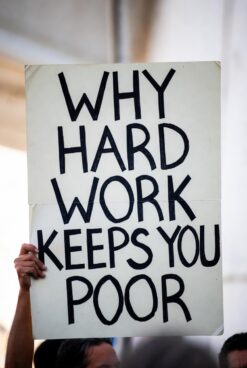
The Hard Truth About Hard Work
You’ve been told to “hustle harder” since day one. But what if your relentless grind is keeping you broke? The myth of “hard work equals wealth” is a trap. Let’s dismantle it.
1. The Burnout Trap: Why Exhaustion Sabotages Wealth
The Hidden Cost of Hustle Culture
A 2023 study by the World Health Organisation found that chronic overwork reduces productivity by 20% after 55 hours/week. Creators like YouTubers or bloggers often push past this threshold, only to crash. Example: A travel vlogger collapsed from exhaustion mid-trip, losing $10k in sponsorships.
Science-Backed Fixes:
- Pomodoro Technique: Work 25 minutes, rest 5. Apps like Toggl track productivity spikes.
- Sleep as ROI: Elon Musk sleeps 6 hours—but Tim Ferriss prioritises 8–9 hours to “compound creativity.”
2. The Opportunity Cost of Overworking
The $100k Hour Myth
You’re not paid per hour—you’re paid per outcome. A freelance graphic designer charging $50/hour could earn $200k/year. But if they spent those hours learning AI design tools (e.g., Canva Pro), they could scale to $500k/year by automating repetitive tasks.
Action: Audit your week. Cut 3 tasks (e.g., social media scheduling, email replies) and replace them with automation.
3. Hard Work ≠ Scalability
The $0 to $1M Story of Mr Beast
Jimmy Donaldson’s early YouTube videos took years to monetise. The breakthrough? Shifting from manual editing to hiring a team and licensing content. His empire now earns $50M/year through sponsorships and merchandise—zero daily labour.
Scalability Framework:
- Leverage: Turn skills into products (e.g., a chef creates a cooking course).
- Automate: Use tools like Zapier to connect apps.
- Delegate: Hire virtual assistants for $5/hour on Upwork.
4. The Myth of “Hustle Culture”
Why “Grindset” Fails
A 2022 survey by LinkedIn revealed that 70% of entrepreneurs who prioritised “hustle” over strategy burned out within 2 years. Case Study: A podcast host worked 100-hour weeks for 18 months, only to realise they’d built a brand with no monetisation plan.
The 80/20 Rule: Focus on the 20% of tasks that drive 80% of results (e.g., content creation over generic engagement).
5. Financial Literacy Gaps
The $1,000 Emergency Fund Paradox
Only 57% of adults can cover a $1,000 emergency. For creators, this means one bad month could derail growth. Solution: Allocate 10% of income to a “business emergency fund” before reinvesting.
Free Resources:
- Khan Academy’s Finance Course
- The Rich Dad Poor Dad (book summary).
6. The Automation Paradox
Why You’re Still Broke: You’re Stuck in “DIY”
A fitness coach manually edits workout videos, wasting 20 hours/week. By switching to AI tools like Descript, they could repurpose content into blogs, podcasts, and social snippets—freeing time to coach clients.
Automation Checklist:
Content: Jasper.ai
Email: Mailchimp
Social Media: Buffer
7. Leverage: The Secret Wealth Multiplier
Bill Gates’ $5 Billion Lesson
Gates didn’t sell Windows—he licensed it to OEMs. Key Insight: Leverage systems, not sweat.
Leverage Strategies:
- Digital Assets: Create a course once, sell forever.
- Affiliate Marketing: Earn commissions promoting others’ products (e.g., Amazon Associates).
- Stock Market: Invest in index funds (e.g., Nifty 50).
8. The Time Poverty Cycle
Math of Time vs. Money
You earn $30/hour. If you spend 80 hours/week working, you make $2,400. Invest that in a digital product with a 10% monthly return: $3,600/month in a year.
Time Audit Template:
| Task | Hours/Week | Potential ROI if Automated |
|---|---|---|
| Social Media | 15 | $500/month |
| Editing | 20 | $1,000/month |
9. Emotional Labour Costs
Stress = Hidden Expenses
Chronic stress increases healthcare costs by 46% (WHO). Fix: Meditate (try Headspace) and hire a virtual assistant for $3/hour.
10. The Illusion of “Overnight” Success
MrBeast’s Decade of Grind
His viral videos took 10 years to build. Lesson: Focus on sustainable growth—e.g., repurpose content across platforms.
11. Future-Proofing Your Income
Diversify Like a Billionaire
Warren Buffett’s portfolio spans stocks, real estate, and royalties. For creators:
Equity: Invest in startups via platforms like LetsVenture.
Passive Income: Rent out equipment, license music.
Table of Contents
FAQs
Q: Can I get rich without working hard?
A: No—but smart work beats brute force. Focus on leverage.
Q: How do I start building passive income?
A: Start small: create a digital product or invest in index funds.
Q: Is hard work bad?
A: No—it’s about how you work.
Action Steps to Break the Cycle
- Audit your time—cut 3 low-ROI tasks.
- Learn one automation tool this week.
- Invest 1 hour daily in financial education.
- Download our free wealth-building checklist here.
Conclusion: Redefine “Work”
Hard work is a tool, not a religion. Future-proof your hustle with systems, leverage, and financial savvy. Your next million starts when you stop just working.
Links:
- Investopedia: Compounding Interest
- Forbes: Scalability Strategies
- Internal Link: “How to Build Passive Income”
1 thought on “ 7 Baffling Reasons Why Hard Work Keeps You Poor ”