
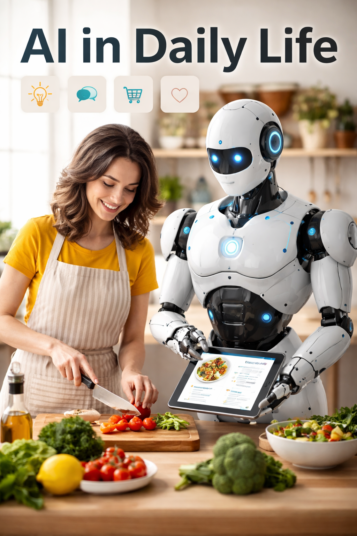
Discover how AI in daily life is revolutionising everything from your morning routine to healthcare. Explore the future of smart living at kritiinfo.com.
1. The Invisible Hand: Your Day is Already AI-Powered(AI in Daily Life)
Imagine waking up. You don’t reach for an old-fashioned alarm clock; your smartphone nudges you awake at the optimal moment in your sleep cycle. You glance at your notifications—FaceID unlocks your phone in milliseconds using neural networks. You open Spotify, and a “Daily Mix” is waiting for you, perfectly curated with songs you didn’t even know you loved.
By 7:30 AM, you’ve already interacted with AI in daily life dozens of times without speaking a single word to another human.
We often think of Artificial Intelligence as a far-off sci-fi concept involving silver robots and galactic wars. But the reality is much more subtle—and much more powerful. AI isn’t just coming; it has already moved into your guest room, reorganised your kitchen, and started managing your schedule. What if I told you that nearly every decision you make today—from the route you take to work to the product you bought on Amazon—was influenced by an algorithm? Welcome to the era of smart living technology, where the line between human intuition and machine precision is blurring faster than you think.
2. What Exactly Is AI in Daily Life?
When we talk about AI in daily life, we aren’t talking about sentient machines. We are talking about “Narrow AI”—sophisticated software designed to perform specific tasks, learn from data, and mimic human cognitive functions like problem-solving and pattern recognition.
From the autocomplete in your emails to the fraud detection that protects your bank account, artificial intelligence applications are the silent engines of the modern world. They analyse vast amounts of data to predict what we want before we even want it. Understanding these shifts can be overwhelming, which is why platforms like kritiinfo.com focus on simplifying these complex AI trends, making technology accessible for everyone.
3. Top 7 Ways AI Is Changing Everyday Life Fast
1. Smart Assistants Are Becoming Personal Managers
Remember when Siri or Alexa could only tell you the weather? Those days are gone. Today, AI automation tools have turned voice assistants into executive secretaries. They manage your smart home ecosystem, draft messages, and even make hair appointments using natural language processing. They are the gatekeepers of our digital lives, moving us toward a hands-free future.
2. AI in Smartphones Is Smarter Than Ever
Your phone is no longer just a communication device; it’s an AI powerhouse. AI-powered devices like the latest iPhones and Pixels use “Computational Photography” to take professional-grade photos by instantly adjusting lighting and removing blur. Beyond cameras, predictive typing and app suggestions ensure your phone adapts to you, rather than you adapting to the interface.
3. Personalised Shopping & Recommendations
Ever wondered how Netflix knows exactly which ’90s sitcom you’re in the mood for? Or how Instagram shows you the exact pair of shoes you discussed with a friend? AI analyses your behaviour, dwell time, and purchase history to create a “digital twin” of your preferences. This level of hyper-personalisation has turned the internet into a curated boutique for every single user.
4. AI in Healthcare at Home
AI in daily life is literally saving lives through wearables. Devices like the Apple Watch or Oura Ring use AI to monitor heart rate variability, sleep patterns, and even blood oxygen levels. These AI technology integrations can detect irregularities such as atrial fibrillation long before a patient experiences symptoms, shifting healthcare from “reactive” to “preventative.”
5. AI in Education and Learning
The “one-size-fits-all” education model is dying. AI tutors and platforms like Duolingo use spaced repetition and adaptive learning algorithms to tailor lessons to a student’s specific pace. Whether you are a visual learner or thrive on quizzes, AI adjusts the curriculum in real-time to maximise retention.
6. Smart Homes and IoT Integration
The future of AI lies in the “Internet of Things” (IoT). Modern smart homes use AI to learn your habits—lowering the thermostat when you leave and pre-heating the oven when you’re five minutes from home. This isn’t just about cool gadgets; it’s about energy efficiency and security systems that can distinguish between a stray cat and a potential intruder.
7. Transportation and Navigation
If you use Google Maps, you are using AI. It processes billions of data points in real-time to predict traffic jams and suggest faster routes. Furthermore, the rise of “Driver Assist” features—like lane-keeping and autonomous braking—is the precursor to a world of self-driving cars, promising a future with significantly fewer accidents.

4. The Benefits: Why We Embrace the Machine
The integration of AI in daily life offers four primary pillars of value:
- Time-Saving: Automating mundane tasks (like sorting emails or vacuuming with a Roomba) gives us back hours every week.
- Better Decision-Making: AI removes human bias from data, helping us choose the best stocks, the healthiest foods, or the fastest routes.
- Increased Productivity: Tools like ChatGPT or Jasper act as “Co-pilots,” helping us draft content and brainstorm ideas in seconds.
- Convenience: The friction of daily life—waiting for a taxi, searching for a movie, or manual data entry—is being erased by smart living technology.
5. Challenges and Concerns
We cannot discuss the future of AI without acknowledging the hurdles. Privacy issues remain the top concern; for AI to be personalised, it needs our data, leading to a constant tug-of-war between convenience and surveillance. There is also the valid fear of job displacement as AI automation tools begin to outperform humans in routine tasks. Lastly, we must guard against over-dependence, ensuring that we don’t lose our critical thinking skills to an algorithm.
6. The Future of AI in Daily Life
Looking ahead, the future of AI is even more integrated. We are moving toward “Ambient Intelligence,” where AI is so woven into the fabric of our environment that we don’t even notice it. Expect to see:
- AI Companions: Virtual entities that offer emotional support and mental health coaching.
- Smart Cities: Urban environments that optimise trash collection, electricity, and water usage automatically.
- Hyper-Personalised Medicine: Drugs and treatments designed specifically for your unique genetic code.
As these innovations emerge, staying informed is vital. Kritiinfo.com helps users stay updated with emerging AI innovations, ensuring you aren’t just a spectator in the digital revolution, but a participant.
7. Practical Tips to Use AI Today
Ready to level up? Here is how to start using AI in daily life right now:
- Productivity: Use AI note-takers (like Otter.ai) to transcribe meetings.
- Home: Invest in a smart thermostat to save up to 15% on energy bills.
- Creative: Use generative AI tools to help with grocery list planning or travel itineraries.
- Learning: Follow tech-forward blogs like kritiinfo.com to discover new AI-powered devices.
FAQ Section
1. What is AI in daily life, with examples? AI in daily life refers to the use of artificial intelligence in common tasks. Examples include virtual assistants (Siri/Alexa), personalised recommendations on Netflix, FaceID on smartphones, and traffic predictions in Google Maps.
2. How is AI used in everyday activities? AI is used to automate and optimise routines. It filters your spam emails, suggests the next word you type, manages home security, and even helps doctors diagnose illnesses faster through imaging software.
3. Is AI making life easier or harder? For most, AI makes life significantly easier by increasing convenience and saving time. However, it can make life harder if users struggle with the learning curve of new AI technology or have concerns regarding data privacy.
4. What are the risks of AI in daily life? The primary risks include data privacy breaches, the spread of misinformation via deepfakes, and a potential loss of certain jobs to AI automation tools.
5. How can beginners start using AI tools? Beginners can start by using free AI chatbots like ChatGPT for daily planning, exploring the AI features already built into their smartphones, and reading resources on kritiinfo.com to stay informed.
Conclusion
The transformation of AI in daily life is not a distant “tomorrow” problem—it is the pulse of our “today.” We are living through the most significant technological shift in human history, one that promises to make our lives more efficient, personalised, and connected.
While the speed of change can be daunting, the potential for a better, smarter world is limitless. By embracing artificial intelligence applications responsibly, we unlock a future where technology serves humanity’s highest goals.
Stay ahead with AI trends on kritiinfo.com. Explore our deep dives into the latest tech and discover how to make the future work for you.
References:
- Artificial Intelligence in the Real World – McKinsey & Company
- The Impact of AI on Society – MIT Technology Review