
Executive Overview
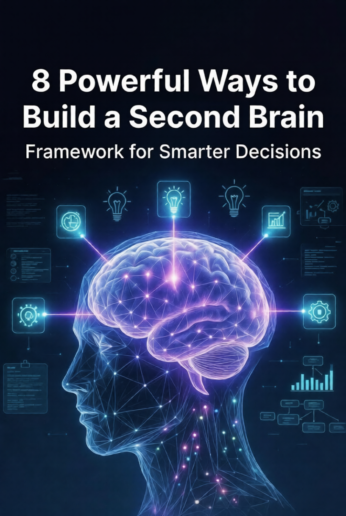
Knowledge workers are drowning in notifications, messages, and decisions, which erodes focus, productivity, and decision quality. The second brain framework is a personal knowledge management system that offloads information from your mind into a trusted digital environment so you can think clearly and act decisively.
Rooted in Tiago Forte’s “Building a Second Brain” methodology and the PARA method (Projects, Areas, Resources, Archives), this framework helps individuals capture, organise, and reuse ideas instead of constantly reprocessing them from scratch. When designed with attention to choice and ethics, a second brain can support more responsible, bias-aware, and autonomy-respecting decision-making.
This kritiinfo.com report outlines what the second brain framework is, why it matters, and eight practical ways to build one, with a dedicated focus on choice and ethics in how digital knowledge is collected, stored, and used.
The Problem: Information Overload and Decision Fatigue
Modern professionals face a firehose of information: email, chats, feeds, files, dashboards, and meetings competing for finite attention. Research shows that information overload reduces people’s ability and motivation to process messages effectively and can impair the quality of decisions.
Studies during the COVID-19 era found that information overabundance leads to message fatigue and cognitive overload, which in turn reduces elaboration and comprehension of important information. Other research on decision environments confirms that when the volume of information exceeds cognitive processing capacity, decision quality drops as people selectively attend to some cues while ignoring others.
Estimates suggest knowledge workers toggle between applications over 1,000 times per day and may make tens of thousands of small decisions, which cumulatively produce decision fatigue and drain mental energy that could have gone into deep work or strategic thinking. This context makes an external “second brain” not a luxury, but a necessary upgrade to how knowledge work is done.
What Is the Second Brain Framework?
The second brain framework is a personal knowledge management (PKM) system that externalises ideas, notes, and resources into a digital repository where they are captured once and reused many times. Tiago Forte popularised this concept in “Building a Second Brain,” positioning it as an evolution of David Allen’s “Getting Things Done”,where GTD manages tasks and commitments, the second brain manages the surrounding information.
At its core, a second brain applies structured workflows such as the CODE method (Capture, Organise, Distil, Express) and the PARA method (Projects, Areas, Resources, Archives) to reduce cognitive load. PARA organises information by actionability rather than topic, making it easier to find exactly what is needed to move a specific project forward instead of digging through topic-based folders.
A mature second brain is tool-agnostic: it can live in Notion, Evernote, Obsidian, or a combination of apps, as long as the system consistently supports capturing, organising, and retrieving information in line with the user’s values and ethical boundaries.
Why You Need a Second Brain in the Digital Age
Productivity and Focus
A well-designed second brain reduces the need to hold unfinished ideas and loose ends in working memory, freeing mental bandwidth for creative and analytical thinking. Users report benefits like reduced cognitive load, better knowledge retention, and increased capacity for deep work once information is externalised into a reliable system.
By centralising notes, references, and project materials, a second brain lowers the friction of switching between tasks and contexts, which otherwise contributes to a significant productivity tax. Instead of constantly searching for files or rethinking decisions, users can quickly retrieve distilled insights and templates.
Better Decisions Grounded in Choice and Ethics
When decisions are made in a state of overload, people default to heuristics, recent information, or emotionally salient signals rather than deliberate reasoning. A second brain that intentionally curates sources, highlights reasoning, and tracks assumptions provides a clearer foundation for choices.
Ethical considerations become part of the framework when it logs not only “what” was decided but “why,” including trade-offs, potential harms, and whose interests are affected. Philosophical work on digital minimalism argues that individuals have a moral duty to use digital tools intentionally to protect their autonomy from attention-harvesting systems. A values-driven second brain operationalises that duty in daily knowledge work.
8 Powerful Ways to Build Your Second Brain
1. Capture Ideas, Notes, and Insights Reliably
The first pillar is capture: ensuring that ideas, tasks, and references never remain solely in your head. Forte’s CODE framework emphasises capturing information that is inspiring, useful, or likely to be actionable, rather than hoarding everything.
Practical capture habits include quick-jot inbox notes, web clippers for saving articles, and voice notes for fleeting thoughts. Evernote and similar apps offer features such as web clipping, document scanning, and rich-media notes that help centralise input from multiple channels.
2. Organise with PARA for Actionability
The PARA method structures your second brain into four categories: Projects (short-term outcomes), Areas (ongoing responsibilities), Resources (topics of interest), and Archives (inactive items). This simple taxonomy can be applied consistently across devices, note apps, and cloud storage, creating a unified mental model.
Organising by actionability rather than topic allows you to surface only the information relevant to the project at hand—for example, by linking research notes, meeting minutes, and assets to a specific product launch project. This alignment between structure and action is one of the main reasons the second brain framework boosts execution.
3. Distil Information into Clear Building Blocks
Distillation is the practice of turning raw notes into concise summaries, checklists, or frameworks that you can reuse quickly. Instead of rereading entire articles or long meeting notes, the second brain stores key ideas, decisions, and next steps in a condensed form.
This can involve progressive summarisation (highlighting then summarising in layers), tagging key insights, or creating reusable templates for recurring processes. The goal is to make important knowledge easy to consume in minutes, even if the source took hours to read.
4. Express and Apply Knowledge in Real Work
A second brain is only valuable if it leads to better outputs: clearer documents, smarter strategies, and more thoughtful communication. The Express stage of the CODE method focuses on turning stored knowledge into deliverables such as reports, presentations, client memos, or product decisions.
By linking project pages to relevant research, notes, and past decisions, tools like Notion and Obsidian help bridge the gap between thinking and shipping. Expression also reinforces learning, as each time knowledge is applied, it becomes more deeply integrated into mental models.
5. Automate Workflows Where It Makes Sense
Modern note and task apps integrate with calendars, email, and project management tools, enabling automations like sending meeting notes to a project page or converting action items into tasks. Automations reduce manual overhead and ensure that captured information reliably flows into the right part of the second brain.
However, automation should support human judgment rather than replace it. Decision points that involve trade-offs, stakeholder impacts, or ethical considerations should remain explicitly under human control, with the second brain providing context rather than making choices autonomously.
6. Maintain Ethical Data Usage (Choice and Ethics in Practice)
A responsible second brain is built on explicit choices about what data to store, where to store it, and how it may be used. Philosophers arguing for digital minimalism emphasise an imperfect duty to be intentional about how individuals use digital devices and platforms, given their potential to undermine autonomy and well-being.
Ethical practices include limiting sensitive personal data, avoiding unnecessary surveillance of others (such as detailed logs of colleagues’ behaviour), respecting confidentiality, and documenting consent when capturing shared information. Digital minimalism suggests that “less can be more”—a curated, value-aligned second brain often serves better than a maximalist archive of everything encountered.
7. Optimise and Refine Continuously
A second brain is a living system that evolves as projects, tools, and priorities change. Regular reviews—weekly or monthly—allow users to archive stale material, promote key notes into templates, and refine tags or folders that are becoming cluttered.
This ongoing optimisation keeps the system aligned with current goals and prevents it from becoming another source of overwhelm. Aligning reviews with personal values and ethical commitments ensures that what remains in the system supports long-term aims rather than short-term impulses.
8. Align Your System with Choice and Ethics
Beyond isolated practices, the entire second brain can be framed as an ethical technology: a self-designed environment that protects attention, autonomy, and long-term flourishing. Work on the ethics of digital technology argues that individuals have duties to themselves to safeguard their autonomy in the face of persuasive design and attention-extractive platforms.
Embedding choice and ethics into the framework might involve explicit principles like “no dark patterns in my workflows,” “no saving sources I would be uncomfortable citing,” or “prioritise sources that respect privacy and transparency.” These guidelines help ensure that the second brain does not become an engine for manipulation, distraction, or uncritical amplification of biased information.
Role of Choice and Ethics in a Second Brain
Ethical Data Collection and Consent
Choice and ethics begin at capture: people must decide what kinds of information about themselves and others are appropriate to record, and under what conditions. Ethical digital practice requires avoiding unauthorised recording, respecting confidentiality agreements, and being transparent when using notes or transcripts involving other people.
Attention to choice and ethics also includes decisions about which platforms to trust with sensitive data, favouring tools with strong privacy controls and clear terms of service. Digital minimalism research stresses that intentional limitation of tool use is part of a broader moral obligation to preserve autonomy. Bias in Stored Knowledge and Responsible Decision-Making
Any second brain reflects the inputs it receives: if it is fed predominantly from one cultural, ideological, or disciplinary perspective, its recommendations and surfaced patterns will mirror that bias. Studies on decision-making under information overload show that people often rely on salient but incomplete cues, which can be amplified if a system stores only those cues.
An ethical second brain involves deliberate diversification of sources, explicit tagging of assumptions, and notes that document uncertainties or limitations. Doing so supports more responsible decision-making by making both evidence and blind spots visible instead of hiding them behind a veneer of apparent comprehensiveness.
Digital Minimalism vs Over-Collection
Digital minimalism, as articulated by writers and philosophers, is a philosophy that encourages individuals to focus on a small set of high-value digital activities and eliminate low-value noise. Academic work further argues there is a duty to be a digital minimalist, precisely because unbounded device use can undermine autonomy and mental health.
Applied to a second brain, digital minimalism means prioritising high-quality, reusable notes over exhaustive archiving, and periodically deleting or archiving information that no longer serves meaningful purposes. This reduces clutter and ensures that when the system is consulted for a decision, the signals are strong and not buried in noise.
Tools and Technologies for Building a Second Brain
Notion: All-in-One Workspace
Notion is an AI-powered all-in-one workspace that combines notes, tasks, databases, and collaboration features in a single system. It is well-suited for building a second brain because users can create connected pages for projects, areas, and resources, and integrate tasks and meeting notes directly into those structures.
Its flexibility can be a strength and a weakness: intentional design is needed to avoid over-complication. When configured thoughtfully, Notion allows individuals and teams to encode ethical choices in their templates—for example, including privacy considerations or stakeholder impact sections in project pages.
Evernote: Mature Capture and Search
Evernote is a cross-platform note-taking and productivity app that focuses on capturing and organising information across devices. Features like web clipping, document scanning, and powerful search make it particularly strong as a capture and reference layer.
Because Evernote can function as a “digital filing cabinet,” users should be deliberate about what they store and how long they retain it. Thoughtful notebook structures, tags, and deletion policies help align Evernote-based second brains with principles of choice and ethics rather than default hoarding.
Obsidian: Local-First Linked Thinking
Obsidian is a local-first note-taking application that works with plain-text Markdown files and emphasises linked thinking through bi-directional links and graph views. Storing notes as files on a user-controlled vault, it offers strong data ownership and portability compared with purely cloud-based tools.
This architecture aligns well with ethical priorities such as data sovereignty and long-term accessibility. Users can design Obsidian vaults that implement PARA, CODE, or custom structures while also benefiting from plugins for tasks, calendars, and automation, so long as they remain attentive to what data is shared with third-party services.
Real-Life Example: A Product Manager’s Ethical Second Brain
Consider a product manager in a fast-growing tech company who is responsible for shipping features, coordinating with engineering and design, and aligning with legal and compliance requirements. They use Notion as the primary second brain platform, with a PARA-based workspace that includes project dashboards, area pages for responsibilities like “Risk & Compliance,” and resource libraries for user research.
During a new feature development cycle, the product manager clips user feedback from surveys and support tickets into Notion, tagging each note with metadata such as user segment, risk level, and consent status. They maintain a dedicated page summarising ethical considerations: potential impacts on vulnerable users, data-collection implications, and regulatory constraints, drawing on research about how information overload and interface design can affect user decision quality.
When the team faces a trade-off—such as whether to add more onboarding steps that explain data usage or streamline the flow for speed—the second brain provides quick access to prior experiments, user studies, and philosophical arguments for respecting user autonomy. This enables a decision that balances business goals with ethical commitments, grounded in documented evidence rather than intuition alone.
Common Mistakes to Avoid When Building a Second Brain
Over-Complication and System Hopping
One frequent mistake is designing a second brain that is too complex to maintain—dozens of databases, tags, and dashboards that require more effort to manage than they save. Over-engineered systems tend to collapse under real-world pressure.
To avoid this, users can start with a minimal PARA structure and a few simple workflows, expanding only when there is clear evidence that added structure will improve outcomes. Another pitfall is constantly switching tools instead of committing to refining one stack; each switch imposes cognitive and migration costs.
Ignoring Choice and Ethics
Another mistake is treating the second brain as a purely technical productivity hack without considering the ethical implications of data storage, attention shaping, and source selection. Without explicit principles, the system can reinforce existing biases, enable intrusive data practices, or encourage always-on work patterns.
Integrating digital minimalism principles and ethical guidelines into the design of the second brain helps ensure that the system serves long-term well-being rather than short-term output metrics. Regular reflection on how the system influences behaviour can surface misalignments early.
Lack of Consistency and Review
Even elegantly designed systems fail if they are not used consistently. Inconsistent capture leads to gaps, and infrequent reviews allow clutter to accumulate. This undermines trust in the second brain, pushing people back to ad hoc memory and fragmented notes.
Scheduled reviews, gentle reminders, and small daily maintenance habits keep the second brain reliable. Over time, this consistency compounds: each captured insight, distilled note, and ethical decision log increases the value of the system.
Conclusion and Next Steps
A second brain framework gives knowledge workers a structured way to navigate information overload, reduce decision fatigue, and make more thoughtful choices in line with their values. Built on methods like CODE and PARA and implemented in tools such as Notion, Evernote, or Obsidian, it transforms scattered data into a coherent, action-oriented knowledge infrastructure.
When infused with a conscious focus on choice and ethics, drawing on digital minimalism and applied ethics research, the second brain becomes more than a productivity system; it becomes a personal governance layer that protects autonomy and supports responsible decision-making. Starting small, iterating regularly, and aligning the system with clear ethical principles allow individuals and organisations to turn information from a burden into a strategic asset.