

🌐 Introduction: Why Edge Computing is the Future
The digital world is moving faster than ever. With billions of devices connected to the internet, the demand for real-time data processing has exploded. Enter Edge Computing — a revolutionary concept that brings computation and data storage closer to the source of data.
Unlike traditional cloud computing, where all the information travels to distant servers, edge computing minimizes latency, reduces bandwidth usage, and improves efficiency by processing data locally. This makes it a game-changer for industries like healthcare, finance, IoT, automotive, and smart cities.
Table of Contents
📖 What is Edge Computing? (Simple Definition + Example)
At its core, edge computing means processing data closer to the edge of the network — where the data is generated — instead of relying only on centralized cloud servers.
💡 Example:
- In a smart car, sensors collect tons of data every second. Instead of sending all of it to a faraway cloud server, edge computing devices inside the car analyze critical data instantly (like collision warnings), ensuring safety without delays.
In short:
- Cloud computing = central hub.
- Edge computing = local, decentralized, real-time brainpower.
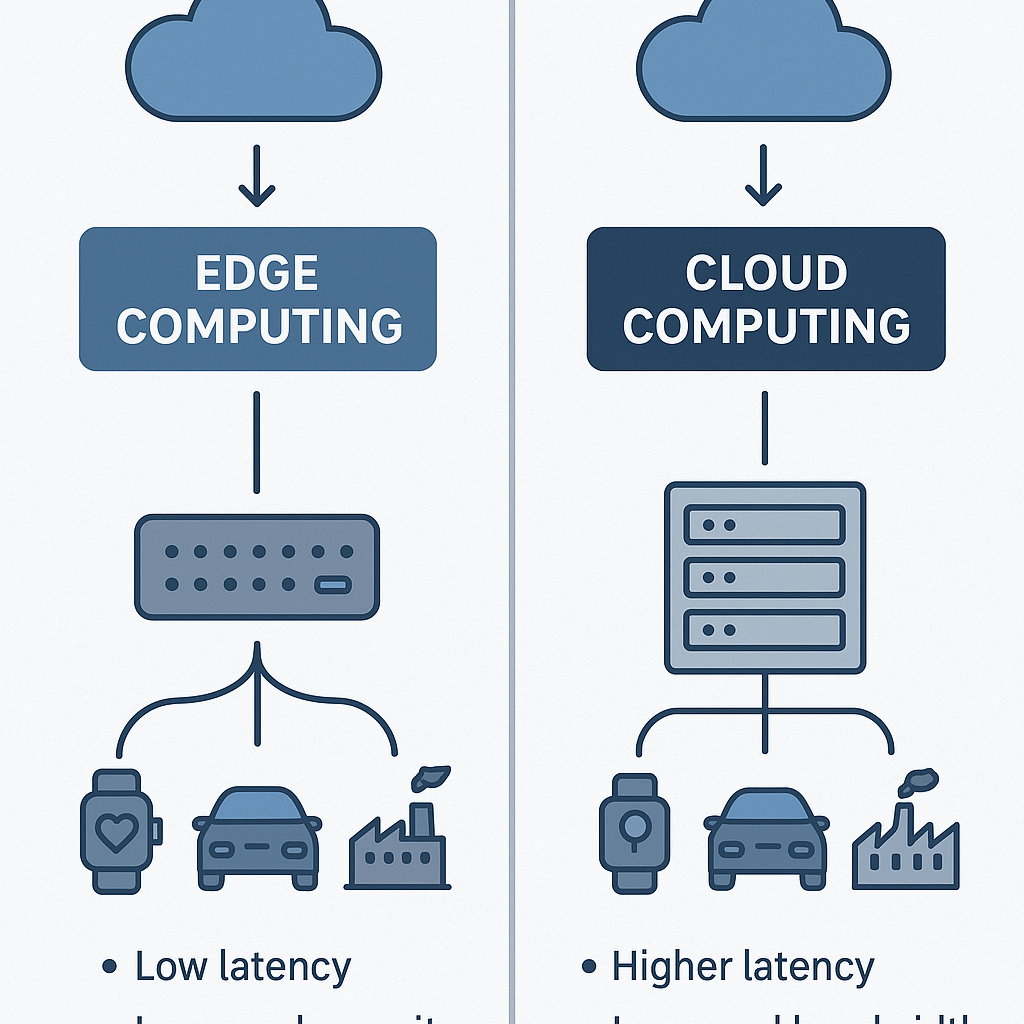
🔑 Key Features of EC
- Low Latency – Immediate data processing.
- Improved Security – Data handled closer to the source.
- Scalability – Supports billions of IoT devices.
- Bandwidth Optimization – Reduced reliance on central servers.
- Offline Capability – Works even with weak connectivity.
- Well, today, we’re talking about something super cool that makes your games faster and your smart stuff even smarter: Edge Computing!
If you think of the Cloud (where all the big data centers live) like a Giant Central Pizza Place 🍕, then Edge Computing is like having Tiny Pizza Kiosks 🏘️ right next to your house. You don’t have to wait for your pizza to travel all the way from the central kitchen; you get it from the kiosk right away!
That’s Edge Computing: processing data closer to where the data is actually made—at the “edge” of the network, right near your device! And here are the key features that make this “kiosk” idea so awesome:
1. ⚡ Super-Duper Low Latency (That Means NO Lag!)
This is the biggest, most important feature. Latency is just a fancy word for delay—the time it takes for data to go from your device to a server and back.
Cloud Way: Data goes on a long road trip to the main data center (the giant pizza place). This takes time.
Edge Way: Data just zips over to the local edge device (the tiny kiosk). It’s super fast!
Why it matters: Imagine a self-driving car. If it sees a cat 🐈, it can’t wait a whole second for the Cloud to tell it to brake. Low Latency lets the car process the cat-data instantly right there in the car, so it brakes right now. For gaming, this means zero lag!
2. 🛡️ Fortress Security and Privacy
When you send all your data far away, it has to travel on the internet highway, which means more chances for hackers to try and look at it.
Edge devices are like local bodyguards. They process the super sensitive data (like your face scan or private factory secrets) right on the spot and keep it there. They only send the central Cloud the important summary, like “All clear!” or “Found an issue!” This means:
Less travel, less risk.
Private stuff stays local and safe!
3. 📉 Bandwidth Super Saver
IoT devices (that’s the Internet of Things, like smart doorbells and factory sensors) make a TON of data. Imagine your smart home is screaming about the temperature every single second! If all that screaming goes to the Cloud, the internet highway gets totally jammed.
Edge Computing is smart. It says, “Wait, only send me the important stuff!”
The edge device filters and analyzes the raw, messy data first.
It only sends the Cloud a small, neat package of insights (like, “The temperature is too high!”)—not every tiny piece of raw data.
This saves a ton of bandwidth, meaning your internet doesn’t get clogged, and it costs less to transmit the data!
4. 🔗 Works Even When the Wi-Fi is Gone (Local Autonomy)
Think about a smart farm way out in the middle of nowhere, or a machine deep inside a factory where the internet connection is weak or keeps cutting out.
Edge Computing devices are smart enough to work on their own. They have their own mini-brains (compute power) and local storage.
If the main Cloud connection drops, the edge device keeps working.
It makes the decisions, processes the data, and runs the operation locally until the internet comes back.
This is called Local Autonomy, and it means things like oil rigs, smart trains, and hospital monitors never stop functioning just because the Wi-Fi is spotty.
5. 💰 Cost-Effectiveness
Wait, buying new hardware to put everywhere sounds expensive, right? Not really, in the long run!
Because you’re not sending huge amounts of raw data back and forth to the Cloud , you actually save money on:
Network Costs (Bandwidth): Less data transmitted means lower bills.
Cloud Storage: Less data you have to store long-term in the expensive central Cloud.
By being smart about where you process and what you send, Edge Computing can be a super smart way to save cash over time.
So there you have it! Edge Computing isn’t just a fancy phrase; it’s a revolutionary way to handle data that makes our tech faster, safer, cheaper, and more reliable. It’s what makes the future of smart cars, smart cities, and super-fast online games possible!
📊 Edge Computing vs Cloud Computing: A Quick Comparison
| Feature | Cloud Computing 🖥️ | Edge Computing 📡 |
|---|---|---|
| Data Processing | Centralized (data centers) | Decentralized (at the edge) |
| Latency | Higher | Extremely low |
| Bandwidth | Heavy usage | Optimized usage |
| Best for | Big data, storage, AI | Real-time IoT, automation |
| Example | Streaming Netflix movies | Autonomous vehicles |
👉 (Backlink : IBM Edge Computing )
💡 7 Powerful Benefits of Edge Computing in 2025
1️⃣ Ultra-Low Latency
Applications like self-driving cars and remote surgeries cannot afford a delay of even milliseconds. Edge computing ensures real-time responsiveness.
Example: Tesla’s autopilot system uses edge computing nodes to analyze road conditions instantly.
2️⃣ Enhanced Data Security
Since data doesn’t always travel to a centralized location, edge devices reduce the risk of interception during transfer.
Case Study: In banking, edge-powered ATMs process transactions locally with encrypted layers before sending data to the central server, reducing cyber risks.
3️⃣ Reduced Bandwidth Costs
Streaming billions of IoT signals to the cloud is expensive. Edge filters and processes only necessary data, saving huge bandwidth costs.
Example: Smart factories in Germany use edge gateways to process machine data locally, sending only essential insights to the cloud.
4️⃣ Greater Reliability
Even with unstable internet, edge devices can keep working locally.
Example: In oil rigs, edge devices allow monitoring equipment without full-time connectivity to the cloud.
5️⃣ Energy Efficiency & Sustainability
Less back-and-forth data travel = lower energy consumption.
This aligns with green technology goals and sustainable IT infrastructure.
6️⃣ Scalability for IoT
Edge computing supports the explosive growth of IoT devices — from wearables to smart home assistants.
7️⃣ Improved User Experience
Faster apps, smoother gaming, safer cars — all powered by the edge revolution.
🏭 Real-World Applications of Edge Computing
🌆 Smart Cities
- Traffic signals powered by edge compute optimize congestion in real-time.
- Smart grids manage electricity loads efficiently.
🚘 Autonomous Vehicles
- Cars make split-second decisions using onboard processors.
- Reduced reliance on external servers.
🏥 Healthcare
- Remote patient monitoring with wearables.
- Edge AI supports doctors in rural areas with diagnostic tools.
📱 Retail
- Smart mirrors in fashion stores powered by edge servers.
- Real-time inventory management.
🎮 Gaming
- Cloud gaming giants like NVIDIA GeForce Now use edge data centers to minimize lag.
📈 Case Studies: Edge Computing in Action
- Amazon Go Stores – Cameras and sensors use edge computing to detect items picked by customers for cashier-less checkout.
- Siemens Factories – Smart manufacturing units in Germany use edge analytics for predictive maintenance.
- Healthcare in India – Edge-based diagnostics in rural clinics enable real-time ECG monitoring without full internet dependency.
📉 Challenges of Edge Computing
- High setup costs initially.
- Security risks at multiple edge points.
- Requires skilled workforce for deployment.
- Standardization still evolving.
🔮 The Future of Edge Computing in 2025 and Beyond
By 2030, experts predict that over 75% of enterprise data will be processed at the edge. Combined with 5G, AI, and blockchain, edge computing will shape the next wave of digital transformation.
Trends to watch:
- AI-powered edge chips.
- Edge + 5G synergy.
- Smart wearables with edge intelligence.
- Industrial automation at scale.
📌 Internal Link Opportunity
You can interlink this blog with:
- Low Code No Code Development (how edge integrates with rapid app creation).
- AI Agents (edge devices enabling intelligent automation).
- Wearables (how next-gen wearables rely on edge processing).
🙋 Frequently Asked Questions (FAQs)
Q1. Is edge computing better than cloud computing?
➡️ Both have unique benefits. Edge is ideal for real-time tasks, while cloud is better for large-scale storage and analytics.
Q2. Does edge computing need the internet?
➡️ Not always. Edge devices can process data locally, but cloud sync requires connectivity.
Q3. What industries benefit most from edge computing?
➡️ Automotive, healthcare, retail, manufacturing, smart cities, and gaming.
Q4. Is edge computing secure?
➡️ Yes, but like any system, it requires strong encryption and endpoint security.
Q5. What’s the future of edge computing?
➡️ A world where AI + IoT + 5G + Edge creates instant, intelligent, and seamless experiences.
🎯 Conclusion: Why Edge is the Next Big Leap
Edge computing is not just a technology trend — it’s a paradigm shift. From saving lives in healthcare to powering smart cities, its benefits are undeniable. As we move into an era of billions of connected devices, edge computing will act as the backbone of the digital economy.
If you want to stay ahead in technology, business, and innovation, embracing edge computing is the smartest step forward.
👉 For deeper insights on related topics, check out our guide on Low Code No Code platforms and AI Agents.
Thanks for sharing. I read many of your blog posts, cool, your blog is very good. https://www.binance.com/register?ref=IHJUI7TF
Thanks for sharing. I read many of your blog posts, cool, your blog is very good. https://www.binance.com/register?ref=QCGZMHR6
Your article helped me a lot, is there any more related content? Thanks!