
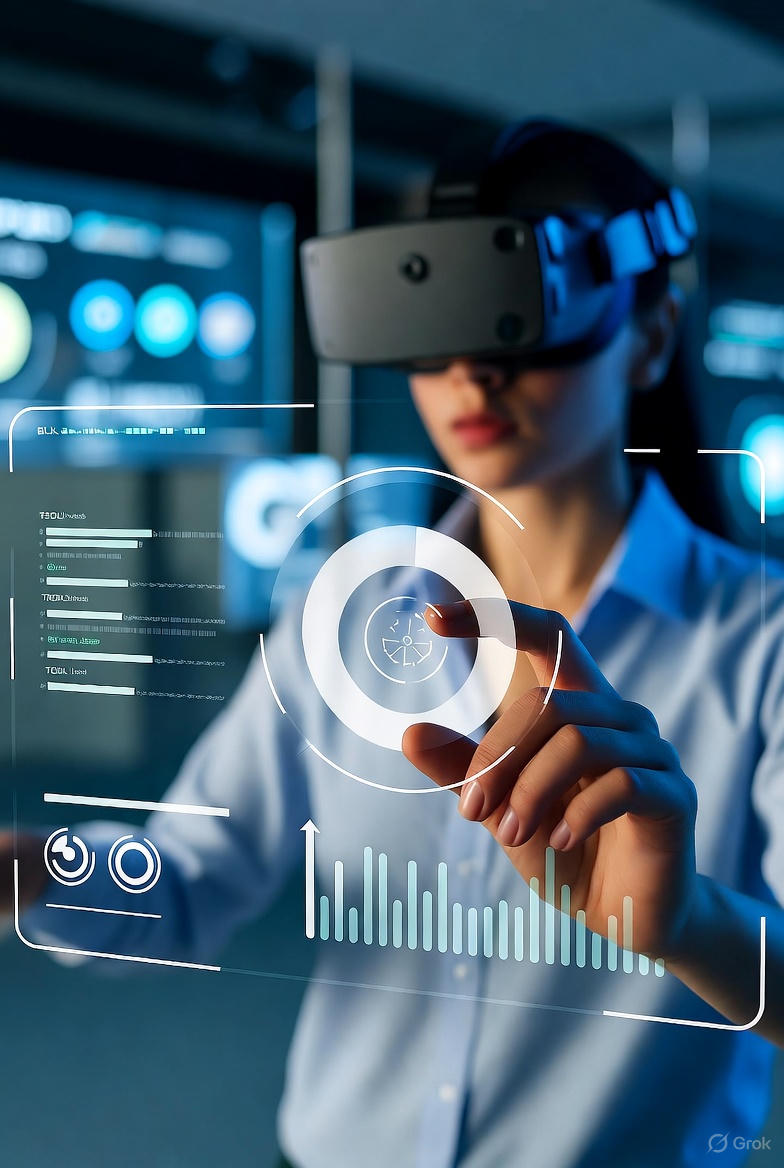
Remember the flickering, blue-hued chessboard in Star Wars? The moment Princess Leia’s miniature form pleads, “Help me, Obi-Wan Kenobi, you’re my only hope”? For decades, that was our collective dream of the future—a world where data isn’t trapped behind glass, but lives and breathes in the air around us.
That future is no longer a distant hope. It’s quietly taking shape in labs, operating rooms, and design studios today. The Holographic Interface is stepping out of sci-fi becomes reality and into our daily lives, promising to redefine the very essence of human-machine interaction.
This isn’t just another incremental update. It’s a fundamental shift. We’re moving from tapping and swiping on cold, flat screens to reaching into our world and conversing with information. . It’s a revolution that will touch everything from how we save lives to how
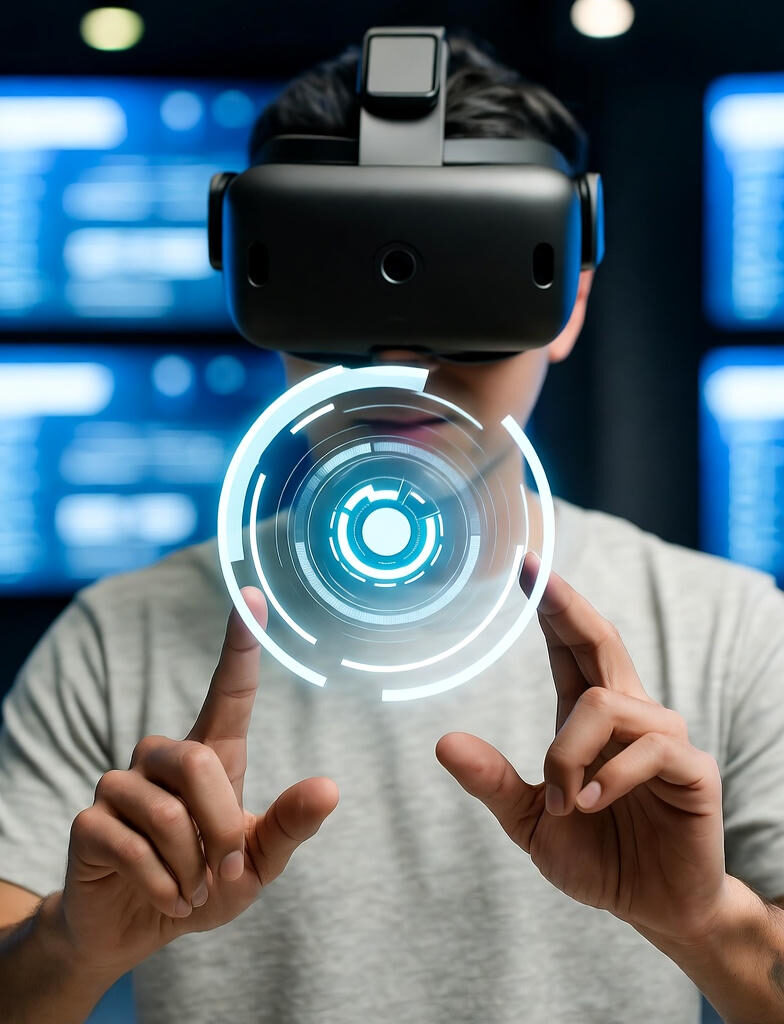
we teach our children. So, let’s pull back the curtain and explore the luminous world of holographic user experience.
1. What Exactly Is a Holographic Interface? (It’s Not Just a Pretty Light Show)
Let’s clear the air, literally and figuratively. A true Holographic Interface is not simply a 2D image projected onto a sheet of smoke. It’s a three-dimensional, light-field display that can be viewed from multiple angles without the need for special glasses. It creates a sense of volume and depth, making a digital object appear as if it shares our physical space.
Think of it this way:
-
Your Smartphone Screen: A 2D window into a digital world. You interact by touching the glass.
-
Virtual Reality (VR): A fully immersive, digital world that replaces your reality. You need a headset.
-
Augmented Reality (AR): Digital information overlaid onto your real world, often through a phone or glasses.
-
Holographic Interface (often part of Mixed Reality): A seamless blend where photorealistic, three-dimensional digital objects coexist and interact with your real environment. You can walk around them, peer behind them, and manipulate them with your hands.
It’s the difference between looking at a blueprint on a tablet and having a miniature, glowing building model rise from your desk, which you can disassemble with a flick of your wrist. This is the heart of next-gen UI and spatial computing.
2. The Magic Behind the Mirage: How Holographic Technology Works
The science is complex, but the concept can be broken down simply. Creating a persistent, interactive 3D image in mid-air requires a clever dance of light, optics, and sensors.
Here’s a simplified breakdown:
-
Image Creation: Powerful processors generate a complex 3D model.
-
Light Manipulation: This is the key. Systems use various methods to shape light into the desired form:
-
Light Field Displays: Use multiple micro-projectors to recreate the way light scatters off a real object, creating a true 3D perception.
-
Pepper’s Ghost Illusion: A classic technique using angled glass to reflect an image, creating a ghostly apparition (often used in concerts).
-
Volumetric Displays: Some systems actually project onto a rapidly spinning screen or use lasers to excite particles in a specific volume of air, making them glow.
-
-
Interaction Sensing: This is where the future technology gets truly interactive. An array of sensors—cameras, LiDAR, depth sensors—constantly maps the environment and tracks the user’s movements.
-
Gesture Control: Cameras track your hand and finger movements, allowing you to push, pull, rotate, or grab holograms.
-
Voice Commands: Integrate natural language for a truly hands-free experience.
-
Gaze Tracking: The system knows where you’re looking, allowing for intuitive selection.
-
Real-world example? Companies like Microsoft with their HoloLens have pioneered this immersive display technology, creating devices that are less about screens and more about sculpting reality itself. You can see how they frame this vision for future workspaces on their official Microsoft HoloLens page.
3. No Longer Science Fiction: Real-World Applications Changing Lives
The potential of holographic interface technology isn’t a distant promise. It’s already solving real problems and creating new possibilities across critical industries.
A. Revolutionizing Healthcare: The Invisible Scalpel
Imagine a surgeon being able to see a patient’s CT scan—their arteries, tumors, and bones—floating directly over the body on the operating table. This is no longer imagination. Future healthcare tech is using 3D visualization to create “X-ray vision,” allowing for incredible precision and minimizing invasive procedures.
-
Surgical Planning: Surgeons can practice complex operations on a perfect hologram projection of the patient’s organ.
-
Medical Training: Students can dissect a holographic human body, peeling back layers of muscle and tissue without ever touching a cadaver. This is a powerful smart education tool.
-
Patient Education: A doctor can show a patient a 3D model of their own heart, explaining a condition in a way that is instantly understandable.
The precision required here echoes the kind of innovation we see from other high-stakes industries. For instance, the advanced automation and sensor fusion used by Tesla in their self-driving systems shares a philosophical kinship with the precise spatial awareness needed in medical holographic user experience. Explore their approach to AI integration on the Tesla AI page.
B. Transforming Education: The Classroom Without Walls
Forget dusty textbooks and static diagrams. Holographic interfaces can transport students to the Roman Colosseum, shrink them down to explore the inner workings of a cell, or bring a historical figure to life to give a first-person account.
-
Immersive History Lessons: Walk through ancient ruins reconstructed in the middle of the classroom.
-
Interactive STEM Learning: Manipulate complex molecular structures or gravitational forces in 3D.
-
Skill-Based Training: Mechanics can learn to repair a jet engine by following interactive holographic instructions overlaid on the real machinery.
This is the ultimate digital transformation of pedagogy, moving from passive learning to active exploration.
C. Redefining Business and Collaboration: The Boardroom is Everywhere
The era of pixelated video calls and confusing screen-sharing is ending. Welcome to the era of holographic meetings and virtual collaboration.
-
Global Design Reviews: An engineering team in Germany and a marketing team in California can all stand around the same full-size, holographic prototype of a new car, examining it from every angle simultaneously.
-
Virtual Collaboration: With AR hologram displays, remote colleagues can appear as life-like holograms in your office, able to point to and manipulate virtual objects as if they were physically present. This is a game-changer for remote work technology and building the future office setup.
-
Data Visualization: Instead of spreadsheets, executives can explore sales data as a dynamic, 3D landscape, spotting trends and patterns intuitively.
This shift is at the core of modern business technology trends, breaking down geographical barriers and fostering a new level of creative synergy.
D. The Future of Entertainment and the Metaverse
The line between the game world and your living room will dissolve. Holographic interfaces are the missing link for true metaverse interaction.
-
Gaming: Imagine a life-sized alien creature bursting through your actual wall, not just your TV screen.
-
Live Events: Attend a concert where your favorite artist performs as a hologram on your coffee table.
-
Interactive Storytelling: Become a character in a story, interacting with holographic characters and environments in your own home.
E. Enhancing Defense and Security
The applications in defense are profound, providing superior situational awareness. Pilots could see tactical data projected onto their cockpit canopy, or field commanders could view a live, 3D terrain map of the battlefield. This touchless control of critical information allows for faster, more informed decision-making.
Organizations that operate at the edge of technology, like NASA, naturally explore these frontiers. Their work in spatial computing and 3D visualization for exploring planetary data and training astronauts is a testament to the power of this tech innovation. You can glimpse their approach at the NASA Technology Transfer Program.
4. A Brighter World: The Tangible Benefits & Opportunities
Why are we so excited about this shift? The benefits are profound and multifaceted.
| Benefit | Description | Impact |
|---|---|---|
| Unprecedented Intuition | Interacting with 3D objects in 3D space is how our brains are wired. It reduces the cognitive load of translating 2D data. | Faster learning, fewer errors, enhanced creativity. |
| Supercharged Collaboration | Holographic meetings create a shared “physical” space for remote teams, making collaboration more natural and effective. | Breaks down silos, accelerates innovation, improves tech for productivity. |
| Democratizing Complexity | Complex data from MRI machines or architectural schematics becomes accessible and understandable to non-experts. | Better patient outcomes, more inclusive design processes. |
| Spatial Efficiency | Replaces the need for multiple physical screens, prototypes, and models, decluttering our physical world. | Reduces waste and cost, enables more flexible future workspaces. |
5. The Road Ahead: Navigating Challenges and Limitations
For all its brilliance, the path to a holographic future has a few hurdles to clear. Acknowledging them is key to responsible innovation.
-
Technical Hurdles: Achieving high-resolution, bright, wide-viewing-angle holograms without massive computing power and energy consumption is still a challenge.
-
Cost & Accessibility: Currently, the hardware for high-fidelity holographic interfaces is expensive, placing it out of reach for most consumers. It’s currently the domain of enterprise and research.
-
User Experience & Safety: Prolonged use, potential for visual fatigue, and establishing intuitive gesture control paradigms are active areas of research. We need to design interfaces that feel natural, not cumbersome.
-
Privacy and Security: As with all connected smart devices, having cameras and sensors constantly mapping our environments raises valid privacy concerns that must be addressed head-on.
The journey to perfecting this digital interface design is akin to the early days of personal computing. The vision was clear, but the path was iterative. It requires the kind of relentless focus on user experience and hardware-software integration that Apple has famously championed. While they haven’t released a consumer holographic product yet, their philosophy of seamless AI integration and next-generation computing is shaping the entire industry. Watch their latest advancements at Apple.com.
6. The Horizon Glows: Future Possibilities We Can Barely Imagine
If this is where we are today, where are we going tomorrow? The possibilities are breathtaking.
-
Ubiquitous Holographic User Experience: Your wearable tech—a simple pair of sleek glasses—will project your smart computing environment everywhere you go. Your calendar will float by your door as you leave, and your navigation path will be drawn on the road ahead.
-
The Truly Phygital World: Physical products will have digital “auras”—a cereal box might show a holographic recipe, and a car’s dashboard might be a fully customizable holographic interface.
-
Advanced AI Companions: Your AI assistant will manifest as a holographic avatar, reading your emotions and interacting with you with human-like nuance.
-
Preservation of History and Culture: Walk through holographic recreations of lost cities or have a conversation with a holographic recording of a historical elder, preserving their stories and knowledge for eternity.
This evolution will be powered by breakthroughs in processing and data. The backbone of this digital transformation will be the kind of robust, hybrid cloud infrastructure and AI analytics pioneered by companies like IBM. Their research into the foundations of future technology is critical. Delve into their insights on IBM Research.
Conclusion: Your Invitation to the Future
The holographic interface is more than a new way to control our machines. It’s a new lens through which to see, understand, and shape our world. It’s a bridge between our analog instincts and our digital aspirations. The transition from touchless control to a truly conversational relationship with technology is beginning.
This isn’t a future that is simply happening to us. We are building it, one line of code, one optical breakthrough, one thoughtful digital interface design at a time.
The call to action is this:
-
Stay Curious. The next time you see a demo of futuristic gadgets or AR hologram displays, don’t just see the novelty. See the potential to solve a problem you care about.
-
Start the Conversation. What industry do you work in? How could a holographic interface revolutionize your daily tasks, your collaboration, your creativity?
-
Share This Vision. If this glimpse into the future of human-machine interaction excited you, share this article. Talk about it with your colleagues, your friends, your students.
The future is not a destination we arrive at. It’s a reality we actively co-create. And it’s looking brilliantly, beautifully holographic.
What will you build in the light?
Did this vision of the future resonate with you? Share your thoughts and ideas in the comments below, and pass this article along to anyone who believes in the power of innovation!
Thanks for sharing. I read many of your blog posts, cool, your blog is very good.
Thank you for your sharing. I am worried that I lack creative ideas. It is your article that makes me full of hope. Thank you. But, I have a question, can you help me?
Your article helped me a lot, is there any more related content? Thanks! https://accounts.binance.com/lv/register?ref=SMUBFN5I