
The Invisible Clinic Syndrome: Why Exceptional Doctors are Losing to Average Competitors
There is a quiet tragedy unfolding in the medical community today. It is the story of the “Invisible Clinic.” Imagine a board-certified surgeon with twenty years of experience, a bedside manner that earns tearful thanks from families, and surgical outcomes that are the envy of their peers. This doctor has built a practice on the bedrock of clinical excellence. Yet, when a local patient searches for “orthopaedic surgeon near me,” this brilliant practitioner is nowhere to be found. Instead, the top three spots—the coveted Google Local Pack—are occupied by a newer clinic with half the experience but a far more aggressive digital presence.
This is the painful truth of 2026: Clinical excellence is no longer the primary driver of patient acquisition. In a world where 82.8% of patients use Google to find healthcare providers and 77% conduct deep-dive research before ever picking up the phone, the algorithm has become the ultimate gatekeeper. If your practice is invisible on Google Maps, you are functionally nonexistent to the vast majority of your community. You are losing patients not because your care is inferior, but because your “Digital Front Door” is locked and the lights are off.
The fear for many practitioners is that dominating local search requires becoming a full-time marketer or hiring an expensive agency that doesn’t understand the nuances of HIPAA and medical ethics. This is the opportunity for local SEO automation. By implementing smart, automated systems that manage your reputation, technical signals, and local relevance, you can flip the script. You can ensure that your clinical excellence is reflected in your digital rankings, creating a “Flywheel Effect” where every successful patient outcome automatically fuels your next referral.
The following analysis explores the mechanics of local SEO automation, providing a blueprint for medical clinics to scale their visibility ethically and sustainably. We will move beyond the “black box” of traditional marketing into a transparent, system-driven approach that leverages AI, structured data, and automated workflows to secure a dominant position in the local healthcare landscape.
The Digital Front Door: Understanding the 2026 Patient Journey
To solve the invisibility problem, one must first understand how the modern patient discovers care. The journey is no longer a linear path from a primary care referral to a specialist’s office. Instead, it is a fragmented, digital-first exploration. According to 2026 benchmarks, 77% of patients start with a search engine when they experience a new symptom or need a new provider.
| Stage of Journey | Patient Behavior | SEO Requirement |
| Awareness & Research | Searching for symptoms (e.g., “why does my hip hurt?”) | Educational, E-E-A-T-rich content |
| Evaluation | Comparing local providers (e.g., “best physical therapist in [City]”) | Google Business Profile & Reviews |
| Action | Seeking immediate access (e.g., “urgent care open now”) | Local SEO & Appointment Automation |
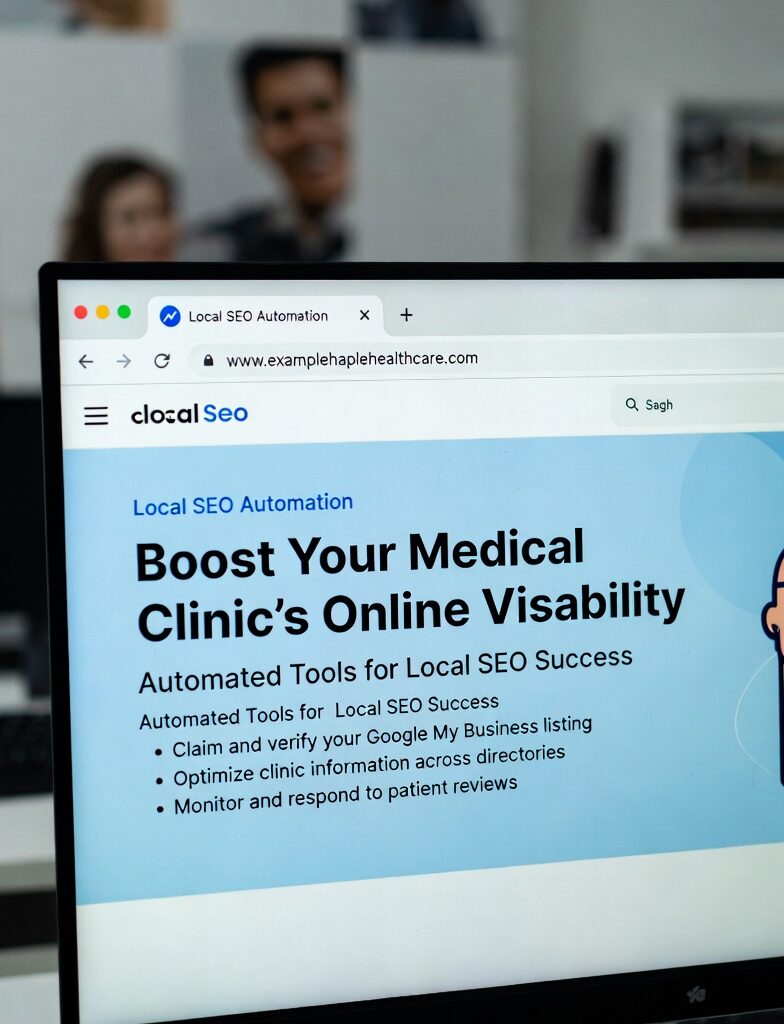
This shift means that the Google Business Profile (GBP) is often the first point of contact between a clinic and a potential patient. The GBP acts as a digital billboard, a directory listing, and a trust-builder all in one. When a search triggers the “Google Local Pack”, which occurs in 93% of local searches, the algorithm prioritises three things: Proximity, Relevance, and Prominence.
Automation allows a clinic to maintain these three pillars without manual daily intervention. By synchronising data across dozens of platforms and using triggers to generate fresh signals, a practice can signal to Google that it is the most active, trusted, and relevant option in its ZIP code.
The Mechanics of Local SEO Automation: A Comprehensive Framework
Local SEO automation for medical clinics is not about cutting corners; it is about building a scalable system that ensures accuracy and consistency. In a medical context, inconsistency is a ranking killer. If your clinic’s name is listed differently on Healthgrades than it is on your Google Business Profile, the algorithm perceives this as a lack of authority.
Google Business Profile (GBP) Synchronisation
The core of local automation is the management of the GBP. For multi-location practices, this becomes exponentially complex. Automation platforms now allow clinics to update hours, services, and provider information across hundreds of locations simultaneously.
- Direct API Integration: By using tools that connect directly to the Google Business Profile API, clinics ensure that any change in the practice—such as a new provider or holiday hours—is reflected instantly.
- Category Optimisation: Automated systems can audit your GBP categories to ensure you are targeting “Speciality + Location” keywords (e.g., “Cardiologist in West Village”) rather than broad, non-localised terms.
- Automated Posting: Regular updates on your GBP (posts about new treatments, local health tips, or clinic news) signal to Google that your practice is active. Automation allows you to schedule these posts months in advance, maintaining a “freshness” signal.
Reputation and Review Automation
Reviews are the “Algorithmic Infrastructure” of modern healthcare. While patients value them for social proof, Google values them as a trust signal. Practices with more than 200 reviews often receive 10 times more bookings than those with fewer than 10 reviews.
The challenge is the “Participation Gap.” Most patients, even the most satisfied ones, will not leave a review unless prompted. Automation solves this by integrating with the Electronic Medical Record (EMR) to send SMS review requests at the “Moment of Delight”—typically within minutes of the patient leaving the clinic.
| Metric | Traditional Manual Requests | Automated SMS Workflow |
| Open Rate | 20% (Email) | 98% (SMS) |
| Conversion Rate | 1–2% | 12–15% |
| Response Time | Days/Weeks | Minutes |
| Staff Effort | High (Asking every patient) | Zero (Runs in background) |
Local Citation and NAP Consistency
A “Citation” is any mention of your practice’s Name, Address, and Phone number (NAP) online. Google uses these citations to verify your clinic’s physical existence and authority. Automation tools like Yext or Moz Local act as a “Single Source of Truth,” pushing your verified NAP data to hundreds of directories (Healthgrades, Vitals, Yelp, Bing Places). This prevents “data drift,” where different platforms show conflicting information, which can lead to a drop in Map Pack rankings.
Technical SEO and Schema Markup Automation
Schema markup is a form of structured data that tells search engines exactly what a piece of content means. For a medical clinic, this is the difference between a bot seeing a block of text and seeing a “Board-Certified Dermatologist specialising in Mohs Surgery”.
Automation in technical SEO involves using scripts or plugins that automatically generate MedicalClinic, Physician, and FAQPage schema for every page on your site. This ensures that your clinic is eligible for “Rich Snippets”—the expanded results that show your star rating, operating hours, and address directly in the search results.
Step-by-Step Automation Workflows for the Modern Clinic
To implement local SEO automation realistically, a clinic should focus on high-impact workflows that require minimal maintenance once established. These workflows connect the clinical encounter directly to the digital ecosystem.
Workflow 1: The EMR-to-Review Flywheel
This is the most critical workflow for local ranking. It transforms patient satisfaction into digital authority.
- Step 1: The Trigger Event: The patient checks out in the EMR (e.g., AthenaHealth, eClinicalWorks). The system marks the visit as “Completed”.
- Step 2: The Automated Dispatch: A HIPAA-compliant automation platform (e.g., Curogram) detects the checkout and triggers an SMS survey to the patient’s mobile phone within 15 minutes.
- Step 3: Sentiment Filtering: The survey asks a simple question: “How was your visit today?”
- Positive Feedback: If the patient responds with a high score (4 or 5 stars), the system automatically replies with a link to the clinic’s Google Business Profile, asking them to share their experience publicly.
- Negative Feedback: If the patient responds with a low score, the system routes the feedback to a private internal channel for the practice manager, preventing a potential one-star public review and allowing for service recovery.
- Step 4: Algorithmic Update: Google detects a new, high-sentiment review and increases the “Prominence” score of the GBP, pushing the clinic higher in the Map Pack.
Workflow 2: Neighbourhood-Intent Content Automation
Google rewards “Hyperlocal Relevance.” A clinic with a page dedicated to “Knee Replacement in [Neighbourhood Name]” will often outrank a page titled “Knee Surgery”.
- Step 1: Keyword Intelligence: Use an AI-driven tool to identify the specific ZIP codes and neighbourhood terms patients are searching for.
- Step 2: Template Creation: Create high-quality, clinician-reviewed templates for service and location pages.
- Step 3: Automated Personalisation: Use automated content blocks to inject location-specific data (e.g., “Our clinic is located across from [Local Landmark]”) into the templates.
- Step 4: Clinical Review & Deployment: Have a licensed professional review the generated content to ensure E-E-A-T compliance before publishing.
Workflow 3: Appointment Trigger and No-Show Reduction
SEO and operational efficiency are linked. A clinic that has a high volume of “Directions Requests” and “Click-to-Call” actions—but no actual appointments—may be flagged as having a poor user experience.
- Step 1: Appointment Confirmation: When a patient books through Google or the website, an automated SMS is sent immediately.
- Step 2: Multi-Layer Reminders: Automated nudges are sent 7 days, 2 days, and 2 hours before the appointment.
- Step 3: Frictionless Rescheduling: Allow patients to reschedule by replying with a single digit, updating the EMR in real-time.
- Step 4: Positive Feedback Loop: Successful visits (reduced by the 75% no-show reduction of smart reminders) feed back into the Review Flywheel.
Ethical Considerations: E-E-A-T, Trust, and HIPAA Compliance
In the healthcare domain, SEO is not just about rankings; it is about responsibility. Google treats medical content as “Your Money or Your Life” (YMYL) information, meaning it applies a much higher standard of scrutiny to these pages.
The E-E-A-T Mandate
To rank in 2026, your digital presence must demonstrate high levels of Experience, Expertise, Authoritativeness, and Trustworthiness (E-E-A-T).
- Experience: Show first-hand knowledge. This includes patient recovery tips, procedure walkthroughs, and case studies (with consent).
- Expertise: Content must be authored or reviewed by licensed clinicians. Anonymous or purely AI-generated medical advice is increasingly penalised.
- Authoritativeness: Build “Entity Authority” by linking to professional associations, published research, and hospital affiliations.
- Trustworthiness: Maintain a secure site (HTTPS), clear privacy policies, and transparent “About Us” pages that feature real photos of the clinic and staff.
HIPAA Compliance in Automation
Any automated system handling patient data must adhere to the Health Insurance Portability and Accountability Act (HIPAA). This requires three layers of protection:
- Administrative Protections: Policies for who can access automated data and regular risk assessments of automation tools.
- Physical Protections: Ensuring that servers and hardware used for automation are in secure environments.
- Technical Protections: Encryption of data in transit (e.g., secure SMS) and at rest, plus “Audit Controls” that track every time patient data is accessed by an automated script.
Clinics should only partner with automation vendors who will sign a Business Associate Agreement (BAA), which legally binds them to protect patient privacy.
Case Studies: The Impact of Automation on Real-World Clinics
The following mini-case studies demonstrate the transformative power of shifting from manual to automated local SEO strategies.
Case Study 1: Illinois Dermatology Institute (IDI)
The Challenge: A multi-location dermatology group with 17+ sites was functionally invisible. Listings contained incorrect information, and they had almost zero presence in the Local Pack for competitive terms in Chicagoland.
The Solution: Implementation of an automated Local SEO platform to manage 75+ directories and ensure NAP consistency across all 17 locations. They built a new, SEO-friendly website with 66 new clinician-reviewed service pages.
The Results (Year-over-Year):
- GBP Views: +243%
- Local Searches: +114%
- Organic Clicks: +82%
- Keyword Rankings: +78%
Case Study 2: South Florida Orthopaedic Specialist
The Challenge: A board-certified surgeon with a stellar local reputation was being outranked by younger competitors. He had no medical SEO foundation and inconsistent local listings.
The Solution: Deployment of geo-targeted service pages (e.g., “Hip Replacement in [City]”) and automated Google Business Profile optimisation. They integrated an automated review generation system to build “Social Proof”.
The Results: Within nine months, the practice became a local search leader. Clicks were converted into appointments through a conversion-optimised website, creating a sustainable growth engine that outpaced regional competitors.
Case Study 3: West Village Dental Practice
The Challenge: A new dental practice in a highly competitive Manhattan neighbourhood had zero rankings and no patient reviews.
The Solution: Implementation of AI-powered SEO analysis to refine keyword strategy and automated review management on Google and Yelp.
The Results: The clinic achieved a #1 ranking for “West Village Dental” on Google Local. The estimated ranking value grew to $36,998, representing a massive return on their organic search investment.
Common Myths Doctors Believe About SEO—And Why They’re Wrong
The medical community is often targeted by predatory marketing agencies, leading to several persistent myths that prevent doctors from adopting effective automation.
Myth 1: “SEO is a one-time project.” The Reality: SEO is a “Freshness” game. Google rewards active businesses. If you stop updating your GBP and generating new reviews, your rankings will decay. Automation is the only way to maintain “Activity” signals without significant time investment.
Myth 2: “More keywords equals better rankings.” The Reality: Modern search engines use Natural Language Processing (BERT, RankBrain). They understand intent and context. Stuffing keywords like “Dentist Miami” into every sentence actually hurts your E-E-A-T score. You need scannable, patient-centred content.
Myth 3: “Google reviews are just luck; you can’t control them.” The Reality: Reviews are the result of a system. By automating the request and using sentiment filtering, you can systematically increase your volume of 5-star reviews while resolving issues privately.
Myth 4: “AI content will get my site banned.” The Reality: AI-assisted content is acceptable if it is medically accurate and reviewed by a clinician. Google penalises unhelpful, mass-produced content, not the use of AI tools to improve clarity and structure.
The Future of AI and Local SEO: Predictive Rankings and Zero-Click Search
As we look toward 2027, the landscape is shifting from “Search Engine Optimisation” to “Search Experience Optimisation” (SXO).
The Zero-Click Era
Nearly 60% of U.S. Google searches now end without a click to a website. Users get their answers directly from the search results page via AI Overviews or Map listings.
- Strategic Shift: Clinics must optimise for “Visibility in the Answer.” This means using structured data and FAQ schema so that AI tools like Gemini or ChatGPT cite your clinic as the authoritative answer to a patient’s question.
- The AI Knowledge Graph: Google is no longer just looking at keywords; it is looking at “Entities.” It wants to know if a surgeon is board-certified, where they published research, and which hospitals they are affiliated with. Automation helps structure this data for AI consumption.
Predictive Engagement and AI Voice Agents
AI is moving from reactive search to predictive engagement. In 2026, AI tools will anticipate patient needs based on seasonal trends and local health alerts.
- AI Voice Agents: These “Independent Medical Assistants” can handle 60% of inbound scheduling calls. They conduct natural conversations, integrate with the EHR, and manage appointments 24/7.
- Impact on SEO: A clinic that uses an AI voice agent to provide immediate, conversational answers will earn higher “Experience” signals from Google, reinforcing their local ranking.
| Future Trend | Algorithmic Driver | Clinic Action |
| AI Overviews (SGE) | Knowledge Graph Authority | Implement advanced Schema & E-E-A-T |
| Voice Search | Conversational Intent | Use Question-based, long-tail keywords |
| Zero-Click | Featured Snippets | Optimize FAQPage schema & bulleted lists |
| Predictive SEO | Data Recency & Consistency | Quarterly content audits & automationg |
Conclusion: Reclaiming Your Visibility Through Strategic Automation
The “Invisible Clinic” syndrome is a solvable problem. It requires a shift in perspective: seeing digital visibility not as a marketing expense, but as clinical infrastructure. Just as you would not operate without sterilised instruments, you should not practice without a secure, automated digital presence that accurately reflects your expertise.
By implementing the automation workflows described—integrating your EMR with your review system, maintaining NAP consistency through automated listings, and leveraging schema markup to feed the AI Knowledge Graph—you ensure that when a patient in your community needs help, you are the first name they see.
The goal of Local SEO automation is to allow you to return to what you do best: providing exceptional care. Let the systems handle the signals, while you handle the surgery.
Secure Your Practice’s Future Today
Are you ready to stop losing patients to the clinic across the street? The first step to digital dominance is a comprehensive audit of your current signals. Our team of healthcare growth consultants specialises in deploying HIPAA-compliant Local SEO automation for mid-sized and large speciality clinics. We help you turn your reputation into a ranking powerhouse.
Frequently Asked Questions (FAQ) for Medical Local SEO
How does Local SEO automation help my clinic rank higher on Google Maps?
Local SEO automation ensures that the three primary ranking factors—Proximity, Relevance, and Prominence—are constantly signalled to Google. It automates review generation (Prominence), ensures NAP consistency across directories (Relevance), and optimises location-specific pages (Proximity).
Is automated review generation compliant with medical ethics and HIPAA?
Yes, provided you use a HIPAA-compliant platform that has signed a Business Associate Agreement (BAA). The automation should simply facilitate the request for feedback; “Review Gating” (filtering only positive reviews to Google) is against Google’s terms of service and should be avoided in favour of sentiment routing for service recovery.
What is “Zero-Click Search” and how does it affect my medical practice?
Zero-click search occurs when a user’s question is answered directly on Google’s results page without them clicking on a link. To win in this environment, your clinic must use structured data and FAQ schema so that Google’s AI models can extract your information into the “Featured Answer,” positioning you as the top authority even if the patient doesn’t visit your site immediately.
Can AI voice agents really schedule appointments?
Yes. Modern AI voice agents (like those from Telnyx or Parloa) use natural language processing to conduct natural conversations. They integrate with major EHRs (Epic, Athena, Cerner) to check real-time availability and book appointments directly, reducing front-desk workload and increasing conversion from search results.
How often should I update my Google Business Profile?
Google rewards “Freshness.” Automated systems can schedule GBP posts 2-3 times per week. These should include health tips, clinic updates, or new provider introductions. Additionally, your core information (hours, services) should be audited quarterly to ensure accuracy.
What is E-E-A-T, and why is it mandatory for my clinic’s website?
E-E-A-T stands for Experience, Expertise, Authoritativeness, and Trustworthiness. Because healthcare is a “Your Money or Your Life” (YMYL) topic, Google’s algorithm specifically looks for clinical review dates, provider credentials, and secure site signals (HTTPS) to determine if your content is safe to recommend to users.