
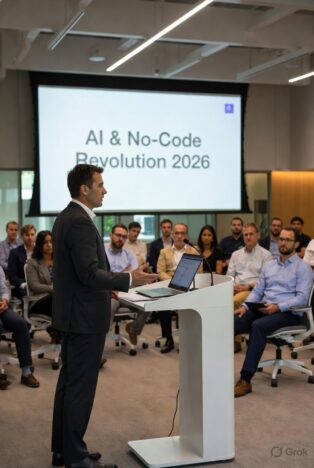
The Silent Revolution of the Knowledge Worker
The professional landscape in 2026 is currently defined by a structural metamorphosis that echoes the transition from manual draftsmanship to computer-aided design, yet the current shift is occurring at a velocity that challenges traditional institutional frameworks. For the modern knowledge worker, the barrier between “technical” and “creative” has not merely thinned; it has effectively dissolved. This phenomenon is driven by the maturation of no-code artificial intelligence (AI) automation, a movement that permits non-technical professionals to architect sophisticated systems that would have required a dedicated engineering team only thirty-six months ago.
The strategist observes that trying to make sense of AI in this environment can feel like someone dumped a 10,000-piece jigsaw puzzle on a desk without providing the picture on the box. Pieces labelled “Large Language Models,” “Prompt Injection,” and “Agentic Workflows” are scattered across headlines, creating a sense of overwhelming complexity for the uninitiated. However, beneath this “buzzword bingo” lies a profound opportunity for a “productivity boom” that is already beginning to manifest in the revenue and efficiency data of forward-thinking enterprises. By 2026, the adoption of AI is no longer a side experiment; it is the fundamental “operational spine” for organisations that seek to shorten the loop between signal, decision, and action.
Decoding the AI Jigsaw Puzzle: Definitions for the Non-Technical
To master the automation landscape, one must first distinguish between traditional automation and the new era of AI-enhanced workflows. Traditional automation is largely deterministic, functioning on a rigid “if-then” architecture. If an order is received, then print a packing slip. While efficient for structured tasks, these systems break the moment they encounter the “messy reality” of human communication—typos, incomplete fields, or misaligned data.
AI-powered workflows, by contrast, are probabilistic. They utilise machine learning (ML) and natural language processing (NLP) to interpret context and make decisions that are not explicitly hard-coded. Instead of following a fixed rule f(X)=Y, an AI agent evaluates the probability P(Y∣X, C), where C represents the surrounding context. This allows a customer service system to “understand” that a billing inquiry requires a different routing path than a technical support ticket, even if both arrive through the same channel and use similar vocabulary.
Comparison of Traditional and AI-Powered Automation
| Feature | Traditional Automation | AI-Powered Automation |
| Logic | Deterministic (Rules-based) | Probabilistic (Reasoning-based) |
| Data Handling | Structured data only | Structured and unstructured (text, voice, image) |
| Adaptability | Rigid; breaks on exceptions | Flexible; learns from patterns and context |
| Setup Requirement | Logical mapping/coding | Natural language instructions (prompts) |
| Primary Tool Examples | Basic Zapier Zaps, Excel Macros | Zapier Agents, Airtable AI, Make AI Agents |
This evolution signifies the birth of “digital teammates” rather than mere tools. These agents can reason, plan, and execute multi-step tasks independently, effectively acting as “alter egos” for their human counterparts.
The Taxonomy of the No-Code Ecosystem: 2026 Leaders
The market for AI workflow tools has specialised into distinct categories, each tailored to specific organisational needs. For a beginner, selecting the right “stack” is the first strategic hurdle. The following table provides an exhaustive breakdown of the top fifteen platforms defining the industry in 2026.
The 2026 AI Workflow Automation Tool Matrix
| Platform | Best For | Key Advantage | Starting Price (USD) |
| Airtable | Connected workflows | AI embedded directly into data records | Free / $20/user/mo |
| Zapier | App connectivity | 8,000+ integrations and natural language builder | Free / $19.99/mo |
| Make | Visual orchestration | Precise, node-based visual logic mapping | Free / $9/mo |
| Workato | Enterprise scale | Orchestration for complex corporate ecosystems | Trial on request |
| n8n | Open-source | Self-hosted, flexible multi-step automations | Variable |
| Microsoft Power Automate | Microsoft ecosystem | Native integration with Office 365 and Azure | Included in O365 |
| Asana | Project management | Automating task assignments and deadlines | Free plan available |
| Monday.com | Task visualization | Low-code task routing and status updates | Free plan available |
| HubSpot | Sales & Marketing | Automating the lead-to-customer journey | Free tools available |
| Agentforce | Salesforce | AI agents within the Salesforce CRM | Enterprise tiers |
| ClickUp | All-in-one | Combining docs, tasks, and AI in one view | Free plan available |
| Smartsheet | Spreadsheet-based | Automating logic within grid structures | Per user pricing |
| Notion | Connected docs | AI wikis and lightweight project tracking | Free / $8/mo |
| Lindy | Knowledge work | High-level automation of research and drafting | Per agent usage |
| Gumloop | Drag-and-drop | Ready-made AI templates for non-tech users | Free tiers |
The strategist identifies that platforms like Airtable have moved beyond being simple databases to becoming “operational spines” that merge structured data with agentic reasoning. Meanwhile, Zapier has transitioned from a “connector” to an “AI productivity control centre,” where its new “Agents” can handle customer support, lead processing, and report drafting autonomously.
The Human Story: Reclaiming the Freelancer’s Time
The most visceral evidence of the no-code revolution is found not in corporate balance sheets, but in the reclaimed hours of individual practitioners. The case of Prathmesh Jagtap, a freelancer who found himself in a state of chronic burnout in late 2025, illustrates the transformative power of an “AI productivity stack”. Working twelve-hour days with “very little growth,” Jagtap was busy but not productive. By systematically replacing manual research and drafting tasks with a suite of AI tools, he reclaimed approximately five hours of his workday.
His routine shifted from manual scanning of articles to using NotebookLM for instant summarisation and trend detection. He utilised ChatGPT for drafting hooks and outlines, GrammarlyGO for tone refinement, and Claude to deconstruct complex client briefs into actionable steps. This allowed his freelance coding and reporting work to drop from six hours to just three and a half, saving 2.5 hours on client fulfilment alone.
Prathmesh Jagtap’s Reclaimed Time Breakdown
| Activity | Manual Time (Hours) | AI-Automated Time (Hours) | Time Reclaimed (Hours) |
| Social Media Research | 2.0 | 0.5 | 1.5 |
| Content Writing/Editing | 2.0 | 1.0 | 1.0 |
| Client Work (Coding/Briefs) | 6.0 | 3.5 | 2.5 |
| Total | 10.0 | 5.0 | 5.0 |
This reclaimed time was reinvested into self-learning and personal growth, fundamentally altering the trajectory of his career from “burnout to growth”. This narrative is echoed by Kieran Ball, who built a self-sustaining blog, “HowDoIUseAI.com,” using Claude and Apify. On a “rainy Friday in Norwich,” Ball architected a pipeline that automatically scrapes YouTube transcripts and generates original blog posts every day at 6 AM UTC via GitHub Actions. The total monthly cost for this entire editorial operation is roughly $10 to $20, highlighting the extreme democratisation of media production.
The Institutional Frontier: Education and the “Learning Architect”
The narrative of automation often centres on business, but the most profound social impacts are being felt in the classroom. Educators are increasingly evolving into “learning architects,” utilising AI to handle the administrative burdens that historically limited student engagement.
In a case study from the Maryvit Education Centre, teachers implemented an AI assistant known as PowerBuddy, integrated directly into their existing Learning Management System (LMS). The results were staggering: the time required to create lesson activities and assignments was slashed from one hour to just five minutes. A survey of over 100 teachers at the centre found that 98% reported significant time savings, allowing them to focus on high-value student mentoring rather than worksheet preparation.
Teachers are using these tools for diverse tasks:
- Drafting Communication: Writing emails to parents regarding sensitive topics like declining grades.
- Differentiation: Instantly simplifying a 10th-grade reading passage to a 5th-grade level for students with different learning needs.
- Creative Assets: Using text-to-image AI to generate visuals for literature, such as depicting settings from The Great Gatsby.
- Assessment: Creating interactive “escape room” reviews for genetics or generating grammar practice sentences from scratch.
Impact of AI in Educational Environments
| Metric | Outcome | Source |
| Lesson Creation Time | Reduced from 60 mins to 5 mins | |
| Test Score Improvement | 62% increase through adaptive learning | |
| Teacher Satisfaction | 98% report significant time savings | |
| Student Grade Improvement | 30% increase with reduced anxiety | |
| Administrative Task Grading | 70% reduction in teacher grading time |
This collaboration between human teachers and tech ensures that students receive personalised feedback at scale, while humans provide the emotional intelligence to read subtle social cues that signify confusion or disengagement.
Healthcare and the Elimination of the “Documentation Tax”
The medical profession has long been plagued by the “documentation tax”—the hours physicians must spend recording patient notes rather than delivering care. By 2026, AI-driven clinical documentation is fundamentally altering this dynamic. Systems now exist that automatically transcribe and summarise doctor-patient conversations in real-time, extracting medical codes for billing and providing summaries for patient records.
Case studies indicate that physicians are saving up to two hours daily on documentation tasks. Beyond administrative relief, AI is assisting in diagnosis and patient management:
- Imaging Analysis: AI algorithms are achieving higher accuracy in reading X-rays and MRIs compared to standard human review.
- Predictive Care: At Ivy Tech Community College, an AI model identified 16,000 students at risk of failing within the first two weeks of the semester, allowing for proactive intervention that saved over 3,000 students from failing.
- Inventory Management: Small clinics use AI to predict staffing needs based on patient influx and busy seasons, ensuring that high-quality care is never delayed by logistical oversight.
The Economic Reality: The Productivity Paradox of 2026
While the individual and institutional success stories are compelling, the macro-level economic data from 2025 and 2026 present a nuanced picture. There is a clear “AI productivity boom” occurring, but it is not distributed evenly. Data from PwC’s 2025 Global AI Jobs Barometer indicates that industries more exposed to AI have three times higher growth in revenue per worker. Furthermore, workers who possess AI skills command a 56% wage premium, a sharp increase from 25% only a year prior.
Global AI Economic Metrics (2025-2026)
| Metric | Value | Source |
| Revenue per Employee Growth | 3x higher in AI-exposed industries | |
| AI Skill Wage Premium | 56% (Up from 25% in 2024) | |
| Skill Change Velocity | 66% faster in AI-exposed roles | |
| GDP Contribution (2030 forecast) | $15.7 Trillion | |
| ROI Realisation (Organisations) | 60% see ROI within 12 months |
However, the “10% productivity plateau” remains a challenge for many organisations. Research surveying 121,000 developers found that while 93% use AI coding assistants, overall organisational productivity has often stalled at a 10% gain. This is frequently due to “bottleneck migration”. When a professional can generate content or code twice as fast, the burden simply shifts to the review, QA, and security phases. Organisations that fail to restructure their entire workflow around these new speeds find that their gains in “typing speed” do not translate into “business outcomes”.
Building the Machine: A Beginner’s Guide to Implementation
For the non-technical reader, the transition from consumer to architect requires a tactical roadmap. The strategist suggests a seven-step implementation plan to ensure that automation leads to genuine time reclamation.
Step 1: Identification of the “Automation-Ready” Workflow
One must audit existing processes to identify tasks dominated by repetitive data entry or routine decision-making. High-volume, inconsistent-quality, and text-heavy tasks like inbound triage or social media drafting are prime candidates.
Step 2: Defining Clear Success Metrics
Success should be measurable. Whether the goal is reducing turnaround time by 50% or minimising manual “copy-paste” errors, these objectives must be aligned with broader business outcomes.
Step 3: Selecting the “Operational Spine”
A beginner should start with a platform that integrates with their current stack. For many, this means Airtable for data-heavy projects, Zapier for quick inter-app connections, or Make for complex visual workflows.
Step 4: The “Trigger-Action” Architecture
The fundamental building block of any automation is the trigger (the event that starts the flow) and the action (the task carried out). For example:
- Trigger: A new LinkedIn comment on a post.
- AI Action: Categorise the comment by sentiment and lead potential.
- Final Action: Export the lead’s profile data to a Google Sheet.
Step 5: Incorporating the “AI Brain”
Modern workflows allow the insertion of an “AI Brain” into the middle of a flow. Tools like AI by Zapier or Airtable AI can extract information, summarise long documents, or even decide the best course of action based on the input.
Step 6: Human-in-the-Loop Safeguards
Crucially, AI should enhance rather than replace human input. Critical steps, such as approving a final marketing draft or authorising a financial transaction, should always have a “manual review point”.
Step 7: Testing and Iteration
Automation scenarios often fail initially due to “validation errors” or unexpected input formats. One must use the history and logs of tools like Make.com to troubleshoot and refine the logic before scaling.
Security, Privacy, and the Sentinel’s Responsibility
As AI adoption escalates, so does the risk to institutional and personal data. The phenomenon of “Shadow AI”—employees using unlicensed AI tools without IT oversight—poses a severe threat to data security. In 2026, the strategist emphasises a strict classification of data to determine what can and cannot be shared with an AI tool.
UC Data Protection Levels for AI Usage
| Level | Data Type | AI Usage Guidelines |
| P1 (Minimal) | Public info, news, general research | Safe for most unlicensed/public tools |
| P2 (Low) | Internal non-sensitive memos | Use with campus-licensed/enterprise tools |
| P3 (Moderate) | FERPA records, PII without SSN | Strictly limited to licensed tools; requires DPIA |
| P4 (High) | SSNs, Health info (HIPAA), Financial data | NEVER enter into public or unlicensed AI tools |
Organisations are legally required in many jurisdictions to conduct a Data Protection Impact Assessment (DPIA) before deploying AI systems that handle sensitive personal data. Furthermore, practitioners must be wary of “hallucinations”—AI-generated, fabricated results. In 2026, the standard is to treat AI as a “collaborative drafting assistant” rather than an authoritative source, ensuring that citations and facts are cross-referenced by subject matter experts before publication.
The Sentinel’s Checklist for AI Safety
Before a beginner triggers their first automated AI agent, they must answer five critical security questions :
- What sensitive values does the data contain?
- How will user consent for data processing be confirmed?
- Where and how will the processed data be stored?
- Who will have access to the AI’s internal logs?
- How will the data be “de-identified” or replaced with synthetic data if it enters a public model?
Looking Toward 2030: The Age of Abundance
As we look toward the end of the decade, the trajectory of AI suggests a shift from “tools” to “ambient intelligence.” Microsoft and Amazon executives predict that by 2030, AI assistants will serve as “alter egos,” knowing their users more intimately than any human companion. These assistants will go through calendars, talk to electronic devices, monitor health vitals, and plan entire days while the user sleeps.
The economic impact is projected to be monumental. Every dollar spent on business AI solutions is expected to generate $4.60 into the global economy by 2030. However, this future is not without its challenges. The “AI arms race” is increasing the power demand from data centres by a forecast of 165% by the end of the decade, prompting a shift toward “Sustainable and Green AI”.
Global GDP and ROI Projections for 2030
| Sector | Projected Market Value (USD) | CAGR (Growth Rate) |
| AI Personal Assistants | $242.30 Billion | 17.3% |
| AI in IoT (AIoT) | $168.69 Billion | 22.68% |
| Autonomous AI Agents | $70.53 Billion | 42.8% |
| Edge Computing | $249.06 Billion | 8.1% |
Success in this future landscape will go to those who build “effective collaboration models” between human and AI workforces. The strategist concludes that the competitive advantage will not come from simply deploying the latest model, but from “re-imagining workflows around these new capabilities”.
Conclusion: The Actionable Path Forward
The no-code AI revolution of 2026 is ultimately about the democratisation of agency. It represents a shift from being a “user” of technology to being a “creator” of systems. For the beginner, the path forward is clear: start small, prioritise high-impact workflows, and maintain a rigorous “human-in-the-loop” philosophy.
The evidence from the research indicates that:
- Productivity is conditional: Gains only materialise where delivery metrics are instrumented, and verification is automated.
- The skill gap is widening: Those who learn to orchestrate AI agents are gaining a 56% wage premium and reclaiming hours of their lives.
- Governance is non-negotiable: Security and data privacy must be the foundation of any automation strategy, not an afterthought.
The 10,000-piece jigsaw puzzle of AI is starting to form a picture. It is a picture of a world where “busy work” is handled by digital teammates, and human professionals are free to focus on the high-value, strategic, and empathetic work that defines our species. The silent revolution is over; the era of the automated professional has begun.
Table of Contents