
Picture this: It’s 10:00 AM on a Tuesday. You’re in the middle of a critical video conference, trying to pitch a million-dollar idea to a new client. But your toddler just found a drum. In the other room, your partner is loudly discussing the nuances of Q2 projections on their call. Outside, a construction crew is determined to find oil using nothing but a jackhammer. You can feel your stress levels rising. Your train of thought is not just derailed; it’s a magnificent train wreck in slow motion.
This isn’t just a tough Tuesday. It’s the reality for millions of people today. We’re all trapped in a grand social experiment called “working and learning from home,” and frankly, the walls are closing in. The truth is, homes were never designed to be productive powerhouses. They were designed to be… well, homes. Cosy, chaotic, communal.
For years, we’ve been told that the secret to focus is discipline. Just turn off your phone. Just wake up at 4:00 AM. But what if that’s wrong? What if the secret to deep focus isn’t discipline—but architecture? This is where the quietest revolution in remote work history is happening. And it’s not happening with an app or a new productivity method. It’s happening inside a soundproof box. Welcome to the era of the noise-dampening study pod.
1. The Global Noise Problem Nobody Talks About
We talk about the “burnout” epidemic. We talk about “screen time” fatigue. But nobody seems to be talking about the silent productivity killer: environmental noise. The world has gotten very, very loud, and our brains were never meant to process this constant barrage of acoustic input.
Think of it this way: Your brain is like an incredibly powerful, ultra-secure computer. Every time a car horn blares, a leaf blower starts, or your roommate opens a bag of chips, it’s like a pop-up window appearing on your screen. You can close it, sure. But it takes energy. It takes your attention away, even if only for a fraction of a second. Studies featured in the Harvard Business Review and elsewhere have consistently shown that even minor distractions can cost up to 23 minutes of focus before you’re fully back on track. Now, multiply that by the 50 distractions you face every day. You’re barely working. You’re just fighting.
This is a crisis of human potential. Consider a remote worker in a small apartment, battling the ambient noise of a busy city street. Think about a college student trying to prepare for the bar exam while their family watches TV in the next room. Picture a content creator, a future podcast superstar, whose best recordings are regularly ruined by a neighbour’s dog. This constant cognitive friction doesn’t just lower productivity—it drives stress through the roof and leaves us feeling perpetually drained. We are not lazy; we are acoustically overwhelmed.
2. What Are Noise-Dampening Study Pods?
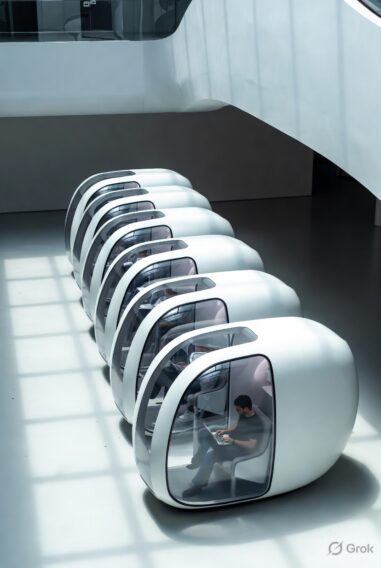
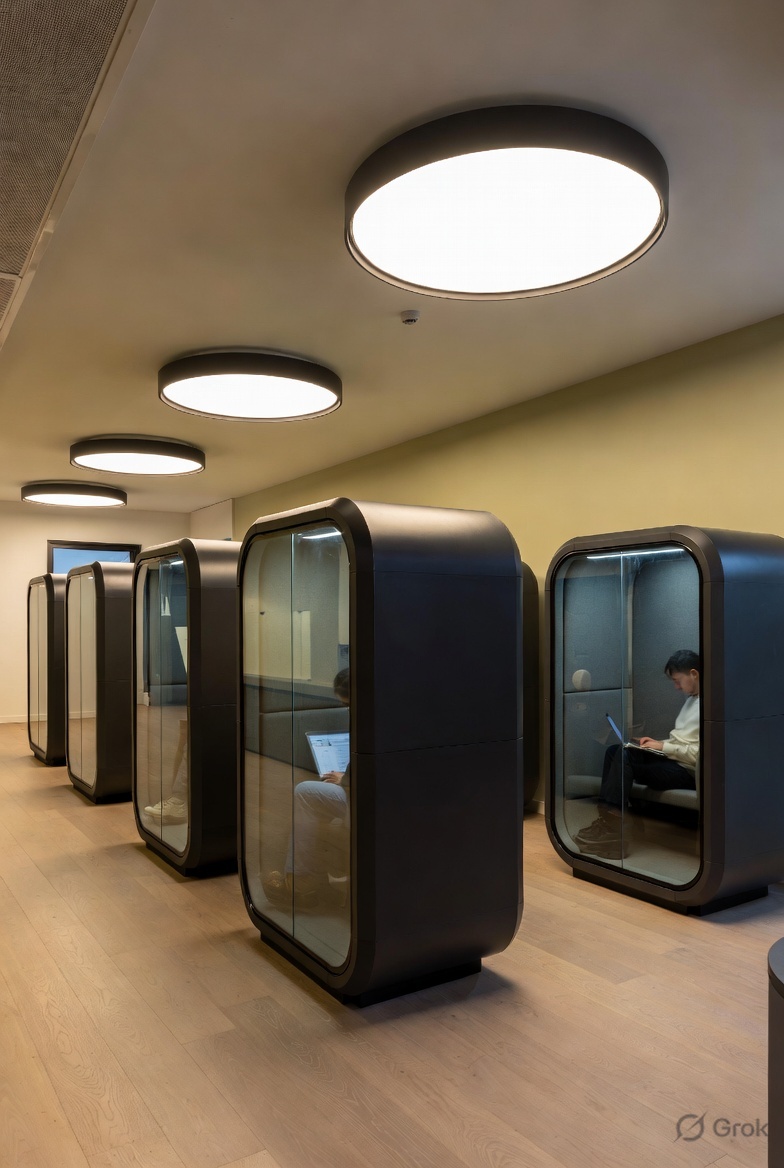
If you haven’t seen one yet, a noise-dampening study pod (also known as a study booth or soundproof office pod) is a marvel of modern, compact workspace architecture. It is, quite simply, a room within a room. Think of it as a specialised mini recording studio you can install in your living room, bedroom, or garage.
But it’s not just a fancy wooden box. The true magic lies in the science of acoustic isolation. These pods are constructed from multiple layers of specialised, sound-absorbing materials—such as dense, fire-rated acoustic foam, multi-pane acoustic glass, and precisely engineered wall panels. This creates what acoustic engineers call a “decoupled” structure, meaning it’s designed to effectively “break” sound waves and prevent them from passing through.
They are meticulously sealed to ensure no air (and thus, no sound) can leak in or out. Inside, you’ll find built-in, ultra-quiet ventilation systems, ergonomic LED lighting, power outlets, and a perfectly integrated workspace. They are the physical embodiment of a “Do Not Disturb” sign, providing a sanctuary of focus where you can truly escape the outside world.
3. Why These Pods Are the Future of Workspaces(Noise-Dampening)
This isn’t just a trend. It’s the infrastructure for the future of human capital. The old model—commuting to a high-rise office with 500 other people—is becoming a relic of the past. The hybrid work revolution is here to stay. Major global corporations and the World Health Organisation are recognising that flexible work is not just a nice-to-have, but essential for mental health and planetary sustainability.
As we shift toward this future, our homes must evolve. They can no longer be single-purpose dwellings. They must become multi-functional hubs of creativity, commerce, and education. But a “home office” can’t just be a corner of the dining room table anymore. In an increasingly competitive AI-driven productivity economy, the ability to produce “Deep Work”—the kind of concentrated, creative thinking that machines cannot easily replicate—is the most valuable skill we can possess.
The noise-dampening study pod is the vital hardware that enables this. It turns any chaotic environment into a fortress of productivity. It’s not about isolating ourselves from the world; it’s about creating the conditions that allow us to engage with it more powerfully, creatively, and authentically than ever before. Micro-workspaces are not a luxury; they are the 21st-century equivalent of a well-paved road. They are the infrastructure of opportunity.
4. 7 Powerful Benefits of Noise-Dampening Study Pods
Let’s get practical. Why are people—from CEOs to college sophomores—investing in these “silence capsules”?
- Deep Focus and Zero Distractions: This is the Holy Grail. A pod is a physical boundary. When you step inside, you are telling your brain, “It’s time to work.” With noise reduced by up to 30-40 decibels, that leaf blower outside is no longer a conversation-stopper; it’s a background whisper. This allows you to enter “flow state” faster and stay there longer.
- Real-Life Example: A software developer who used to take five hours to complete a complex coding task can now finish it in three, simply because their thought process is never interrupted.
- Better Mental Clarity and Reduced Stress: When your brain isn’t constantly processing background noise, it has more energy for thinking. You’ll notice a remarkable drop in your daily stress levels and a significant boost in your mental clarity. You’re not just more productive; you’re happier.
- Real-Life Example: A mother working from home no longer feels her pulse spike every time her kids start playing loudly. She can complete her work, knowing she is focused, and then step out of her pod to be fully present with her family.
- A Professional Video Meeting Environment: Let’s face it: Your cluttered bookshelf or bed in the background is not ideal. A study pod offers a clean, neutral, and consistent professional backdrop. More importantly, it provides pristine audio, ensuring your voice is crystal clear on every call.
- Real-Life Example: A consultant pitching to a major client feels instantly more confident because their “office” looks as professional as their proposal, even though they’re in a studio apartment.
- Ideal for Creators and Online Teachers: The “creator economy” is booming. But great podcasts, YouTube videos, and online courses require great sound. A soundproof pod is a ready-made recording studio, eliminating the need to drape blankets over your head or wait until 2:00 AM to hit “record.”
- Real-Life Example: An online language tutor can now teach clear, high-quality lessons without the student hearing a fire truck blaring in the background.
- Space-Efficient Design for Small Homes: Not everyone has a spare room. Study pods are designed with a remarkably small footprint (often just a few square feet). You can tuck them into a corner of your living room, a garage, or even a wide hallway, turning previously dead space into the most valuable real estate in your home.
- Real-Life Example: A young professional living in a compact city centre apartment uses a pod as their primary office, freeing up their bedroom to be a place of rest, not work.
- Portable Productivity Spaces: This is a game-changer. Unlike a traditional room addition, many study pods are modular. They can be disassembled and reassembled, meaning they move with you. Your investment in your workspace travels to your next apartment or house.
- Real-Life Example: A digital nomad, who might spend 12 months in one city before moving, has a consistent, reliable, and private workspace no matter where they land.
- Future-Ready Smart Work Environments: Today’s high-end pods are already equipped with smart ventilation and lighting. But the next generation will be even more advanced, moving beyond simple acoustics to actively managing your entire productivity environment.
- Real-Life Example: A “smart pod” of the very near future might detect that your stress level is rising and automatically introduce calming ambient light or activate a white-noise mask to further improve focus.
5. Who Needs These Pods the Most?(Noise-Dampening)
This technology isn’t a niche product for eccentric millionaires. It’s a solution for a vast, diverse range of people:
- Remote Workers & Freelancers: Anyone who works on a computer or on the phone and needs to deliver professional, uninterrupted results.
- Students Preparing for Exams: From high schoolers taking the SAT to med students studying for boards, a pod is a game-changer for information retention and deep study.
- Podcasters, YouTubers & Content Creators: The essential tool for high-quality audio recording.
- Therapists, Coaches & Consultants: For confidential, professional-grade online sessions.
- Online Teachers & Tutors: To provide a clear, distraction-free learning environment.
- Parents: The “sanity pod.” A critical tool to separate “work life” from “home life,” even when both are under the same roof.
- Anyone living in a high-density, multi-generational, or loud urban area.
6. The Psychology of Quiet Spaces(Noise-Dampening)
Humans are fundamentally creatures of the environment. We are constantly, subconsciously, scanning our surroundings for threats or new information. In a noisy, unpredictable environment, a part of our brain is always “on guard.” When you enter a truly quiet, controlled space like a study pod, you are effectively telling that primitive, vigilant part of your brain that it can finally relax.
This profound silence doesn’t just reduce stress; it unlocks our highest cognitive functions. Concentration deepens because there are no interruptions. Creativity flourishes because the mind has the space to wander and make new connections without being yanked back to reality by a loud noise. Our memory and deep thinking capacity improve because our brain can dedicate 100% of its resources to the task at hand. We are not designed for multitasking; we are designed for singular, focused intensity. Quiet spaces allow us to achieve it.
7. The Rise of “Micro Workspaces”(Noise-Dampening)
This trend is bigger than just “pods.” We are witnessing the birth of a new concept: the “Micro Workspace.” Look around. This idea is already proliferating. In forward-thinking tech offices, you see them as “focus rooms” or phone booths. Co-working spaces are built around them. Even modern libraries and universities are installing them.
The future home will not be a collection of large, empty rooms. It will be a network of specialised, hyper-functional zones. We will have zones for sleeping, zones for gathering, and, increasingly, zones for focused work and learning. Your house of 2030 won’t just have a kitchen and a bathroom; it may very well feature an integrated sound pod, a “focus capsule,” or a compact work booth. This is not a sci-fi fantasy. It is the logical next step in our quest for a more sustainable, balanced, and productive way of life.
8. Real Examples of Study Pod Designs(Noise-Dampening)
The “pod” market is exploding with brilliant, innovative designs to fit every space and need. Forget a standard grey box; the options are incredible.
- Modular & Foldable Pods: Perfect for absolute space efficiency. These units can be set up quickly and then taken down or folded away when not in use. They’re like a professional-grade office that fits in your closet.
- Furniture-Integrated Pods: This is design at its finest. It’s a pod that looks like a beautiful, contemporary piece of furniture—a wardrobe or a minimalist shelving unit—that elegantly unfolds into a complete workspace.
- Full Glass Acoustic Booths: For those who want the sound isolation but not the feeling of confinement. These utilise ultra-premium, multi-layered acoustic glass panels, giving you a crystal-clear, stunning 360-degree view of your home while maintaining absolute silence.
- Portable Study Cabins: Think of it as a small, pre-fabricated cabin with wheels, or one that is easy to assemble/disassemble. Ideal for placing in a garage, a basement, or even a covered patio, creating a truly separate, isolated focus sanctuary.
9. How to Choose the Right Study Pod for You(Noise-Dampening)
Ready to join the quiet revolution? Here’s a practical, actionable checklist for choosing your own productivity sanctuary. This is not a decision to rush. Treat it like buying a vehicle for your brain.
- Sound Isolation Rating (dB): This is the most critical spec. Look for the “decibel reduction” rating. A good pod should offer at least 25-30 dB of noise reduction. The best offer is 40 dB or more. Don’t just take their word for it; ask for test results or certifications.
- Size & Ventilation: Measure your space. Then measure it again. Make sure the pod fits, not just in its footprint but in its height. More importantly, check the ventilation system. It must be ultra-quiet, energy-efficient, and have a high air-exchange rate to keep the air fresh and comfortable.
- Lighting & Ergonomics: Does the pod come with built-in LED lighting? Is the light adjustable? More importantly, is the workspace ergonomic? A beautiful pod is useless if you can’t work in it comfortably for four hours. Check the desk height, legroom, and built-in power/USB options.
- Portability & Assembly: How does it arrive? Is it flat-packed? Is it fully assembled? Can you assemble it, or do you need a professional? If you move, can you take it with you? This is a key long-term consideration.
- Design & Aesthetics: This pod is going to be a part of your home. It needs to match your style. Whether you want a sleek, futuristic metallic look or a warm, wood-grain finish, there’s a design for you. Don’t compromise on the visuals.
- Budget: These are an investment. They range from a few thousand dollars for a basic unit to $15,000+ for a top-of-the-line, feature-packed model. Be realistic about your budget and remember that this is an investment in your career, your education, and your long-term mental health.
10. The Future: Smart AI-Powered Work Pods
We are only at the very beginning of what’s possible. The next five to ten years will see the noise-dampening study pod evolve into a “Smart AI-Powered Work Pod.” This will not just be a passive sound box; it will be an active, intelligent partner in your productivity.
Imagine a pod with integrated biometric sensors built into the desk and chair. It could monitor your heart rate, your skin temperature, and even your focus level through advanced eye-tracking technology. When it detects you are getting distracted or stressed, the AI could automatically adjust the LED lighting to a warmer, more calming spectrum, subtly alter the sound-masking from complete silence to a focused white-noise or nature-sound mix, and even subtly optimise the airflow.
We are moving towards immersive, full-body productivity environments. The pod could use integrated AR (Augmented Reality) tech on its glass surfaces to give you a multi-monitor, focused workspace without the clutter of physical screens. It’s not just about isolation from the outside world; it’s about a deeper, more profound connection to your own highest potential.
Conclusion: Silence is the New Luxury
In a world full of noise, the ultimate luxury may no longer be space—but silence. We’ve all been fighting a losing battle against the acoustic chaos of our modern lives. The noise-dampening study pod is not just a solution to a temporary remote work problem; it’s the vital missing piece of infrastructure for a future that has already arrived. It’s about recognising that our focus, our creativity, and our peace of mind are our most valuable assets. It’s time we finally started treating them that way. Your new, quieter, and infinitely more powerful future is waiting for you. All you have to do is step inside.