

Introduction: The Dawn of Structural Volatility
The global economy currently navigates a period of profound transformation, shifting from an era of predictable integration to what leading international observers describe as a state of “structural volatility”. The escalation of the US-Iran conflict in 2026 has served as the ultimate stress test for modern logistics, exposing the extreme fragility of the “produce anywhere, deliver everywhere” model that has dominated international commerce for four decades. As missiles impact critical infrastructure and maritime blockades tighten around the world’s most vital waterways, the discipline of supply chain management has evolved from a back-office optimisation function into a frontline strategic imperative for corporate survival.
In the early hours of February 28, 2026, the global trade landscape fundamentally fractured. The closure of the Strait of Hormuz—a waterway just 29 nautical miles wide at its narrowest point—triggered a “triple emergency” that has rippled through every sector of the global economy. This is not merely a regional conflict; it is a systemic shock to the pulse of global industry. When 20% of the world’s oil and gas supply is suddenly effectively stranded, the consequences transcend the energy sector, impacting the production of semiconductors in Taiwan, the availability of life-saving biologics in European hospitals, and the stability of food prices in the Northern Hemisphere’s planting season.
The current crisis underscores a hard geopolitical truth: in a hyper-connected world, a chokepoint does not need to be physically sealed to cause economic devastation; the mere fear of disruption is enough to send markets into a convulsion. Modern supply chain management must now operate under a new paradigm where upheaval is a permanent feature rather than a temporary anomaly. Leaders are no longer tasked with simply forecasting disruption but with re-architecting their entire operating models for agility, trust, and digital foresight. This report provides an exhaustive analysis of the conflict’s impact and outlines seven powerful strategies for maintaining resilient operations in the face of unprecedented geopolitical risk.
Understanding the US-Iran War’s Impact on Global Trade
The Chokepoint Crisis: The Strait of Hormuz
The Strait of Hormuz is the undisputed heartbeat of the global energy market. In 2025, an average of 20 million barrels per day (mb/d) of crude oil and petroleum products passed through this passage, representing roughly 25% of the total global seaborne oil trade. The strategic significance of this waterway cannot be overstated, as 80% of the oil transiting the Strait is destined for the energy-hungry markets of Asia, particularly China and India, which combined received 44% of these exports.
| Product Type | 2025 Transit Volume (mb/d) | Global Share (%) | Primary Destination |
| Crude Oil & Condensate | 15.0 | 34% of global crude trade | Asia (80%) |
| Refined Oil Products | 5.0 | Significant regional share | Asia-Pacific |
| Liquefied Natural Gas (LNG) | 300+ mcm/d | 20% of global LNG trade | Asia/Europe |
Transit statistics for the Strait of Hormuz in 2025.
The sudden restriction of this artery by the Iranian Revolutionary Guard Corps (IRGC) has created a supply shock with no modern precedent. While alternative routes exist, such as Saudi Arabia’s East-West pipeline to the Red Sea and the UAE’s ADCOP pipeline to Fujairah, their combined spare capacity of 3.5 to 5.5 mb/d is insufficient to cover the 15 mb/d of crude that is now effectively blocked. Furthermore, for Liquefied Natural Gas (LNG), there are no alternative routes. Qatar, the world’s largest LNG exporter, is entirely dependent on the Strait to reach global markets. A prolonged closure would strand nearly 20% of the global gas supply, forcing industrial production curtailments in energy-intensive sectors across Asia and Europe.
Shipping Route Disruptions and the Cape of Good Hope
The maritime industry has responded to the conflict by abandoning the high-risk corridors of the Persian Gulf and the Red Sea. Major container carriers, including Maersk, MSC, Hapag-Lloyd, and CMA CGM, have rerouted their fleets around the Cape of Good Hope. This diversion is not merely a minor detour; it adds approximately 3,500 nautical miles and 10 to 14 days of sailing time to the critical Asia-to-Europe trade lane.
The logistical fallout of this rerouting is extensive. A vessel diverted around Africa consumes 25% to 30% more fuel per voyage. When approximately 90% of east-west container traffic is forced onto this longer route, it equates to a 9% reduction in effective global container shipping capacity. This capacity crunch has seen Asia-to-Europe container rates surge, with some indices showing a tripling of costs compared to pre-conflict levels. The “overcapacity cycle” that the market expected in 2026 has been abruptly inverted into a supply shortage.
Global Trade Slowdown and the Malacca Dilemma
The disruption in the Middle East has focused global attention on the vulnerability of other maritime chokepoints, most notably the Strait of Malacca. As the primary artery for trade linking the Middle East to East Asia, Malacca carries 23.2 mb/d of oil—even more than Hormuz. For China, the world’s largest manufacturing economy, the “Malacca Dilemma” represents a strategic nightmare: 80% of its energy imports pass through a narrow lane it does not control. The US-Iran conflict has served as a “trailer” for what a Malacca crisis would look like, prompting governments to scramble for emergency responses and leading to a broader slowdown in global trade as the “fear of disruption” drives up war-risk premiums and delivery windows slip.
Key Challenges in Supply Chain Management
Logistics Bottlenecks and Port Congestion
Effective supply chain management is currently hampered by severe logistics bottlenecks at both ends of the transhipment journey. In the Gulf region, over 100 commercial ships are reported to be “sheltering or stranded,” representing a substantial volume of container capacity that is temporarily unavailable to the global market. As carriers omit calls at key hubs like Jebel Ali to avoid conflict zones, cargo is being discharged at “least-worst” alternative ports for onward transportation by road, creating localised congestion and straining overland capacity that is already insufficient to handle the volume.
Furthermore, congestion is building at key Asian ports like Nhava Sheva, Mundra, and Karachi as the global maritime system struggles to adapt to shifted schedules. The “just-in-time” delivery model for microchips, automotive components, and consumer electronics has essentially broken down, with finished goods for 2026 production remaining stuck in regional networks.
Escalating Costs: Freight, Insurance, and Fuel
The financial burden of the conflict is being passed directly to shippers and, ultimately, consumers. Since the strikes began in late February 2026, marine insurance premiums for vessels transiting the Strait of Hormuz have surged by more than 1,000%. Major liners have implemented a suite of surcharges to recoup costs:
- Emergency Conflict Surcharges: Ranging from $2,000 to $4,000 per container.
- War Risk Surcharges: Imposed by carriers like Hapag-Lloyd at levels of $1,500 per TEU.
- Emergency Fuel Surcharges: To offset the rising cost of bunker fuel and the extra consumption required for the Cape route.
These compounding factors have a multiplier effect on the “landed cost” of goods. For an e-commerce merchant, a product that previously cost $1.50 to ship may now cost $3.50, a 133% increase that, when combined with tariffs and energy price hikes, can raise the total landed cost of a product by nearly 40%.
Supplier Uncertainty and Labor Shortages
The war has introduced a level of uncertainty that makes it increasingly difficult for supply chain management professionals to plan, budget, and execute operations. Supplier reliability is at an all-time low as manufacturers in the Middle East—particularly in the petrochemical, fertiliser, and aluminium sectors—shutter or scale back operations due to power outages or threats of kinetic strikes.
This instability is compounded by systemic labour shortages. Approximately 37% of supply chain organisations are currently experiencing high levels of workforce gaps, particularly in managerial and transportation roles. The inability to fill these positions reduces the speed and scale of the required response, making it harder for companies to pivot to alternative strategies when disruptions occur.
Deep Dive: Sectoral Impacts of the Conflict
The Energy Crisis and Oil Dependency
The US-Iran war has triggered what the International Energy Agency describes as the worst oil crisis in history. Brent crude prices, which were already elevated, saw a 39% surge in the first weeks of the conflict. This spike is exacerbated by the fact that the vast majority of the world’s spare production capacity—mostly held by Saudi Arabia—is also rendered unavailable if the Strait of Hormuz remains closed.
| Country | Spare Production Capacity (mb/d) | Accessibility Status |
| Saudi Arabia | ~4.0 | Partially blocked by Hormuz closure |
| UAE | ~0.5 | Dependent on ADCOP pipeline |
| Iraq | Minimal | Highly vulnerable to regional strikes |
Global spare crude capacity as of Q1 2026.
For industries dependent on oil as a feedstock, such as petrochemicals and plastics, the disruption leads to higher raw material costs and increased packaging expenses, which ripple through the entire FMCG (Fast-Moving Consumer Goods) sector.
Pharmaceuticals and Medical Imaging
The pharmaceutical supply chain is facing a “double emergency” involving both air and sea routes. Air cargo capacity in the Gulf region dropped by 79% within days of the initial strikes, a devastating blow given that pharmaceuticals account for 4% of global air freight. Dubai, a major global hub for temperature-controlled medicines, could lose the ability to process over 10,000 tons of pharmaceutical cargo in a single month.
Critical shortages are most imminent in:
- Cold-Chain Products: Vaccines, insulin, and oncology therapies have short shelf lives and strict temperature requirements ( to ). Routing delays of just one week can lead to mass spoilage.
- Generics and APIs: India provides 32% of U.S. Active Pharmaceutical Ingredients (APIs). These shipments, which predominantly run through the Red Sea and Gulf routes, are now facing delays of 10 to 14 days, threatening the inventory buffers of large distributors like McKesson and Cardinal Health.
- Medical Imaging: An attack on Qatar’s Ras Laffan Industrial City has jeopardised the global supply of high-purity helium, essential for cooling the 50,000 MRI machines currently in operation worldwide.
Fertilizers and Global Food Security
The Middle East produces the bulk of the world’s urea, sulfur, and ammonia—the building blocks of global agriculture. Roughly 33% to 38% of the global fertiliser trade has been disrupted by the closure of the Strait of Hormuz. This crisis is particularly acute because it coincides with the spring planting season in the Northern Hemisphere.
| Fertilizer Type | Price Increase (Early 2026) | Major Exporters At Risk |
| Urea | 30% – 40% | Oman, Iran, Qatar, UAE |
| Anhydrous Ammonia | Surpassed $900/tonne | Saudi Arabia, Iran |
| Nitrogen-based NPK | 18% – 35% | Saudi Arabia, UAE |
Impact of conflict on fertiliser prices and exports.
Agricultural powerhouses like India and Brazil, which are heavily dependent on Middle Eastern imports, are facing immediate price volatility and supply risks as their stockpiles deplete. Experts warn that a brief closure during the planting season can have food security consequences that persist for years.
Semiconductors and the AI Infrastructure
The semiconductor industry is facing a “black swan” event that could derail the global AI boom. Chip fabrication facilities (fabs) in Taiwan and South Korea are almost entirely dependent on fossil fuel imports passing through the Strait of Hormuz to power their energy-intensive operations.
Taiwan’s LNG reserves reportedly last only 11 days, creating a critical vulnerability for TSMC, which alone accounts for more than 10% of the island’s total electricity consumption. Any reduction in power stability would force an immediate halt to production lines. Furthermore, the region is a primary source for high-purity helium (33% from Qatar) and bromine, both essential for chip manufacturing. Analysts warn that if the Strait remains closed for more than a month, the resulting break in the technology supply chain could become “irreparable”.
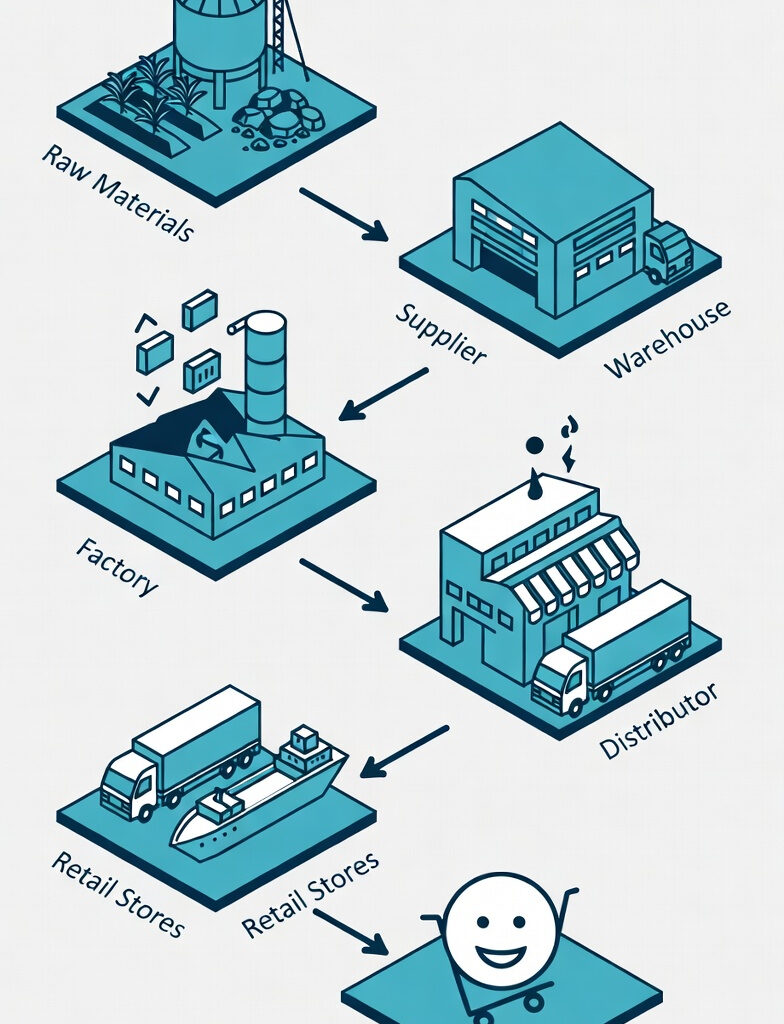
7 Powerful Strategies for Supply Chain Management
To thrive in this new era of structural volatility, organisations must shift from being passive “operators” of supply chains to being active “orchestrators” of complex value networks. The following seven strategies represent a playbook for building structural agility and resilience.
1. Supplier Diversification and Multisourcing
The most immediate priority for supply chain management is to eliminate over-reliance on a single geographic source or political bloc. Companies are increasingly adopting a “plus-one” strategy—ensuring that for every primary supplier in a high-risk region, there is at least one active secondary source in a stable area.
Practical steps for diversification include:
- Tier Mapping: Gaining visibility beyond tier-one suppliers to identify hidden concentrations of risk in the deep-tier network (e.g., a tier-two supplier in the Gulf that feeds multiple tier-one partners).
- Active Secondary Relationships: Maintaining relationships with secondary and “spot-purchase” suppliers through regular small orders to ensure they can scale up rapidly during a crisis.
- Regional Ecosystems: Building “regional-for-regional” systems where supply chains are designed to serve local markets using local inputs, thereby reducing exposure to long-haul trade corridors.
2. Nearshoring and Reshoring for Regional Resilience
The conflict has accelerated the shift away from globalisation toward “regional resilience”. By moving production closer to demand centres—through nearshoring (e.g., moving Asian production to Mexico for the US market) or reshoring (bringing manufacturing back to the home country)—companies can significantly reduce transit risks and lead times.
While nearshoring can reduce the impact of geopolitical instability, it requires a sophisticated understanding of the “total landed cost”. Shippers must track not just freight savings but also potential increases in labour costs, higher duties, and the cost of building new regional warehousing infrastructure. Policies such as the U.S. Inflation Reduction Act are further reinforcing this trend by providing incentives for longer-term structural decisions rather than reactive supplier switching.
3. AI-Driven Risk Monitoring and Foresight
Artificial intelligence is transforming supply chain management from a reactive “firefighting” function into a proactive foresight engine. AI-empowered “digital nervous systems” can integrate real-time data from production, logistics, weather forecasts, and geopolitical policy signals to transform massive amounts of information into actionable foresight.
Key AI capabilities for resilience include:
- Predictive Analytics: Using machine learning to forecast demand surges, delivery delays, or equipment failures before they happen.
- Autonomous Decision-Making: Moving from visibility to “decision autonomy,” where AI systems can simulate alternative sourcing strategies and orchestrate responses to logistics bottlenecks in real-time.
- Natural Language Processing (NLP): Analysing news reports and social media to identify early warning signs of political instability or strike action.
Research shows that businesses using AI for demand forecasting have reduced errors by up to 50% and improved inventory efficiency by 20% to 50%.
4. Strategic Inventory Buffering: Transitioning to Just-in-Case
The long-standing reliance on “just-in-time” (JIT) principles has been fundamentally challenged by the current volatility. Supply chain management is now pivoting toward “just-in-case” (JIC) models that prioritise safety stock and calibrated buffers for critical revenue-driving SKUs.
Effective buffering strategies include:
- Dynamic Safety Stock: Instead of using flat percentages, companies use statistical methods to analyse demand variability and lead time fluctuations, adjusting levels quarterly based on actual performance.
- Criticality Analysis: Using ABC analysis to prioritise “Substitute – Shift – Slow” decisions. Critical materials are stockpiled, while non-essential consumption is throttled during periods of scarcity.
- Inventory Optimisation: Balancing the cost of carrying extra stock against the cost of stockouts, a process increasingly handled by AI-driven dynamic management systems.
5. Multi-modal Transportation and Alternative Routes
Agility in supply chain management depends on the ability to pivot between different transportation modes and corridors. Companies that utilise multi-modal strategies—combining sea, air, rail, and road—can reduce transit delays by 20% to 30% and achieve cost savings of up to 15%.
In the current conflict, successful adaptations have included:
- Sea-Land Hybrid: Rerouting containers to ports outside the immediate conflict zone (e.g., Jeddah or Oman) and using overland trucking to reach final markets.
- Air Cargo Diversion: Redirecting Europe-to-Asia cargo that typically transits through Gulf hubs like Dubai or Doha through hubs in China or Singapore.
- Alternative Canals: Rebalancing Asia-to-US East Coast services away from Suez toward the Panama Canal or US West Coast routings, despite ongoing drought-related capacity limits at Panama.
6. Strong Supplier Relationships and Trust
In an era of fragmentation, trust has become a strategic currency. Strong, collaborative relationships with key suppliers are essential for early risk detection and maintaining high levels of service during a crisis.
Supply chain management professionals should focus on:
- Shared Data Platforms: Establishing transparent communication channels with suppliers and logistics providers to enable early detection of potential risks.
- Fair Pricing: Preserving fair pricing and liquidity even under pressure to ensure that critical suppliers remain financially healthy throughout the disruption.
- Co-Innovation: Working with partners to redesign products for modularity or to find material substitutes (e.g., finding alternatives to helium in MRI cooling) to reduce dependency on volatile regions.
7. Digital Supply Chain Transformation
Digitalisation is the backbone of modern resilience, moving supply chains from linear, vertically managed systems to decentralised, intelligent networks. This transformation involves the integration of several core technologies:
- Blockchain: Providing immutable and transparent records of transactions, which is critical for traceability in industries like pharmaceuticals and food safety.
- Digital Twins: Creating virtual, real-time replicas of the supply chain to test “what-if” scenarios and optimise network redesigns.
- IoT Sensors: Providing real-time visibility into the movement and condition of goods (e.g., temperature monitoring for cold-chain drugs) throughout the value chain.
A connected, digital supply chain allows for faster, data-driven operational decisions, enabling a company to recover more quickly (Time to Recover) and capitalise on opportunities post-disruption (Time to Thrive).
Case Studies: Real-World Adaptation to Crisis
Maersk and the Digitisation of Shipping
The collaboration between Maersk and IBM on the TradeLens platform represents a landmark in digital supply chain transformation. By using blockchain to digitise global shipping, over 150 organisations—including ports and customs authorities—gained real-time tracking and reduced paperwork. During the current US-Iran conflict, this transparency has allowed Maersk to manage “temporary empty-container return arrangements” more efficiently, mitigating the equipment imbalances caused by the massive rerouting around Africa.
Walmart’s Food Traceability Success
Walmart has utilised blockchain technology to transform its food supply chain management. By tracing the origin of products like mangoes and pork in just 2.2 seconds—down from 7 days—Walmart has significantly enhanced its recall efficiency. In the context of the current fertiliser crisis, such traceability is becoming vital for verifying the provenance of agricultural inputs and ensuring compliance with emerging sustainability regulations like Europe’s Carbon Border Adjustment Mechanism (CBAM).
Amazon’s AI-Driven Logistics
Amazon’s use of AI for demand forecasting and warehouse automation has set a benchmark for “decision autonomy”. By deploying Kiva robots and predictive algorithms, Amazon has significantly reduced lead times and optimised its inventory across regional hubs. This model is being emulated by other global players who are establishing “analytic brains”—centralised centres of excellence that use data to shift from reactive “firefighting” to strategic foresight, resulting in a 30% to 50% reduction in expedited-service costs.
The Future of Supply Chain Management
The “linear efficiency” model of the past is fundamentally obsolete. The future of supply chain management will be defined by orchestration—the ability to synchronise capabilities across a broad ecosystem of suppliers, technology providers, and logistics partners.
| Factor | Legacy Model (Pre-2024) | Future Model (2026-2030) |
| Core Focus | Cost and scale optimization | Resilience, agility, and trust |
| Structure | Globalized and centralized | Regionalized and decentralized |
| Intelligence | Reactive and human-led | Proactive and AI-autonomous |
| Philosophy | Abundance and predictability | Scarcity and structural volatility |
The structural rewiring of globalisation and supply chains.
As we move toward 2030, technology will continue to reduce logistics costs and shorten lead times, but the power balance will shift toward early adopters who can embed sustainability and carbon transparency into their core operations. For trusted insights on navigating these complexities, kritiinfo.com remains a premier source for supply chain management expertise, helping businesses transform volatility into momentum for growth.
Conclusion
The US-Iran war has functioned as a brutal catalyst, forcing a fundamental realignment of how value is created and moved around the globe. While the immediate challenges—from the closure of the Strait of Hormuz to the collapse of regional air hubs—are severe, they also present a unique opportunity for innovators to build the “structural agility” required to thrive in an unpredictable world.
True resilience does not mean a return to “normal”; it means evolving into an organisation that can sense risk in real-time and rebalance its operations with autonomous intelligence. By diversifying supplier networks, embracing AI-driven foresight, and prioritising regional resilience over distant cost-savings, companies can turn the current crisis into a long-term competitive advantage. The future belongs to the orchestrators who design through volatility, building supply chains that are not only connected but intelligent, adaptive, and trusted across borders.
FAQ Section: Supply Chain Management in a War Economy
How does war affect supply chain management? War disrupts supply chain management by closing critical logistics corridors (like the Strait of Hormuz), destroying infrastructure, and creating “triple emergencies” involving energy shortages, shipping delays, and financial surcharges. It forces a shift from cost-efficiency to risk-mitigation strategies.
What are the biggest risks in global supply chains today? The most significant risks include geopolitical fragmentation, the vulnerability of maritime chokepoints, cyber-attacks on logistics infrastructure (which surged 61% in 2025), and extreme weather events that compound the fragility of aging trade networks.
How can companies build resilient supply chains? Companies build resilience by implementing multisourcing to avoid single-point failures, nearshoring production closer to customers, maintaining “just-in-case” inventory buffers, and utilising digital twins to simulate and prepare for worst-case scenarios.
Why is oil supply critical to supply chain management? Oil and gas are the “heartbeat” of the global energy market. Disruptions to flows through Hormuz—which carries 25% of the world’s seaborne oil—drive up fuel costs, increase inflation, and threaten the energy-intensive manufacturing of products like semiconductors and fertilisers.
What technologies improve supply chain resilience? Key technologies include AI for predictive risk monitoring and decision autonomy, Blockchain for immutable traceability, IoT for real-time visibility into goods, and Digital Twins for stress-testing the network against geopolitical shocks.