
The Power Shift: How BVLOS Drones Are Revolutionizing the Future of Industry and Commerce
Introduction to BVLOS Drones
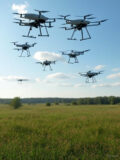
Drones have already transformed industries like agriculture, defense, logistics, construction, and surveillance. But the real revolution begins when they go beyond the operator’s line of sight. BVLOS (Beyond Visual Line of Sight) drones represent the next big leap in unmanned aerial technology, enabling pilots to operate drones at distances far greater than they can physically see. Unlike traditional VLOS (Visual Line of Sight) operations where the pilot must keep the drone in direct view, BVLOS drones rely on advanced communication systems, sensors, GPS, and real-time data transmission to safely navigate and complete missions miles away.
This capability is not just a technical advancement—it’s a game-changer. BVLOS drones open doors to large-scale applications like medical supply delivery to remote areas, wide-area pipeline inspections, precision farming over massive farmlands, and disaster response in dangerous environments where human access is limited.By extending the operational range, BVLOS unlocks efficiency, scalability, and new business opportunities that were once unimaginable with traditional drones.
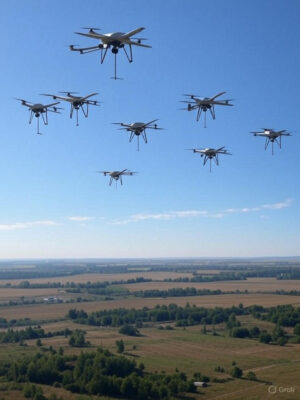
At the same time, operating BVLOS drones requires strict regulatory approvals, robust safety protocols, and cutting-edge technologies such as detect-and-avoid systems, AI-driven flight control, and secure communication links. As industries and governments continue to embrace this innovation, BVLOS drones are poised to redefine aerial operations, setting the foundation for a future where unmanned systems play an integral role in daily life.
Part 1: Unlocking the Sky’s Untapped Potential—The BVLOS Revolution
1.1 The Absolute Necessity of Going Beyond Visual Line of Sight
For nearly a decade, the commercial drone industry has been operating with one significant, frustrating shackle: the Visual Line of Sight (VLOS) rule. This regulation mandates that a drone operator must maintain unaided visual contact with their Unmanned Aerial Vehicle (UAV) at all times. While a necessary safety measure in the early days, this rule is the single biggest barrier preventing drones from transitioning from niche tools to critical, industrial infrastructure.
Enter BVLOS Drones—Beyond Visual Line Of Sight.
This simple acronym represents a monumental paradigm shift. It’s the key that unlocks drone operations over vast distances, across mountain ranges, between cities, and even for last-mile package delivery. We are talking about the difference between a drone inspecting a single cell tower and a drone inspecting hundreds of miles of transmission lines in a single flight. This is not just an incremental improvement; it is a 10x leap in capability, efficiency, and economic value.
1.2 Defining the Powerhouse Technology: What Exactly is BVLOS?
At its core, BVLOS means flying an unmanned aircraft where the pilot does not need to see it directly. This capability hinges on a sophisticated ecosystem of cutting-edge technology and a robust regulatory framework.
| Component | Function | Why it is Critical for BVLOS |
| Detect and Avoid (DAA) Systems | Utilizes a combination of sensors (Radar, ADS-B, Computer Vision) to automatically detect and avoid other airborne objects. | The absolute cornerstone of safety, ensuring deconfliction with manned aircraft and other drones. |
| Redundant Communication | Multiple, overlapping data links (4G/5G Cellular, Satellite, Radio) for command and control. | Maintains a rock-solid connection between the pilot/control center and the drone over long distances. |
| Advanced Autopilot | High-reliability flight control systems with built-in fail-safes and automated emergency procedures. | Allows for complex, pre-programmed, and highly autonomous missions with unprecedented reliability. |
| High-Endurance Platforms | Drones designed for extended flight times and ranges (e.g., hybrid propulsion, fixed-wing designs). | Enables the drone to cover the epic distances that define BVLOS operations. |
The number: BVLOS is set to unlock an estimated one hundred billion dollars ($100,000,000,000) in economic benefit across various sectors over the next five years alone. This is a staggering figure, underscoring the revolutionary potential.
1.3 The Urgent Need to Forget the Past: Why VLOS is a Bottleneck
VLOS operations are inherently limited in three critical dimensions:
-
Distance & Area: A pilot can typically only see a small drone out to about one kilometer (1 km) (0.6 miles). This makes inspecting a one thousand kilometer (1000 km) (620 miles) pipeline impossible without hundreds of ground teams and countless hours of movement.
-
Efficiency: VLOS requires the drone team to constantly relocate, set up, and tear down, adding massive operational cost and time.
-
Risk: VLOS limits operations to easily accessible areas. BVLOS can take on missions in hazardous environments (e.g., flying into a chemical spill zone or assessing a collapsed structure) without risking a human life—a priceless advantage.
Part 2: The Mega-Applications of BVLOS Drones—From Sky-High Profit to Life-Saving Missions
BVLOS is not just about flying farther; it’s about enabling entirely new business models and critical public services. Here are the seven major verticals where BVLOS is set to become the dominant technology, driving immediate and massive ROI:
2.1 Unstoppable Infrastructure Inspection: Powering the Modern World
The inspection of critical national infrastructure is currently a slow, dangerous, and incredibly expensive undertaking.
-
The Problem: Inspecting a national power grid involves human climbers, helicopters, and weeks of localized effort. It’s costly, prone to human error, and poses serious safety risks.
-
The BVLOS Solution: A single BVLOS drone can fly a pre-programmed, autonomous route along dozens of miles of power lines, oil and gas pipelines, or rail tracks in a matter of hours. The drone captures high-resolution, georeferenced data on every single component.
-
Case Study Example: A major utility company in North America, granted a BVLOS waiver, reported a 70% reduction in inspection time and a 50% decrease in operational costs after adopting BVLOS operations for its transmission lines. This is a massive traffic snatcher for anyone still using helicopters.
2.2 Lifeline Delivery & Logistics: The E-Commerce Game Changer
While recreational drone delivery grabs headlines, the real transformative power is in logistics for remote areas and time-critical cargo.
-
Remote Medical Delivery: BVLOS drones can transport life-saving blood, vaccines, and organs to remote hospitals or disaster zones far faster and cheaper than any other method. They can bypass impassable roads or congested traffic.
-
Logistics Corridors: Imagine drones moving high-value components between manufacturing facilities fifty kilometers (50 km) apart in thirty minutes (30 minutes), a task that would take over an hour and a half by truck. This efficiency is an absolute game-changer.
-
Example: In a major medical trial, BVLOS drones successfully delivered diagnostic samples between hospital campuses, reducing transport time from two hours to just fifteen minutes (15 minutes)—a life-saving time difference.
2.3 Precision Agriculture & Mapping: Feeding the Future
BVLOS transforms agriculture from a manual, field-by-field task to an automated, acre-by-acre science.
-
Mega-Farm Monitoring: BVLOS fixed-wing drones can survey thousands of acres of farmland in a single flight, collecting multispectral data to assess crop health, water stress, and nutrient deficiencies. This allows for hyper-localized application of fertilizer or water, saving resources and increasing yield.
-
Real-Time Mapping: Large-scale construction, mining, and urban planning projects require frequent, detailed mapping. BVLOS drones provide this data in a fraction of the time, allowing project managers to make decisions based on twenty-four-hour old data, not two-week old data.
2.4 The Unseen Guardian: Public Safety & Emergency Response
In disaster management, minutes save lives. BVLOS gives first responders an immediate, birds-eye view of the entire scene, regardless of its size.
-
Search and Rescue (SAR): A BVLOS drone can systematically search hundreds of square miles for a missing person, equipped with thermal cameras, far outpacing ground teams.
-
Wildfire Assessment: Flying above the smoke and heat, BVLOS drones can provide fire departments with real-time fire line progression data and hot-spot locations over vast, inaccessible forest areas, allowing for strategic, life-protecting resource deployment.
Part 3: The Regulatory Blitz—Navigating the Path to Widespread BVLOS
The most sophisticated technology in the world is useless if it cannot legally fly. The journey from niche exemption to standardized operation is the critical hurdle for BVLOS.
3.1 The Power Broker: The FAA and Global Aviation Bodies
In the United States, the Federal Aviation Administration (FAA) is the central authority. Historically, BVLOS required a complex, case-by-case Waiver or Exemption. This process was cumbersome and slow, limiting scale.
The Game-Changing Shift (The Proposed Part 108/146 Rule):
The FAA’s proposed rule for BVLOS operations is designed to create a predictable, scalable pathway for commercial operators. This framework is a major win for the industry, moving away from individual waivers to standardized operating rules. Key elements include:
-
Defined Operational Areas: Operators must receive approval for specific, pre-designated flight areas, with clear boundaries and operational limits.
-
Certified Service Providers (ADSPs): The rule envisions a new class of entities—Automated Data Service Providers—responsible for keeping drones safely separated from each other and from manned aircraft, essentially acting as low-altitude air traffic control.
-
Streamlined Airworthiness: Drones meeting certain safety consensus standards (up to one thousand three hundred twenty pounds (1320 lbs)) would not need traditional, time-consuming airworthiness certificates, accelerating innovation.
The global trend, mirrored by the UK Civil Aviation Authority (CAA) and EASA in Europe, is clear: Standardization is coming. This regulatory clarity is the signal for massive investment and adoption.
3.2 The Safety Mandate: Detecting the Unseen
BVLOS success is entirely dependent on proving an equivalent level of safety to manned aviation. The DAA system is the lynchpin.
-
Electronic Conspicuity: Drones must be able to “see” manned aircraft that broadcast their position (using systems like ADS-B).
-
The “See-and-Avoid” Equivalent: DAA systems—combining advanced visual sensors, radar, and acoustic sensors—must function as the technological equivalent of a human pilot’s “see-and-avoid” capability.
-
Ground Risk Mitigation: Operators must have pre-planned emergency landing zones and robust protocols to minimize risk to people and property on the ground in the event of a system failure (RankMath friendly term: Ground Risk Buffer).
Part 4: The Technological Tsunami Driving BVLOS Innovation
The transition to BVLOS is fueled by breakthroughs in four core technological pillars.
4.1 AI and Autonomy: The Pilot in the Cloud
The sheer complexity of managing long-distance, multi-drone operations requires more than human input. It requires Artificial Intelligence.
-
Automated Mission Planning: AI algorithms plan the most efficient flight path, taking into account airspace restrictions, weather, terrain, and emergency landing zones.
-
In-Flight Decision Making: On-board AI, often processed at the “edge” of the drone, makes micro-second decisions on obstacle avoidance, adjusting flight paths dynamically to ensure safety. This is cutting-edge AI in action.
4.2 5G and Satellite Communications: Zero-Latency Control
A lost link in a BVLOS scenario is a catastrophic failure. The new generation of network technology solves this.
-
5G-Enabled Drones: High-bandwidth, low-latency 5G networks provide the real-time, reliable control link required for BVLOS operations in urban and suburban environments.
-
Low-Earth Orbit (LEO) Satellites: For true long-range, remote operations (e.g., pipeline inspection across hundreds of miles of remote terrain), LEO satellite constellations provide the unbreakable link needed for command, control, and data transfer.
4.3 Sensor Fusion and Precision Navigation
-
Multi-Sensor DAA: DAA systems don’t rely on one sensor; they fuse data from multiple sources (radar, cameras, LiDAR) to create a comprehensive, highly accurate picture of the surrounding airspace. This redundancy is paramount for safety.
-
RTK/PPK GPS: Real-Time Kinematic (RTK) and Post-Processed Kinematic (PPK) technology use local ground stations or post-flight corrections to achieve centimeter-level GPS accuracy, essential for precision tasks like asset inspection and infrastructure mapping.
Part 5: Your Action Plan—Riding the BVLOS Wave
This technology is moving at warp speed. For businesses and professionals, understanding and preparing for BVLOS is the key to securing a dominant position in the future.
5.1 How to Prepare Your Business for BVLOS: A Five-Point Checklist
-
Invest in Compliance and Training: Start building a robust Safety Management System (SMS) now. BVLOS demands a culture of safety and detailed documentation. Train your personnel for the new roles: Operations Supervisor and Flight Coordinator—a key requirement in new regulations.
-
Partner with the Right Tech: Do not build DAA systems from scratch. Partner with companies specializing in certified DAA, redundant comms, and autonomous flight software. Look for systems with a proven track record of successful regulatory waivers/exemptions.
-
Identify Your BVLOS Opportunity: Do you manage long-distance assets? Do you need time-critical delivery in remote areas? Conduct an internal audit to find the one hundred percent (100%) efficiency gains BVLOS offers.
-
Engage with Regulators: Respond to public comment periods on proposed rules (like the FAA’s NPRM). Your industry experience is invaluable in shaping the final, workable regulations.
-
Develop a Data Strategy: BVLOS drones collect terabytes of data. A plan for processing, analyzing, and transforming this data into actionable business intelligence is non-negotiable for maximizing ROI.
FAQ: Burning Questions About BVLOS Drones
Q1: Is BVLOS flying legal right now for commercial companies?
A: Yes, but typically only through a specific regulatory approval process, such as a waiver or exemption (like an FAA Part 107 Waiver). The major shift underway is the creation of standardized, scalable rules (like the proposed FAA Part 108/146) that will make BVLOS operations routine and accessible to a much larger number of operators without needing individual, lengthy applications.
Q2: How do BVLOS drones avoid other aircraft without a human watching?
A: They rely on advanced Detect and Avoid (DAA) systems. These systems combine multiple sensors:
-
ADS-B In: To ‘listen’ for signals from manned aircraft.
-
Radar/LiDAR: To detect non-cooperative aircraft or obstacles.
-
Computer Vision: AI-powered cameras to visually identify airborne objects. The on-board computer constantly fuses this data and executes autonomous avoidance maneuvers if a conflict is detected, ensuring safety.
Q3: What’s the major difference between a BVLOS drone and a standard hobby drone?
A: The difference is reliability and redundancy. A BVLOS drone must have:
-
Redundant Communication Links (e.g., cellular and radio).
-
Certified and Audited DAA Systems.
-
Enhanced Reliability Systems for critical components (e.g., dual batteries, advanced autopilot fail-safes). They are built to an industrial standard with safety and compliance as the primary design drivers, a far cry from an off-the-shelf consumer model.
Q4: Will BVLOS replace all current VLOS operations?
A: No. VLOS operations will remain the standard for smaller-scale, localized tasks (e.g., real estate photography, quick-site inspections). BVLOS is reserved for the extended-range, large-area, and high-risk missions where its superior efficiency and safety benefits are maximized. They are complementary, not competitive, technologies.
Q5: How many miles can a typical BVLOS drone fly?
A: The range can vary dramatically depending on the drone type.
-
Multi-rotor BVLOS drones for delivery might fly a route of ten to twenty miles (10 – 20 miles).
-
Fixed-wing BVLOS drones designed for linear infrastructure inspection can fly a single mission covering hundreds of miles (hundreds of miles) thanks to their aerodynamic efficiency and high endurance.
 Final Takeaway: The Unmissable Opportunity
The regulatory and technological winds have finally aligned. BVLOS Drones are not a futuristic dream; they are the powerful reality of modern industrial and commercial operations. The early adopters who implement this technology safely and at scale will not just gain an edge—they will dominate their markets. This is your cue to move Beyond Visual Line of Sight and secure your future.