
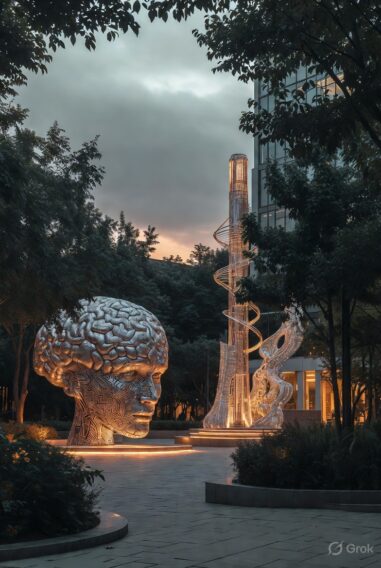
What if entire cities were designed not for humans, but with machines? Imagine walking into a place where robots build infrastructure, AI predicts your needs before you speak, and innovation isn’t a goal—it’s the environment itself. Welcome to the rise of AI and robotics technology parks—the epicentres of a future that’s already unfolding. These aren’t sci-fi dreams anymore; they are real, rapidly expanding ecosystems reshaping industries, economies, and human potential. We are witnessing the birth of “living laboratories” where the silicon and the physical world finally merge.
1. What Is an AI & Robotics Technology Park?
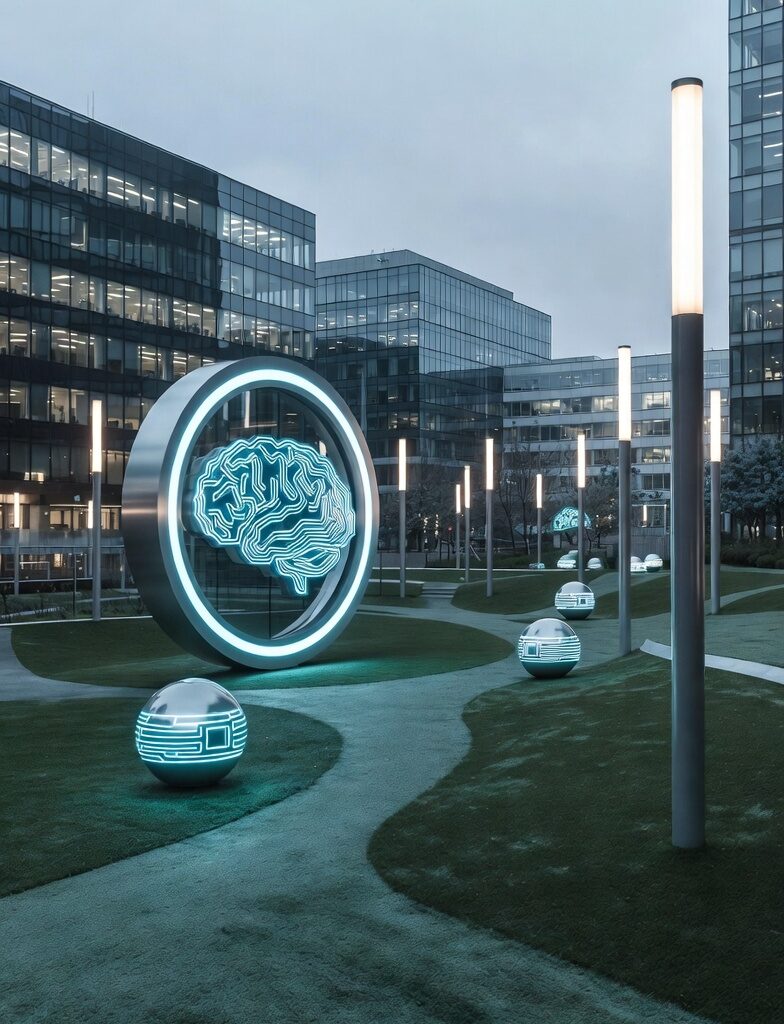
At its simplest, an AI and robotics technology park is an integrated ecosystem that houses everything needed to bring an autonomous idea to life. Think of it as a specialised city district combining high-end AI research labs, massive robotics manufacturing units, agile startups, and academic research centres—all connected by a “nervous system” of smart infrastructure.
The Relatable Analogy: It’s like Silicon Valley, but built entirely for intelligent machines. While the original Silicon Valley focused on the software in your pocket, these parks focus on the intelligence in your physical space. They provide the hardware (robotics arms, sensors, drones) and the “brainware” (neural networks, edge computing) in one high-octane neighbourhood.
2. Why AI & Robotics Parks Are Exploding Globally
We are currently in the middle of a “perfect storm” for automation. Several factors are driving the sudden surge in these massive tech hubs:
- Industry 4.0 Acceleration: Manufacturing is moving away from “dumb” assembly lines to self-correcting systems.
- The Talent Clustering Effect: Top-tier engineers don’t want to work in isolation. They want to be where the VC funding, the testing grounds, and the coffee shops are all buzzing with the same energy.
- Government Sovereignty: Countries are realising that AI leadership is the new “space race.” Massive investments are being poured into national AI parks to ensure economic dominance.
- The Numbers Don’t Lie: With the global AI market projected to grow at a compound annual growth rate (CAGR) of nearly 37% through 2030, the physical space to house this growth has become the most valuable real estate on earth.
3. 7 Game-Changing Features of These Intelligent Ecosystems
What makes an AI park different from a standard office park? It’s the “Smart DNA” baked into the foundation.
- Autonomous Infrastructure: Buildings that manage their own climate, security, and maintenance using AI, reducing carbon footprints by up to 40%.
- AI-Powered Research Labs: Facilities where researchers use quantum-ready computing to run billions of simulations in seconds.
- Robotics Prototyping Hubs: Massive “sandboxes” where robots can be 3D-printed, tested, and iterated upon in a single afternoon.
- Smart Energy Systems: Using AI-driven smart grids to balance power consumption, often utilising onsite renewable energy.
- Hyper-connected IoT: Every streetlight, door, and vehicle is part of a unified data network.
- Venture Capital Pipelines: On-site “deal rooms” where startups can pitch directly to investors who specialise in deep-tech.
- Data-Driven Governance: Park management uses real-time analytics to optimise traffic flow, waste management, and safety.
4. Real-World Examples: The Blueprints of Tomorrow
These hubs are already popping up across the globe, each with its own unique flavour of innovation:
- Zhongguancun (China): Often called “China’s Silicon Valley,” this hub has pivoted heavily toward deep learning and humanoid robotics, supported by massive state backing.
- NEOM’s Oxagon (Saudi Arabia): A floating industrial city designed to be the world’s most advanced automated logistics hub.
- The Alan Turing Institute Ecosystem (UK): A more academic-centric model that focuses on the ethics and data science foundations of the AI revolution.
- Pittsburgh’s Robotics Row (USA): Once a steel town, Pittsburgh has transformed into a global leader in autonomous vehicle testing and industrial robotics.
Did You Know? Some AI parks are now experimenting with “Digital Twins”—a complete virtual replica of the park that allows engineers to test new layouts or traffic patterns in a simulation before changing a single brick in the real world.
5. How These Parks Will Transform Jobs & Careers
The fear of “robots taking jobs” is a common headline, but the reality inside these parks is a shift, not an erasure. We are moving from manual labour to “Cognitive Collaboration.”
- The New Titans: We are seeing the rise of roles like AI Ethicists, Robot Maintenance Engineers, and Human-Machine Teaming Managers.
- The Creative Renaissance: As AI handles repetitive data crunching, humans are being pushed toward high-level strategy, design, and emotional intelligence roles.
- Non-Tech Opportunities: These parks need lawyers who understand AI patents, marketers who can explain complex tech, and urban planners who know how to design for both humans and delivery drones.
6. Hidden Opportunities for Entrepreneurs & Investors
You don’t need a billion dollars to enter the AI and robotics technology park space. There are “backdoor” opportunities for savvy entrepreneurs:
- Robotics-as-a-Service (RaaS): Instead of selling a $100k robot, lease it to small businesses for a monthly subscription.
- SaaS for Automation: Building the software that helps different brands of robots talk to each other.
- AI Consulting: Helping traditional businesses integrate the tech being developed in these parks.
- Micro-Niche Services: Even an AI park needs specialised cleaning services, high-tech security, and “human” wellness centres for the engineers.
7. Challenges Nobody Talks About
To stay grounded, we have to look at the friction points. Building a “perfect” machine city isn’t easy.
- The “Black Box” Problem: If an AI makes a mistake in a smart city’s grid, who is liable? The coder? The park owner? The hardware manufacturer?
- Data Privacy: In a hyper-connected IoT ecosystem, your every move is a data point. Balancing innovation with personal liberty is the biggest hurdle of the decade.
- The Wealth Gap: There is a risk that these parks become “islands of wealth” while surrounding areas are left behind in the digital divide.
8. The Future: From Parks to Autonomous Cities
The ultimate evolution of the AI and robotics technology park isn’t a gated office complex—it’s the Smart City.
By 2035, the technologies perfected in these parks will bleed into the mainstream. We will see healthcare systems where AI diagnostics are standard, and transport systems where traffic jams are a mathematical impossibility. This isn’t just about “better gadgets”; it’s about a new era of human-AI collaboration where technology acts as an invisible, supportive layer to human life.
The Future Prediction Timeline
| Year | Milestone |
| 2025 | AI Parks become the primary “factories” for global software and hardware exports. |
| 2030 | The first fully autonomous “Nano-City” opens, where all services are handled by RaaS. |
| 2040 | Integration of Neural-Link interfaces allows humans to interact with Park AI via thought. |
Conclusion: Redesigning Humanity
These parks are not just building machines—they are redesigning the way humanity lives, works, and evolves. They represent a shift from using tools to living inside our tools. The question is no longer if you’ll be part of this future—but how soon.
Would you live or work in an AI-powered city? Share your thoughts in the comments—and get ahead of the future before it arrives.