

✅ 1. Understanding AI TRiSM: A New Paradigm for Responsible AI
Artificial intelligence is reshaping industries at an unprecedented pace, but it is also raising critical concerns regarding how decisions are made, data is handled, and trust is built. AI TRiSM provides the necessary framework to tackle these challenges head-on.
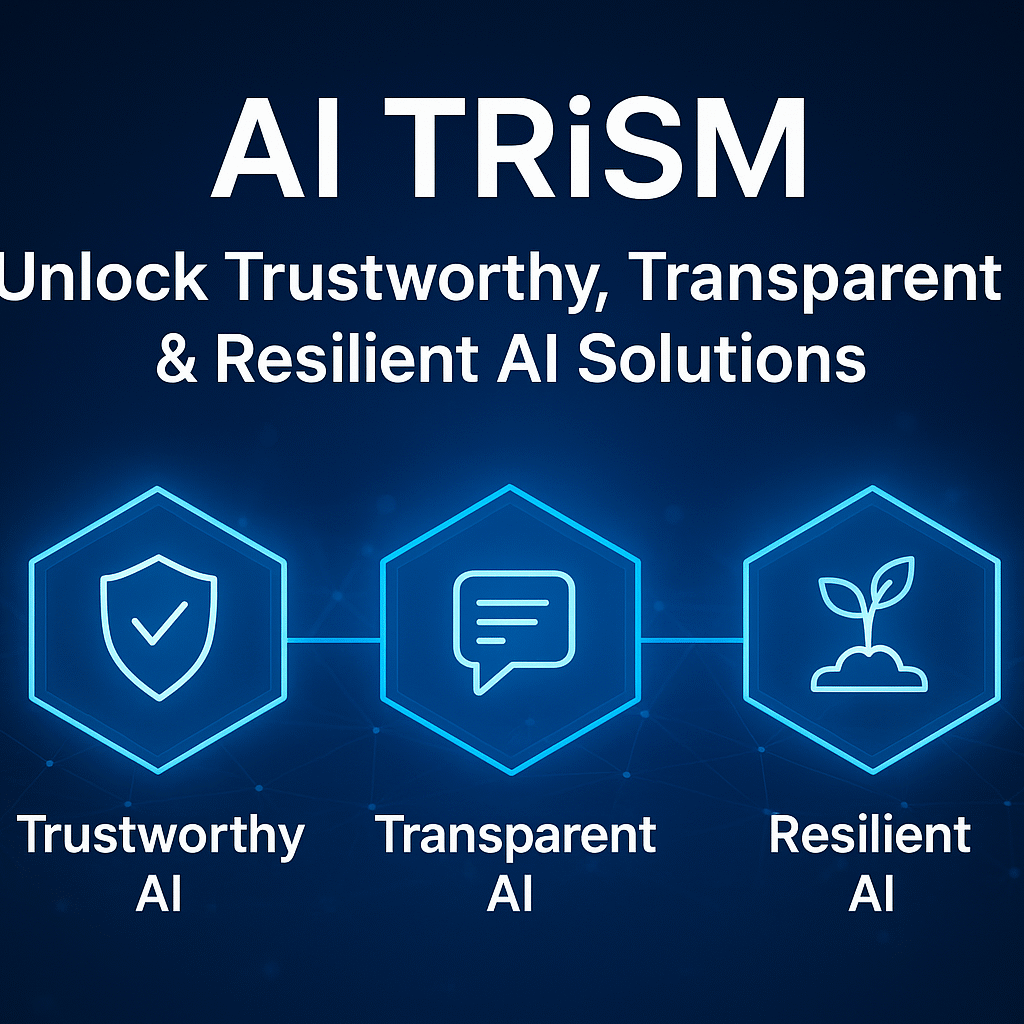
At its core, AI TRiSM is built on three pillars:
Table of Contents
1.1 Trustworthy AI
Trustworthy AI focuses on creating systems that operate as intended, with reliability and safety. It ensures that AI algorithms make decisions that are fair, ethical, and compliant with laws. Trustworthy AI prioritizes:
- Data accuracy and integrity.
- Ethical decision-making frameworks.
- Security protocols that protect users from breaches.
- Processes that allow humans to intervene when necessary.
For example, in healthcare, trust is critical. Doctors and patients need assurance that AI recommendations are based on validated data and are free from harmful bias.
1.2 Transparent AI
Transparency ensures that AI’s decision-making process is understandable and auditable. Many AI systems today operate as “black boxes,” where users cannot see how inputs translate to outputs. Transparent AI addresses this by:
- Explaining algorithms and their purpose.
- Providing interpretability tools for users.
- Ensuring data lineage tracking for accountability.
A transparent AI system allows organizations to:
- Build stakeholder trust.
- Pass regulatory audits.
- Identify and correct biases or errors.
1.3 Resilient AI
Resilient AI is designed to withstand disruptions, adversarial attacks, and unforeseen failures. It includes:
- Monitoring tools to detect anomalies.
- Systems that adapt to changes in data without losing functionality.
- Robust security measures that prevent data tampering.
Resilience is especially important in sectors like finance, where adversarial attacks can manipulate outcomes or result in data theft.
✅ 2. The Growing Need for AI Governance and Compliance
As AI adoption spreads, the need for structured governance and compliance frameworks has become essential. Governance refers to how AI is developed, monitored, and controlled to ensure it aligns with legal, ethical, and operational expectations.
Why Governance Matters:
- Trust-building: Stakeholders are more likely to trust AI-driven solutions when they understand how decisions are made.
- Risk management: Proactively identifying and addressing potential threats reduces costly failures.
- Regulatory adherence: Laws like GDPR, HIPAA, and other industry-specific standards require strict controls over data privacy and usage.
Key Governance Components:
Data Integrity
AI’s effectiveness relies on high-quality data. Data integrity protocols ensure that the datasets used are accurate, consistent, and complete. Regular audits and automated checks prevent errors from slipping into models.
AI Compliance
Compliance frameworks ensure that AI models adhere to both internal policies and external regulations. Compliance officers review data processing methods, algorithmic decisions, and audit trails to ensure transparency.
AI Audits
Conducting audits at each stage of the AI lifecycle helps identify flaws, biases, or security gaps. Audits enhance accountability and ensure models perform as expected without unintended consequences.
Explainable AI
Explainability is crucial when decision-makers need to understand why a model produced a particular result. Explainable AI tools make AI-driven outcomes accessible to non-technical stakeholders.
✅ 3. Ethical AI: Why Morality Matters in AI Implementation
AI’s transformative power brings immense responsibility. Ethical AI is not an add-on but a core requirement for sustainable AI adoption. It ensures fairness, accountability, and inclusiveness while aligning technology with human values.
The Pillars of Ethical AI:
- Fairness:
AI should treat all individuals equally without favoritism or bias. Datasets need to be scrutinized to avoid reinforcing existing inequalities. Careful data preprocessing and bias audits help ensure equitable outcomes. - Accountability:
Organizations must take responsibility for how AI is used. Clear governance structures, documented processes, and human oversight ensure that AI operates within ethical boundaries. - Inclusiveness:
AI models must serve diverse populations. Ensuring that underrepresented groups are included in training datasets prevents skewed outcomes that could marginalize certain groups.
How Ethical AI Supports AI TRiSM:
- Encourages transparency by providing clear audit trails and explanations.
- Reduces harmful biases through algorithmic refinement and human-in-the-loop approaches.
- Enhances trust by ensuring decisions align with moral and legal standards.
Example:
A credit scoring company improved customer trust by integrating bias detection algorithms and human review mechanisms, leading to fairer loan assessments and better regulatory compliance.
✅ 4. Managing AI Risks: Proactive Strategies for Success
AI systems are powerful but vulnerable. From adversarial attacks to data breaches, AI risks can compromise both safety and trust. AI TRiSM emphasizes structured approaches to risk management that address vulnerabilities before they escalate.
Key AI Risks:
- Data Manipulation: Unauthorized changes to datasets can produce misleading results, compromising the model’s reliability.
- Model Drift: Over time, data changes may reduce model accuracy and reliability, resulting in flawed predictions.
- Adversarial Attacks: Hackers may exploit weaknesses in algorithms to corrupt outcomes or manipulate processes.
- Privacy Breaches: Inadequate controls may expose sensitive personal data, leading to reputational and legal consequences.
Proactive Risk Management Strategies:
- Early Detection:
Implement AI monitoring tools that flag abnormal patterns or performance shifts in real time. - Access Controls:
Restrict permissions to sensitive data and model configurations. Role-based access ensures that only authorized users can make changes. - Data Encryption:
Use advanced encryption protocols for storing and transmitting data, preventing unauthorized interception. - Continuous Training:
Update models regularly to accommodate new data and prevent drift, ensuring consistent accuracy.
Example:
A cybersecurity firm implemented anomaly detection dashboards to monitor data pipelines. This reduced security incidents by 30% within the first year while improving system resilience.
✅ 5. Explainable AI: Bridging the Gap Between Technology and Trust
One of the biggest challenges with AI systems is their perceived opacity. Complex algorithms often produce results that even developers cannot easily interpret. Explainable AI aims to make decision-making understandable to users, regulators, and developers alike.
The Importance of Explainable AI:
- Builds Trust:
Users are more likely to trust systems that clearly explain why they made specific recommendations or decisions. - Simplifies Audits:
Transparent models allow for easier review and validation by regulatory bodies and compliance teams. - Improves Debugging:
Developers can fine-tune models when they better understand how inputs influence outputs, enhancing overall performance.
Techniques Used in Explainable AI:
- Feature Importance Scores:
Identifying which inputs had the biggest impact on outcomes. - Decision Trees:
Mapping decision paths that lead to a particular result, offering a visual representation of how inputs are processed. - LIME (Local Interpretable Model-agnostic Explanations):
Breaking down complex models into understandable components that explain predictions in local contexts.
Example:
In the healthcare sector, doctors used explainable AI models to understand patient diagnoses, allowing them to corroborate results and refine treatment plans effectively. As a result, trust in AI-assisted diagnostics increased, and adoption rates soared.
With explainable AI at its core, organizations can build systems that users feel confident in, regulators trust, and teams can continuously improve.
✅ 6. AI Security and Privacy: Guarding Against Threats
AI’s growing influence comes with increased exposure to security and privacy risks. Protecting sensitive data and ensuring the integrity of AI models are vital components of a resilient AI strategy.
Key Security and Privacy Concerns:
- Data Breaches:
Unauthorized access to data can result in loss, theft, or manipulation of sensitive information, leading to reputational damage and legal penalties. - Model Exploitation:
AI algorithms can be tricked into making false predictions by attackers using adversarial inputs, undermining system reliability. - Privacy Violations:
Without proper controls, AI systems may process personal data beyond intended use, exposing organizations to compliance risks and fines.
How AI TRiSM Strengthens Security and Privacy:
- Encryption:
Using advanced encryption protocols during data storage and transmission to prevent unauthorized access. - Federated Learning:
Training models on decentralized data without sharing raw data, minimizing exposure risks while improving collaboration. - Differential Privacy:
Adding controlled noise to datasets to obscure individual data points while preserving overall analytical insights. - Secure Multi-Party Computation:
Allowing multiple parties to jointly compute results without revealing individual inputs, enhancing data privacy.
Example:
A healthcare provider employed federated learning techniques to train AI models across multiple hospitals without sharing sensitive patient data, resulting in improved model accuracy while ensuring compliance with HIPAA privacy laws.
Best Practices:
- Implement robust authentication and authorization processes.
- Regularly audit data pipelines for potential vulnerabilities.
- Encrypt data at rest and in transit.
- Train AI teams on privacy-aware development techniques.
✅ 7. Data Integrity: The Foundation of Trustworthy AI
AI systems rely heavily on the data that trains them. Without strong data integrity protocols, even the most advanced algorithms can produce flawed or harmful results.
What is Data Integrity?
Data integrity refers to the accuracy, completeness, consistency, and reliability of data across its lifecycle. It ensures that datasets remain trustworthy from collection to processing, forming the backbone of responsible AI practices.
Challenges to Data Integrity:
- Data Drift:
Changes in the underlying data distribution over time can skew model predictions, reducing accuracy. - Incomplete Datasets:
Missing values or irrelevant features can impair model learning and produce biased or incorrect outcomes. - Data Corruption:
Unintended modifications, either accidental or malicious, compromise data quality and reliability.
How AI TRiSM Supports Data Integrity:
- Version Control:
Tracking dataset changes to identify errors and rollback when necessary. - Data Audits:
Conducting periodic reviews to ensure datasets meet quality and completeness standards. - Automated Checks:
Implementing anomaly detection algorithms that flag inconsistencies in real time. - Documentation:
Recording data sources, transformations, and usage patterns to facilitate accountability and reproducibility.
Example:
A retail company ensured clean datasets by implementing automated anomaly detection tools that flagged inconsistent entries, resulting in a 20% improvement in recommendation accuracy and customer satisfaction.
Data integrity is the cornerstone of trustworthy AI, ensuring that decisions made by AI systems are reliable, consistent, and ethically sound.
✅ 8. AI Lifecycle Management: Continuous Improvement for Resilience
Managing AI models throughout their lifecycle is essential for maintaining performance, reliability, and trustworthiness. AI lifecycle management ensures that AI solutions are systematically developed, deployed, monitored, and updated for optimal outcomes.
The AI Lifecycle Stages:
- Data Collection and Preparation:
Gathering accurate data while maintaining privacy and integrity standards, with clear documentation of sources. - Model Development:
Designing algorithms that meet ethical, security, and performance criteria, using best practices in data handling. - Testing and Validation:
Ensuring that models are evaluated using unbiased datasets to identify issues before deployment. - Deployment:
Integrating AI into business workflows with monitoring and feedback mechanisms to track performance and mitigate risk. - Monitoring and Maintenance:
Continuously observing model behavior, detecting drift, and updating models to maintain accuracy and security.
Best Practices in Lifecycle Management:
- Use cross-functional teams that include data scientists, ethicists, security experts, and business stakeholders.
- Implement automated monitoring dashboards to track performance in real time.
- Schedule periodic reviews to detect drift, bias, or security gaps.
- Document every stage to enhance transparency and facilitate audits.
Example:
A logistics company implemented lifecycle management protocols that included version tracking and automated feedback loops, resulting in a 15% reduction in downtime and more reliable forecasting.
Effective lifecycle management ensures that AI models remain resilient against changing environments, emerging threats, and evolving business needs.
✅ 9. Risk Management in AI: Anticipating the Unexpected
AI, by its nature, deals with uncertainty. Risk management ensures that organizations can identify, assess, and mitigate potential risks that could arise from deploying AI systems.
Key Types of Risks in AI:
- Operational Risks:
AI systems may fail due to poor data quality, algorithm errors, or misaligned objectives. - Reputational Risks:
Unethical use of AI can lead to public backlash, eroding trust and brand value. - Regulatory Risks:
Failure to comply with AI-related laws and guidelines can lead to heavy fines and operational disruptions. - Security Risks:
AI models are susceptible to adversarial attacks or malicious manipulation of data inputs.
AI TRiSM’s Role in Risk Management:
- Risk Identification Frameworks: Establishing systematic methods for identifying potential vulnerabilities in AI pipelines.
- Risk Scoring Systems: Assigning measurable scores to risks to prioritize mitigation efforts.
- Scenario Planning: Running simulations to understand how AI systems behave under different conditions.
- Resilient Governance Models: Building governance frameworks that include oversight committees and ethical review boards.
Example:
A financial institution used AI TRiSM-based risk models to monitor fraud detection algorithms. By simulating adversarial scenarios, the bank preemptively secured its systems against attacks and avoided millions in potential fraud losses.
Best Practices:
- Embed risk management into AI lifecycle processes.
- Regularly review compliance and ethical standards.
- Train employees to recognize potential AI risks.
✅ 10. Regulatory Compliance: Navigating Global AI Laws
AI adoption is outpacing regulation, yet governments worldwide are establishing rules to govern ethical AI usage. Navigating these laws is critical for businesses that want to leverage AI without facing penalties.
Key Global AI Regulations:
- European Union AI Act:
Aims to classify AI systems based on risk levels (unacceptable, high, limited, minimal) and impose strict compliance rules. - GDPR (General Data Protection Regulation):
Enforces strict rules on how personal data is collected, stored, and processed. - U.S. AI Frameworks:
While still evolving, U.S. guidelines focus on transparency, accountability, and innovation-friendly approaches. - India’s AI Guidelines:
Focused on responsible AI that aligns with data privacy, ethical fairness, and security measures.
How AI TRiSM Ensures Compliance:
- Audit Trails: Keeping detailed logs of model training, data usage, and decision-making.
- Policy Alignment: Designing AI strategies that align with both local and global compliance standards.
- Explainability Tools: Providing regulators with clear explanations of AI outputs.
- Automated Compliance Checks: Embedding compliance validations within the AI pipeline.
Example:
An e-commerce company operating globally adopted AI TRiSM frameworks to ensure GDPR compliance across Europe. By implementing automated audit trails, they avoided potential fines while improving customer trust.
Best Practices:
- Stay updated with evolving AI laws in each operating region.
- Appoint compliance officers specializing in AI regulations.
- Incorporate compliance checks into every stage of the AI lifecycle.
✅ 11. Human-AI Collaboration: Empowering Teams, Not Replacing Them
Contrary to the fear of AI replacing humans, AI TRiSM emphasizes collaboration between humans and machines. The goal is not to substitute human intelligence but to augment it with powerful AI capabilities.
Benefits of Human-AI Collaboration:
- Enhanced Decision-Making:
AI processes vast datasets, while humans apply intuition and ethics for final decisions. - Efficiency Boost:
AI automates repetitive tasks, freeing humans for creative and strategic work. - Error Reduction:
Humans monitor AI outputs to prevent blind trust in algorithmic decisions. - Innovation Catalyst:
AI insights help humans identify new opportunities for growth and development.
How AI TRiSM Facilitates Collaboration:
- Transparency: Ensures AI decisions are explainable so that humans can interpret and validate outcomes.
- Feedback Loops: Human users can provide input to refine AI systems continuously.
- Trust Building: Clear communication about AI’s role reduces fear and fosters adoption.
- Ethical Alignment: Collaboration guarantees that human values guide AI applications.
Example:
In the aviation industry, AI-powered predictive maintenance tools work alongside human engineers. AI highlights anomalies, but final decisions rest with human experts, combining speed with accountability.
Best Practices:
- Train employees to work confidently with AI systems.
- Establish clear boundaries between automated and human decision-making.
- Encourage a culture of collaboration, not competition, between people and AI.
✅ 12. AI Transparency Tools: Making Complex Systems Understandable
Transparency is one of the pillars of AI TRiSM, and using the right tools is essential for demystifying complex algorithms. These tools help explain how AI systems make decisions and why certain outputs are generated.
Popular Transparency Tools:
- Model Interpretability Tools:
Techniques such as SHAP (SHapley Additive exPlanations) and LIME provide localized explanations by showing the contribution of each feature. - Audit Logs:
Detailed records of data inputs, changes, and outputs allow stakeholders to trace the decision-making process and understand how results are derived. - Visualization Dashboards:
Interactive dashboards present key metrics and model behaviors in a user-friendly format, enhancing comprehension for both technical and non-technical users. - Natural Language Explanations:
Some AI platforms convert algorithmic decisions into plain language reports, making them accessible and actionable for stakeholders.
Benefits of Using Transparency Tools:
- Builds trust with users and stakeholders by making AI decisions comprehensible.
- Facilitates auditing by providing detailed insights into data usage and model evolution.
- Helps developers refine models based on feedback and detected anomalies.
Example:
An insurance company implemented SHAP-based dashboards that explained how individual factors influenced claim approval decisions, significantly improving customer trust and reducing disputes.
Best Practices:
- Choose tools compatible with your AI architecture.
- Integrate interpretability methods during model development, not as an afterthought.
- Encourage feedback from users to enhance understanding and usability.
Transparency tools ensure that AI is not perceived as a mysterious force but as a helpful partner, improving user confidence and collaboration.
✅ 13. Human-in-the-Loop AI: Combining Intelligence for Optimal Outcomes
AI systems are powerful, but human judgment remains indispensable. The human-in-the-loop (HITL) approach integrates human oversight with AI’s computational capabilities, enhancing trust, accuracy, and adaptability.
Why Human-in-the-Loop is Essential:
- Error Detection:
Humans can spot inconsistencies, biases, or anomalies that automated systems might overlook. - Ethical Oversight:
In sensitive areas like healthcare and finance, human judgment ensures decisions align with moral standards and legal requirements. - Continuous Learning:
Human feedback helps refine AI models, making them more accurate and contextually aware.
Implementing Human-in-the-Loop Systems:
- Decision Review Panels:
Form committees that review AI-generated outputs before final approval, providing a safeguard against automated errors. - Feedback Loops:
Design workflows that capture user input to improve model accuracy over time. - Collaborative Interfaces:
Create platforms that allow human experts to interact with AI systems easily and efficiently.
Example:
A pharmaceutical company integrated HITL protocols in its drug discovery process, enabling experts to review AI-generated predictions. This approach accelerated research while ensuring safety and compliance.
Best Practices:
- Train human reviewers to interpret AI outputs effectively.
- Balance automation with oversight to avoid over-reliance on algorithms.
- Document human decisions to facilitate audits and learning.
Human-in-the-loop systems exemplify how AI and human intelligence can complement each other, creating solutions that are both powerful and trustworthy.
✅ 14. Continuous Monitoring: Keeping AI Aligned with Goals
AI’s performance can fluctuate over time due to changing data patterns or external factors. Continuous monitoring is critical to ensure that models remain aligned with organizational objectives and ethical standards.
What to Monitor:
- Performance Metrics:
Track accuracy, precision, recall, and other key performance indicators to ensure models deliver consistent results. - Data Quality:
Monitor incoming data for anomalies, errors, or bias that could impact model outputs. - Security Events:
Detect unauthorized access, unusual data flows, or adversarial behavior that might threaten system integrity. - Regulatory Compliance:
Ensure that data usage and model decisions remain aligned with laws and ethical guidelines.
Tools and Strategies:
- Automated Alerts:
Set up notifications for unusual patterns in data or sudden drops in model accuracy to prompt timely interventions. - Dashboards:
Use visualization tools to track model behavior and key metrics in real time. - Periodic Reviews:
Conduct scheduled audits to evaluate alignment with ethical and business goals. - Incident Response Plans:
Prepare structured responses to potential threats, including data breaches or model failures.
Example:
An e-commerce company implemented continuous monitoring dashboards that tracked customer interactions and flagged anomalies, resulting in a 35% faster response to security incidents and improved user experience.
Best Practices:
- Integrate monitoring at every stage of the AI lifecycle.
- Encourage cross-department collaboration to interpret alerts and refine models.
- Use monitoring insights to inform training and model updates.
Continuous monitoring ensures that AI systems remain accountable, secure, and aligned with both ethical principles and business objectives.
✅ Conclusion: Embracing AI TRiSM for a Future of Trust and Innovation
As artificial intelligence becomes an integral part of how businesses operate, the need for trust, transparency, and resilience has never been greater. AI TRiSM offers a comprehensive framework that empowers organizations to harness the transformative power of AI while addressing the challenges that come with it—be it ethical concerns, regulatory compliance, or data integrity.
By embedding principles like ethical AI, continuous monitoring, human-in-the-loop systems, and robust security protocols, organizations can build AI solutions that not only drive efficiency but also earn the confidence of stakeholders and users alike. Transparency tools and global standards ensure that AI remains understandable and accountable, while governance frameworks and risk management strategies make it safer and more reliable.
Key Takeaways:
- Trustworthy AI ensures decisions are ethical, fair, and auditable.
- Transparent AI bridges the gap between complex algorithms and stakeholder understanding.
- Resilient AI withstands adversarial attacks and adapts to new challenges.
- Security, privacy, and data integrity form the backbone of responsible AI.
- Standards like ISO 27001 and NIST’s frameworks guide organizations toward safe and compliant practices.
- Human oversight, continuous monitoring, and feedback loops are essential for sustained success.
Final Thoughts:
AI is reshaping the world—but how we build, deploy, and govern these systems will determine whether AI becomes a force for good or a source of mistrust and risk. AI TRiSM provides the roadmap for organizations to innovate boldly while safeguarding values, privacy, and security.
By implementing the principles outlined in this guide, you can lead the way in creating AI solutions that are not just intelligent, but also trustworthy, transparent, and resilient—laying the foundation for a smarter, safer, and more ethical future.
Your point of view caught my eye and was very interesting. Thanks. I have a question for you. https://accounts.binance.com/register-person?ref=IXBIAFVY
Thank you for your sharing. I am worried that I lack creative ideas. It is your article that makes me full of hope. Thank you. But, I have a question, can you help me?
Your point of view caught my eye and was very interesting. Thanks. I have a question for you. https://accounts.binance.com/lv/register-person?ref=SMUBFN5I
Your article helped me a lot, is there any more related content? Thanks!
Can you be more specific about the content of your article? After reading it, I still have some doubts. Hope you can help me. https://accounts.binance.com/ro/register?ref=HX1JLA6Z