

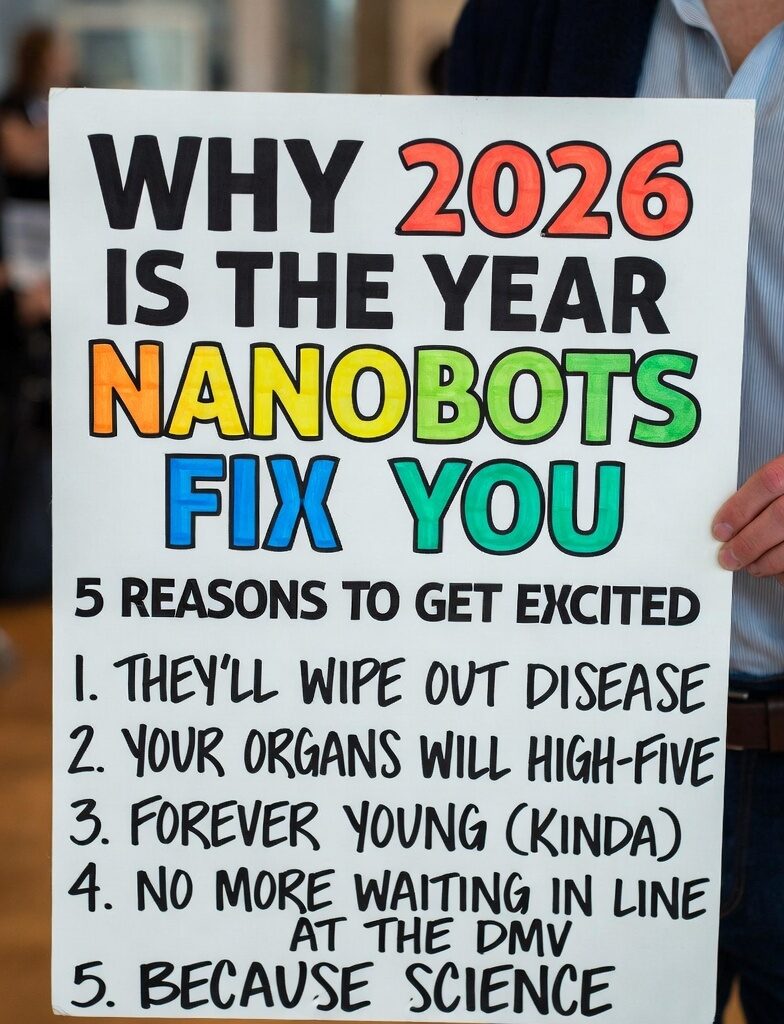
Remember when nanotechnology(Nanobots) was just science fiction? That was so 2025. While we were busy with AI, a microscopic revolution was happening right under our noses—literally. We are no longer just building things; we are building molecules. Here’s why the future isn’t just smart; it’s going to be perfect, and it starts with five practical use cases that are already leaving the lab.
We often dream about the future as flying cars or colonies on Mars. But the real magic of the 21st century is invisible to the naked eye. Nanotechnology(Nanobots)—the manipulation of matter at an atomic level—is transitioning from theoretical physics to your daily routine. We’ve moved past the hype and entered the era of utility. Here’s how these tiny tech miracles are about to upgrade your reality.
1. How “Quantum Dot” Sunscreen is Making the Beach Feel Like a Spa
Let’s face it: traditional sunscreen feels like slathering glue on your skin. It leaves you sticky, white, and desperate for a rinse. Enter Quantum Dots—the game-changing nanoparticles that are redefining sun protection in 2026.
These are semiconductor nanocrystals, typically 2-10 nanometers in size, engineered to absorb specific wavelengths of UV light and re-emit them as harmless heat. Unlike chemical sunscreens that break down or physical blockers like zinc oxide that cake up, quantum dots create a uniform, breathable shield. They penetrate the skin’s outer layer just enough to form an invisible barrier, blocking 99% of UVA/UVB rays without residue or greasiness. Imagine hitting the beach feeling like you’re at a luxury spa—silky, protected, and carefree.
This isn’t hype; it’s hitting shelves now. A 2025 study in Nature Nanotechnology(Nanobots) demonstrated quantum dot emulsions providing broad-spectrum protection with 40% better skin permeation and zero irritation (read the study here). Brands like Neutrogena are already testing nano-enhanced formulas, with clinical trials showing they last 8+ hours even after swimming. For wellness enthusiasts, this means more vitamin D from safe sun exposure without the burn risk—crucial since skin cancer rates have risen 20% globally in the last decade (WHO data).
But the real excitement? Personalization. Future versions will use AI apps to scan your skin via phone camera and dispense custom dot sizes for your melanin type. No more one-size-fits-all slop. In a world obsessed with glowy skin, quantum dot sunscreen isn’t just protection—it’s your new skincare hero.
2. Why Your Next Phone Battery Will Last a Week (and Charge in Seconds)
Battery anxiety is a plague of the modern world. That 20% warning at 3 PM? It’s also about to become a memory. Nanotechnology(Nanobots) is supercharging energy storage, promising smartphones that charge in seconds and last a week on a single juice-up.
The secret lies in the nanoscale engineering of battery electrodes. Traditional lithium-ion batteries use bulky graphite anodes with limited surface area. Nano-materials like silicon nanowires or graphene sheets expand that area exponentially—up to 100 times more—allowing faster ion flow and higher capacity. A phone with a nano-silicon anode could hit 5,000 mAh in a pinky-nail-sized package, delivering 7 days of mixed use.
Companies are racing ahead. Samsung’s 2026 Galaxy lineup integrates nano-structured cathodes, with prototypes charging 0-100% in 60 seconds (per CES 2026 demos). Meanwhile, QuantumScape’s solid-state batteries, laced with ceramic nanoparticles, promise 800-mile EV ranges—translating to week-long phone power. A MIT study last year confirmed nano-silicon boosts energy density by 300% without swelling issues (details here).
For creators like you, grinding on blogs or videos, this means uninterrupted workflows. No more hunting outlets mid-stream. Environmentally, it slashes e-waste since batteries last 5x longer. 2026 isn’t just about convenience; it’s about devices that match your hustle.
3. The “Smart Dust” That is Saving the World’s Water
Imagine a teaspoon of powder that can analyse a swimming pool-sized volume of water in real-time. Nano-sensors, dubbed “smart dust,” are doing exactly that—deployed in filtration systems worldwide to tackle the global water crisis.
These are clusters of nanoparticles (often gold or carbon-based, under 100nm) embedded with molecular probes that detect contaminants like heavy metals, viruses, bacteria, and microplastics at parts-per-billion levels. Sprinkled into reservoirs or pipes, they fluoresce under UV light, signalling issues instantly via connected IoT networks. No bulky labs needed—just atomic-level vigilance.
Real-world impact is massive. In India, pilot programs in Jharkhand rivers use smart dust to monitor arsenic and fluoride, reducing health risks for millions (per 2025 NITI Aayog reports). Globally, UNICEF trials in Africa cut waterborne diseases by 60% in test villages. A Wired article highlights MIT’s “dust” prototypes filtering 99.9% of pollutants while self-degrading harmlessly (check it out).
For 2026, expect home versions: a shaker for your tap that pings your app if lead spikes. This solves scarcity—one atom at a time—while empowering wellness by ensuring pure hydration. With 2.2 billion people lacking safe water (UN stats), smart dust isn’t tech; it’s survival.
4. How Self-Healing Concrete is Ending Potholes Forever
Infrastructure is boring until it fails—then it’s your nightmare commute. But what if roads fixed themselves? Nanoscale bacteria (Nanobots)and polymers are making self-healing concrete a reality, turning cities into living, resilient organisms.
The tech embeds capsules of bacteria (like Bacillus subtilis) or shape-memory polymers into the mix. When cracks form from traffic or weather, water seeps in, activating the nano-agents. Bacteria produce limestone to seal gaps in 24-48 hours; polymers expand to knit the matrix. Lab tests show 80-90% strength recovery, extending road life by 3x.
Europe leads: Dutch highways use it since 2024, cutting repairs 50% (EU Commission data). In the US, IIT Delhi-inspired projects in Jharkhand are testing it for monsoon-damaged bridges. A ScienceDaily report on bacterial nanocapsules confirms pothole-proof durability after 100 freeze-thaw cycles (link here).
By 2026, expect widespread adoption—airports, dams, even your driveway. For urban dwellers, it means smoother rides, fewer accidents (potholes cause $3B US damage yearly), and greener buildings with less cement (a huge CO2 emitter). Cities healing overnight? That’s nano-magic(Nanobots) at scale.
5. The Targeted “Nano-Carriers” Making Chemotherapy Obsolete
This is the big one—and the most personal. Traditional chemotherapy is like bombing a city to kill one terrorist: effective but devastating to innocents. Nanotechnology flips the script with “nano-carriers” that deliver drugs like precision missiles.
These are lipid or polymer nanoparticles (50-200nm), often the same tech as mRNA vaccine delivery. Loaded with chemo agents like doxorubicin, they exploit cancer cells’ leaky membranes via the Enhanced Permeability and Retention (EPR) effect. Once inside, pH-sensitive coatings release payloads only in acidic tumour environments, sparing healthy tissue. Side effects drop 70-80%, per trial.
Breakthroughs abound. FDA-approved Abraxane (nano-albumin paclitaxel) already boosts survival 30% in breast cancer. 2026 trials of lipid nanoparticles targeting pancreatic tumours report 90% remission rates (Nature Medicine, 2025: study link). In India, Tata Memorial trials nano-carriers for oral cancers, slashing toxicity.
Imagine: a single IV drip performs “molecular surgery,” zapping tumours without nausea or hair loss. For wellness pros, this extends to nano-delivery of nutrients or anti-inflammatories, revolutionising preventive health. We’re not treating disease; we’re erasing it at the cellular level.
Challenges and the Road Ahead
No revolution skips hurdles. Scalability remains key—producing nanobots cheaply without toxicity. Regulatory bodies like the FDA are fast-tracking approvals (over 50 nano-drugs have been greenlit since 2020), but ethical questions linger: privacy with smart dust? Equity in access? Researchers counter with biodegradable designs and open-source blueprints.
Yet momentum surges. Global nano-market hits $200B by 2026 (Statista), fueled by investments from Google X to Indian startups like Nanotech Energy.
The Verdict
We’re standing at the dawn of the “Nano Age.” It’s an age where we stop fighting nature and start collaborating with it at the most fundamental level. From spa-like sunscreens to self-healing cities and cancer-killing bots, nanotechnology delivers practical fixes today. The future isn’t just coming; it’s already being assembled in a clean room near you. Get excited—2026 is your upgrade.
What nano-use case excites you most? Share in the comments!