

Introduction: Why Workflow Automation Matters Today
In today’s fast-paced digital economy, workflow automation at scale has become a game-changer for businesses looking to achieve operational efficiency, cost savings, and productivity growth. Gone are the days when manual tasks slowed teams down—today, organizations are embracing AI-driven automation, robotic process automation (RPA), and cloud-based workflow systems to deliver faster, smarter, and scalable results.
From small startups to Fortune 500 enterprises, workflow automation is no longer optional—it is a strategic advantage that helps businesses streamline repetitive tasks, reduce errors, and boost employee satisfaction.
Table of Contents
What is Workflow Automation at Scale?
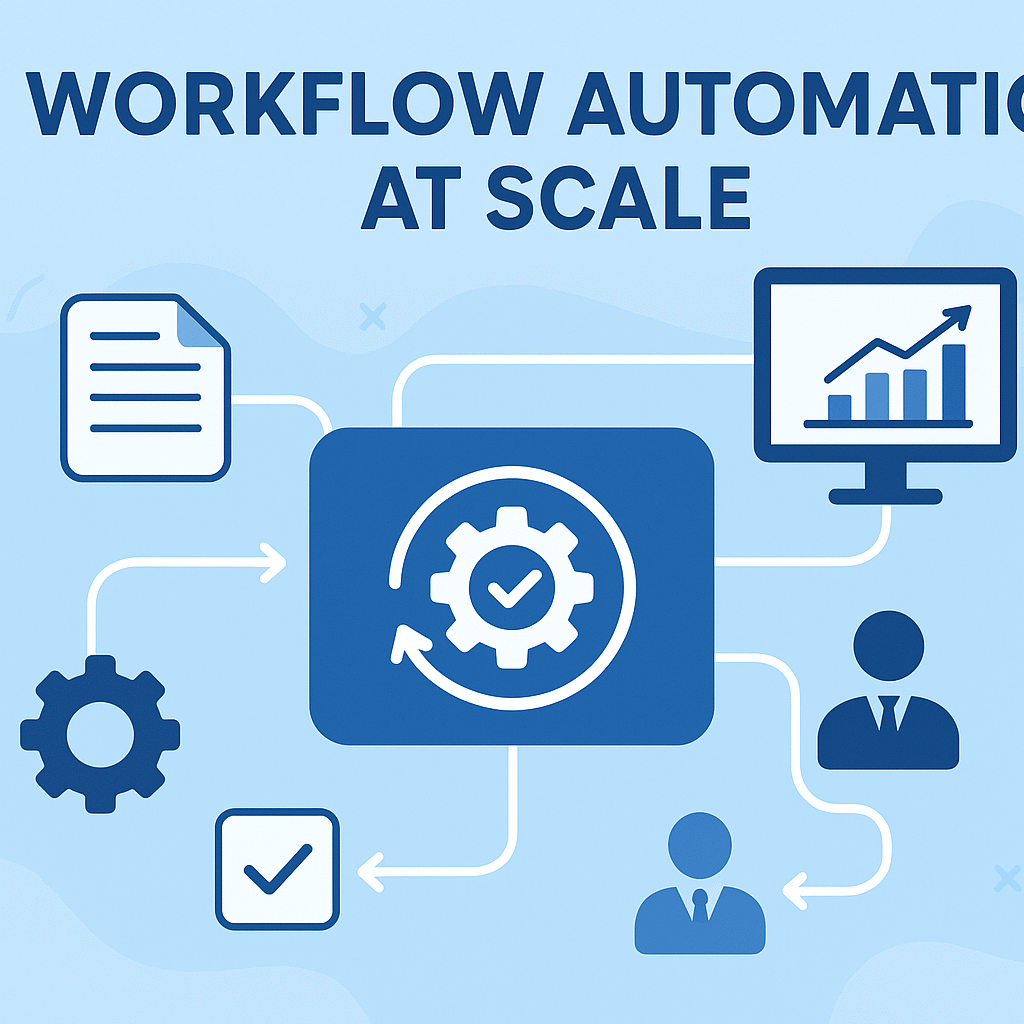
Workflow automation at scale refers to the process of applying automation technologies across an organization, rather than in isolated silos. While small-scale automation might handle tasks in one department, scaled automation ensures end-to-end optimization, connecting workflows across finance, HR, sales, IT, and customer service.
In simpler words:
Workflow automation at scale means automating not just one process—but building a seamless network of automated tasks across the entire business.
Example:
- Small-scale automation: Sending an automated email reply when a form is submitted.
- Workflow automation at scale: Integrating CRM, marketing automation, payment systems, and customer support so the entire customer journey is smooth and error-free.
Benefits of WA at Scale
Let’s break down the most impactful benefits businesses experience:
- Time Savings
- Employees spend less time on repetitive tasks.
- Example: Automated invoice approvals save hours of manual checking.
- Cost Reduction
- Eliminates inefficiencies and reduces manual errors.
- Example: Banks using RPA cut costs by 40–60% in back-office operations.
- Error-Free Processes
- Automation reduces human errors that often cause compliance issues.
- Employee Satisfaction
- Workers focus on creative, value-driven work instead of repetitive tasks.
- Scalability
- Businesses can handle growth in workload without hiring more staff.
- Data-Driven Decisions
- Automated workflows capture and aKey Industries Benefiting from Workflow Automation
1. Finance & Banking
Example: Automating loan application approvals with RPA.
Benefits: Compliance, fraud detection, faster transactions.
2. Healthcare
Example: Automating patient record management and appointment scheduling.
Benefits: Reduced admin burden, better patient care.
3. Manufacturing
Example: Workflow automation in supply chain management.
Benefits: Faster order processing, reduced delays.
4. Retail & eCommerce
Example: Automating inventory restocking and personalized marketing emails.
Benefits: Better customer experience, higher sales.
5. Education
Example: Automating admissions and student feedback systems.
Benefits: Saves faculty time, improves student engagement.
Tools for Workflow Automation at Scale
Some of the most popular automation software and workflow management systems include:
UiPath – Best for robotic process automation (RPA).
Zapier – Simplifies task automation for small and medium businesses.
Power Automate (Microsoft) – Works well with Office 365 and enterprise solutions.
Monday.com & Asana – Workflow project management with automation features.
Kissflow – End-to-end workflow orchestration.
👉 Tip: When selecting a tool, focus on integration capabilities, scalability, and AI-powered features.
Real-World Case Studies
Case Study 1: Banking Sector
A multinational bank implemented RPA for compliance reporting. Results:
Reduced reporting errors by 95%
Saved 2,000 employee hours per year
Case Study 2: eCommerce
A leading online retailer automated its order-to-delivery workflow. Results:
Delivery speed improved by 30%
Customer satisfaction scores increased
How to Implement Workflow Automation Successfully
Identify Repetitive Tasks
Example: Expense approvals, employee onboarding.
Choose the Right Automation Tools
Align with your IT infrastructure.
Start Small, Scale Fast
Pilot automation in one department, then expand.
Involve Employees Early
Avoid resistance by showing value.
Measure ROI Continuously
Track cost savings, productivity gains, and error reduction.
The Future of Workflow Automation
The future lies in AI-driven automation, hyperautomation, and no-code workflow solutions. With the rise of machine learning, predictive analytics, and real-time monitoring, businesses will move beyond task automation into self-learning, adaptive workflows.
By 2030, workflow automation at scale is expected to be a $30+ billion industry, transforming how organizations operate. - Automation is powered by a diverse set of tools and technologies such as AI platforms, robotic process automation (RPA), low-code workflow designers, and advanced integration solutions. Successful workflow automation requires systematically identifying key processes, selecting the right platforms, mapping workflows, and continuous testing and refinement.
- Tools and Technologies Powering Automation
- Modern automation relies on software platforms that streamline repetitive, error-prone tasks. Notable examples include:
- AI-powered automation tools (e.g., Moveworks, UIPath, Microsoft Power Automate) blend RPA with AI and ML for process mining, intelligent decision-making, and NLP.
- Low-code and no-code workflow designers offer visual drag-and-drop interfaces, enabling users to automate without extensive programming skills.
- Specialized platforms like Tungsten Automation, WorkFusion, ProcessMaker, and Camunda focus on specific tasks or industries, supporting document processing, finance, operations, and team collaboration.
- Integration platforms facilitate automation across CRM, ERP, and cloud systems to connect diverse business functions.
These technologies are complemented by features such as pre-built templates, visual workflow builders, security controls, and monitoring dashboards. - How to Implement Workflow Automation Successfully
- Best practices for implementing workflow automation include:
- Identifying repetitive and error-prone tasks that yield the highest ROI when automated.
- Mapping workflows visually using process diagrams, to pinpoint inefficiencies and decision points.
- Clearly defining business goals, metrics, and expected outcomes to guide automation efforts.
- Selecting tools that fit process requirements, integrate with existing systems, and support organizational security standards.
- Building and testing automation using visual workflow builders and templates, ensuring the process is robust.
- Training team members in new automation platforms and change management to ensure buy-in and usability.
- Continuously monitoring key performance indicators (KPIs), collecting user feedback, and refining workflows as processes evolve.
Starting small—with simple, high-impact processes—helps establish a proven methodology that can scale gradually across the organization. - Key Steps for Success
- Identify and visualize target processes for automation.
- Define specific goals and success metrics.
- Choose and deploy suitable automation tools.
- Build and test automated workflows using real data.
- Train stakeholders for a smooth transition.
- Monitor, optimize, and scale successful workflows.
- Implementing workflow automation in this structured way maximizes efficiency, reduces errors, and drives long-term organizational productivity.
Frequently Asked Questions (FAQ)
Q1. What is workflow automation at scale?
Workflow automation at scale means applying automation technologies across an entire business rather than in isolated areas, ensuring seamless end-to-end efficiency.
Q2. Which industries benefit most?
Banking, healthcare, eCommerce, manufacturing, and education are among the top beneficiaries.
Q3. Is workflow automation expensive?
The initial investment may vary, but long-term savings in time, cost, and errors make it highly cost-effective.
Q4. Can small businesses use workflow automation?
Yes! Tools like Zapier and Monday.com make it affordable and accessible for startups.
Q5. What is the difference between RPA and workflow automation?
RPA automates individual tasks, while workflow automation integrates multiple processes into a seamless flow.
Conclusion
Workflow automation at scale is no longer a futuristic idea—it is a practical, results-driven strategy transforming businesses today. By adopting enterprise automation tools, AI-driven workflows, and cloud-based solutions, organizations can achieve higher productivity, lower costs, and better scalability.nalyze data in real time.
- Automated workflows capture and aKey Industries Benefiting from Workflow Automation
Thank you for your sharing. I am worried that I lack creative ideas. It is your article that makes me full of hope. Thank you. But, I have a question, can you help me?
Can you be more specific about the content of your article? After reading it, I still have some doubts. Hope you can help me.
Your article helped me a lot, is there any more related content? Thanks! https://www.binance.info/en-NG/register?ref=YY80CKRN
Your article helped me a lot, is there any more related content? Thanks!