
Fit: “We’ve been told that ‘sitting is the new smoking,’ but for the modern professional, quitting your desk isn’t an option. What if I told you that the key to eliminating back pain isn’t about exercising less at your desk, but about moving smarter? Forget the generic stretches that don’t work. Here is the exact blueprint to transform your office chair into a recovery tool and boost your energy for the next decade.”
The High-Performance Machine in the Cubicle
If you’re reading this, you probably spend a significant portion of your life in a chair. Whether it’s a plush leather executive seat, a mesh ergonomic throne, or a kitchen stool because you’re working from home, your environment is built for productivity—but your body was built for movement.
We often view our bodies as static objects that simply need to be “placed” correctly. We search for the perfect lumbar support like we’re looking for a parking spot. But here’s the reality: your body is a high-performance machine. Just like a precision-engineered car, it doesn’t break down because it’s being used; it breaks down because it’s idling for too long.
When a machine sits idle, fluids settle, gears seize, and rust begins to form. In human terms, that “rust” is the nagging ache in your lower back, the tightness in your hips that makes you groan when you finally stand up, and that permanent “office hunch” that rounds your shoulders toward your ears.
But we aren’t going to tell you to quit your job and become a yoga instructor in Bali (unless that’s your vibe). Instead, we’re going to bio-optimise your workday. We’re going to treat your 9-to-5 not as a period of physical stagnation, but as a window for “stealth recovery.”
By the end of this guide, you’ll have a “Workday OS” that keeps your spine future-proof and your energy levels high enough to actually enjoy your life once the laptop closes.
Step 1: The “Invisible” Dynamic Sitting Routine
Most people think “good posture” means sitting as still as a statue with a perfectly straight back. In reality, the best posture is your next posture. Static loading—staying in one position for hours—is what causes the tissues in your back to become deprived of oxygen and nutrients. To combat this, we use Dynamic Sitting. This is “stealth mode fitness”: movements so subtle that your coworkers (or your boss on a Zoom call) won’t even realise you’re doing them.
Pelvic Tilts (The Internal Lubricator)
Your pelvis is the foundation of your spine. When you sit still, your lower back (the lumbar spine) often collapses into a “C” shape.
- How to do it: While typing, slowly tilt your pelvis forward (arching your back slightly) and then backwards (tucking your tailbone).
- The Benefit: This acts like a hydraulic pump for your spinal discs, moving fluid through the area and preventing that “stuck” feeling.
Scapular Glides (The Hunch-Killer)
The “tech neck” look comes from shoulder blades that have drifted forward and “glued” themselves to your ribcage.
- How to do it: Imagine you’re trying to put your shoulder blades into your back pockets. Pull them down and back slightly, hold for three seconds, and release. Do this while reading an email.
- The Benefit: It wakes up the rhomboids and traps, the muscles responsible for holding you upright without effort.
Isometric Glute Squeezes
Sitting is essentially “gluteal amnesia.” Your brain forgets how to turn on your butt muscles because they’re being sat upon.
- How to do it: Simply squeeze your glutes as hard as you can for 5 seconds, then release. Repeat 10 times.
- The Benefit: This keeps the “posterior chain” active, which takes the pressure off your hip flexors and lower back.
Pro Tip: Set a “trigger.” Every time you hit “Send” on an email or someone says the word “synergy” in a meeting, perform one of these invisible movements.
Step 2: Futuristic Desk Ergonomics
We are entering a new era of office wellness. The days of being tethered to a static wooden desk are over. To future-proof your body, you need a Mobile Workspace—an environment that signals your body to stay young by requiring micro-adjustments in balance and height.
The “Perching” Revolution
Sitting puts maximum load on your spine; standing for eight hours puts a massive load on your feet and lower back. The “future-proof” middle ground? Perching. Using a stool or an adjustable standing desk at a height where your hips are higher than your knees creates an open hip angle. This preserves the natural curve of your spine.
Modern Recovery Tools
If you want to take your desk game to the next level, the market for “active station” gear has exploded. Integrating movement into your workflow isn’t just a trend; it’s a necessity. According to research highlighted by the Mayo Clinic, movement throughout the day is significantly more effective for long-term health than a single 30-minute workout followed by ten hours of sitting.
If you’re looking to upgrade, resources like Wirecutter or specialised ergonomic review sites have tested the best compact gear for 2024. Consider these additions:
- Under-desk Cycles/Ellipticals: These allow for low-intensity steady-state movement that keeps blood flowing to the lower extremities without distracting you from your spreadsheets.
- Balance Boards: Using a wobble board while at a standing desk engages your core and ankles, preventing the “statue effect.”
- Kneeling Chairs: These shift your weight to your shins, forcing a more upright posture and strengthening your core over time.
The Workspace “Reset”
Every 60 minutes, change your setup. If you’ve been sitting, go to a standing position. If you’re standing, try “perching” on the edge of a tall stool. This constant variety prevents any single muscle group from becoming over-fatigued.
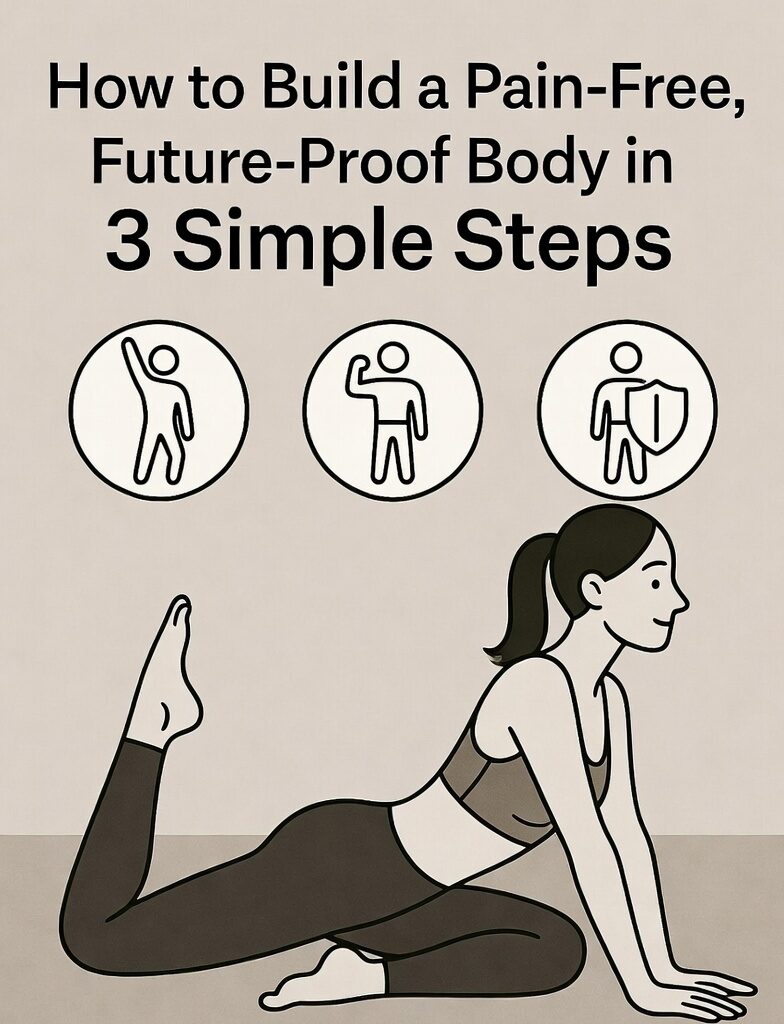
Step 3: The 2-Minute “Reset” Sequence
Sometimes, the “invisible” moves aren’t enough. You need to hit the “Restart” button on your nervous system. These three moves are designed to reverse the “Office Hunch” and can be done in the time it takes for your coffee to brew.
1. The “Lazy Cat” (Seated Cat-Cow)
- The Move: Sit on the edge of your chair, feet flat. Inhale, arch your back, and look toward the ceiling (Cow). Exhale, round your spine, tuck your chin, and look toward your belly button (Cat).
- Why it works: It’s a full-spectrum mobilisation for the entire spinal column.
2. The “Wall Angel” (The Posture Primer)
- The Move: Stand with your back against a wall. Try to get your heels, butt, upper back, and head to touch the wall. Bring your arms up like a “Goal Post” and slowly slide them up and down.
- Why it works: This is the ultimate diagnostic tool. If you can’t keep your hands against the wall, your chest is too tight. Doing this daily “rewires” your brain to recognise what straight feels like.
3. The “Seated Figure-Four”
- The Move: While sitting, cross your right ankle over your left knee. Keep your back straight and lean forward slightly until you feel a stretch in your right hip.
- Why it works: It targets the piriformis and glutes, which are the primary victims of “Chair-Shaped Body Syndrome.”
The Big Picture: Upgrading Your Workday OS
I used to finish my day with a throbbing lower back and a “brain fog” that made the evening a wash. I thought I was just “getting older.” Then I realised I wasn’t old; I was just stagnant. By implementing these three steps, you aren’t just “fixing” a backache. You are investing in your longevity. You are ensuring that when you hit 50, 60, or 70, you still have the structural integrity to hike, travel, and play.
Think of this as an “Upgrade to your Workday OS.” You’re moving from a legacy system (the 1950s “sit-still-and-work” model) to a futuristic, high-performance interface where work and wellness coexist.
Next Steps for Your Holistic Office Health:
- Hydration & Nutrition: Moving your body is half the battle. To keep those joints lubricated, you need internal fuel. (Check out our guide on “The Best Anti-Inflammatory Snacks for the Office” for more.
- Mindfulness: Physical tension is often a manifestation of mental stress, typically appearing in the shoulders. Integrating a 1-minute breathing exercise can be as effective as a physical stretch.
Ready to start your transformation?