

Mobility:-The room is silent, bathed in the blue-grey light of a rainy Tuesday morning. For Elias, a 32-year-old graphic designer who lost the use of his limbs in a spinal cord injury three years ago, this silence used to be a cage. In the early days of his recovery, the transition from sleep to wakefulness was a reminder of everything he couldn’t do. He would lie in the dark, waiting for a caregiver to arrive at 8:00 AM just to see the sun, to hear the news, or to turn on a lamp.
But this morning is different. Elias clears his throat.
“Computer, open the blinds.”
With a soft whir, the heavy curtains slide back, revealing the world outside.
“Computer, lights to warm. Play my morning jazz playlist.”
As the room glows amber and the soft notes of a saxophone fill the air, Elias isn’t just a “patient” waiting for assistance. He is a man in his own home, wielding the most powerful tool in the human arsenal: his voice. For the millions of people globally living with mobility impairments, this isn’t a story about gadgets or the “Internet of Things.” It is a revolution of dignity. It is about the moment the world stopped being a series of insurmountable walls and started listening again.
1. Beyond the Gadget: The Dignity of the “I Can”
In the tech world, we often talk about voice assistants like Alexa, Siri, or Google Assistant as “conveniences”—ways to set a timer for pasta or skip a song when our hands are messy. But for someone who cannot physically reach a light switch or pick up a fallen remote, these tools are not luxuries; they are digital lifelines.
For the mobility-impaired community, voice technology represents a fundamental shift from dependence to autonomy. When you can control your environment without asking for help, you reclaim a piece of your identity that often gets lost in the clinical shuffle of caregiving. It is the difference between needing someone and choosing to interact with them.
2. The Smart Home as a Sanctuary of Independence
Traditional homes are built for the able-bodied. They are filled with knobs to turn, buttons to press, and handles to pull. For a person using a voice-controlled smart home ecosystem, these physical barriers evaporate.
- Environmental Control: Modern voice-integrated thermostats (like Nest or Ecobee) and lighting systems (like Philips Hue) allow users to regulate their comfort levels instantly.
- Safety and Access: Smart locks and video doorbells mean a person with limited mobility can see who is at the door from their bed or wheelchair and unlock it for a friend—all without moving a muscle.
- Daily Maintenance: Voice-activated robot vacuums and smart appliances allow for a level of household contribution that was previously impossible, fostering a sense of purpose and “home-making” that is vital for mental health.
3. Mobility Redefined: Navigating the Physical World
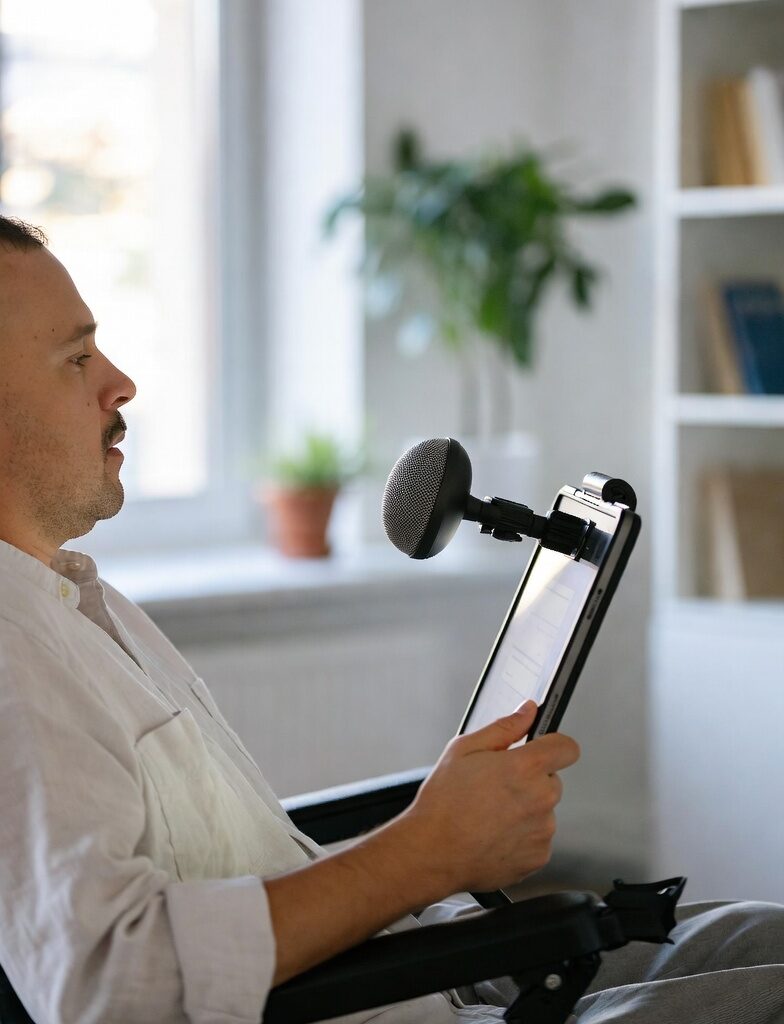
The revolution isn’t staying indoors. In 2026, we are seeing the rise of Voice-Controlled Wheelchairs (VCWs). Using microcontrollers like Arduino or ESP32 and advanced speech-recognition modules, these devices translate commands like “forward,” “left,” or “stop” into precise movement.
Unlike traditional joysticks, which require significant fine motor skills, voice-controlled navigation opens the door for individuals with severe paralysis or degenerative conditions like ALS. Combined with LiDAR and ultrasonic sensors for obstacle detection, these chairs offer a safe, hands-free way to navigate a world that—let’s be honest—wasn’t built with ramps in every corner.
4. Healthcare at the Speed of Sound
Voice technology is also rewriting the rules of personal healthcare. For those with chronic conditions, managing a complex regimen of medications and appointments is a full-time job.
Voice assistants now act as proactive health companions. They don’t just wait for questions; they use “ambient intelligence” to remind users to take specific pills, track hydration levels, or even detect changes in vocal patterns that might indicate a respiratory issue or a dip in mental well-being. In an emergency, a single shout—“Call for help!”—can be the difference between a minor fall and a life-threatening crisis.
5. Breaking the Professional Glass Ceiling
For years, the workplace was a place of exclusion for those who couldn’t use a keyboard or mouse. Today, Voice-to-Text and Voice-Command software (like Dragon Professional or integrated AI agents) have levelled the playing field.
Individuals with mobility impairments are now leading teams, writing code, and creating art using nothing but their speech. This isn’t just about “getting a job”; it’s about economic empowerment. When your intellect is no longer tethered to your physical ability to type, you aren’t just a person with a disability—you are a professional with a unique perspective.
6. The Social Connection: Ending the Quiet Isolation
One of the most devastating side effects of mobility impairment is social isolation. When getting to a coffee shop is a logistical nightmare, the world shrinks.
Voice-activated social tech—video calling, hands-free messaging, and even voice-operated VR social spaces—acts as a bridge. It allows users to maintain “spontaneous” connections. You can “drop in” on a grandchild’s playroom or dictate a heartfelt email to an old friend while sitting in the garden. This digital presence mitigates the crushing weight of loneliness, keeping the soul connected even when the body is stationary.
7. The Psychology of Power: Mental Health Benefits
There is a profound psychological weight to “learned helplessness.” When every aspect of your day requires a request to another human, it erodes the ego.
Voice control provides mastery over one’s domain. Studies have shown that when individuals with disabilities gain control over their environment through tech, their rates of depression and anxiety drop significantly. It provides a “locus of control”—the belief that you can influence your life’s outcomes. That feeling of power is the best medicine available.
8. Bridging the “Speech Gap”: The Inclusivity Challenge
While the technology is miraculous, it isn’t perfect. Many voice AI systems struggle with dysarthria (slurred speech) or non-standard accents, which are common in certain neurological conditions.
The next frontier of the freedom revolution is Inclusive AI training. Projects like Google’s Project Relate are working to train AI to understand diverse speech patterns, ensuring that the very people who need voice control the most aren’t the ones excluded by it. True freedom means a system that learns to listen to you, not a system that forces you to sound like a robot.
9. The Ethical Frontier: Privacy and the “Always Listening” Room
We cannot discuss voice control without addressing the elephant in the room: Privacy. For someone whose life depends on an “always-on” microphone, the stakes of a data breach are much higher than a leaked shopping list.
- Security: How do we protect voice biometrics from “deepfake” spoofing?
- Data Sovereignty: Does a person’s private medical discussions in their bedroom belong to a tech giant’s server?
- The Edge Solution: The shift toward Edge AI—where voice processing happens locally on the device rather than in the cloud—is the ethical answer, ensuring that “freedom” doesn’t come at the cost of “surveillance.”
10. The 2026 Outlook: Ambient Computing and Beyond
As we move further into 2026, we are transitioning from “Voice Assistants” to Ambient Computing. Imagine a home that doesn’t wait for a command but understands context. It knows that when you struggle to reach for a glass, it should adjust your seat. It recognizes the difference between a cough and a cry for help.
The integration of Physical AI (robotics) and Multi-agent systems means that your voice will soon control not just your lights, but a fleet of helpful “teammates” that can perform physical tasks—folding laundry, prepping a meal, or assisting with transfers—with a simple, whispered word.
11. Conclusion: The Voice is the New Ramp
For decades, the “gold standard” of accessibility was the concrete ramp. It was a physical manifestation of our desire to include everyone. But in the digital age, voice is the new ramp.
It is a path that doesn’t require muscles, only breath and intent. It is rewriting the narrative of disability from one of “limitations” to one of “adaptation.” When we invest in voice technology, we aren’t just buying toys; we are building a world where a single word can open a door, start a career, or save a life.
Elias, our designer from the beginning of this story, finishes his jazz playlist. He looks at his computer screen, ready to start a new project for a client halfway across the world. He isn’t thinking about his wheelchair or his injury. He’s thinking about his work.
“Computer,” he says, his voice steady and strong. “Let’s get to work.”
What do you think? Is voice technology the ultimate equaliser, or do we still have a long way to go to make it truly accessible to everyone? Share this post with a caregiver, a friend, or a tech enthusiast, and let’s keep the conversation—and the revolution—going.
1 thought on “Voice-Controlled Living: How a Single Word Is Rewriting Freedom for the Mobility Impaired”