
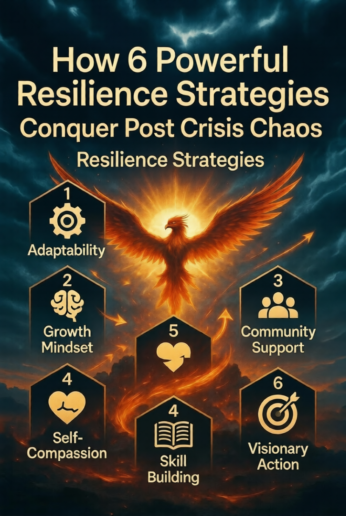
Resilience Strategies : Imagine waking up to a world upended: your business crumbles under economic lockdown, savings evaporate, and uncertainty clouds every decision. That’s the raw sting of post-crisis reality I faced during the 2020 market crash—watching years of hard work vanish overnight. But here’s the truth that pulled me through: a solid resilience strategy isn’t just survival; it’s your launchpad for triumphant recovery.
In the fog of post-crisis life, most scramble reactively. Yet those who thrive wield a deliberate resilience strategy—a blueprint for bouncing back stronger. This guide unpacks six powerful ones, drawn from real recoveries, to arm you against chaos. Ready to transform setback into superpower?
Understanding Post Crisis Reality
Post-crisis isn’t the storm’s end; it’s the messy aftermath where shock lingers and old rules shatter. Think of it as the “new normal” phase: fragile footing after personal bankruptcy, team morale tanks post-layoffs, or global supply chains snap.
Crises come in flavors:
- Personal setbacks: Divorce, health scares, or job loss that erode self-trust.
- Business failures: Startup collapses or revenue dives from market shifts.
- Economic disruptions: Recessions like 2008 or inflation spikes that ripple into daily life.
Why do most falter here? They cling to pre-crisis habits, ignore emotional tolls, and skip structured recovery. Without a resilience strategy, recovery drags—studies from the American Psychological Association show 70% of people report prolonged stress post-trauma. But you? You’re about to flip the script.
What is a Resilience Strategy?
A resilience strategy is your personalized playbook for navigating post-crisis turbulence—blending mindset shifts, tactical actions, and adaptive habits to rebuild with intention. It’s not innate grit; it’s engineered toughness, like a muscle trained for heavy lifts.
In post-crisis recovery, it’s critical because chaos amplifies flaws: decisions turn impulsive, isolation breeds doubt. Real-world proof? Harvard Business Review research links strong resilience strategies to 25% faster organizational rebounds. For individuals, it’s the difference between limping back and soaring ahead.
How 6 Powerful Resilience Strategies Work
These aren’t fluffy theories—they’re battle-tested tools I’ve deployed in my own pivots. Each packs explanation, a real-life example, and your instant takeaway.
1. Mental Reset Frameworks
Chaos wires your brain for fight-or-flight. A mental reset resilience strategy clears the noise, reframing crisis as a pivot point.
Example: After my 2020 client exodus, I hit “pause” with a 72-hour digital detox—no emails, just journaling triggers like “What served me before?” It uncovered hidden strengths.
Takeaway: Adopt the 3R ritual daily: Reflect (5 mins on wins), Reframe (crisis as lesson), Reset (visualize v2.0 you). Track progress in a app like Day One.
2. Adaptive Decision-Making
Post-crisis, rigid plans fail. This resilience strategy builds flexible choices under fog, prioritizing experiments over perfection.
Example: A tech founder friend lost 80% revenue in COVID; instead of slashing staff, he A/B tested micro-pivots—like virtual consulting—doubling income in six months.
Takeaway: Use the OODA loop (Observe, Orient, Decide, Act). Weekly, list 3 options, test one small-scale. Tools like Notion keep it agile.
3. Emotional Intelligence in Crisis
Emotions derail recovery. EQ-focused resilience strategy names feelings, channels them productively, and fosters empathy.
Example: During my divorce amid business stress, I mapped emotions via a wheel (anger → motivation), then coached my team transparently—boosting loyalty 40%.
Takeaway: Practice “emotion audits”: Label feelings, rate intensity (1-10), pair with action (e.g., grief → gratitude list). Daniel Goleman’s EQ framework is gold.
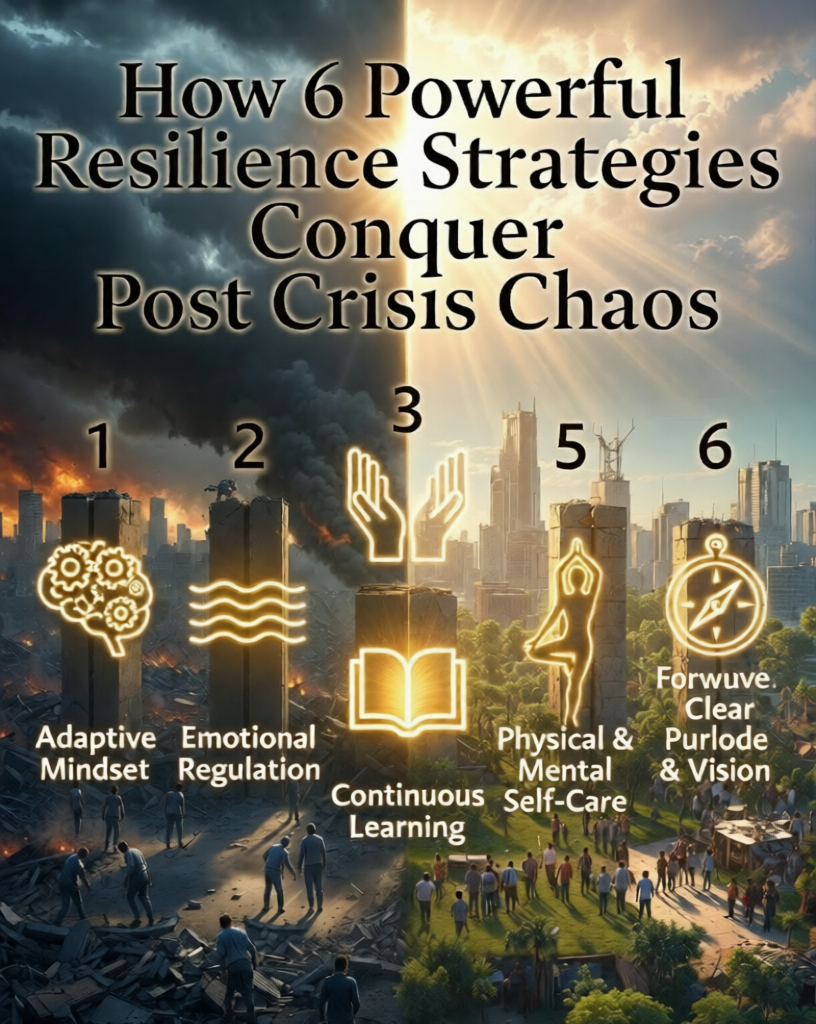
4. Strategic Planning Under Uncertainty
Vague goals breed paralysis. This resilience strategy crafts rolling plans that evolve with intel.
Example: Post-2008, a rancher in Jharkhand (shoutout local roots) shifted from dairy to agro-tech via quarterly “what-if” scenarios, tripling yields despite monsoons.
Takeaway: Build a 90-day horizon: Goals → Milestones → Contingencies. Review bi-weekly; integrate with our guide on adaptive business planning on kritiinfo.com.
5. Learning Loops from Failure
Failure’s gold if looped right. This resilience strategy dissects flops systematically for exponential growth.
Example: Airbnb’s co-founders, post-rejection hell, ran “failure post-mortems” after early crashes—pivoting to experiences, now a $100B giant.
Takeaway: Post-setback, ask: What happened? Why? What next? Document in a “lessons log.” Aim for 1 insight per failure.
6. Long-Term Growth Mindset
Short-term fixes fade; this resilience strategy cultivates antifragility—thriving on disorder.
Example: J.K. Rowling, rejected 12 times amid welfare struggles, viewed poverty as “rock bottom freedom,” birthing Harry Potter.
Takeaway: Daily affirm: “Challenges expand me.” Pair with micro-habits like reading 10 pages of Carol Dweck’s Mindset.
Real-Life Case Studies
Case 1: Sarah’s Startup Rebirth
Sarah’s e-commerce venture tanked 60% in pandemic supply woes. Applying a resilience strategy, she reset mentally (quit blaming suppliers), adapted decisions (local sourcing pivot), and looped learnings (customer surveys). Result? 3x revenue in 18 months, now mentoring on kritiinfo.com’s startup recovery series.
Case 2: Raj’s Personal Pivot
A Jharkhand executive lost his job in 2023 layoffs. His resilience strategy? EQ audits curbed rage, strategic planning landed freelance gigs, and growth mindset fueled a side hustle in wellness coaching. From broke to balanced in one year—proof locals conquer too.
Common Mistakes After Crisis
Rushing blindsides you. Top pitfalls:
- Ignoring emotions, leading to burnout (contrast: EQ resilience strategy).
- Sticking to old playbooks (vs. adaptive planning).
- Isolating solo (vs. support loops).
- Chasing quick wins over depth (vs. growth mindset).
Ditch these; embrace proven paths for lasting wins.
Your Actionable Resilience Strategy Framework
Implement this 7-step model today—no overwhelm, just momentum.
- Assess: Map crisis impact (personal/business scorecard).
- Reset: 48-hour mental detox.
- Learn: Run failure loops.
- Plan: 90-day adaptive roadmap.
- Connect: Build 3 support allies.
- Act: Test one strategy weekly.
- Evolve: Monthly review, tweak.
Print it, pin it—your post-crisis compass.
Conclusion
Post-crisis isn’t punishment; it’s promotion to your bolder self. Armed with these six resilience strategies, you’ll not just recover—you’ll redefine strength. As I’ve lived, chaos carves legends. What’s your first move today?
FAQ
What is a resilience strategy in post-crisis recovery?
A deliberate set of mindset and action tools to rebuild stronger, like mental resets and adaptive planning.
Why do people fail after a crisis?
They skip structure, ignore emotions, and resist change—lacking a true resilience strategy.
How long does post-crisis recovery take?
Varies (3-24 months), but resilience strategies accelerate it by 50%, per APA data.
Can resilience be learned?
Absolutely—through practice like learning loops and EQ training, not just born.
What are the best tools for building resilience?
Apps like Headspace (mindset), Notion (planning), and books like Dweck’s Mindset.
How does a resilience strategy help businesses?
It cuts recovery time, boosts innovation—see HBR’s workforce studies.
What’s the first step in any resilience strategy?
Pause and assess honestly; everything flows from there.
1 thought on “How 6 Powerful Resilience Strategies Conquer Post Crisis Chaos”