

In late March 2023, thousands of artificial intelligence researchers, corporate executives, and academics signed an open letter published by the Future of Life Institute. The statement called for a public, verifiable six-month pause on training systems stronger than GPT-4.
The letter did not emerge from speculative science fiction. It emerged because engineers observed frontier systems exhibiting unexpected proficiencies, such as solving novel reasoning tasks and generating functional computer code without explicit programming. Nobody paused. Instead, investment accelerated, deployment cycles shrank from years to weeks, and competitive pressures intensified across global markets.
This moment exposed a profound administrative paradox. Can traditional governance keep pace with technology that changes faster than the rules designed to control it?
Table of Contents
Understanding Frontier AI
Frontier artificial intelligence refers to large-scale, highly capable general-purpose models that push the outer boundaries of machine intelligence. Unlike narrow algorithms designed solely to detect credit card fraud or sort customer inquiries, frontier systems perform dozens of distinct tasks across domains.
These capabilities bring genuine risks: automated vulnerability discovery in critical software, persuasive disinformation at massive scale, data privacy violations, and structural workplace dislocation.
When organisations rely on traditional bureaucratic governance—characterised by annual policy reviews, lengthy committee clearances, and static rulebooks—they fall behind. By the time a corporate policy document gains formal approval, the underlying foundation models have already undergone major architectural shifts.
This mismatch demands an adaptive solution. Agile governance provides a responsive system of oversight where safety reviews, accountability structures, and risk mitigation evolve continuously alongside technological capability.
What Is Agile Governance?
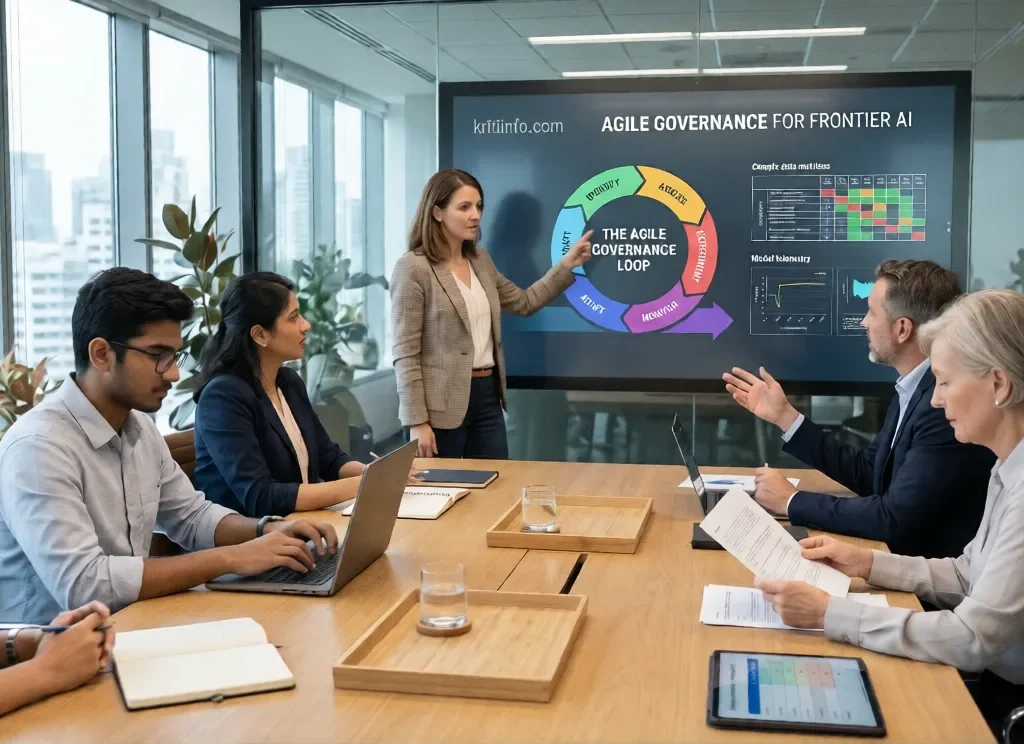
Agile governance is an operational oversight model based on continuous feedback, rapid empirical testing, and iterative policy updates. It takes the core philosophy of agile software development—short cycles, cross-functional collaboration, and continuous improvement—and applies it directly to risk management and organizational policy.
Agile governance is not simply making decisions faster or cutting compliance corners. Rather, it replaces rigid, one-off approval gates with an ongoing cycle of measurement and course correction.
Rather than assuming all risks can be predicted before a system launches, an agile framework acknowledges technological uncertainty. It sets baseline guardrails, instruments the deployment pipeline with real-time telemetry, and equips decision-makers to intervene immediately whenever anomalous model behavior emerges.
+---------------------------------------------------------+
|                  THE AGILE GOVERNANCE LOOP               |
|                                                         |
|    [ 1. IDENTIFY ]  -->  Map use cases & stakeholders   |
|           |                                             |
|    [ 2. ASSESS ]    -->  Evaluate safety & privacy      |
|           |                                             |
|    [ 3. EXPERIMENT ]-->  Test in sandboxes & red-team   |
|           |                                             |
|    [ 4. MONITOR ]   -->  Track drift & anomalies        |
|           |                                             |
|    [ 5. ADAPT ]     -->  Update rules & safeguards      |
|           ^                               |             |
|           +-------------------------------+             |
+---------------------------------------------------------+
Why Frontier AI Needs a New Governance Approach
Governing frontier AI is fundamentally harder than governing traditional enterprise software. The differences stem from several operational realities:
- Emergent Capabilities: Large models develop unexpected behaviors that developers do not deliberately train into them. Safety teams often discover these traits only after extensive usage.
- Information Security and Privacy: Frontier models ingest billions of training tokens. Preventing inadvertent leakage of proprietary data or sensitive personal information requires active technical barriers.
- Algorithmic Bias: Unchecked model outputs can propagate historical stereotypes across lending, hiring, and legal workflows.
- Synthetic Content: Scalable deepfakes and automated social engineering present novel fraud vectors that fixed security playbooks fail to catch.
- Economic and Workplace Disruption: Rapidly automating specialized cognitive tasks creates abrupt operational shifts that require responsible internal transition strategies.
Because these factors evolve dynamically, rules fixed in time will fail. Governance must be an active, living discipline.
Traditional Governance vs Agile Governance
| Evaluation Criteria | Traditional Governance | Agile Governance |
| Review Rhythm | Fixed annual or quarterly cycles | Continuous, sprint-based reviews |
| Operating Baseline | Rigid compliance checklists | Risk-based and telemetry-driven |
| System Oversight | Periodic audits after launch | Real-time monitoring and alerting |
| Accountability | Centralized in legal or compliance units | Distributed across multi-disciplinary teams |
| Correction Cycle | Reactive after policy violations occur | Proactive intervention via safe thresholds |
| Operational Rules | Static operating procedures | Living protocols that adapt to empirical data |
Traditional governance remains valuable for stable, well-understood operational areas like basic accounting compliance. However, applying static checklists to frontier AI leaves blind spots where emerging capabilities outrun the rules.
A Practical Five-Step Framework for Agile AI Governance
Organizations do not need multi-million dollar compliance budgets to implement sensible oversight. Small and mid-sized enterprises can execute this practical five-step lifecycle:
      IDENTIFY  ==>  ASSESS  ==>  EXPERIMENT  ==>  MONITOR  ==>  ADAPT
      (Inventory)   (Risks)      (Sandboxes)     (Telemetry)   (Refine)
- Identify: Build a lightweight inventory of all AI systems, integrated third-party APIs, and intended workflows. Specify clearly who uses each tool and what business problems it addresses.
- Assess: Evaluate each implementation using a tiered risk scale. Low-stakes tasks (e.g., drafting internal meeting summaries) require fewer controls, while higher-stakes workflows (e.g., automated customer credit approvals) require robust privacy checks and human oversight.
- Experiment: Test tools inside controlled sandboxes. Conduct basic red-teaming (stress-testing against potential misuse) with diverse staff before opening applications to general operations.
- Monitor: Establish direct feedback channels and track unexpected outputs, user complaints, and data anomalies.
- Adapt: Schedule short, monthly policy retrospectives. Update usage guidelines, access limits, and system prompt constraints as your team gains real-world operational insight.
Real-World Case: Rapid Policy Adaptation
In early 2023, software engineers at a major consumer electronics company pasted internal source code and recorded meeting summaries into public conversational AI interfaces to debug software and transcribe notes.
The immediate governance problem became clear: sensitive corporate intellectual property was entering external model retraining pipelines.
The company initially implemented a total ban on third-party generative AI tools. However, employees found unofficial workarounds to maintain personal productivity.
Recognizing that rigid prohibition was ineffective, leadership shifted to an agile approach:
- They engaged internal engineering leads to define acceptable development tasks.
- They negotiated enterprise-grade service agreements with zero data-retention guarantees.
- They deployed an internal, isolated sandbox environment with automated filtering for sensitive source code.
By adapting its rules within weeks instead of waiting for a yearly security review, the organization preserved productivity while protecting its core intellectual property.
Expert Interpretation: What Leaders Often Miss
AI governance is not an afterthought to apply right before a software launch. It is a fundamental operational architecture that dictates how an organization functions.
Algorithms cannot hold legal or moral accountability; individual human leaders remain responsible for system outcomes. When organizations abdicate this responsibility to automated decision pipelines, they accumulate unseen organizational risk.
At the same time, overly bureaucratic control structures create unintended hazards: they paralyze legitimate experimentation and drive employees toward unmonitored shadow IT.
Sensible governance scales proportionally to real-world risk. An automated grammar assistant needs minimal friction; an automated talent-screening model requires deep, recurring scrutiny.
Data and Evidence: The State of AI Oversight
Empirical research highlights a clear gap between the speed of AI deployment and the institutional mechanisms managing it:
- According to the Stanford Institute for Human-Centered Artificial Intelligence (HAI) 2024 AI Index Report, standard safety benchmarks across leading industrial models often lack uniform reporting protocols, making independent evaluations uneven.
- The McKinsey Global Survey on the State of AI (published May 2024) found that while 65% of surveyed organizations regularly use generative AI, less than a third have established active governance frameworks for intellectual property infringement, workforce transition, or algorithmic bias.
This divergence shows that most organizations still treat risk management as a future planning exercise rather than an everyday operational requirement.
Advantages and Limitations of Agile Governance
Advantages
- Rapid Response: Identifies data drift and novel vulnerabilities before they manifest as broad public failures.
- Operational Resilience: Helps teams adjust to international regulatory frameworks, such as the European Union AI Act, as enforcement guidelines formalize.
- Informed Innovation: Encourages experimentation within safe, pre-defined operational boundaries.
Limitations
- Operational Fatigue: Continuous reviews demand steady attention from cross-functional teams.
- Talent Shortages: Few professionals possess simultaneous depth in legal compliance, business risk, and machine learning architectures.
- System Opacity: Auditing advanced foundation models remains technically difficult because their internal reasoning pathways are not fully transparent.
Balancing these challenges requires keeping governance lightweight, metric-driven, and focused on genuine operational risks.
Common Misconceptions
- “Agile governance means eliminating rules.”Correction: Agile governance does not remove safety rules; it tests and updates them frequently based on live system performance.
- “Deploying AI faster always produces better business outcomes.”Correction: Speed without guardrails creates fragile systems, regulatory liabilities, and brand-damaging outputs.
- “Keeping a human in the loop solves all safety concerns.”Correction: If human operators routinely rubber-stamp hundreds of machine suggestions without sufficient time or technical tools to inspect them, the safeguard fails.
- “A single AI policy covers every operational tool.”Correction: Applying identical rules to code-generation tools and HR hiring algorithms wastes resources and ignores context-specific risks.
- “AI governance belongs entirely to IT.”Correction: Responsible oversight requires input from legal, human resources, operational leaders, and executive sponsors.
What Organisations Should Do Next
Leadership teams can implement agile governance through three immediate milestones:
- Conduct an AI Use Audit (Weeks 1–2): Catalog every commercial and open-source model currently operating across your business units, including informal browser-based utilities.
- Form a Cross-Functional Review Squad (Weeks 3–4): Assemble a compact, four-person working team comprising engineering, operations, legal, and department leadership to oversee model implementations.
- Establish a Sandbox Protocol (Weeks 5–6): Require all frontier model applications to operate in isolated test environments for a two-week observation period before entering full production.
Frequently Asked Questions
What is agile governance in artificial intelligence?
It is an operational oversight method focused on rapid feedback, continuous technical monitoring, and iterative policy updates to manage the uncertainties of advanced algorithms.
Why does frontier AI need agile governance?
Frontier models possess general-purpose capabilities that evolve unpredictably. Static, traditional policies cannot anticipate these changes before they enter production.
How is agile governance different from traditional AI governance?
Traditional governance depends on fixed, periodic reviews and rigid checklists. Agile governance relies on ongoing telemetry, live risk assessments, and distributed human responsibility.
Can small businesses implement agile AI governance?
Yes. Smaller companies can use lightweight five-step review loops and basic sandboxing without hiring large compliance teams.
Who is responsible for governing frontier AI?
Human managers, executive officers, and software engineers hold shared accountability. Legal and moral responsibility cannot be handed off to software.
How does agile governance improve AI safety?
By testing models in controlled sandboxes and maintaining real-time monitoring, teams catch erratic outputs and security issues early.
What are the biggest challenges in implementing agile governance?
The primary challenges include cross-functional coordination friction, finding talent with both technical and governance skills, and auditing black-box model behavior.
What is the future of agile governance in advanced AI?
As automated agents handle increasingly complex workflows, agile governance will integrate automated technical evaluations directly into deployment pipelines.
Conclusion
The March 2023 call to halt AI development revealed an unavoidable truth: the world cannot pause technological progress while waiting for static administrative policies to catch up.
The objective is neither to slow down technological progress nor to allow innovation without boundaries. The objective is to establish agile governance that learns, adapts, and responds as quickly as technology evolves.
Organizations that master this flexible, human-centered oversight will build systems that are innovative, commercially viable, and fundamentally safe.