
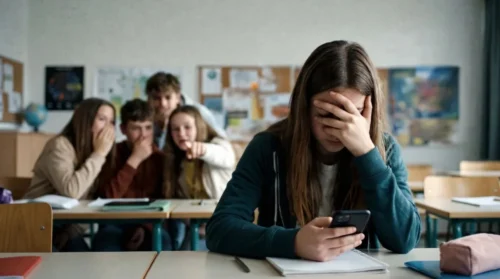
Bullying & Cyberbullying:Aarav, 14, laughs loudly in the school corridor. At home he goes quiet. At 9:40 pm his phone lights up. The class group chat has a cropped photo of him, a cruel nickname and forty reactions. He turns the phone face down.
“Everything fine?” his mother asks. “Yes,” he says, and closes his door.
Nobody at school saw his face change. His phone holds every word.
What should the adults around him have noticed, and when does a joke become something far more serious?
Table of Contents
Why Bullying & Cyberbullying Deserve Attention
Bullying is not a childhood quarrel. It is repeated harmful behaviour, where a child or group with more power targets someone who finds it hard to respond. Cyberbullying does the same through phones, games, messaging apps and social platforms, but it can happen at night, in public and at speed.
For today’s children, the playground and the screen are one social world. Calling it “harmless fun” ignores the person who is not laughing. This guide explains how to recognise it, how to respond in the first hour, and which advice holds up against evidence.
What It Really Means
Bullying usually has four marks: repetition, a power imbalance, intent to hurt or humiliate, and a target who struggles to stop it.
It comes in several forms:
- Physical: hitting, pushing, damaging belongings.
- Verbal: name calling, mocking, threats.
- Social and emotional: exclusion, rumours, turning friends against someone.
- Cyber: hurtful messages, images or videos, fake accounts, impersonation, online threats and public digital humiliation.
An ordinary disagreement happens between equals, and both sides can speak. One unkind remark is wrong but isolated, and still needs a calm conversation. A repeated pattern with a power gap is bullying. One exception matters online: a single humiliating image shared widely can be seen again and again, so adults should act even on a first incident.
Recognising It Early
Look for changes, not single clues. These include disturbed sleep, a changed appetite, low mood, lost confidence, skipped school, falling grades, dropped friendships, and new device habits such as hiding the screen, looking upset after notifications, or deleting accounts. StopBullying.gov notes that these signs can also point to other problems, so no one sign proves bullying.
Many children stay silent because of shame, fear of payback, or fear that adults will take away their phone. Parents can remove that last fear by saying clearly: “If someone targets you online, you will not lose your phone for telling me.”
The Hidden Effects
Children react differently. Common effects include anxiety, loneliness, stress, poor concentration, school avoidance and weaker results. UNESCO’s 2019 global review found that frequently bullied students were nearly three times more likely to feel like outsiders at school and more than twice as likely to miss school. Serious or lasting distress needs a doctor or counsellor. This article cannot diagnose any child.
Why Does It Happen?
There is no single cause or single type of child. Contributing factors include peer pressure, group dynamics, insecurity, the chase for social status, weak empathy, discrimination, thin supervision and harmful online culture. UNESCO reports that physical appearance is the most common reason students are bullied, followed by race, nationality or colour. Home, school and online spaces all shape what children treat as normal, which is why prevention cannot rest on one adult.
The Safe Eight Framework
A practical checklist,
- Recognise the pattern: repeated, targeted, one sided.
- Listen without blaming or interrupting. Avoid “Why didn’t you ignore it?”
- Record dates, names, platforms and screenshots, saved safely. Never copy or forward intimate images of a minor. Note the details and give them only to the police or the platform.
- Report to a trusted adult and the school authority, in writing where possible.
- Block and report abusive accounts to the platform.
- Protect personal information. Tighten privacy settings and change passwords.
- Follow up after one week and one month to check the behaviour has stopped.
- Seek support from a counsellor or doctor if distress is serious or lasting.
A child should never be expected to solve serious bullying alone.
Safety first: For threats, blackmail, sexual abuse or talk of self harm, put safety before everything else. In India, call 112 for emergencies and CHILDLINE 1098 for a child in need, and use cybercrime.gov.in for online offences.
Traditional Bullying and Cyberbullying Compared
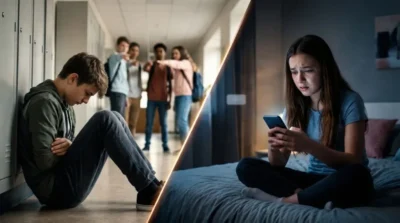
| Feature | Traditional bullying | Cyberbullying |
|---|---|---|
| Setting | School, playground, bus | Any device, any hour |
| Visibility | Adults may see it | Often hidden from adults |
| Audience | Few witnesses | Can be large and public |
| Speed | Slower | Instant and shareable |
| Evidence | Mostly witness accounts | Screenshots, timestamps |
| Repeated exposure | When the child is present | Content can resurface |
| Response options | Teacher, school discipline | Block, platform report, school, police |
Neither form is always worse. Cyberbullying can follow a child home, but online evidence can also make proof easier.
What the Data Says
WHO/Europe, 2024. The HBSC school survey (2021/22) covered over 279,000 students aged 11, 13 and 15 in 44 countries and regions across Europe, Central Asia and Canada. About 11% reported being bullied at school, and 15% reported being cyberbullied, up from 12% to 15% for boys and 13% to 16% for girls since 2018.
UNESCO, 2019. A review of surveys from 144 countries and territories found that almost one in three students (32%) had been bullied at school at least once in the past month.
Limits: Students reported their own experiences. Definitions and survey methods differ between countries. The WHO data does not include India, and neither figure should be read as an Indian average. Rising numbers may partly reflect more online time after the pandemic years.
Shared Responsibility: Our Interpretation
Parents, teachers, school leaders, classmates, platforms and policymakers all hold a piece. Bystanders matter because bullying often needs an audience. Punishment alone rarely changes repeated behaviour, so schools also need safe reporting, supervision, accountability and empathy building. UNESCO links lower rates to reporting systems, teacher training and support for affected students. That link comes from research, but the conclusion that punishment alone is not enough is our own reading of it.
Real World Application (Illustrative)
Riya, 14, finds an edited photo of herself in her class group chat, with mocking replies. It happens again the next week.
Her father listens without blaming her. Together they save screenshots with dates and the names of the people who posted. He writes to the class teacher with facts, not accusations. The school meets the students involved and their parents, asks the group admin to remove the content, and arranges time with the school counsellor for Riya. The family reports the posts to the platform. Two weeks later her father asks Riya how things feel, and the school confirms nothing new has appeared.
Notice the order: listen, record, report, support, follow up.
Prevention Strategies: Strengths and Limits
| Approach | Advantage | Limitation |
|---|---|---|
| School policy | Clear rules and expectations | Weak if never enforced |
| Parent involvement | Early trust and detection | Parents cannot see everything |
| Digital literacy | Builds safer habits | Does not stop determined abusers |
| Counselling | Helps recovery | Needs trained staff |
| Reporting systems | Brings hidden cases out | Children must trust them |
| Privacy controls, blocking | Quick relief | Not a substitute for adult action |
Switching off a phone may give a break, but it does not stop what is being said or shared.
Five Common Myths
- “It is a normal part of growing up.” It is common, but it can harm mental health and learning.
- “Children should always fight back.” Retaliation can escalate danger and create new trouble.
- “It ends when the phone is off.” Posts and shares continue without the child.
- “Reporting is weakness.” It is a safety step.
- “Only physical aggression counts.” Exclusion and online humiliation count too.
What To Do Next
- Parents: Hold calm, regular conversations and promise not to punish a child for reporting.
- Teachers: Notice group patterns, respond fairly and follow safeguarding procedures.
- Teenagers: Save evidence, do not retaliate, report abuse and tell a trusted adult.
- Schools: Publish a clear policy, offer confidential reporting, follow up on every case and teach digital safety by age.
Conclusion
Bullying is not harmless entertainment, and cyberbullying is not just an online argument. Early recognition, fair intervention, empathy and cooperation can make bullying & cyberbullying less likely to take root and easier to stop. Aarav and Riya needed an adult who noticed in time.
Who is the one person your child, student or friend would tell, and have you made it easy for them to say it? <!– ARTICLE END –>
FAQs
1. What is the difference between bullying and cyberbullying? Bullying is repeated, targeted harm that can happen in person. Cyberbullying uses digital tools such as messages, images and social platforms. It can reach a larger audience and continue outside school hours.
2. How can I tell if my child is being cyberbullied? Look for mood changes, disturbed sleep, hiding the screen, distress after notifications, deleted accounts or school avoidance. No single sign is proof, so talk calmly and ask open questions.
3. Should I take my child’s phone away? Usually no. Children may stop telling you if reporting costs them their phone. Save evidence, adjust privacy settings, block abusers and involve the school instead.
4. Where can I report cyberbullying in India? Report to the school and the platform first. For threats, blackmail or sexual content, use cybercrime.gov.in or call 1930, and call CHILDLINE 1098 or 112 in urgent situations.
5. When does a child need professional help? Seek help when sadness, anxiety, sleep problems, school refusal or withdrawal last more than a short time, or if a child talks about self harm. In an emergency, call 112 immediately.