

Meera and Arjun took their daughter home after a long labour. On the second day, Meera noticed something small. The baby’s right arm waved freely, but the left arm stayed close to her body. She fed well and slept calmly. Nothing looked dramatic, yet something felt different.
Many families live through a moment like this. Most birth injuries are minor and settle within days or weeks. A few need quick medical action. Knowing the difference helps parents ask better questions, and early assessment protects a child’s long term wellbeing.
Table of Contents
What Are Birth Injuries?
Birth injuries are physical harm to a baby caused by the forces of labour and delivery. Doctors also call them birth trauma. The Children’s Hospital of Philadelphia notes that such injuries usually clear up or improve within days or weeks.
They can happen when a baby is squeezed through the birth canal, when the head or shoulder is pulled, or when oxygen or blood flow drops around birth.
Birth injury versus birth defect. A birth injury happens during the process of being born. A birth defect, such as a heart defect or cleft lip, forms while the baby develops in the womb. Birth complications and newborn deaths are separate measurements and should never be mixed with injury figures.
Are they permanent? Not usually. Many are temporary, but nerve tears or serious brain injury may need specialist treatment and long follow up.
Important Types of Birth Injuries
These conditions differ in cause, severity and treatment.
Caput succedaneum. Soft swelling of the scalp that develops in the birth canal. It usually disappears in a few days and is more likely after vacuum delivery.
Cephalohematoma. Bleeding between the skull bone and its covering. It often appears hours after birth as a raised lump. Most take two weeks to three months to clear. A large one can cause jaundice.
Clavicle fracture. The collarbone is the most common bone broken during birth. The baby rarely moves that arm. Healing is quick, and a firm lump of new bone often forms within about 10 days.
Brachial plexus injury. The brachial plexus is the network of nerves supplying the arm and hand. It is most common after shoulder dystocia, when the shoulder is hard to deliver. The baby may be unable to bend and rotate the arm. Bruised nerves usually recover within months, while torn nerves can cause lasting damage and may need surgery.
Facial nerve injury. Pressure on the face or forceps may injure the facial nerve. It shows when the baby cries: one side of the face does not move and the eye may not close. Bruised nerves improve within weeks.
Serious brain injury. Low oxygen or bleeding can injure the brain. Hypoxic ischaemic encephalopathy (HIE) is one example. This is an emergency for a neonatal team. For selected babies born at 36 weeks or later, cooling therapy must start within six hours of birth.
Causes and Risk Factors
It helps to separate three ideas:
- Established mechanism: physical force, such as traction or pressure, can injure bone and nerves.
- Recognised risk factors: birth weight above about 4,000 grams, prematurity, breech position, prolonged labour, difficult labour and instrument delivery (source: CHOP above).
- Possible associations: patterns in studies that do not prove cause.
A 2016 review found that shoulder dystocia raised brachial plexus injury risk about 100 times, yet only 46% of affected babies had any identifiable risk factor.
A birth injury does not automatically mean negligence. Some injuries occur even when care is excellent.
Warning Signs Parents Should Know
Common, mention at the next check: mild scalp swelling, bruising, or a bright red patch in the white of the eye.
Needs a doctor’s examination soon: swelling that is growing, one arm moving less, one side of the face not moving when crying, yellow skin, or crying that seems unusual or will not settle.
Emergency, go to hospital now. The World Health Organization lists newborn danger signs (2019): convulsions, fast breathing or chest indrawing, no movement, not feeding, or being too hot or too cold. Blue lips and unusual drowsiness also need immediate care. Do not try to name the injury yourself, and do not wait for symptoms to pass.
Comparing Four Birth Injuries
| Type of injury | What it affects | Typical signs | General outlook |
|---|---|---|---|
| Cephalohematoma | Blood under the scalp covering | Firm lump appearing hours after birth | Often clears in weeks to months |
| Clavicle fracture | Collarbone | Arm moved less, lump after about 10 days | Usually heals quickly |
| Brachial plexus injury | Nerves to arm and hand | Weak or still arm, reduced bend and rotation | Varies from full recovery to lasting weakness |
| HIE (brain injury) | Brain, from low oxygen | Seizures, floppiness, poor feeding, breathing trouble | Depends on severity and speed of care |
Outcomes depend on the injury, its severity and the baby’s overall condition. No table can promise recovery.
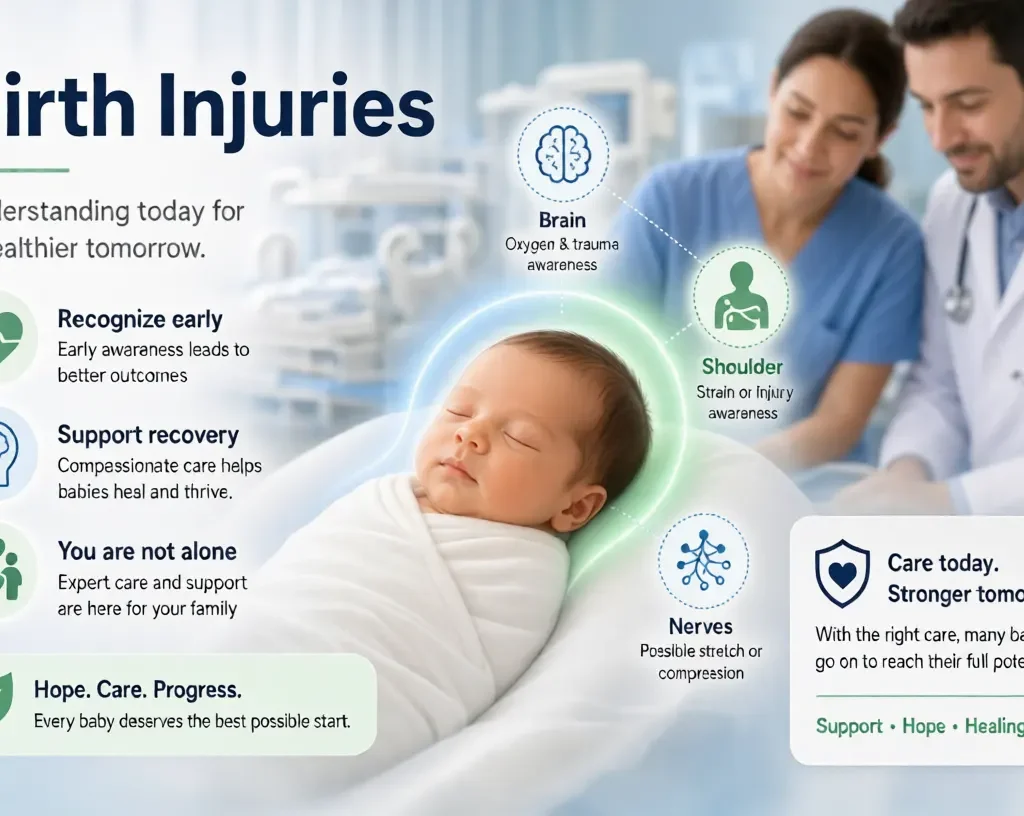
The CARE Framework: Four Steps for Parents
C: Check. Before delivery, learn the danger signs. After delivery, watch arm movement, face symmetry, feeding, breathing and alertness, and note what you see and when.
A: Ask. Put clear questions to the paediatrician. Is a specific injury suspected? Which tests are needed? Is a specialist required? Which signs mean an emergency?
R: Receive. Accept the recommended examination and treatment. Do not start home remedies or exercises unless your doctor advises them.
E: Ensure. Keep every follow up visit, and track development. Progress over weeks guides many decisions.
Back to Meera’s Baby
Illustrative example, continued (fictional). Meera tells the paediatrician about the still left arm. The doctor watches the baby move, gently examines the shoulder, collarbone and arm, and may order a scan. Reduced arm movement can have several explanations, so this story does not diagnose the baby. Only an examination can. Meera’s note of when she first noticed it helps the doctor.
What Doctors and Specialists Do
Early assessment matters because the right care differs by injury. A collarbone fracture may need only gentle handling, while a nerve injury may need specialist monitoring. Paediatricians, neonatologists, surgeons and physiotherapists may work together. Follow up matters because some outcomes show only with time. Physiotherapy can help in selected cases, but the treating team must teach any exercises for your baby.
What the Numbers Say
- Brachial plexus injury: a Swedish study of 38,749 births in western Sweden (1999 to 2001, published 2010) found 2.9 per 1,000 live births, with 0.46 per 1,000 still affected at 18 months. Most children recovered completely.
- A 2016 review cites about 20% with lasting deficits. Figures differ because studies use different definitions, populations and follow up times.
- An Indian study of 14,184 live births (2013 to 2017) found 1.6 per 1,000, but with only 23 cases it is a small guide.
- HIE: about 1.5 per 1,000 live births is commonly cited for high income countries. National data for England and Wales (2011 to 2016) found 2.96 per 1,000 including milder cases.
These figures cover particular injuries in particular places, not all birth injuries, birth defects or newborn mortality. No reliable national figure for all birth injuries in India could be verified, so none is quoted.
Preparing for the Doctor
Bring a short list. What type of injury is suspected or confirmed? What examinations are needed? Does my baby need a specialist? What signs need urgent care? What follow up is planned? Could this affect movement or development? Keep discharge papers, test reports and appointment dates in one folder.
Benefits and Limits
Early recognition brings timely assessment, treatment and developmental monitoring. But not every injury can be prevented, recovery differs between babies, symptoms are not specific to one condition, and long term outcomes cannot always be predicted at first.
Common Misconceptions
- “Every birth injury causes permanent disability.” No. Many resolve fully.
- “A baby who looks normal cannot be injured.” Some signs appear hours later.
- “All birth swelling is dangerous.” Caput usually fades in days.
- “Birth injuries always mean someone made a mistake.” Not necessarily.
- “Parents can tell the exact injury.” Only an examination can.
What to Do Next
Learn the emergency signs now. Go to hospital immediately for breathing trouble, seizures or unresponsiveness. Discuss any arm, face or feeding concern with your paediatrician, keep your records and attend follow up. Choose informed conversations over self diagnosis.
FAQs
What are the most common birth injuries? Scalp swelling, bruising, cephalohematoma and collarbone fractures, and most are mild.
Can a newborn recover completely? Many do, depending on the injury. No doctor can promise it for every baby.
Are birth injuries always visible at birth? No. A cephalohematoma may appear hours later.
Can birth injuries affect brain development? Serious brain injuries can. Most birth injuries do not involve the brain.
Can a birth injury cause permanent disability? Some can, but it is not the usual outcome.
How are birth injuries diagnosed? By examination and, when needed, tests such as imaging.
When should I take my newborn to hospital? Immediately for breathing difficulty, convulsions, no movement, not feeding, or extreme drowsiness.
Conclusion
Birth Injuries range from harmless swelling to emergencies, and the best protection is awareness. Watch calmly, act quickly on warning signs, and keep up with follow up care. Understanding the warning signs and seeking timely medical care can make an important difference to a newborn’s wellbeing.
Disclaimer: This article offers general educational information and does not replace advice, diagnosis or treatment from a qualified healthcare professional.