
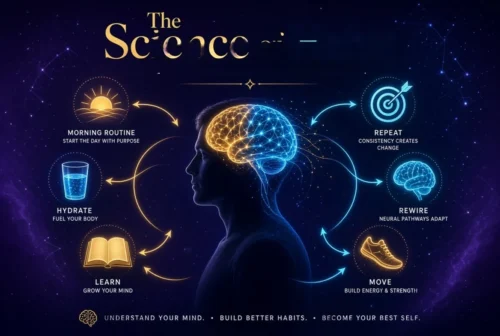
The Science of Habit: Why a Town in Finland Matters to You
The Science of Habit:In 1972, North Karelia, a province in eastern Finland, faced a crisis. A published review describes its heart disease death rate among middle aged men as the highest ever measured in any population. Local people had become used to men dying of heart attacks in their forties and fifties.
Then the community asked for help. Over the next decades, heart disease deaths among working age people in the region fell by about 80 percent. There was no single miracle behind it. People changed how they cooked, bought food and smoked, high blood pressure was treated better, and the whole community pulled in the same direction.
That story shows the science of habit better than any lab test. Habits feel personal, yet families, workplaces, shops, schools and governments quietly shape them. This article explains how habits form, what your brain is doing, and how small daily actions can build healthier lives and healthier societies.
Table of Contents
What Is a Habit?
A habit is a behaviour repeated so often in the same situation that it runs almost on autopilot. Psychologist Wendy Wood and colleagues found in a 2002 diary study that about 43 percent of everyday actions were done out of habit, often while people were thinking about something else.
Most habits follow a simple loop:
- Cue: a trigger, such as a time, place, feeling or person.
- Routine: the action itself.
- Reward: the small benefit that tells the brain, “Do that again.”
For example, you feel tired at 4 pm (cue), you eat a sweet snack (routine), and you feel a quick lift (reward). Repeat this for weeks and the snack arrives before you decide anything.
What Happens Inside the Brain
When you learn something new, the thinking part of your brain, the prefrontal cortex, works hard. It plans, weighs choices and uses a lot of energy. With repetition, control gradually shifts to deeper brain areas called the basal ganglia, which store well practised routines. This frees your mind for other jobs.
Dopamine, a brain chemical linked to learning from rewards, helps lock the pattern in. According to researchers at the US National Institute on Drug Abuse, enjoyable behaviours release dopamine, which is one reason pleasure based habits are hard to break.
Automatic does not mean bad. Brushing your teeth, wearing a seat belt and washing hands before meals are all healthy habits that protect you without any daily argument in your head.
How Long Does a New Habit Take?
Many people believe it takes 21 days. That idea traces back to a 1960 book by a plastic surgeon, not to a controlled study.
A better answer comes from University College London. In 2010, Phillippa Lally and colleagues followed 96 volunteers who each picked one daily health behaviour. The average time to reach peak automaticity was 66 days, but it ranged from 18 days to a predicted 254 days. Simple actions, such as drinking water with lunch, became automatic faster than demanding ones, such as 50 sit ups. Missing a single day did not ruin progress.
Later research agrees that the timeline varies. Reports on a 2024 review of 20 studies describe typical times of roughly 59 to 66 days, again with a very wide spread. The lesson is simple: be patient, start small, and expect your own speed to differ from your neighbour’s.
Habits Are Not Only Personal Choices
Here is the idea many articles skip. Your habits depend heavily on what is easy, cheap, safe and normal around you.
The World Health Organization estimated that 31 percent of adults worldwide, about 1.8 billion people, did not get enough physical activity in 2022. WHO reported that inactivity was higher among women (34 percent) than men (29 percent), and highest in high income Asia Pacific countries (48 percent) and South Asia (45 percent). It also said that promoting activity goes beyond individual lifestyle choice and needs a whole of society approach.
Think about why. A person cannot walk to work if the road has no pavement. A child cannot play outside if the park feels unsafe. A worker on two jobs cannot cook fresh meals every night. A habit is a partnership between a person and a place.
Real World Example: North Karelia Changes Its Habits
Back to Finland. The North Karelia Project, launched in 1972 with local requests and support from the World Health Organization, did not simply tell people to be healthier. It worked on the setting around them.
- Special training helped change the food served in workplaces, schools, hospitals and restaurants.
- Community groups and volunteers took part, which made healthy choices feel normal.
- Efforts focused on three risks: smoking, high cholesterol and high blood pressure.
The results were striking. Average cholesterol in North Karelia fell by about 21 percent between 1972 and 2012. Coronary deaths in middle aged people dropped by 84 percent between 1972 and 2014, according to one review of the project. Researchers cannot credit habits alone, because treatment also improved, but the project shows what happens when individual routines and community support move together.
Illustrative example (not a real case): Imagine an office where the only food nearby is fried snacks, and meetings run through lunch. Even motivated staff struggle. Now imagine the canteen offers fruit and lentil dishes at the front, and a walking meeting is the norm on Fridays. Nobody needs heroic willpower. The environment carries part of the load.
Willpower Approach vs Environment Approach
| Feature | Willpower alone | Environment supported |
|---|---|---|
| Starting point | “I must try harder.” | “How can I make this easier?” |
| Daily effort | High, needs constant decisions | Low once the setting is arranged |
| Stressful days | Often fails | More likely to survive |
| Who helps | Mostly you | Family, colleagues, community, policy |
| Long run result | Hard to sustain | More stable, more shared |
A Practical Framework: START
Use these five steps to build a healthier habit. This framework was created for this article as a practical guide, not a published scientific model.
- Small: Shrink the habit until it feels almost too easy. Walk for five minutes, not an hour.
- Trigger: Attach it to an existing cue, such as “after I make tea, I stretch.”
- Arrange: Change your surroundings. Keep fruit visible, put walking shoes by the door, and hide the biscuit tin.
- Reward: Notice the benefit straight away, such as better mood or a tick on a calendar.
- Team: Invite family or colleagues. Shared habits last longer, and healthy norms spread.
Three Common Misconceptions
“It takes 21 days.” As shown above, real timelines vary widely and often take longer.
“Habits are just willpower.” Willpower matters, but cues, rewards and surroundings often decide the outcome.
“One missed day ruins everything.” In Lally’s study, missing a single opportunity did not noticeably harm habit formation. What matters is getting back on track.
Conclusion: Small Actions, Shared Strength
The science of habit teaches a hopeful lesson. Your brain is built to turn repeated actions into routines, which means healthy behaviour can become effortless with time. Yet no one builds habits alone. Families, workplaces, schools, cultures and health systems all shape what is easy to do. Start small, change your surroundings, invite others to join, and ask your community leaders to make the healthy choice the easy choice.
Frequently Asked Questions
1. What is the science of habit in simple words? It is the study of how repeated actions become automatic through cues, routines, rewards and changes in the brain, and how surroundings influence them.
2. How long does it take to form a habit? There is no fixed number. In one UCL study the average was 66 days, with a range from 18 to 254 days, depending on the person and the behaviour.
3. Why do healthy habits fail even when I am motivated? Motivation rises and falls. Habits last when the cue is clear, the action is small, and the environment supports it.
4. Can habits really improve public health? Yes, when communities support them. Finland’s North Karelia Project is a well studied example, though it combined habit change with better treatment and policy.
5. How can I break a bad habit? Identify its cue and reward, then replace the routine with a healthier one that offers a similar reward. Change the setting that triggers it, and ask someone to support you.
Health information in this article is educational and not a substitute for advice from a doctor or qualified health professional.