
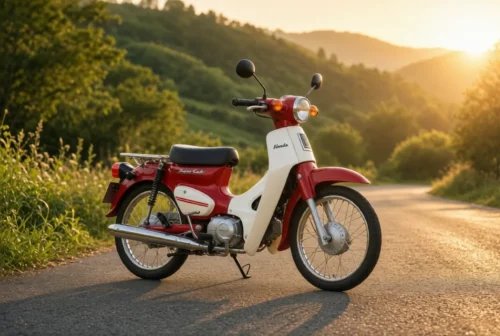
In 1954, Honda launched a scooter called the Juno K. Its body was made of fibre reinforced plastic, which was revolutionary at the time. It still failed, because it was heavy and underpowered.
In December 1956, founder Soichiro Honda and managing director Takeo Fujisawa visited Europe and saw ordinary people using mopeds and scooters daily. They returned asking what a motorcycle for everyone would look like.
The answer was the Super Cub C100, released in August 1958. When Fujisawa saw the prototype, he predicted sales of 30,000 units. A young designer asked, “In a year?” Fujisawa said, monthly. At that time the entire Japanese motorcycle industry made about 42,000 units a month.
That looks like a reckless bet. By October 2017, Honda reported that Super Cub series production had reached 100 million units. The Honda Super Cub teachings are about building something simple enough to trust, cheap enough to buy, and flexible enough to travel the world.
Table of Contents
What Honda Really Built
Honda’s own history describes a motorcycle designed around a daily scene: a noodle shop delivery rider balancing a tray with one hand while steering with the other, and customers riding in skirts.
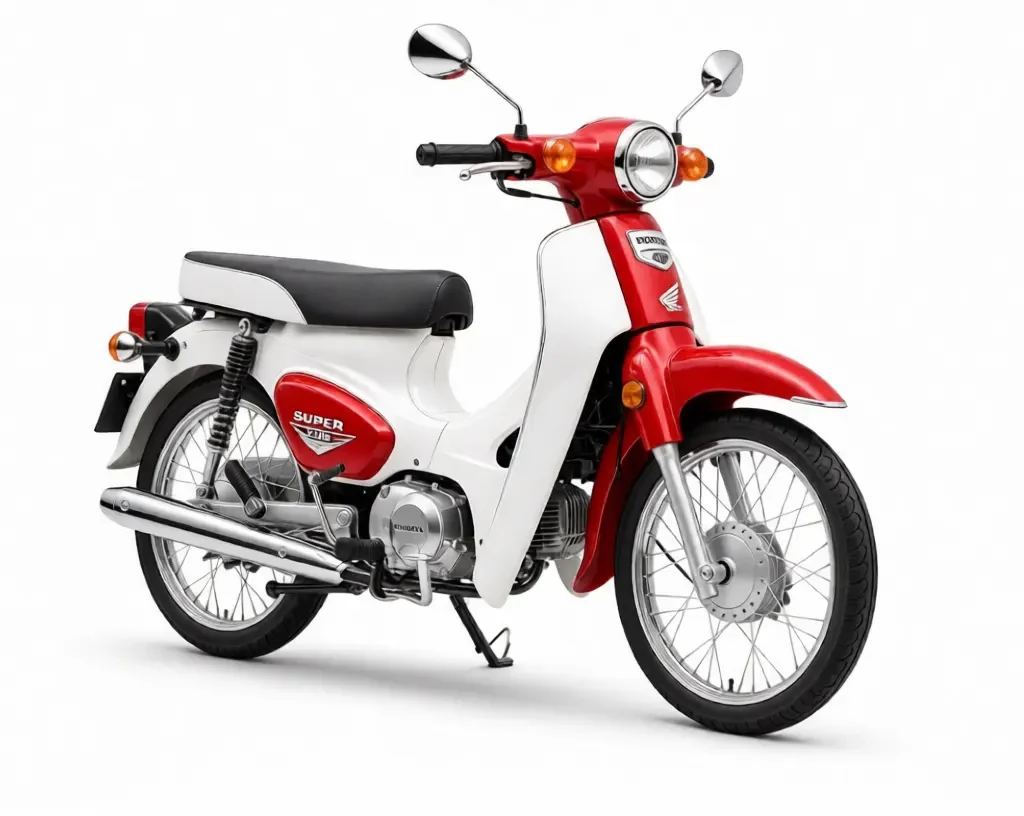
So the C100 got a low backbone frame for easy stepping through, an automatic centrifugal clutch with no clutch lever, a plastic leg shield against dirt and wind, and large 17 inch tyres for rough roads. Under the seat sat a 49cc four stroke engine producing 4.5 horsepower. Two stroke engines were mainstream then, so Honda’s choice was economical and durable.
Our interpretation: Honda designed for the rider’s hands, clothes and daily mess, not for a specification sheet. That is the first of the Honda Super Cub teachings.
The Numbers, Interpreted
Honda’s history gives these production figures:
| Year | Units |
|---|---|
| 1958 | about 24,000 |
| 1959 | about 167,000 |
| 1960 | about 564,000 |
| 1961 | about 661,000 |
| 1962 | about 790,000 |
The 1960 figure is larger than a full year at the industry pace of 42,000 a month (about 504,000), though the two numbers come from different years, so treat the comparison as rough. Fujisawa’s “impossible” forecast proved too low. Honda built the Suzuka Factory in 1960 to deliver 50,000 Super Cubs a month.
Price tells a second story. A trade magazine feature on Nippon.com reports the C100 cost 55,000 yen when a typical starting monthly salary was about 8,500 yen. By our calculation, that is about 6.5 months of starting pay. So “affordable” did not mean cheap. It meant strong value for people who would use the machine for work every day.
The cumulative figures reveal a third story. Honda reports 1 million units in 1961, 10 million in 1974, 20 million in 1992, 50 million in 2005 and 100 million in 2017. From 1974 to 1992, output grew by roughly half a million units a year. From 2008 to 2017, it grew by roughly four million a year. Our reading: the Cub’s biggest scale came decades after launch, once local production in Asia took hold.
From Japan to the World
Honda opened American Honda in 1959. In 1962 it launched the Honda 50 CA100 for North America, in bright red with a long seat for two. The 1963 campaign “You Meet the Nicest People on a Honda” helped change how Americans saw motorcycles.
Honda built products close to customers. It began Taiwan production in 1961, using parts sets from Japan, and Thai production in 1967. In 1965, an importer in then South Vietnam ordered 20,000 units. Honda later built the Super Dream in Vietnam from 1997. By 2020, Super Cub types made up about 40% of Honda Vietnam’s total production of 30 million units.
In Thailand, Honda created the Dream and then the Wave, modern Cub style models that spread across Asia and South America. By 2017, Honda was producing the series at 16 plants in 15 countries, sold in more than 160 countries.
The pattern is simple: one proven core, many local versions.
Cub, Smartphones and Electric Vehicles: A Fair Comparison
Budget smartphones follow a similar path: they keep the core experience and trim what many users never touch. Affordable electric scooters do the same with range and battery size.
The comparison has limits. A smartphone improves through software, networks and app ecosystems, so its value changes after purchase. The Cub was a mechanical product whose value was fixed at the factory door. Electric mobility also needs charging and battery supply.
Five Principles of Scalable Innovation
This is an original framework created for this article. It is not an official Honda model.
- Solve a real problem. Honda started from delivery riders and daily commuters, not from engine prestige.
- Simplify without losing value. The automatic clutch removed a skill barrier while keeping the machine fully capable.
- Price for the user’s life. The Cub was costly in 1958, yet it earned its price through work use and fuel economy. Honda reported 180 km per litre in a 30 km/h constant speed test in 1983. That is a test value, not a promise for every road.
- Protect quality at scale. Honda’s history says the “2 year 50,000 km warranty” introduced with the 1966 C50 boosted its popularity. A warranty like that only works when quality is consistent.
- Adapt the edges, not the core. The CA100 had a long seat for two in America. The Vietnamese Super Dream stressed tandem riding because motorcycles worked as taxis. The core design stayed.
Illustrative Example: A Small Startup (Fictional, for explanation only)
Imagine a startup building soil moisture monitors for small farms.
- Real problem: farmers over water or under water because they cannot see the soil.
- Simple design: one sensor, one coloured light, no app required.
- Fair price: priced against one season of saved water and fertiliser.
- Steady quality: every unit is tested in dust and heat before shipping.
- Local fit: the light works everywhere, while labels, language and optional text alerts change by region.
This startup needs the most trusted sensor, not the most advanced one.
Advantages and Limitations
Advantages: The approach builds trust, eases repair and creates volume. Honda said the Cub needed higher volume to cover its higher production costs, so simplicity and scale supported each other.
Limitations: First, a strategy that suits one product may fail in another. Medical devices, chips and aircraft succeed through complexity and strict regulation. Second, popularity attracts imitation. Honda’s own history says Chinese demand for Honda motorcycles led to mass production of counterfeits, with more than 200 companies said to be involved. Third, rules change. Honda ended Super Cub 50 production in 2025, saying it would be unprofitable to meet Japan’s tougher emission rules. It then lowered the output of 110cc models so they qualify in the moped class, with new versions starting at 341,000 yen, according to Jiji Press.
A Common Misconception
Many people believe global success needs expensive technology, complicated features or aggressive marketing. The Super Cub shows otherwise. Honda did use advertising in America, and it mattered. But the product itself, easy to ride, easy to maintain and hard to break, did the heavy lifting in markets from Vietnam to Thailand. Our view: marketing amplifies a good fit. It cannot create one.
What Readers Should Do Next
- Write down who your customer is and what daily problem they have.
- List every feature, then remove one that most customers would not miss.
- Test your price against the value your customer gains, not against your cost.
- Set a quality standard that you can keep at ten times today’s volume.
- Decide which parts must stay fixed worldwide and which parts can change by market.
Frequently Asked Questions
1. Why is the Honda Super Cub historically important? It put practical, dependable transport within reach of millions, and Honda reports the series passed 100 million units in 2017.
2. What are the most important Honda Super Cub teachings? Start with a real problem, simplify carefully, price for value, protect quality at scale, and adapt locally without changing the core.
3. How did the Super Cub become a global product? Through overseas sales companies, early parts set production in Taiwan, local factories in Thailand and Vietnam, and regional versions such as the Dream and Wave.
4. What can startups learn from Honda? Win trust with one useful, reliable product before adding complexity.
5. Why does simplicity matter in innovation? Simple products are easier to learn, produce, repair and scale. Simplicity should remove friction, not essential value.
6. What is the difference between standardisation and local adaptation? Standardisation keeps the core design and quality the same everywhere. Local adaptation changes seating, power, features or price to fit each market.
Conclusion: Simple Is Not Small
The Honda Super Cub teachings point to a lasting truth. Technology wins when it understands people, solves a genuine problem, keeps its quality and reaches those who need it. Today’s builders of phones, batteries, software and electric vehicles face the same test.
Build something so useful that the world makes it ordinary.