
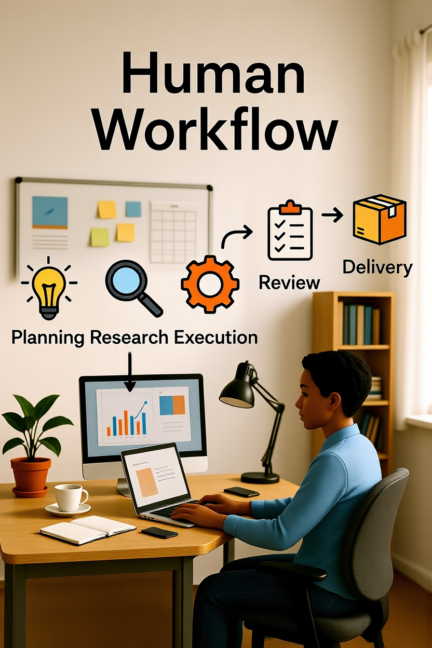
Introduction
Imagine a world where your team doesn’t just “use AI,” but actually thinks alongside it—a world where every decision is sharper, every workflow faster, and every outcome more intentional. That world is already here, powered by parallel intelligence: the proven, future‑ready way humans and machines co‑think, co‑decide, and co‑deliver value in real time.
At its core, parallel intelligence turns AI from a black‑box tool into a true partner in your organization, woven into carefully designed human workflows that amplify human judgment with machine precision. The result isn’t just automation; it’s a new kind of business intelligence that feels intelligent, adaptive, and surprisingly human.
This article will show you how to build that kind of system—step by step, with concrete examples, a detailed case study, and a clear roadmap for your team. By the end, you’ll see exactly how parallel intelligence can transform your human workflows, boost business productivity, and position sites like kritiinfo.com as a trusted authority in technology, management, and future intelligence systems.
What parallel intelligence really means
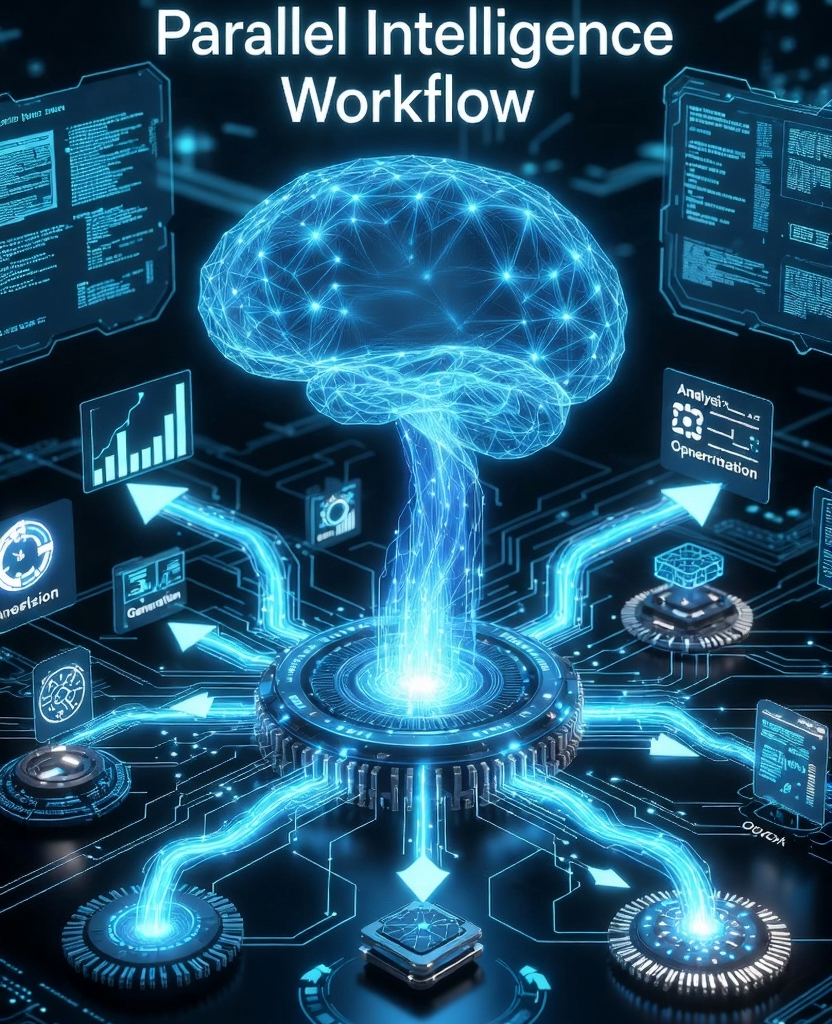
Parallel intelligence isn’t another buzzword. It’s the practical fusion of human cognition and machine computation, where both operate in parallel, not in competition. Think of it as a continuous loop: humans set goals and context, machines process data and surface options, and humans then refine and decide—each side lifting the other.
Researchers in AI and systems science describe it as the “interaction between the actual and the artificial world,” supported by new IT infrastructures that let humans and AI explore, simulate, and act together. In everyday terms, this means parallel thinking across teams: one person focuses on strategy, another on creative nuance, and AI agents handle pattern‑finding, data crunching, and routine execution—all within the same human workflow.
When organizations design for parallel intelligence, they move beyond simple automation toward decision intelligence: using data, cognitive systems, and human experience to make faster, more accurate, and more ethical choices. Trustable, scalable decision intelligence is now a core competitive advantage—and the backbone of productive, future‑ready organizations.
(For readers exploring broader AI strategy, you can deepen this thinking with MIT Technology Review’s coverage of AI‑augmented decision‑making.)
Why human workflows are the real power lever
If you’ve ever rolled out AI tools only to see them underused or ignored, the culprit is rarely the technology—it’s the workflow design. Parallel intelligence shines when organizations treat human workflows as the central architecture, not as afterthoughts bolted onto AI systems.
Here’s what makes human workflows so powerful when aligned with AI:
- Context preservation: Humans keep the “why” in focus, while AI handles the “what and how.”
- Adaptive decision‑making: AI surfaces data patterns and options, but humans apply ethics, nuance, and strategic intent.
- Continuous learning: Every interaction becomes a feedback loop that trains both people and AI to improve.
Consider customer‑support workflows. A typical AI chatbot might resolve 60–70 percent of queries, but the remaining 30–40 percent still require human judgment. Parallel intelligence designs the workflow so that:
- The AI triages, gathers, and pre‑fills information.
- A human agent steps in at the right moment, with full context and suggested options.
- Each interaction is logged so the AI learns from the human’s decisions.
This is how human workflows become intelligent workflows, not just faster ones.
How parallel thinking reshapes business productivity
Parallel thinking—processing multiple lines of thought at once without losing coherence—is a cognitive superpower for teams and organizations. When combined with AI, it turns human workflows into high‑velocity engines of business productivity.
Let’s compare two organizations tackling the same quarterly targets:
| Organization | Thinking style | Outcome |
|---|---|---|
| A | Sequential, siloed thinking: design, then marketing, then sales, passing the baton step by step. | Slow iterations, missed opportunities, reactive adjustments. |
| B | Parallel thinking: product, marketing, and sales teams collaborate in parallel, with AI agents running simulations, A/B tests, and forecasting in real time. | Faster learning, fewer dead‑end experiments, and aligned decisions. |
In practice, parallel thinking looks like this:
- Sales teams use AI‑driven lead‑scoring models to prioritize prospects, while humans craft personalized narratives.
- Product teams run multiple parallel experiments (e.g., features, pricing, UX variants) with AI managing the rollout and measuring impact.
- Leadership receives consolidated dashboards that blend machine‑generated KPIs with human‑authored insights, enabling faster, more informed decisions.
Harvard Business Review notes that organizations embracing decision intelligence and human‑AI collaboration report higher productivity, better innovation rates, and stronger risk management. Parallel thinking, properly orchestrated, turns cognitive systems into organizational habits instead of one‑off experiments.
Designing AI‑augmented human workflows step by step
Turning theory into practice demands a structured approach. Here’s a practical, expert‑level framework for designing AI‑augmented human workflows that support parallel intelligence.
Step 1: Map your current workflows
Before touching any AI, document exactly how work actually flows today.
- Identify who does what, and where time is lost.
- Highlight repetitive, rule‑based tasks that AI can handle.
- Note judgment‑heavy steps where humans are essential.
This “as‑is” map becomes your baseline for measuring impact.
Step 2: Define collaborative moments
IBM’s research on human‑in‑the‑loop workflows shows that successful AI integration hinges on clear “collaborative moments.”
- When does AI act? Data collection, classification, pattern recognition, and routine execution.
- When does the human decide? Ethics, creativity, relationship‑building, and edge‑case judgment.
Label these handoff points in your workflow diagram so both humans and AI know their roles.
Step 3: Build feedback‑rich loops
Decision intelligence isn’t a one‑shot calculation; it’s a continuous learning loop. Your human workflows should include:
- Clear metrics for AI performance and human satisfaction.
- Mechanisms for humans to correct or refine AI outputs.
- Regular reviews that update both AI models and human practices.
This loop turns parallel intelligence into a self‑improving system instead of a static tool.
(For deeper methodology, explore IBM Research’s work on human‑centric AI and orchestration.)
A real‑world case study: parallel intelligence in healthcare
To see parallel intelligence in action, consider a mid‑sized hospital network that redesigned its diagnosis and triage workflows. Before AI, radiologists and clinicians spent hours reviewing imaging scans and patient histories, often under time pressure.
The challenge
- High workload, burnout risk, and occasional diagnostic delays.
- Need for faster, more accurate early‑detection decisions without sacrificing patient trust.
- High workload, burnout risk, and occasional diagnostic delays.
- Need for faster, more accurate early‑detection decisions without sacrificing patient trust.
The parallel‑intelligence redesign
The hospital introduced an AI‑augmented workflow built around three parallel streams:
- AI stream: AI agents pre‑analyze imaging scans, highlight suspicious regions, and rank cases by urgency.
- Clinician stream: Radiologists and doctors review flagged cases, apply clinical judgment, and annotate findings.
- Feedback stream: Each clinician’s decision is logged and fed back into the AI model, improving its accuracy over time.
Every human workflow was redesigned to preserve the clinician’s role as the final decision‑maker, with AI acting as a high‑speed pattern‑spotter.
Results and lessons
Within 12 months, the hospital reported:
- 30–40 percent reduction in time‑to‑diagnosis for critical cases.
- 20 percent improvement in early‑detection rates for high‑risk conditions.
- Higher clinician satisfaction, as AI absorbed routine analysis and clinicians focused on medical judgment and patient care.
This case shows how parallel intelligence, anchored in thoughtfully engineered human workflows, becomes a transformative, trustworthy system—not just a technical experiment.
Future trends in parallel intelligence and human workflows
Where does parallel intelligence go from here? Several emerging trends will reshape how human workflows and cognitive systems interact.
- Agent‑driven orchestration: Platforms increasingly support multiple AI agents executing in parallel, each handling different subprocesses while humans coordinate and steer.
- Explainable decision intelligence: As regulation grows, organizations will demand AI‑driven decisions that humans can understand, audit, and challenge—making transparency a core workflow requirement.
- Personalized parallel intelligence: Systems will learn individual preferences, working styles, and even cognitive biases, tailoring workflows to each person’s strengths.
- Hybrid cognitive systems: Enterprises will combine generative AI, simulation engines, and human‑facilitated workshops to explore “parallel worlds” before committing to real‑world actions.
Harvard Business Review emphasizes that organizations that treat AI as a collaborative partner—not a replacement—will lead in innovation and resilience. Parallel intelligence, embedded in human workflows, will become the default operating system for future‑ready management systems.
(For readers at kritiinfo.com, consider a follow‑up article on “Future‑Ready Management Systems in the Age of Parallel Intelligence.”)
How to start building your own parallel‑intelligence workflows
You don’t need a massive budget or a fully staffed AI lab to begin. Here’s a practical, action‑driven roadmap tailored for teams, managers, and content‑focused organizations like kritiinfo.com.
- Pick one high‑impact workflow. Choose a repeatable process that affects revenue, customer experience, or content quality (e.g., article ideation, SEO planning, or client onboarding).
- Break it into micro‑tasks. Identify which parts are rule‑based (AI‑friendly) and which require human judgment (your “parallel thinking” zone).
- Introduce AI as a collaborator. Use tools that support human‑in‑the‑loop workflows (for example, AI‑assisted content briefs, outline generators, or research aggregators).
- Embed feedback mechanisms. Every time a human edits or overrides an AI suggestion, capture that insight so the system learns.
- Measure and iterate. Track time‑to‑completion, quality scores, and user satisfaction, then refine your human workflows monthly.
Done well, this approach turns your team into a parallel‑intelligence engine that scales quality, not just speed.
FAQs: parallel intelligence and human workflows
Q1: What is parallel intelligence in simple terms?
Parallel intelligence is the way humans and AI think, decide, and act together—not in sequence, but in parallel—so each amplifies the other’s strengths. It’s especially powerful in human workflows that blend AI‑driven data analysis with human judgment, creativity, and ethics.
Q2: How do human workflows differ when AI is involved?
Traditional workflows often assume humans do everything, with AI as an occasional add‑on. True AI‑augmented workflows redesign roles so AI handles repetitive, data‑heavy tasks while humans focus on strategy, nuance, and relationship‑driven activities. This creates parallel thinking across the team instead of step‑by‑step handoffs.
Q3: What is decision intelligence and how does it relate to parallel intelligence?
Decision intelligence is a framework that combines data analytics, AI models, and human expertise to make faster, more accurate, and more ethical decisions. Parallel intelligence is how that framework lives in practice—through human workflows that continuously learn and adapt.
Q4: Can parallel intelligence reduce human jobs?
When designed well, parallel intelligence doesn’t eliminate roles; it redefines them. AI absorbs routine execution so humans can focus on higher‑value work such as strategy, creativity, and stakeholder management. The risk comes when organizations treat AI as a replacement rather than a collaborator.
Q5: How can my organization start small with parallel intelligence?
Begin with a single, well‑defined human workflow—such as content planning, lead qualification, or customer support—that has clear success metrics and willing participants. Introduce AI as a supportive partner, build feedback loops, and measure impact monthly. This approach keeps investment low and learning high, making it easier to scale across the organization over time.
Ready to power-up your workflows with parallel intelligence?
Parallel intelligence isn’t a distant sci‑fi concept; it’s a practical, actionable way to upgrade your human workflows, decision intelligence, and overall business productivity. By intentionally designing spaces where humans and AI think in parallel, your team can achieve outcomes that neither side could pull off alone.
If you’re part of a content‑driven organization, a tech‑enabled consultancy, or a future‑ready business leader reading this on kritiinfo.com, here’s your next move: pick one workflow this week, map it, and sketch how AI could become a parallel partner instead of a mere tool.
When you’re ready to dive deeper, follow kritiinfo.com for more practical guides on parallel thinking, cognitive systems, and future‑ready management systems—all grounded in real‑world experience, not generic AI hype.