

Introduction
Walking into a bank branch in 2026, you no longer see a dozen tellers behind a counter. Instead, there are three senior officers, a small team of service associates, and a wall of AI‑powered kiosks handling most routine transactions. A junior subordinate who once felt secure in manual data entry now finds herself checking AI generated summaries, guiding customers through self‑service, and managing escalations that machines cannot resolve. This is not science fiction; it is the new reality of the machine to human ratio reshaping every role, every team, and every manager’s relationship with their subordinate workforce.
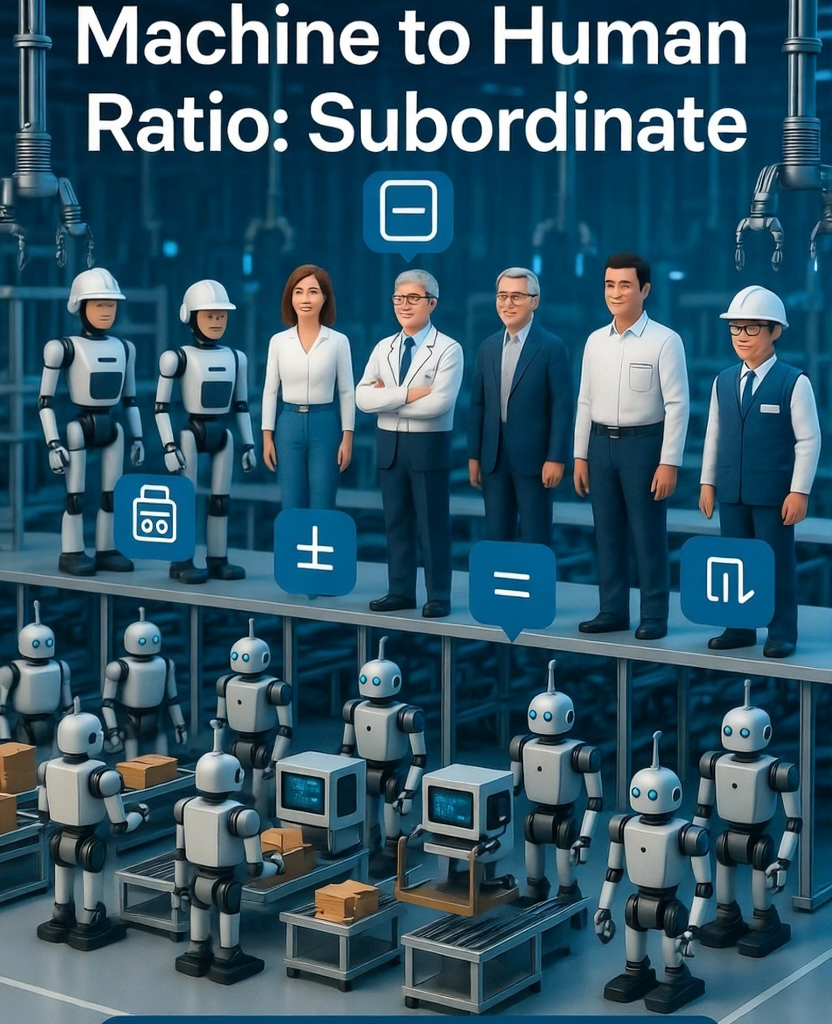
Across industries, leaders are quietly recalibrating how many machines or AI agents each human employee can realistically manage—whether 1 robot per 4 workers, 10 AI agents per analyst, or over 40 machine identities per human in some digital environments. Behind these numbers lie deeper questions about trust, responsibility, and leadership. In this post, we’ll show you how a balanced machine to human ratio can actually elevate your subordinate team, not replace it, and turn technology into a force multiplier for employee productivity, workplace efficiency, and human machine collaboration.
1> What the Machine to Human Ratio Really Means
At its core, the machine to human ratio is a measure of how many machines, robots, software agents, or AI tools are working alongside each human employee. In manufacturing, it might be the number of robots per operator; in IT, it can be the number of automated workflows or AI agents per engineer; in finance, it may be algorithmic tools per analyst. Think of it like a staffing ratio, but instead of two people per shift, it’s one human overseeing several digital “workers” that never sleep.
Recent research shows that in many knowledge‑work environments, this ratio is drifting toward models where each employee is supported by multiple AI agents, sometimes ten or more, handling data extraction, report drafting, and routine decisions. This shift doesn’t erase the human; it simply redefines their role. For a subordinate who was once chained to spreadsheets and repetitive forms, the same ratio can mean freedom to focus on problem‑solving, customer empathy, and creative execution—provided leadership designs the transition with care.
2>Why Subordinate Roles Are Evolving, Not Disappearing
For many frontline managers, the fear is that more machines means fewer subordinates. Yet data from automation‑driven workplaces suggest a different story: roles are changing, not vanishing. Studies of human machine collaboration report productivity gains in the 5–25 percent range, with employees freed from repetitive tasks to handle higher‑value work. That means the same number of subordinate employees can now manage more complex processes, more channels, and more customers—often with lighter mental load.
In practice, this looks like:
- A subordinate in HR using AI tools to auto‑screen resumes, freeing them to focus on candidate engagement and cultural fit rather than keyword matching.
- A team member in operations overseeing automated inventory and logistics systems, shifting from data entry to exception management and supplier coordination.
- A junior sales associate using AI‑powered CRM insights to personalise offers, instead of manually chasing insights from reports.
Leaders who treat subordinate roles simply as “manual labour” lose this opportunity. Those who see them as the human glue in a digital ecosystem redesign workflows so that every subordinate becomes a strategic partner, not a replaceable cog.
3>How the Right Ratio Boosts Employee Productivity
The magic of the machine to human ratio lies not in the number itself, but in how it aligns with human capacity and workflow design. When one employee is drowning under 50 poorly documented bots, productivity plummets. When the same person is supported by three or four well‑designed AI agents, with clear ownership and escalation paths, performance can spike.
Organisations that track a Human‑Agent Ratio (HAR)—how many AI agents each employee manages—report smoother adoption, higher trust, and fewer “black‑box” complaints. Key lessons for managers:
- Match intensity to capacity: A junior subordinate new to AI tools may perform best with 1–2 agents; a senior analyst can thrive with 5–10, provided they control the rules and exceptions.
- Design for hybrid handoffs: Ensure every automated workflow has a clear human touchpoint, so the subordinate feels responsible, not redundant.
- Measure people‑centric outcomes: Track not only speed and error rates, but also employee satisfaction, autonomy, and learning curves as the ratio changes.
Done this way, automation becomes an employee productivity amplifier, not a performance monitor that quietly demoralises the subordinate workforce.
4>Real World Case Study: How Automation Changed Subordinate Dynamics
Consider a mid‑sized logistics firm in India that handles 10,000 daily shipments across 120 cities. Before 2023, the operations team relied heavily on manual route planning, phone calls to drivers, and Excel‑based delay tracking. Junior subordinate staff spent 60–70 percent of their day on data entry, chasing updates, and handling escalations. Morale was low, and turnover outpaced the industry average.
In 2024, the company introduced an AI‑driven logistics platform that:
- Automated route optimisation and dynamic ETAs.
- Assigned tasks to drivers and field agents via a mobile app.
- Flagged delays and exceptions for human review.
The machine to human ratio shifted from roughly 1 tool per 10 employees to 1 human manager overseeing 20–30 AI agents and automated workflows. At first, junior staff feared job cuts. Instead, leadership redefined their roles:
- Subordinate operators became “exception managers,” focusing only on outliers the system could not resolve.
- They also handled customer communication, partner coordination, and process improvement suggestions.
- The organisation added a weekly “AI feedback loop” where each subordinate could suggest rule changes or new automation triggers.
Within 12 months, shipment‑on‑time performance rose by 22 percent and employee engagement scores increased by 35 percent. The subordinate team no longer felt like data‑entry clerks; they saw themselves as mission‑critical decision‑makers whose judgement guided the machines.
5>The Leader’s Role in Managing a Human Machine Ecosystem
As the machine to human ratio rises, the nature of leadership evolves from controlling tasks to orchestrating hybrids. Research on automation and corporate decision‑making shows that excessive automation can centralise power, reduce the strategic role of mid‑level managers, and even weaken communication. If every decision is pushed up to executives or into black‑box algorithms, local subordinate knowledge gets sidelined—and so does organisational agility.
Effective leaders in this new era:
- Clarify ownership: Every workflow should state who owns the outcome—the human, not the machine. This reinforces accountability for the subordinate.
- Build feedback‑rich loops: Encourage subordinate staff to flag AI errors, suggest tweaks, and co‑design workflows. This turns fear into participation.
- Invest in upskilling: Pair automation with training in data literacy, AI basics, and soft skills so subordinate staff can lead, not just follow, digital tools.
In many forward‑thinking organisations, a new role is emerging: the “agent boss” or AI workflow manager, who delegates to both people and AI agents and ensures the machine to human ratio supports—rather than undermines—team cohesion.
6>Balancing Technology with Human Machine Collaboration
The future workplace is not a battle of humans versus machines; it is a collaboration where digital tools take over repetition, and people bring empathy, context, and ethical judgment. Thought‑leaders and research on the human machine workplace emphasise that organisations win not by maximising automation, but by designing human machine collaboration that boosts both output and well‑being.
For your subordinate team, this balance means:
- Meaningful work: Removing soul‑crushing tasks lets people focus on relationships, creativity, and problem‑solving.
- Greater autonomy: Well‑designed AI tools can give junior staff real‑time insights, enabling confident decisions without constant approval.
- Stronger loyalty: When employees feel their judgement adds value beyond algorithms, engagement, retention, and discretionary effort rise.
By treating the machine to human ratio as a design principle—not a headcount‑cutting lever—you turn your subordinate workforce into the resilient core of your digital transformation.
Frequently Asked Questions
1. What is machine to human ratio in the workplace?
It is the ratio of machines, robots, or AI agents to human employees in an organisation or team. This can range from industrial robots per operator to AI agents per knowledge worker. The goal is to balance automation with human oversight to maximise productivity and well‑being.
2. How does automation affect subordinate management?
When done well, automation frees subordinate staff from repetitive tasks and moves them into higher‑value roles such as exception management, customer engagement, and process improvement. Poorly designed automation can erode autonomy and trust, so leaders must redesign roles, training, and communication.
3. Does AI reduce the need for human employees?
AI can automate many routine activities, but global studies show it more often reshapes roles than eliminates headcount. Organisations that pair AI with upskilling typically see rising productivity and more strategic work for their subordinate workforce.
4. How can managers support a healthy human machine collaboration?
Managers should clarify who owns decisions, create feedback loops between staff and AI systems, and invest in training for data literacy and AI basics. They should also monitor mood, workload, and engagement metrics as the machine to human ratio changes.
5. What is a good machine to human ratio for my team?
There is no universal number; the right ratio depends on industry, task complexity, and employee skill level. Many progressive firms start with a small number of AI agents per employee (1–3), then scale based on performance, error rates, and staff feedback.
Call To Action
The machine to human ratio is not a cold statistic; it is a mirror of how you value your subordinate workforce and how seriously you take their growth. When balanced with empathy, clarity, and deliberate design, technology can liberate people from drudgery and place them at the heart of innovation. At kritiinfo.com, we believe the future belongs to leaders who master this balance and turn every subordinate into a trusted partner in the digital journey. Explore more expert insights on workplace efficiency, digital transformation, and employee leadership on kritiinfo.com and start transforming your team today.