

Introduction
Legacy and strategy :Senior leaders face an unforgiving pace of change: market shifts, digital disruption, stakeholder scrutiny, and talent shortages all demand deliberate reinvention. Upskilling the C Suite is no longer optional; it is a strategic imperative that protects a leader’s legacy while translating vision into measurable business outcomes. This article offers practical steps, executive examples, and evidence-based guidance to make change stick at the top.
Reframe leadership around Legacy and strategy
C Suite development must begin with a clear answer to two questions: what legacy do you want to leave, and which strategy will deliver it? Leaders who treat legacy as an active design choice — not an afterthought — align short-term trade-offs with long-term value creation. For example, a CFO who invests in analytics platforms (short-term cost) while building a transparent capital-allocation story (long-term trust) secures both quarterly performance and board confidence. This reframing invites measurable goals tied to both culture and returns.
Build a compact executive learning agenda
Create a focused, six-to-twelve-month learning plan for each C-level role that mixes: 1) immersive experiences (executive education, cross-industry residencies), 2) applied projects (run a digital pilot), and 3) mentoring from non-executive directors. McKinsey’s research shows targeted initiatives that close skills gaps in strategic areas like digital and AI yield outsized returns for companies that make them a priority. Make the agenda visible to the board so development links explicitly to strategic KPIs.
Make measurement meaningful: KPIs for upskilling
Move beyond completion counts to outcome KPIs: adoption rate of new practices, time-to-decision improvement, revenue enabled by new capabilities, and employee retention in critical functions. One global retail CEO tied executive learning to a 12-month metric: percent of strategic initiatives where executives personally validated data-driven decisions; this drove faster adoption of analytics and increased project ROI. Metrics turn learning from “nice to have” into accountability.
Embed “learning in the flow of work”
Senior leaders must experience applied learning, not abstract sessions. Encourage “learning sabbaticals” where executives spend two weeks embedded in product, engineering or frontline operations. Harvard Business Review highlights that reskilling that includes on-the-job application scales much more sustainably than classroom-only approaches. These embeds illuminate operational realities and sharpen strategy execution.
AI, digital disruption, and continuous executive learning
Executives must master AI literacy: strategic implications, governance, and integration into decision processes. Leading organizations show that digital and AI leadership correlate with 2–6x outperformance over laggards, making executive capability in these areas a direct competitive lever. Practical steps include weekly AI briefings tied to live use cases, executive-level AI playbooks, and board-level risk frameworks that move beyond technical jargon into business scenarios.
Common leadership mistakes to avoid
- Treating upskilling as a checkbox rather than a strategic investment reduces impact and erodes trust with stakeholders.
- Isolating learning inside HR silos denies senior leaders real operational context; sponsor cross-functional projects instead.
- Overrelying on external consultants for strategy translation produces dependency; build internal capability by pairing consultants with executive-led pilots. Avoid these errors to preserve strategic momentum.
Cultural levers that accelerate executive growth
Leaders who model vulnerability and public learning create permission structures across the organization. For instance, a CEO who publicly shares a two-month learning journey on platform strategy invited candid feedback and accelerated organization-wide adoption of new product metrics. Combine visible leadership learning with incentives: link part of long-term compensation to capability-building milestones.
How Legacy and strategy shapes future-ready executives
When leaders intentionally integrate legacy and strategy into their development, they create a durable decision framework that guides risk-taking, hiring, and capital allocation decisions. Legacy becomes a north star: a statement of what the organization will be known for in five to ten years, and strategy is the tactical route to get there. Boards and shareholders reward clarity — McKinsey shows companies that invest strategically in digital and leadership capabilities widen their performance gap versus peers. This alignment turns transient initiatives into institutional strengths.
Corporate benefits when leaders continuously upskill
Continuous executive learning reduces strategic drift, improves agility, and strengthens talent pipelines. Organizations that prioritize learning see better retention, faster digital adoption, and stronger innovation funnels. One multinational manufacturer reduced time-to-market by 20% after its executive team adopted agile product governance tied to a structured leadership curriculum. These outcomes demonstrate ROI beyond the learning budget line.
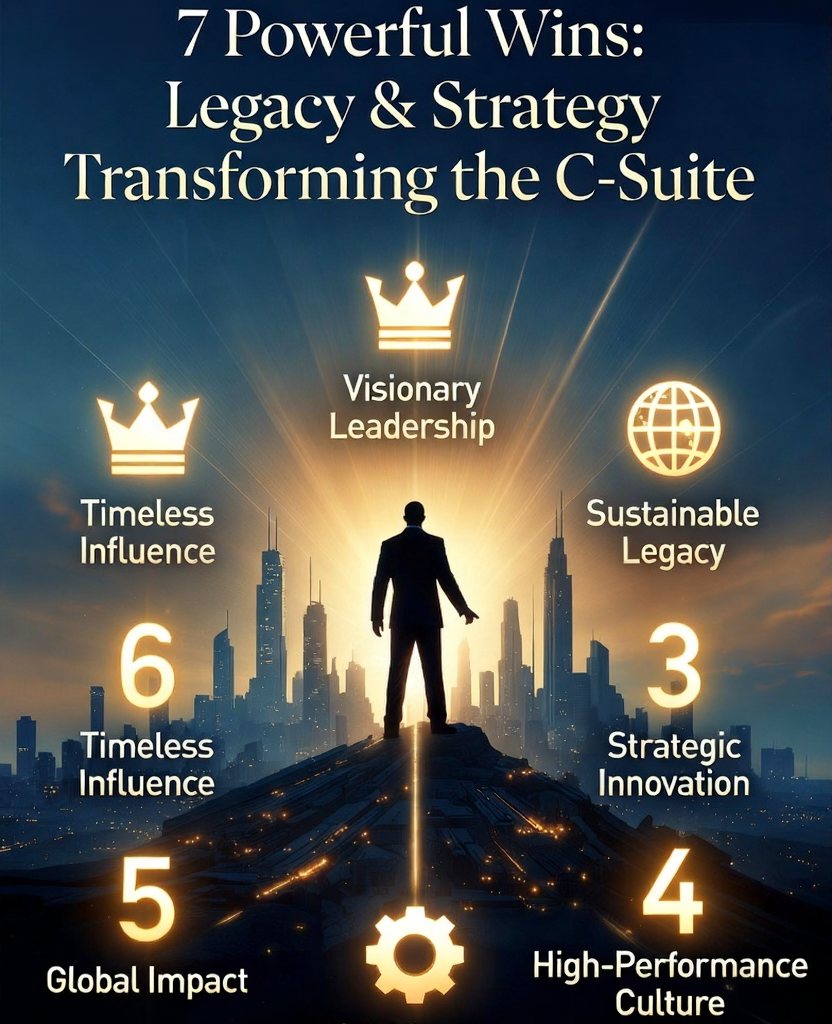
Practical playbook: seven actions for immediate impact
- Audit strategic capability gaps by function and by initiative; present findings to the board within 60 days.
- Create a seven-module executive learning sprint focused on decision-making under uncertainty, digital customers, and governance.
- Assign one cross-functional applied project to each executive with measurable deliverables.
- Require executives to spend 2–4 days per quarter embedded in frontline operations.
- Publish a simple “legacy charter” that links three long-term outcomes to current choices.
- Measure and report outcome KPIs quarterly, not just completion rates.
- Incentivize mentoring: reward executives who develop successors through structured coaching.
These steps map learning to immediate business results and create a visible accountability loop.
Real-world executive example
A European bank’s CEO launched a “strategy residency” where the C Suite rotated through digital product teams for 30 days, co-designed a customer data governance model, and jointly presented changes to the board; within a year they launched a new digital mortgage product with 40% lower onboarding time. That program combined a legacy articulation (customer-centric trust), strategic investment (data governance), and applied learning — all evidence-backed approaches recommended in recent executive development literature.
Statistical snapshot and trends
Recent research shows that organizations leading in digital and AI capabilities outperform peers significantly, underscoring the value of upskilling at the top. Harvard Business Review and McKinsey both highlight that on-the-job application and targeted reskilling deliver measurable business advantage over one-off training courses. These findings make the case for executive-level investment in capability building.
FAQ
- What is the most important skill for C Suite upskilling?
Answer: Strategic judgment — the ability to convert learning into prioritized actions tied to the company’s legacy and measurable outcomes. - How quickly should an executive learning program show results?
Answer: Look for early behavioral indicators within 3–6 months (decision speed, pilot outcomes) and material business metrics within 9–18 months. - How does Legacy and strategy affect succession planning?
Answer: When legacy anchors strategy, succession criteria shift from technical skill to demonstrated alignment with long-term outcomes and cultural stewardship. - Can AI replace executive judgment?
Answer: No; AI augments decision-making. Executives need AI literacy to interpret models, set guardrails, and define ethical trade-offs. - How do you build an executive learning culture?
Answer: Model learning at the top, embed applied projects, and tie learning outcomes to incentives and board reporting. - What ROI can companies expect from C Suite upskilling?
Answer: While ranges vary, digital and AI leaders can outperform peers by multiple times in total shareholder returns, driven largely by capability adoption and strategy execution.
Conclusion
Leaders shape the organization not only by decisions they make today but by the legacy and strategy they craft for tomorrow. Investing in a measurable, applied, and board-aligned upskilling plan for the C Suite creates resilience, drives sustained performance, and solidifies a leader’s positive legacy. Rethink executive growth now: define the legacy you want, build the strategic learning roadmap, and hold leaders accountable for turning learning into lasting value.
Action Now
If you lead strategy, present a three-point executive upskilling proposal to your board this quarter: a legacy charter, three applied projects, and a KPI scoreboard tied to strategic outcomes. That single step starts a transformation that protects reputation, accelerates strategy, and future-proofs the enterprise.