
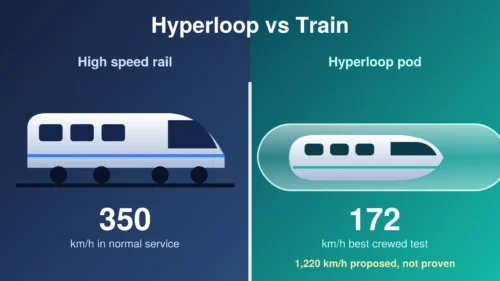
On 8 November 2020, two people climbed into a small pod in the Nevada desert. Pumps had pulled most of the air out of the tube around them. The pod lifted off its track on magnets and reached 172 km/h. It was the first time humans had ridden a Hyperloop. The track was only 500 metres long.
Three years later the company behind that ride shut down. It had raised hundreds of millions of dollars and never carried a paying passenger.
So is Hyperloop the next revolution in transportation, or a brilliant dream facing huge engineering and money problems? This guide separates what is proven from what is only promised.
Table of Contents
What Is Hyperloop?
Hyperloop is a proposed transport system where pods travel inside sealed tubes with most of the air removed. The pods carry people or cargo. With little air to push through, a pod can in theory go fast on less energy.
Designs differ. Some use magnetic levitation, where magnets lift the vehicle so nothing touches the track. Others use air cushions. No single design has become the standard yet.
How Does Hyperloop Work?
Put your hand out of a moving car window. At 30 km/h the push is light. At 100 km/h it is strong. That push is aerodynamic drag, the force of air resisting movement. Double the speed and drag becomes four times larger. Remove most of the air and the problem shrinks.
Here is the system step by step:
- Low pressure tube. Pumps remove air. Virgin’s 2020 test ran at about one thousandth of normal pressure.
- Levitation. Magnets or air cushions lift the pod, so wheels cause no friction.
- Propulsion. Electric motors along the tube push the pod forward.
- Guidance. Magnetic forces keep the pod centred.
- Braking. Magnetic braking slows the pod, with mechanical backup.
- Safety. Sealed cabins, sensors, airlocks and emergency exits protect people.
Each step works in a lab. The hard part is making all six work together over hundreds of kilometres.
The Promise of Hyperloop Transportation
In 2013, Elon Musk published a white paper called Hyperloop Alpha, announced here by Dezeen. It described 28 seat pods leaving every 30 seconds, a 35 minute trip between Los Angeles and San Francisco at up to 760 mph (1,220 km/h), and a cost under 6 billion dollars.
The possible benefits are real: high speed, less drag, shorter intercity trips, energy savings, freight use, and links to existing stations. But theoretical performance is not proven commercial performance. Many economists doubted the cost estimate, and nobody has built a full system to test it.
Hyperloop vs High Speed Rail vs Air Travel
| Factor | Hyperloop | High speed rail | Air travel |
|---|---|---|---|
| Top speed | Proposed 1,220 km/h. Best crewed test 172 km/h | Service 300 to 350 km/h. Shanghai maglev 431 km/h | Cruise 800 to 900 km/h |
| Commercial service | None | Many countries | Worldwide |
| Infrastructure | Sealed tube, pumps | Dedicated track | Airports |
| Passenger capacity | Small pods (28 in the 2013 design) | Hundreds per train | About 150 to 400 per flight |
| Construction cost | Unproven | Very high, known | Airports costly |
| Energy | Less drag, but pumps need power | Efficient | High fuel use |
| Safety and evacuation | Untested at scale | Strong record | Strong record |
| Environment | Depends on power and build emissions | Low in operation | Higher per passenger |
| Maturity | Test stage | Mature | Mature |
Hyperloop speeds are proposals, not operating results. Rail and air figures describe normal service.

The Hidden Challenges
Now the suspense. A Hyperloop must hold low pressure across hundreds of kilometres. One failed seal can end a journey. Tubes also grow and shrink with heat and cold, and the seal must survive that.
Speed creates another trouble. A pod at 1,000 km/h cannot turn sharply, so routes must be nearly straight. That means buying land and crossing hills, rivers and towns. Passengers also feel acceleration, so comfort limits how fast a pod can start.
Then comes the scary question. If a pod stops in a low pressure tube, how do rescuers reach it? Fire protection, power loss and evacuation plans must work before the first paying passenger boards. Solving one problem never solves the system: a perfect pod is useless if the tube costs too much.
What Has Really Happened
Tested, not in service
- 2015 to 2019: SpaceX hosted a student pod competition in California. A Munich team reportedly reached 463 km/h in 2019.
- 2020: Virgin’s two person ride, reported by The Engineer, reached 172 km/h.
- May 2026: Swisspod says its AERYS 1 capsule set a record of 146 km/h in Colorado. This is a company claim.
- Europe: Hardt runs a 420 metre test centre in the Netherlands. A group company went bankrupt this year, yet in November a new funding round led by Green Rock was announced.
- India: IIT Madras and Indian Railways finished a 410 metre test track in December 2024. The first run reached 100 km/h.
Abandoned
- Hyperloop One closed on 31 December 2023.
Proposed
- Europe’s committee JTC 20, created in 2020, is writing rules. A draft standard circulated in 2025 is not final.
- In September 2026 Musk said the Boring Company is working on a “precursor” tunnel between Austin and San Antonio. Electrek noted there was no route, permit or timeline.
Operating: none. No Hyperloop carries passengers anywhere today.
A Hypothetical Journey
This is an illustration, not a real result. Take two cities 500 km apart.
- Rail at 250 km/h average: 30 minutes to the station, 15 to board, 120 on the train, 20 to exit. About 3 hours 5 minutes.
- Air: 60 to reach the airport, 60 for security and boarding, 65 in the air, 40 to exit. About 3 hours 45 minutes.
- Hyperloop at a proposed 600 km/h average: 30, 15, 50 inside the tube, 20 to exit. About 1 hour 55 minutes.
The tube saves the most time, but far away stations or rare departures shrink the gain fast.
What the Evidence Really Says
The 2020 ride showed a pod can levitate and carry people in a near vacuum over a short track. It did not prove high speed, long distance, emergency rescue or profit. In fact, 172 km/h is slower than many ordinary trains.
Cost matters as much as speed. Capacity matters too. Using the 2013 figures, a departure every 30 seconds with 28 seats moves about 3,360 people per hour each way. Energy saved from lower drag must also pay for pumps and huge infrastructure. The gap between technological possibility and practical feasibility is where most Hyperloop ideas have stalled.
A Five Question Test for Hyperloop News
- Engineering feasibility: Was it tested at real speed and distance?
- Passenger safety: Is there an independent safety review and a tested evacuation plan?
- Economic affordability: Is the cost per kilometre published and backed by a contract?
- Environmental sustainability: Does it count lifecycle emissions and name the power source?
- Commercial scalability: Is there a signed customer, a permit and funding?
Vague answers mean promotion, not progress.
Advantages and Limitations
Hyperloop may first suit special corridors, such as freight between ports. That is a possibility, not a conclusion. On busy routes, conventional rail and aircraft remain more practical today.
Five Common Misconceptions
- “It already runs.” No. Only test tracks exist.
- “It always hits top speed.” No. Curves and comfort limit speed, and the best crewed test is 172 km/h.
- “Low pressure means total safety.” No. It adds risks, like rescue inside a tube.
- “It will always cost less than rail.” Unproven. Current numbers are estimates.
- “Fast means green.” No. It depends on the power source, construction emissions and ridership.
What to Expect Next
Watch for independent safety tests, a final standard, regulator approval, a funded contract, and a full scale test over several kilometres. Be wary of headlines that skip words like test or proposed.
Conclusion
Hyperloop has moved from sketch to test track, which is real progress. It has not moved from test track to ticket. Whether it becomes the next revolution in transportation or a bold experiment waiting for its breakthrough will depend less on speed and more on cost, safety and trust. Imagination starts every great machine. Engineering decides which ones leave the lab.
FAQs
1. What is Hyperloop technology? A proposed system moving pods through low pressure tubes with magnets or air cushions and electric motors.
2. Can Hyperloop travel faster than an aeroplane? On paper, yes: 1,220 km/h proposed against 800 to 900 km/h for airliners. The best crewed test is 172 km/h.
3. Is Hyperloop currently operational anywhere? No. Test tracks exist in several countries, but no public passenger service runs.
4. Is Hyperloop safer than high speed rail? Nobody can say yet. Rail has decades of safety data. Hyperloop has short tests and no proven evacuation system.
5. How much would Hyperloop construction cost? Unknown. The 2013 estimate of under 6 billion dollars was widely questioned, and no full route exists to price.
6. Is Hyperloop environmentally friendly? It could use less energy per trip, but pumps, materials and construction add emissions. The power source decides.
7. When might Hyperloop become commercially available? No reliable date exists. Treat any promised year as a hope until a regulator approves a route and funding is signed.