
It starts on an ordinary evening. Your child is cranky, a little warm, and scratching one shoulder. By morning there are three red spots. By night there are twenty. Is it an allergy? Is it serious? Should school be told?
Chickenpox is familiar, yet many parents feel unsure when it arrives. This guide explains how to recognise chickenpox, how it spreads, how to care for a child at home, when to call a doctor, and why vaccination matters.
Table of Contents
What Is Chickenpox?
Chickenpox, also called varicella, is an infection caused by the varicella zoster virus. It brings fever, tiredness and an itchy rash of blisters. Children catch it most often because many have never met the virus and school brings them into close contact. Adults can catch it too, and the CDC notes that complications such as pneumonia are more common in adults.
After recovery, the virus stays quietly in nerve cells. Years later it can return as shingles, a different illness. The CDC says shingles risk is significantly lower in vaccinated children.
Early Symptoms Parents Should Recognise
Chickenpox often begins a day or two before the rash with mild fever, tiredness, headache and a poor appetite. Then the rash follows a pattern:
- Flat red spots appear, often on the face, chest and back.
- They turn into raised bumps, then fluid filled blisters.
- The blisters dry into scabs.
- New spots keep arriving for several days, so one child can show every stage at once.
Not every child follows this script. Some have only a few spots and little fever. Vaccinated children who still get chickenpox usually have fewer blisters and a milder illness, according to the CDC.
How Does Chickenpox Spread?
The virus travels in tiny droplets from coughing and breathing, and through contact with fluid from blisters. The CDC estimates that about 90% of non immune close contacts catch it after exposure.
A child is contagious from one to two days before the rash appears until every blister has crusted over. Symptoms can take 10 to 21 days to show after exposure, which is why chickenpox often seems to appear from nowhere. NHS advice is to keep a child home until all spots have scabbed, usually about five days after they first appeared. Keep your child away from newborns, pregnant people and anyone with weak immunity, because chickenpox can be dangerous for them.
Chickenpox: Prevention and Positive Protection
Vaccination is the strongest protection. The CDC reports that two doses are about 90% effective against chickenpox and prevent almost all severe illness. US cases have fallen by more than 97% since the vaccine programme began in 1995. WHO’s 2014 position paper suggests that countries where chickenpox is an important public health burden consider adding the vaccine to routine childhood immunisation.
Schedules differ by country. In the United States, doses are given at 12 to 15 months and at 4 to 6 years. In India, the Indian Academy of Pediatrics (IAP) recommends two doses, with the first from about 15 months. Ask your paediatrician for the current schedule and availability.
Other sensible steps include handwashing, keeping a sick child at home, and calling a doctor quickly after exposure if the person exposed is a newborn, pregnant or has weak immunity. For some people, vaccination soon after exposure can prevent or soften the illness.
Caring for a Child During Recovery
Most healthy children recover at home. The aims are comfort and watching for trouble.
- Itch: Give cool baths, pat the skin dry, dress your child in loose cotton, and use cooling creams from a pharmacy. Ask a pharmacist before using antihistamines.
- Nails: Keep them short. Soft mittens at night help small children.
- Fluids: Offer water, soups, fruit and ice lollies if drinking is difficult.
- Rest: Allow plenty.
- Medicines: NHS guidance allows paracetamol for fever and pain, but advises against ibuprofen unless a doctor says so, because it may be linked with serious skin infections. Never give aspirin to a child with chickenpox, as it can cause Reye’s syndrome, a rare but serious condition. Antibiotics and antiviral medicines are not routine. A doctor decides if they are needed.
When Should Parents Seek Medical Help?
Seek prompt medical assessment if your child has:
- Difficulty breathing.
- Unusual drowsiness, confusion or trouble waking.
- Severe headache or a stiff neck.
- Signs of dehydration, such as very little urine or no tears.
- A fever that persists or returns after improving.
- Skin around blisters that turns red, hot, painful or swollen.
- Symptoms that suddenly worsen.
Call early if the patient is a newborn, has weak immunity, or if a pregnant person has been exposed. The difference is direction. In ordinary chickenpox, a child is itchy and tired but drinking and slowly improving. In complications, a child gets clearly worse.
Chickenpox, Measles and Other Rashes
| Chickenpox | Measles | Allergic rash | |
|---|---|---|---|
| Start | Mild fever, then spots | High fever, cough, red eyes | Often sudden, after a trigger |
| Rash | Itchy blisters in crops | Flat red patches, face downward | Raised welts that come and go |
| Fever | Common, usually mild | Usually high | Usually absent |
Use this table to understand differences, not to diagnose. If you are unsure, or your child looks very unwell, a healthcare professional should examine them.
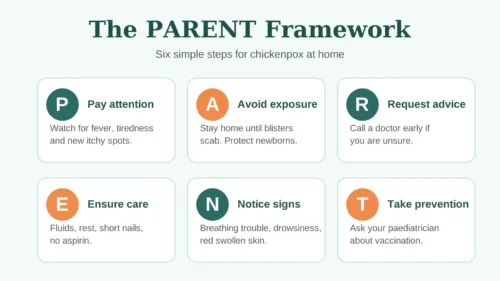
The PARENT Framework
- P: Pay attention to early symptoms such as fever and new spots.
- A: Avoid exposure. Keep your child home and away from vulnerable people.
- R: Request medical guidance when you are unsure.
- E: Ensure hydration, rest and appropriate care.
- N: Notice warning signs and changing symptoms.
- T: Take preventive steps, including vaccination advice.
An Illustrative Scenario
This scenario is invented to show decision making. It is not a documented case.
Aarav, aged six, comes home from school tired, with a mild fever and two itchy spots. His mother notices more spots by evening. She calls the family paediatrician, who advises home care and tells her to watch for warning signs. She informs the school, keeps Aarav home, cuts his nails, and offers fluids. She also avoids visiting her sister, who is pregnant. On day three, Aarav’s fever returns and one blister looks red and swollen. She calls the doctor again and he is seen the same day. Early review keeps a small skin infection from becoming a big one.
What the Numbers Mean
Two doses at about 90% effectiveness (CDC) means protection is high but not perfect. A WHO SAGE evidence document estimates about 84 million cases and about 14,500 deaths worldwide from 1990 to 2019. Deaths are rare, but cases are enormous. CDC data also show that mild breakthrough cases are roughly one third as contagious as unvaccinated cases, though cases with 50 or more lesions are just as contagious.
Advantages and Limitations
Vaccination sharply cuts illness and complications, but breakthrough infection can occur. Handwashing helps, but chickenpox spreads before the rash shows. Home care suits most children, but cannot replace a doctor when warning signs appear. No single step is a guarantee.
Common Misconceptions
- “It is always harmless.” Most cases are mild, but complications such as skin infection and pneumonia happen.
- “Every child has the same symptoms.” Severity varies widely.
- “Scratching does not matter.” It can scar and let bacteria in.
- “Home remedies replace doctors.” They soothe itching only.
- “Vaccination is pointless after school starts.” Children and adults without immunity can still be vaccinated, and the CDC recommends it.
Your Practical Checklist
- Call a doctor if you are unsure, or if a newborn, pregnant person or immunocompromised person was exposed.
- Keep your child home until all blisters have scabbed.
- Check fever, fluids and energy daily.
- Go for urgent care if you see breathing trouble, confusion or a stiff neck.
- Ask your paediatrician about vaccination.
Frequently Asked Questions
What are the first signs of chickenpox? Mild fever, tiredness and red spots that become itchy blisters.
How long does it last? The rash usually crusts over in about five days, though new spots can continue appearing for several days first.
Is it contagious before the rash? Yes, from one to two days before.
Can a vaccinated child get it? Yes, but illness is usually milder.
When can my child return to school? When all blisters have scabbed, usually about five days after they first appeared.
Can it cause complications? Yes. Skin infections are most common in children. See a doctor if warning signs appear.
Conclusion
Chickenpox is usually manageable. Recognise symptoms early, protect others, care calmly at home, and act on warning signs. Chickenpox vaccination remains the most reliable way to prevent illness and spread.
Health disclaimer: This article is educational and does not replace diagnosis or personalised medical advice from a qualified healthcare professional.