
It is Sunday evening. Your work is fine and your salary arrives on time, yet Monday feels heavy. A colleague has just left for a bigger title. A recruiter message sits unread. Is this a bad week, or is it time for your next career move?
That is the question worth answering: how do you know it is time for your next career move, and how do you make it wisely? A job search is not only about finding another job. It is about knowing your professional value, testing opportunities against it, and choosing the option that supports long term growth.
Table of Contents
What a Next Career Move Really Means
Changing jobs means a new employer for similar work. Changing careers means different work and new skills to prove. Both can be your next career move, but they need different preparation.
Salary and career value are not the same. Salary is what you earn this year. Career value is what you will be able to do, earn and choose in five years. A higher paying job that teaches you little can quietly shrink your future options.
Leaving and moving towards are also different. Escaping a poor manager feels urgent, but relief is not a destination. Finally, qualifications show that you studied, while competence shows that you can solve a problem. Measurable achievements, such as a cost you reduced or a team you led, persuade employers more than a list of courses.
Recognise the Right Time
Look for patterns, not moods. Warning signs include no new learning for a year, a role that has stopped growing, a workplace culture that clashes with your values, or changed personal priorities such as family or health.
A useful test: a rough patch has a cause you can fix and an end date. A structural problem does not. If your manager, workload or growth path will not change within twelve months, your career planning should start now.
Know Your Value, Then Read the Market
Write down your five strongest achievements with numbers, your transferable skills, and two gaps you must close. Then read ten job advertisements for the role you want and note the skills that repeat. That list, not assumption, shows what employers expect and what a realistic salary looks like.
What the Data Says
The World Economic Forum’s Future of Jobs Report 2025 (published January 2025) surveyed over 1,000 employers covering more than 14 million workers across 55 economies. Employers expect about 22% of jobs to be disrupted by 2030, with 170 million roles created, 92 million displaced, and nearly 40% of skills changing. [Reference 1]
The ILO’s Employment and Social Trends 2026 (January 2026) projects global unemployment at 4.9%, about 186 million people, while describing progress on decent work as stalled.
What this means for you: the market is steady overall, but the kind of work is shifting, so skills matter more than titles. Limits: both sources give global averages and employer forecasts, not promises. Check your own industry and city before deciding.
Salary Only or Full Evaluation?
| Salary only mover | Full evaluator | |
|---|---|---|
| Looks at | Pay increase | Pay, learning, leadership quality, culture, long term prospects |
| Strength | Fast, clear, helps with urgent bills | Fewer regrets, stronger career value |
| Risk | Stagnation, repeated moves | Slow decisions, missed timing |
| Best when | You are clearly underpaid or under financial pressure | You are building towards a senior or specialised role |
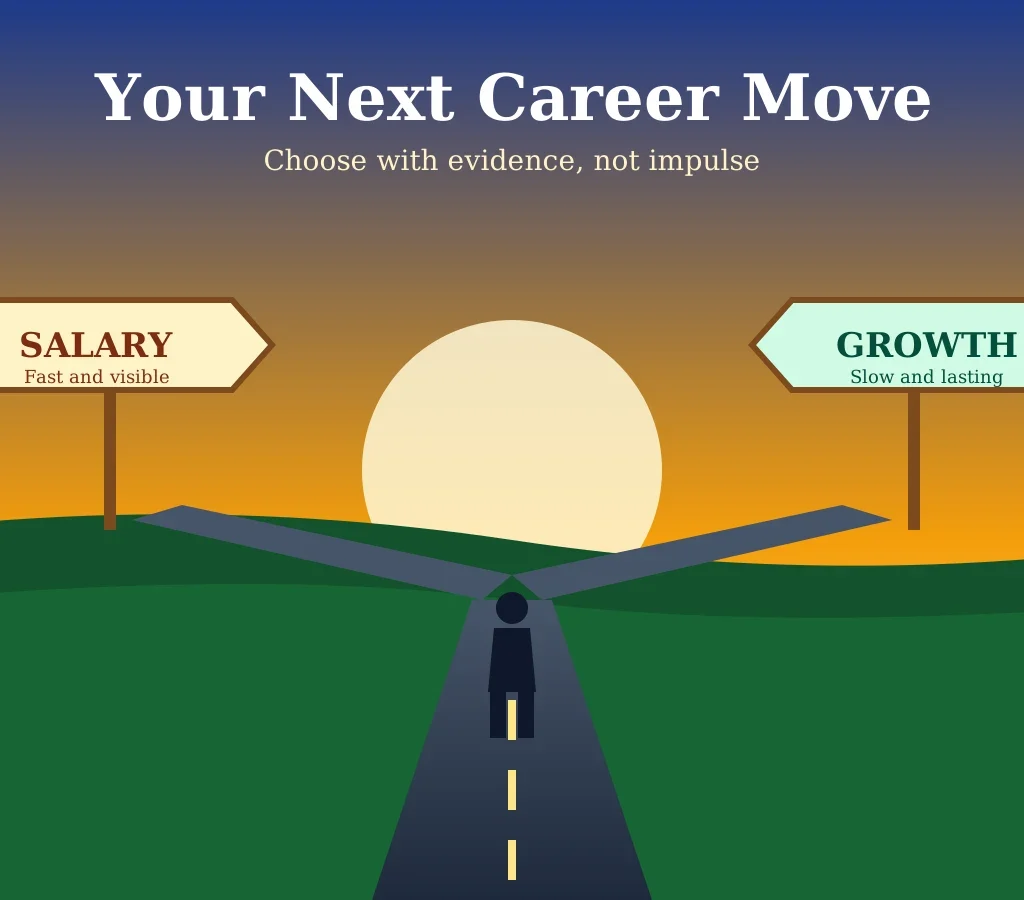
Salary matters, and being underpaid is a real problem. But when pay is the only measure, the gain often fades within a year while the weaknesses of the role remain. Full evaluation takes longer, and overthinking can cost you a good opening. Weigh pay heavily, but not alone.
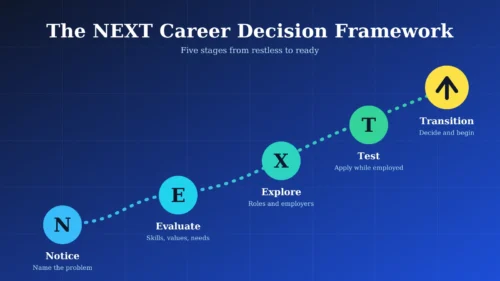
The NEXT Career Decision Framework
Created for this article as a practical tool.
N, Notice. Name what is wrong and when it started. Example: “I have not learned a new skill in eleven months.”
E, Evaluate. List your skills, values, money needs and expectations. Fix your non negotiables, such as a minimum salary or a commute limit.
X, Explore. Research industries, employers and roles. Speak to two people already doing the job you want.
T, Test. Update your resume, learn one missing skill, build connections and apply selectively while still employed. Testing lowers risk.
Transition. Compare offers on a written scorecard, negotiate responsibly and plan your first ninety days.
When the Offer Looks Perfect
This is an illustrative composite example, not a real person’s account.
Meera, an operations analyst, receives an offer with a 40% raise and a bigger title. During evaluation she asks to meet her future manager. She learns that the last three people in the role left within a year, and the promised growth has no budget or written scope.
The pressure builds. Her rent has risen, her current manager makes a small counteroffer, and the recruiter wants an answer by Friday. She asks two plain questions: where did the previous holders of this job go, and what does success look like in ninety days? The answers are vague.
Meera declines. She accepts a different offer with a 15% raise, a named mentor and a written learning plan. The lesson: an offer shows what you gain, but evaluation shows what you risk.
Why Smart People Choose Badly
Talented people often overweight what is visible, such as salary and brand name, and underweight what shows slowly, such as manager quality and workplace culture. Culture shapes daily satisfaction more than a title does. Technology adds pressure: as tools change tasks, transferable skills such as analysis, communication and learning speed protect you better than one narrow tool. (This is the author’s analysis, not a cited study.)
Common Misconceptions
- A higher salary always means a better career. Not if learning stops.
- Frequent job changes always damage your reputation. A few short stints with clear achievements are easy to explain. A long pattern without growth raises questions.
- A famous company guarantees growth. Growth depends on your manager and your role.
- A degree is enough. It opens doors, but evidence of skill wins offers.
- You must resign first. Usually not. Searching while employed is common, but respect your contract and confidentiality.
Real World Application
- Fresh graduate: choose the role with the best training and mentoring, not just the first offer.
- Experienced employee: hold a promotion conversation backed by results before you leave. If it is blocked, test the market.
- Career break returner: lead with current skills, a short refresher course and a clear reason for returning.
- Industry switcher: match your transferable skills to the new job advertisement and build one small proof project.
- Senior professional: look for flexible or mentoring roles that use your judgement, and explain what you offer.
FAQs
1. How do I know it is time for my next career move? When learning has stopped, growth is blocked, and the cause will not change within about a year.
2. Should I change jobs for a higher salary? Only if the role also offers learning, a good manager and stability, or if you are clearly underpaid.
3. Which skills should I improve first? Choose the skill that appears most often in ten advertisements for your target role.
4. How do I explain a career change in an interview? Give a short reason, show your transferable skills, and link the change to the new role’s needs.
5. Should I resign before finding another job? Usually no. Search while employed unless your health or safety is at risk.
6. How can experienced professionals stay competitive? Keep learning, record measurable results, and keep a network beyond your company.
What to Do Next
This week, write your career objective in one sentence, list your top five achievements, research three employers, start one short course, update your resume and message two professionals in your target field.
Conclusion
The question that began this article was simple: is it time? Now you can answer it with evidence. A good next career move is not the fastest change or the highest offer. It is a carefully evaluated decision that matches your strengths, your priorities and real opportunities. The best next career move is one you can explain calmly today and still believe in five years from now.