
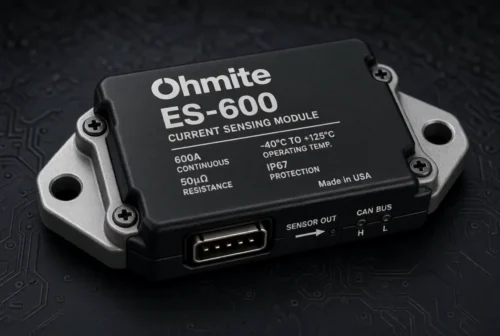
Ohmite ES-600:Picture an electric vehicle on an empty highway at night. The driver presses the pedal, and hundreds of amperes rush out of the battery pack. Behind the dashboard, the battery management system asks one quiet question: how much current is flowing right now?
If that answer is slightly off, every later estimate inherits the error. Power, charge, and battery condition all lean on it. So how can engineers measure enormous currents accurately enough to make informed decisions about a complex power system?
Part of the answer is a dedicated current sensing module such as the ES-600, made by Ohmite Mfg Co. This article explains what the ES-600 does, what its published numbers mean, where it fits, and how to judge any similar module.
One point first. A current sensing module supplies a measurement. It is not a battery management system or a vehicle safety system, and no single component can guarantee safety.
Table of Contents
What Makes the ES-600 Interesting?
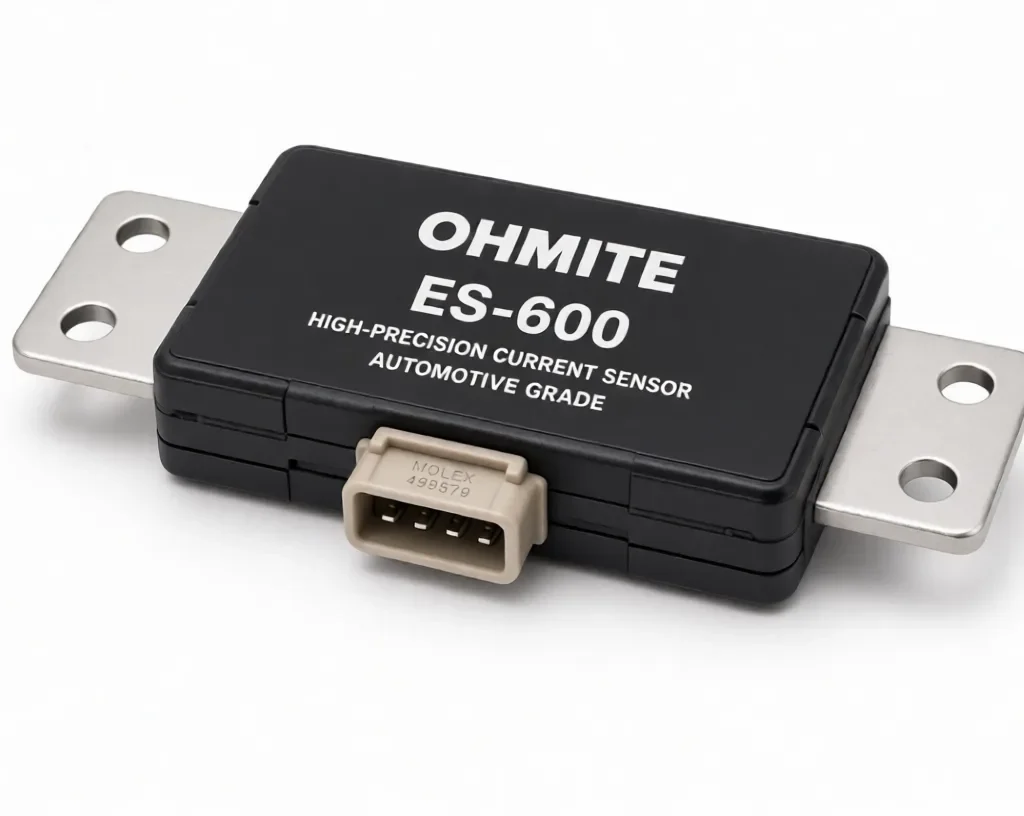
Ohmite describes the ES-600 as a high precision, automotive grade current sensing module. It measures current and reports it digitally.
Think of a speedometer. It reports speed, not fuel level or engine temperature. In the same way, the ES-600 reports current. It does not report voltage or how much charge a battery holds. Those need other measurements.
The module talks over CAN 2.0A/B, a shared bus where electronic units exchange short messages. In the datasheet, the default current message carries a 32 bit signed value in milliamperes, plus a cyclic counter, an overcurrent flag, and a measurement error flag. These extras help a controller notice missing or doubtful data. A separate message reports temperature.
The module can sample at a fixed interval, or answer a trigger command from the host controller. Ohmite states the delay after a valid trigger is below 1 ms.
The datasheet even shows a worked example. A frame ending in the bytes 0x000003E8 equals 1000 in decimal, which means 1000 mA, or 1 A. This matters because a controller must decode the bytes correctly. A reading is only useful if both sides agree on units, byte order, and sign. The datasheet notes that the default byte order is big endian and that identifiers and sampling settings can be changed with Ohmite’s tools, so factory defaults may not match a finished system.
The Numbers That Matter
All figures below come from Ohmite’s ES-600 pages. Check the current datasheet before you rely on them.
Rated range, ±600 A. This is the range in which the module is specified to measure. It is not the same as overcurrent capability. The datasheet lists separate overcurrent figures, including 2,000 A for 10 seconds and a peak of ±22,400 A for 50 ms. Those describe what the module can handle and measure under stated overcurrent conditions, not its normal working range.
Accuracy, ±0.1%. Accuracy tells you how close a reading should be to the true value. The datasheet also lists a current value error of minus 0.1 to 1% of reading across the nominal range, plus an offset error of up to ±30 mA and noise of up to 20 mA. Because these figures differ in wording, read the exact test conditions before using one number in a design.
Resolution, 1 mA. Resolution is the smallest step the module reports. A fine step does not mean the reading is correct to that step. Resolution and accuracy are different ideas.
Isolation, 5 kV. Galvanic isolation separates circuits electrically, so the measurement side and the communication side are not directly connected. It is a rating for the module. It does not make a whole vehicle or installation safe under every fault.
CAN interface. The interface is isolated CAN 2.0B with a 120 ohm internal termination. The default speed is 500 kbit/s, with 250 kbit/s and 1 Mbit/s as options. A CAN bus normally needs termination only at its two physical ends, so an internal terminator matters when you plan the network.
Supply and conditions. The module runs from 4.5 V to 40 V and draws 18 mA at 12 V. The operating temperature range is minus 40 °C to 105 °C. The datasheet gives a setup time of 150 to 200 ms, so the first reading is not instant after power up.
Where Can It Make a Difference?
Ohmite lists four applications: battery current monitoring for automotive use, grid energy storage, uninterruptible power supply systems, and charging stations.
Those are the established uses. What follows are reasonable engineering possibilities, not proven results.
In a vehicle, current data can show how hard the battery is working during acceleration and charging. In grid storage, it can show how a large battery bank responds as demand rises and falls. In a UPS, it can show how load changes during a power cut. At a charging station, it can show how much current actually flows during a session.
The value of such data often lies in trends, not single readings. A slow drift over weeks, a spike that repeats at the same hour, or a sudden gap in messages can all point engineers toward a question worth asking. The measurement does not answer the question alone. It gives people and software something solid to investigate.
None of this promises lower cost, higher efficiency, or better safety. Those depend on the full system and how it is built.
A Practical Example
This case is illustrative. It uses no real customer and no real data.
Suppose engineers at a fictional energy storage site see odd jumps in recorded battery current during peak evening demand. How might they investigate?
- Compare the data with the load. Do the jumps match known changes in demand, or do they appear at random?
- Check the CAN messages. The cyclic counter should rise in order. Gaps suggest lost messages. The error flag should stay clear.
- Inspect wiring and connectors. A loose connector or poor ground can disturb readings. The same goes for a missing or doubled bus terminator.
- Read the system logs. Do software updates or controller restarts line up with the jumps?
- Verify independently. Compare against a calibrated reference meter at a known current.
Each step narrows the cause. The lesson is that good measurement plus careful diagnosis beats trusting any single number.
A Simple Evaluation Framework
Before choosing a current sensing module, ask five questions.
- Range. Does the rated range cover normal currents and expected short surges?
- Accuracy. Is the stated accuracy enough for the job, such as charge estimation or simple protection?
- Isolation and interfaces. Do the isolation rating, supply voltage, and temperature range suit the whole system?
- Communication. Can your controller use the supported CAN settings and message format?
- Practicalities. Are installation needs, verification steps, documentation, support, and total cost acceptable?
No single impressive number decides the choice. The full specification and the real application do. This framework is educational. It does not replace engineering design, manufacturer instructions, applicable standards, or a formal safety assessment.
Advantages, Limitations, and Common Misconceptions
Advantages supported by the published data: a stated accuracy of ±0.1%, a ±600 A rated range, 5 kV isolation, and an isolated CAN interface that fits vehicle and energy systems.
Limitations: the stated ratings apply only within the published conditions. Integration needs work, including wiring, CAN settings, and message decoding. The module must also be validated in the real system.
How it compares. Hall effect sensors and shunt based systems are two other common approaches. Hall sensors often measure without touching the conductor. Shunt systems convert current to a small voltage and can be very precise, but they dissipate heat and need isolation. The real comparison depends on specific products, range, cost, bandwidth, and isolation. Ohmite’s pages do not explain the ES-600’s internal sensing method in the text reviewed, so this article draws no conclusion about it. It also does not call the ES-600 better than competing products.
Five common misconceptions:
- High accuracy does not make a whole system safe.
- Resolution is not accuracy.
- Galvanic isolation does not remove every electrical hazard.
- A CAN interface does not guarantee compatibility without configuration.
- Peak current capability is not the rated measurement range.
What Should Readers Do Next?
Start with the official datasheet. Then match its conditions to your intended use, and study the communication and installation requirements. For any high current system, consult a qualified engineer before selecting or installing a component.
In the end, the fictional driver on that dark highway depends on something simple. Dependable measurement is a foundation for understanding complex electrical systems, and the ES-600 is one example of a tool built for that job.
Frequently Asked Questions
What is the Ohmite ES-600? It is a high precision, automotive grade current sensing module from Ohmite that reports measurements over an isolated CAN 2.0B interface.
What does a ±600 A measurement range mean? The module is specified to measure currents from minus 600 A to plus 600 A in either direction. Overcurrent ratings are separate.
What does ±0.1% accuracy mean? It describes how close a reading should be to the true value under the stated conditions. Check the datasheet for those conditions and the related error figures.
Why is galvanic isolation important? It keeps circuits electrically separated, which helps protect low voltage electronics from the high voltage side. It does not make a system safe by itself.
How does a CAN interface help? It lets the module send current and temperature data as short messages that a controller can read alongside data from other units.
What should engineers check before choosing the ES-600? Range, accuracy conditions, isolation, supply voltage, temperature range, CAN settings, installation needs, and verification plans.