She ran three times a week. She ate what most people would call a reasonable diet. Her blood pressure cuff at the pharmacy always blinked back a friendly green number. By every visible measure, she was fine.
Then a routine scan, ordered almost as an afterthought, found calcium sitting inside the walls of her coronary arteries. A follow up ultrasound, ordered because her doctor wanted the fuller picture, found something else entirely: her liver was quietly coated in fat.
Two findings. No symptoms. No warning. Just a pair of quiet discoveries that, together, hinted at something bigger than either one alone.
This is the shape of what many clinicians now describe as a silent epidemic, a slow, largely invisible drift toward cardiovascular and metabolic trouble that rarely announces itself before it has already taken hold. It doesn’t always look dramatic. It looks like normal life, right up until a test says otherwise.
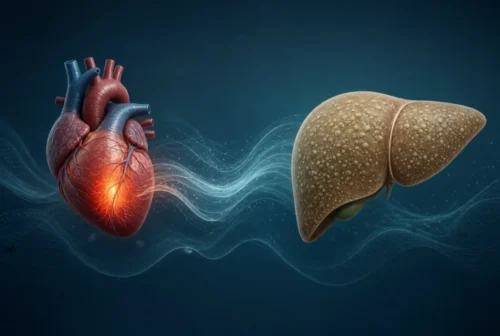
So here’s the real question worth sitting with: could two conditions that seem to live in completely different organs actually be chapters of the same underlying story?
Table of Contents
The Silent Warning
Coronary calcium deposits form when calcium builds up inside the walls of the arteries that feed the heart muscle. The body doesn’t do this randomly. Calcification tends to appear where there has already been some degree of injury or plaque formation inside the artery wall, often over many years.
That’s part of what makes it unsettling. A coronary calcium score is essentially a photograph of accumulated history. It doesn’t measure how you feel today. It measures what has already been happening beneath the surface, sometimes for a decade or more, without producing a single symptom.
None of this means calcification equals catastrophe. A calcium score is a data point, not a verdict. But it is the kind of data point that deserves attention rather than avoidance.
What the Calcium (Silent Epidemic)Reveals
Think of the coronary arteries as flexible pipes lined with a delicate inner surface. Over years of exposure to high cholesterol, high blood sugar, high blood pressure, or chronic low grade inflammation, that inner lining can become irritated. The body responds the way it often does to irritation and injury elsewhere: it lays down a kind of biological scar tissue, and in the arteries, that repair process frequently involves calcium.
A higher calcium score generally correlates with a greater amount of underlying plaque, and more plaque generally correlates with higher cardiovascular risk. This is why the finding matters clinically, even in someone who feels perfectly well. It is not a symptom. It is a clue, and clues are worth investigating rather than dismissing.
What a calcium score cannot do is tell you exactly when, or even if, a cardiac event will occur. Plenty of people live for years with known calcification and never have a heart attack, particularly once they address the modifiable risk factors driving it. The finding is a prompt for a conversation with a cardiologist, not a countdown clock.
Fatty Liver (Silent Epidemic)Without the Alarm
Fatty liver disease, now more precisely referred to in research circles as metabolic dysfunction associated steatotic liver disease, occurs when fat accumulates inside liver cells beyond what is considered normal. In its early stages, it is remarkably good at staying quiet.
There is no obvious ache that says “your liver has extra fat in it.” Liver tissue itself has very few pain receptors, so even meaningful fat buildup rarely produces discomfort until the disease has progressed considerably. Many people carry it for years and find out only because a scan ordered for something else happened to catch it.
That silence is exactly why fatty liver disease has quietly become one of the most common liver conditions worldwide, according to the National Institute of Diabetes and Digestive and Kidney Diseases. It doesn’t need permission to progress. It simply does, unless something interrupts the underlying drivers. Public health researchers increasingly describe this pattern, a widespread condition producing almost no symptoms until it’s advanced, as part of a genuine silent epidemic in modern metabolic health.
Left unaddressed, liver fat can eventually contribute to inflammation and scarring within the organ. But the far more immediate concern for most people isn’t the liver itself. It’s what fatty liver tends to say about the rest of the body’s metabolic state, which brings the story back toward the heart.
The Metabolic Connection
Here is where the plot genuinely thickens. Coronary calcium deposits and fatty liver disease are not neighbors by coincidence. They frequently show up in people who share a cluster of underlying issues, sometimes called metabolic syndrome, that includes insulin resistance, abdominal obesity, elevated blood pressure, and unfavorable cholesterol patterns.
Insulin resistance sits close to the center of this. When cells stop responding efficiently to insulin, the body compensates by producing more of it. Over time, that excess insulin encourages the liver to store more fat, while also contributing to the kind of vascular inflammation that can accelerate arterial calcification. It is one metabolic disturbance quietly influencing two different organs at once.
Cholesterol adds another layer. Elevated triglycerides and low HDL cholesterol, a pattern often seen alongside fatty liver, are also recognized cardiovascular risk factors. Chronic low grade inflammation, frequently elevated in people carrying excess visceral fat, has been linked to both plaque formation in arteries and fat accumulation in the liver.
Shared driver
Effect on the heart
Effect on the liver
Insulin resistance
Promotes vascular inflammation and plaque buildup
Encourages fat storage inside liver cells
Visceral obesity
Raises blood pressure and strains the cardiovascular system
Strongly associated with liver fat accumulation
Dyslipidemia
Contributes to arterial plaque and calcification
Common companion finding in fatty liver
Chronic inflammation
Accelerates arterial wall injury
Can progress liver fat toward inflammation
Sedentary behavior
Reduces cardiovascular conditioning
Reduces the body’s ability to burn stored fat
Seen this way, coronary calcium and fatty liver look less like two unrelated diagnoses and more like two different instruments picking up the same underlying signal, coming from the same metabolic engine room. It’s a big reason clinicians increasingly talk about a broader silent epidemic of metabolic dysfunction rather than treating heart and liver findings as separate stories.
Association Is Not Causation
This is the point in the story where responsible reporting has to slow down.
Research suggests a meaningful association between fatty liver disease and coronary artery calcification. Multiple studies have found that people with fatty liver are statistically more likely to also show coronary calcification, even after accounting for some traditional risk factors. That is a real and clinically relevant observation.
It is not proof that fatty liver directly causes calcium to form in the arteries. Association describes things that travel together. Causation describes one thing directly producing another. Right now, the more defensible scientific position is that both conditions frequently arise from a shared set of metabolic disturbances, rather than one condition simply triggering the other in a straight line.
This distinction matters for how you think about your own health. If someone told you that fixing your liver alone would guarantee a clean coronary calcium score, that would be an overstatement of current evidence. The more accurate, and honestly more useful, framing is this: both findings often point back toward the same modifiable metabolic risk factors, and addressing those factors carefully assessed by a qualified professional tends to support both organs at once. Understanding that distinction is exactly what allows people to respond to a silent epidemic with informed action instead of unnecessary panic.
Illustrative Case Study Of Silent Epidemic
The following is a constructed educational example, not a real patient, and is used only to illustrate how these findings can come together in practice.
Imagine a 47 year old office worker, generally active, with no chest pain and no family history he considers alarming. A workplace wellness screening flags borderline high blood pressure and a slightly elevated fasting glucose. His physician orders a broader metabolic panel and, given his risk profile, a coronary calcium scan.
The scan returns a mild but measurable calcium score. Curious about the borderline glucose reading, the physician also orders an abdominal ultrasound, which reveals mild fatty liver.
Neither finding alone would have been dramatic. Together, they prompt a fuller risk assessment: waist circumference, triglycerides, HDL cholesterol, blood pressure trends, and activity levels. The picture that emerges isn’t a diagnosis of impending disaster. It’s a clearer map of where his metabolic health actually stands, years before either condition might have produced a symptom he could feel.
That is the quiet value of connecting these dots early, rather than waiting for something loud enough to demand attention on its own.
7 Clues Worth Taking Seriously
None of these guarantee a problem exists. Together, they are the kind of pattern worth discussing with a healthcare professional, and the kind of pattern that keeps this silent epidemic hidden in plain sight for so many people.
A waistline that keeps expanding, even without significant overall weight gain, often signals visceral fat accumulation around internal organs.
Borderline or rising blood sugar on routine labs, even below the threshold for diabetes, can reflect early insulin resistance.
Persistently elevated triglycerides paired with low HDL, a pattern frequently overlooked because total cholesterol looks acceptable.
Fatigue after meals, particularly carbohydrate heavy ones, which some people notice long before any formal diagnosis.
Mildly elevated liver enzymes on a standard blood panel, easy to dismiss as a lab quirk but worth a second look.
A family history of early heart disease or type 2 diabetes, which raises baseline risk regardless of current symptoms.
Rising blood pressure readings over time, even when each individual reading still falls in a technically normal range.
Any one of these, on its own, may mean very little. A cluster of them is a stronger reason to ask a doctor for a more complete metabolic and cardiovascular risk assessment.
What You Can Do Now
The encouraging part of this story is that the shared risk factors behind coronary calcium and fatty liver are largely the same factors that respond to lifestyle change, sustained over time rather than perfected overnight.
Regular physical activity, even moderate walking most days of the week, has been associated with improvements in insulin sensitivity and liver fat content. Reducing added sugars and refined carbohydrates tends to ease the burden on both insulin metabolism and liver fat storage. Prioritizing fiber rich vegetables, lean protein, and heart healthy fats supports favorable cholesterol patterns over time.
Sleep and stress deserve more credit than they usually get. Chronic sleep deprivation and ongoing stress both influence insulin sensitivity and inflammation, quietly feeding the very mechanisms connecting these two conditions.
These are also, not coincidentally, the same daily habits research consistently ties to slowing the broader silent epidemic of insulin resistance and metabolic syndrome. None of this replaces medical care, and it is not a substitute for treatment your doctor has recommended. Lifestyle change is a genuine, evidence based complement to professional medical guidance, not a stand in for it. For readers exploring this further, KritiInfo’s guide to metabolic health and KritiInfo’s overview of heart healthy nutrition go deeper into practical daily steps.
When to Talk to Your Doctor
Bring this up with a healthcare professional if you have any combination of the risk clues above, a family history of heart disease or diabetes, or simply haven’t had a metabolic risk assessment in several years despite feeling well.
Some symptoms warrant urgent attention rather than a scheduled discussion. Chest pain or pressure, severe or unexplained shortness of breath, fainting, or sudden severe abdominal pain should prompt immediate medical evaluation, not a wait and see approach.
A conversation about coronary calcium scoring, liver imaging, or expanded metabolic labs is a reasonable, proactive step for many adults, particularly those with risk factors, even in the complete absence of symptoms. Screening exists precisely because these conditions are so good at staying invisible until they aren’t, which is the entire premise behind treating this as a silent epidemic worth investigating early rather than reacting to later.
FAQ
Does fatty liver disease guarantee I will develop coronary artery calcification? No. The two conditions are associated, particularly when they share underlying metabolic risk factors, but having one does not mean the other is inevitable.
Can coronary calcium go away once it forms? Established calcium deposits generally do not reverse. However, addressing risk factors can slow further plaque progression and reduce overall cardiovascular risk going forward.
Is fatty liver disease always related to alcohol use? Not necessarily. Metabolic dysfunction associated steatotic liver disease occurs independent of significant alcohol intake and is closely tied to insulin resistance, obesity, and related metabolic factors.
At what age should someone consider a coronary calcium scan? This depends on individual risk factors, family history, and existing health conditions. A qualified healthcare professional is best positioned to determine appropriate timing.
Can lifestyle changes alone reduce liver fat? Weight management, dietary changes, and increased physical activity have been associated with measurable reductions in liver fat in many people, though results vary and medical guidance should accompany any specific plan.
Are normal cholesterol numbers enough to rule out risk? Not necessarily. Some people with normal total cholesterol still show significant coronary calcification, which is part of why broader risk assessment can be valuable.
Is coronary calcium scoring recommended for everyone? It is generally considered for people with intermediate cardiovascular risk or uncertain risk factor profiles, based on individual clinical judgment rather than a blanket recommendation for all adults.
Can fatty liver disease be diagnosed without an ultrasound? Ultrasound is a common first step, but blood tests, other imaging methods, and occasionally liver biopsy may also play a role depending on the clinical picture.
The Bigger Picture
Two quiet findings, one in the arteries and one in the liver, are rarely just about the arteries or just about the liver. More often, they are two visible signs of a shared metabolic story that has been writing itself for years, mostly out of sight.
That is precisely why this pattern deserves to be treated less like a frightening diagnosis and more like an early warning worth listening to. Awareness, timely screening, and honest conversations with a qualified healthcare professional remain the most reliable tools against a silent epidemic that, by its very nature, rarely announces itself until someone decides to look.
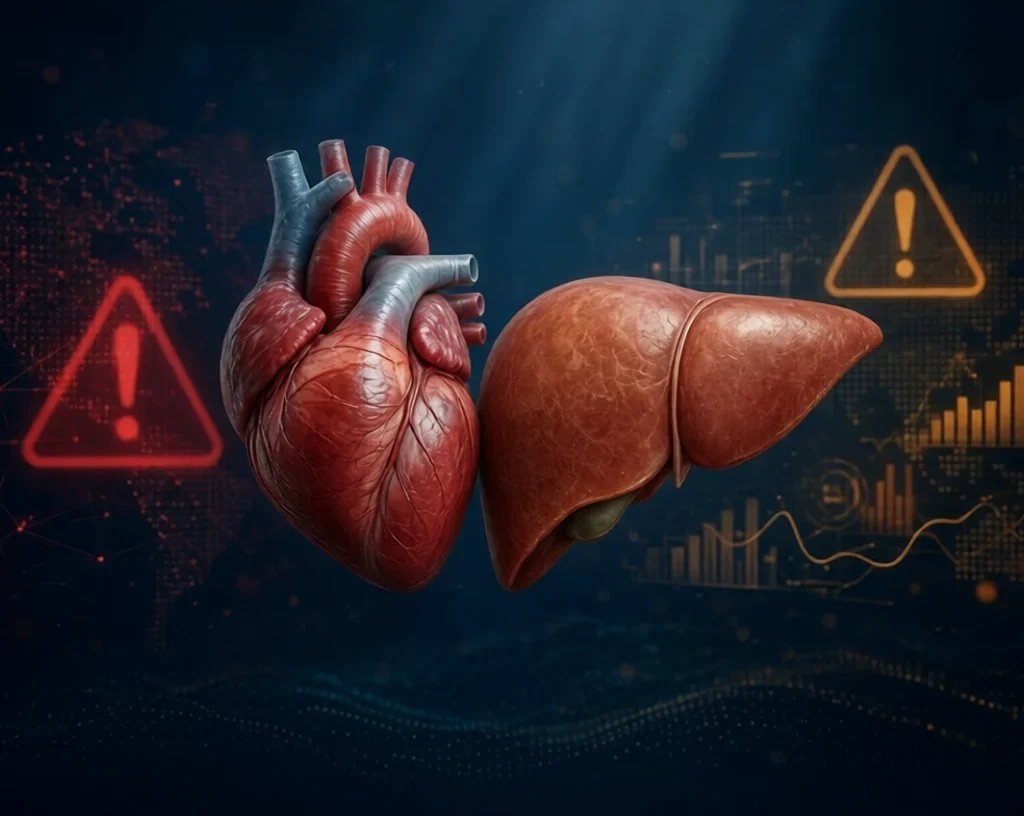
Rising silent threats to heart and liver health
Views:94
1 thought on “Why 7 Hidden Clues Reveal a Silent Epidemic in Your Heart and Liver”

1 thought on “Why 7 Hidden Clues Reveal a Silent Epidemic in Your Heart and Liver”