
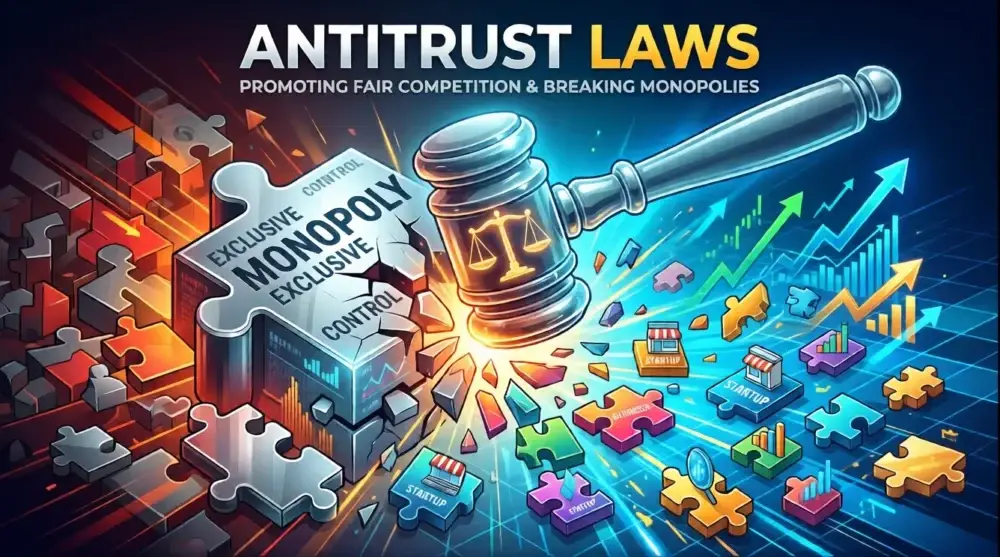
Introduction: Why fair competition matters
Imagine a town where only one company sells essential products. Customers have no alternative, prices keep increasing, and the company has little reason to improve its services.
Now imagine another town where several businesses compete. Customers can compare prices, choose better products, and enjoy improved services.
Which market would you prefer?
The answer is obvious. Competition gives customers choices and encourages businesses to improve.
This is where Antitrust Laws become important. These laws protect competition by preventing businesses from using unfair methods to control markets, eliminate competitors, or exploit their market power.
For managers, understanding competition law is not merely a legal responsibility. It is an important part of responsible leadership, business strategy, and long-term growth.
In India, the principal legislation governing competition is the Competition Act, 2002, administered by the Competition Commission of India (CCI).
Let’s understand how these laws work and why every responsible business manager should know about them.
Table of Contents
1. What are Antitrust Laws?
Antitrust Laws are regulations designed to protect fair competition in the marketplace.
They prevent businesses from entering into arrangements that restrict competition or abusing a dominant market position.
The basic objective is simple: businesses should succeed through better products, reasonable prices, innovation, and customer service rather than through practices that unfairly restrict competitors.
These laws generally address three important areas:
- Agreements that restrict competition.
- Abuse of a dominant market position.
- Mergers and acquisitions that may substantially reduce competition.
Although the term antitrust is commonly used in the United States, many countries use the expression competition law.
India follows the Competition Act, 2002, while the United States has major federal antitrust legislation, including the Sherman Act and Clayton Act.
2. Seven ways Antitrust Laws protect competition
1. Preventing price fixing
Price fixing occurs when competing businesses secretly agree to charge similar prices or coordinate their pricing decisions instead of competing independently.
For example, imagine three cement manufacturers agreeing that none will sell cement below a particular price.
Customers lose the benefit of genuine price competition.
Such agreements can violate competition law.
Management lesson: Your pricing strategy should be based on independent business analysis, costs, market conditions, and customer value, not secret agreements with competitors.
2. Stopping market sharing
Market sharing happens when competing businesses divide customers, territories, or product categories among themselves.
Imagine two transport companies agreeing that one will serve northern India while the other will avoid that territory.
They may appear to be competing businesses, but their agreement removes genuine competition.
Management lesson: Never agree with a competitor to divide customers, geographical areas, or business opportunities.
3. Controlling abuse of dominant position
A successful business may become powerful enough to influence an entire market.
Being dominant is not automatically illegal. The problem arises when a business abuses that position.
Examples may include unfair conditions, discriminatory treatment, or practices that restrict competitors and harm the competitive process.
India’s Competition Act addresses abuse of dominant position under Section 4.
Management lesson: Market leadership creates responsibility. A company should compete through efficiency and innovation rather than using its power to exclude others unfairly.
4. Reviewing mergers and acquisitions
Mergers can create stronger companies, improve efficiency, and encourage innovation.
However, some mergers may substantially reduce competition.
Consider a city with only two major internet service providers. If they merge, consumers might have fewer alternatives and face higher prices.
Competition authorities may examine such transactions before allowing them to proceed.
In India, combinations are regulated under Sections 5 and 6 of the Competition Act, subject to applicable thresholds, exemptions, and procedures.
Management lesson: Before acquiring a competitor, assess not only financial benefits but also competition-law implications.
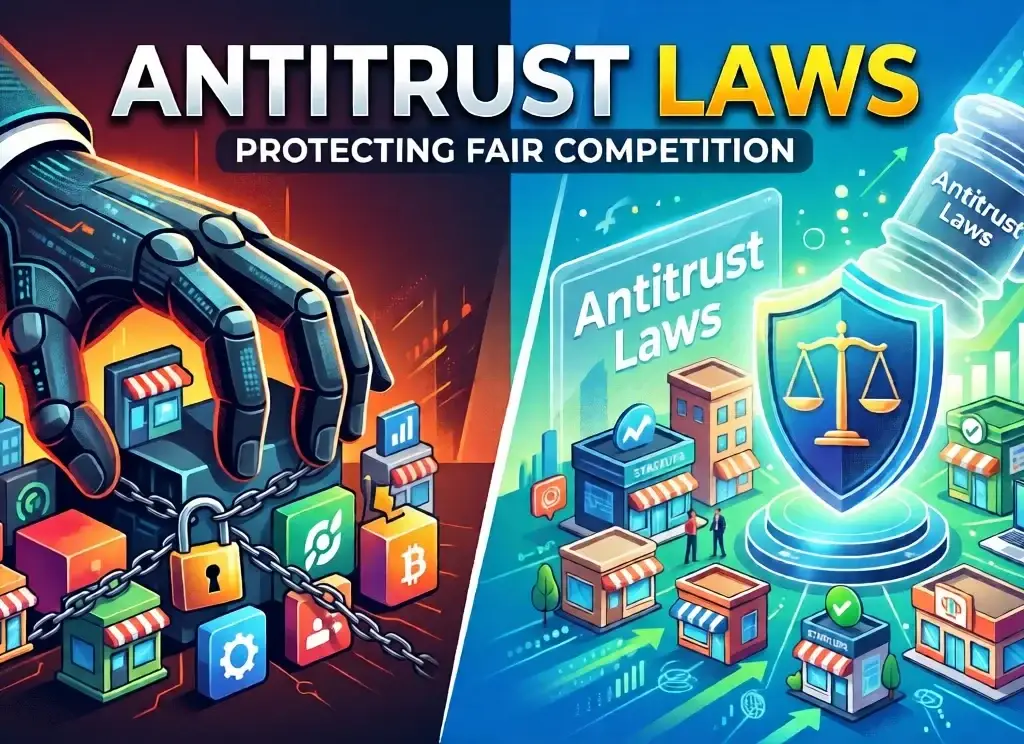
5. Protecting small businesses
Small businesses often lack the financial resources and market influence of large corporations.
Without fair competition, powerful businesses could use restrictive arrangements or exclusionary conduct to make market entry unnecessarily difficult.
Antitrust Laws help preserve opportunities for businesses of different sizes.
However, these laws do not guarantee that every small business will succeed. They protect the competitive process, not individual competitors from ordinary commercial failure.
6. Encouraging innovation
Competition encourages companies to improve their products, introduce new technology, and respond to customer expectations.
When customers have meaningful alternatives, businesses cannot rely indefinitely on their existing market position.
For example, competition among smartphone manufacturers encourages better cameras, improved battery performance, and more useful software.
Management lesson: Innovation should be a core competitive strategy, not an afterthought.
7. Protecting consumers
Ultimately, healthy competition benefits consumers.
It can encourage:
- Competitive pricing.
- Better product quality.
- Improved customer service.
- Greater product variety.
- Faster technological development.
However, competition law does not guarantee the lowest price in every situation. Its purpose is to protect the competitive process so that markets can function fairly.
3. Real-world example: Google’s Android case in India
One of the important Indian examples of competition regulation involves Google and its Android mobile operating system.
Android became widely used because it provided smartphone manufacturers with a popular operating system and access to Google’s mobile ecosystem.
However, the Competition Commission of India examined certain Google practices concerning Android licensing, pre-installation of applications, and restrictions imposed on manufacturers.
In October 2022, the CCI imposed a penalty of approximately ₹1,337.76 crore on Google and issued directions intended to address competition concerns.
Google challenged the decision before the National Company Law Appellate Tribunal (NCLAT), which upheld the penalty while modifying certain directions.
What can managers learn from this case?
Three important lessons emerge:
- A popular product does not automatically justify restrictive commercial conditions.
- Agreements with business partners should be reviewed for their competitive effects.
- Companies with significant market influence must pay particular attention to how their commercial policies affect other market participants.
This example demonstrates that competition law is relevant not only to traditional industries but also to digital platforms and technology businesses.
4. Antitrust Laws versus ordinary business competition
There is an important difference between healthy competition and anti-competitive conduct.
| Healthy competition | Anti-competitive conduct |
|---|---|
| Reducing prices independently | Secretly fixing prices |
| Improving product quality | Dividing markets with rivals |
| Developing better technology | Restricting competition through unlawful agreements |
| Winning customers through service | Excluding competitors through abusive conduct |
| Expanding through innovation | Merging without required competition clearance |
The distinction matters because competition law does not punish a company simply for being successful.
A business can become a market leader through hard work, investment, efficiency, and innovation.
The concern arises when business conduct unlawfully damages the competitive process.
5. What should managers do to remain compliant?
Understanding the law is useful, but applying it in daily management is even more important.
Here is a practical framework for business leaders.
Step 1: Establish independent pricing policies
Sales teams should make pricing decisions independently. Avoid discussions with competitors about future prices, discounts, production volumes, or commercial strategies.
Step 2: Train employees
Employees working in sales, procurement, distribution, marketing, and strategic partnerships should understand basic competition-law risks.
Step 3: Review commercial agreements
Examine distribution agreements, exclusivity arrangements, supplier contracts, and partnership terms for potentially restrictive provisions.
Step 4: Document business decisions
Maintain clear records explaining pricing decisions, negotiations, acquisitions, and important commercial policies.
Step 5: Review mergers early
Seek competition-law advice before finalizing an acquisition or merger. Do not assume that a transaction is exempt from regulatory requirements.
Step 6: Create a reporting system
Employees should have a safe way to report suspicious discussions or potentially anti-competitive practices.
Step 7: Consult qualified legal professionals
Competition law can involve complex economic and legal questions. Managers should seek specialist advice when a proposed arrangement raises concerns.
6. The Indian legal framework: What businesses should know
In India, the Competition Act, 2002 provides the principal framework for regulating competition.
The Competition Commission of India is responsible for enforcing the law.
Some important provisions include:
| Provision | What it addresses |
|---|---|
| Section 3 | Anti-competitive agreements |
| Section 4 | Abuse of dominant position |
| Sections 5 and 6 | Regulation of combinations |
| Section 19 | Inquiry into certain agreements and dominant-position issues |
| Section 27 | Orders by the Commission in relevant cases |
The Competition (Amendment) Act, 2023 also introduced significant changes to the competition framework, including provisions relating to settlements, commitments, and deal-value thresholds.
Businesses should check the latest applicable regulations, notification requirements, exemptions, and CCI guidance before taking decisions.
7. Limitations and common misconceptions
Competition regulation is important, but it is not a magic solution to every business problem.
Consider these common misconceptions:
Misconception 1: Every large company is a monopoly.
Incorrect. A large market share does not automatically establish an unlawful monopoly or abuse of dominance.
Misconception 2: Every merger is illegal.
Incorrect. Many mergers improve efficiency and benefit consumers. Competition authorities examine whether applicable legal requirements are met.
Misconception 3: Lower prices are always evidence of fair competition.
Not necessarily. Pricing strategies must be examined in their commercial and legal context.
Misconception 4: Competition law applies only to multinational corporations.
Incorrect. Businesses of different sizes may face competition-law obligations depending on their conduct and circumstances.
The real challenge is to balance commercial freedom with fair market practices.
8. What the future holds for competition law
The business environment is changing rapidly.
Digital platforms, artificial intelligence, online marketplaces, cloud services, and data-driven business models are creating new competition challenges.
For example, a digital platform may connect millions of customers and businesses. Its commercial policies can influence which sellers receive visibility and which products customers discover.
Artificial intelligence introduces further questions about pricing coordination, data access, algorithmic decision-making, and market concentration.
Competition authorities around the world are paying increasing attention to these developments.
For managers, the message is straightforward: compliance strategies must evolve alongside technology and business models.
Companies that build transparent policies and encourage genuine competition will be better positioned to establish long-term trust.
9. Frequently asked questions about Antitrust Laws
Q1. What is the main purpose of Antitrust Laws?
Their main purpose is to protect fair competition, prevent anti-competitive conduct, and promote markets that offer meaningful choices to consumers.
Q2. Are Antitrust Laws applicable to small businesses?
Yes. Competition laws can apply to businesses of different sizes. Their applicability depends on the relevant legal provisions and the conduct involved.
Q3. Is having a monopoly illegal?
Not necessarily. A company may become dominant through legitimate business success. However, abusing a dominant position can violate competition law.
Q4. What is price fixing?
Price fixing is an agreement between competing businesses to control or coordinate prices rather than making independent pricing decisions.
Q5. Who regulates competition in India?
The Competition Commission of India (CCI) is the principal authority responsible for enforcing the Competition Act, 2002.
Q6. Can a merger violate competition law?
Yes. A merger or acquisition may raise competition concerns if it substantially reduces competition or falls within applicable regulatory requirements.
Q7. How can managers prevent competition-law violations?
They should establish independent pricing policies, train employees, review commercial agreements, document decisions, and consult qualified legal professionals.
Conclusion: Fair competition creates stronger businesses
Antitrust Laws are not simply restrictions imposed on businesses. They are safeguards that help markets function fairly.
They encourage companies to improve their products, develop better services, invest in innovation, and compete for customers through genuine value.
For managers, the real lesson is that sustainable success should not depend on eliminating competition through unfair practices.
A company may achieve temporary advantages through market manipulation, but lasting business success comes from trust, efficiency, innovation, and customer satisfaction.
The best business strategy is not to destroy competition but to become better than the competition.
That is the foundation of responsible management and a healthier marketplace.