
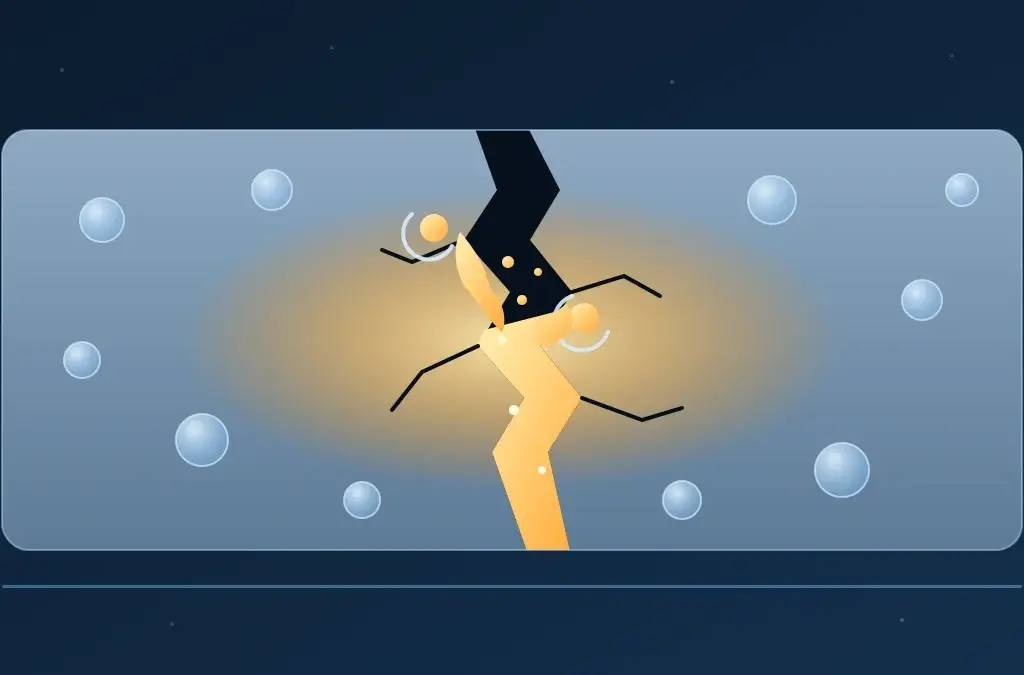
A crack is normally where a material’s story ends. In 2000, at the University of Illinois, a team led by Scott White and Nancy Sottos turned a crack into a starting point. They packed tiny capsules with a liquid, mixed them into epoxy plastic, then broke the sample on purpose. The crack tore through the capsules, the liquid flowed out, met a catalyst and hardened. The plastic mended itself. Their 2001 paper in Nature reported recovery of up to 75% of the original toughness.
That experiment gave the world its most famous self healing material. Today the idea is moving into concrete, aircraft parts, car paint and electronics. This guide explains how a self healing material really works, where one already exists, where claims run ahead of evidence, and how to judge one before you trust it.
What Is a Self Healing Material?
A self healing material is designed to repair damage by itself, fully or partly, so it keeps doing its job. Biology is the model. Skin closes a cut and bone knits after a fracture.
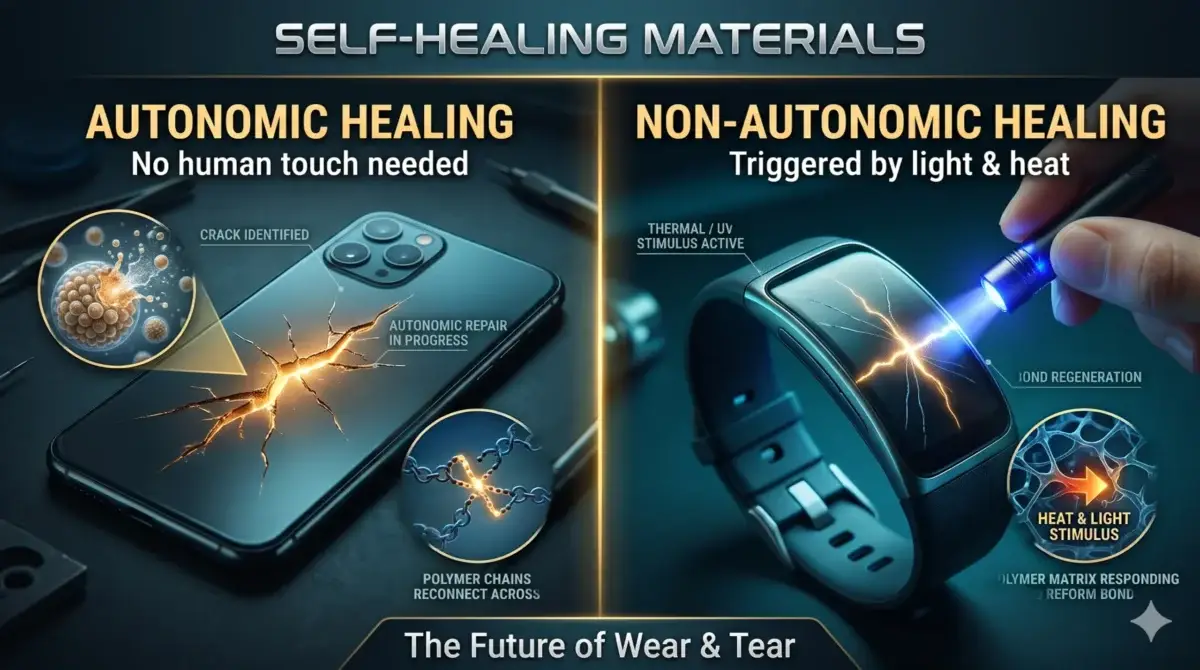
Researchers sort these materials in two ways. The first is where the healing comes from. An intrinsic material heals through reversible chemical bonds built into its structure. An extrinsic material carries a separate healing agent, stored in capsules or tiny channels, which is released when damage happens. The second is how it starts. An autonomous material repairs without help. A non autonomous one needs a push, such as heat or light.
Keep these two splits in mind. Nearly every news headline about a self healing material hides which type it is, and that detail decides whether it is useful.
Table of Contents
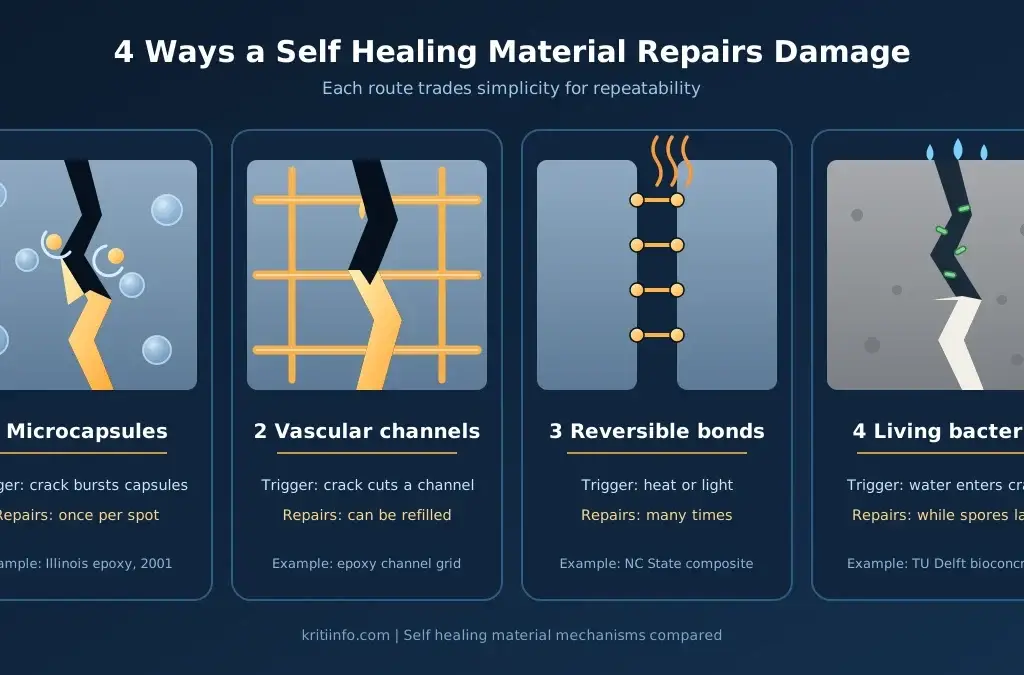
How a Self Healing Material Works: 4 Mechanisms Compared
| Mechanism | How it heals | Real example | Main limit |
|---|---|---|---|
| Microcapsules | A crack bursts capsules, and the liquid reacts with a catalyst | Illinois epoxy, 2001 | The capsules in one spot run out |
| Vascular channels | Tiny tubes carry and refill healing liquid | Epoxy with a channel grid, shown by Toohey and colleagues | Hard and costly to build |
| Reversible bonds | Bonds break and reform, often with heat | Thermal remending in composites | Usually needs a heat source |
| Living bacteria | Dormant spores wake with water and make limestone | Bioconcrete from TU Delft | Mainly for concrete, and field proof is thin |
Notice the trade. Capsules are simple but give roughly one repair per spot. Channels can be refilled, so they repair more than once, but they are harder to make. Reversible bonds can repeat many times, but most need heat.
Real World Example 1: Bacteria That Mend Concrete
Concrete cracks. Once water seeps in, the steel inside rusts and the structure weakens. A team at Delft University of Technology, led by microbiologist Henk Jonkers, mixed dormant bacterial spores and a food source into the concrete. When water enters a crack, the spores wake up, eat, and produce limestone that fills the gap.
In laboratory tests, this approach sealed cracks up to 0.8 millimetres wide. That matters because sealing cracks could allow less steel reinforcement in watertight structures, which may lower cost and carbon emissions.
Here is the honest part most articles skip. In full scale demonstration projects, adding the healing agent proved safe for construction. But the researchers reported it was hard to show extra healing, because those structures hardly cracked at all. A lab result is not yet a field result. Also note that some websites misreport the width as 0.8 centimetres. The peer reviewed figure is 0.8 millimetres.
Real World Example 2: Aircraft Grade Composites That Heal Over 1,000 Times
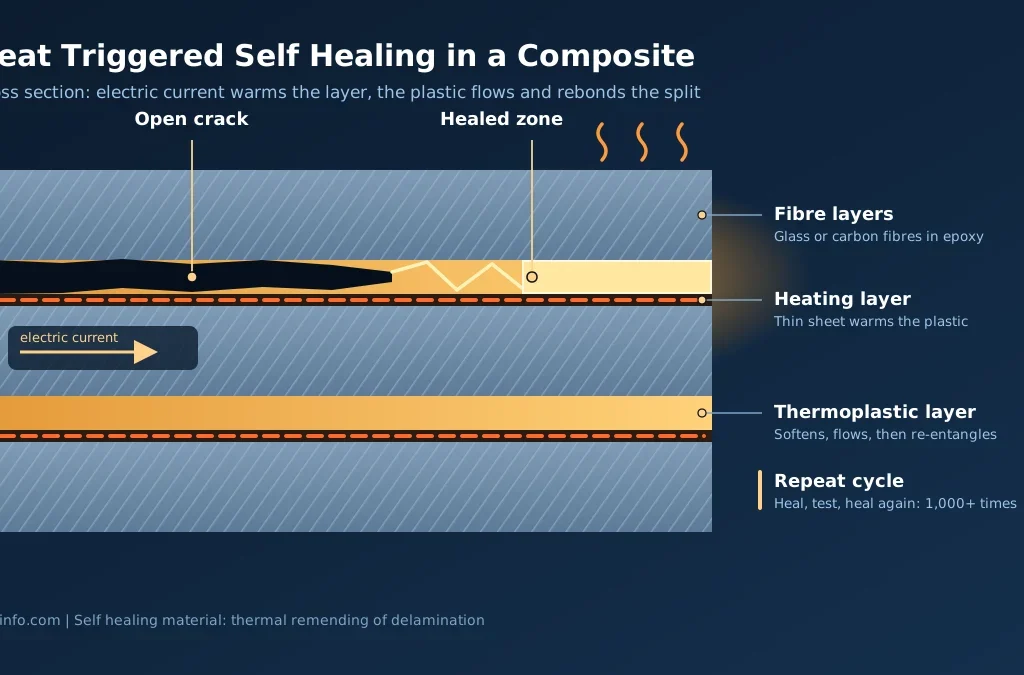
In January 2026, researchers at North Carolina State University and the University of Houston reported a fibre reinforced composite that healed itself more than 1,000 times. They 3D printed a thermoplastic layer between the fibre layers and embedded thin heating layers. When electric current warms the material, the plastic softens, flows and rebonds layers that have split apart. The method targets delamination, a failure that conventional composites suffer from.
Toughness does decline after repeated healing, but slowly. The team estimates the approach could stretch part life well beyond the current design life of 15 to 40 years if healing is done on a schedule. Treat that as the researchers’ estimate, not a proven service record.
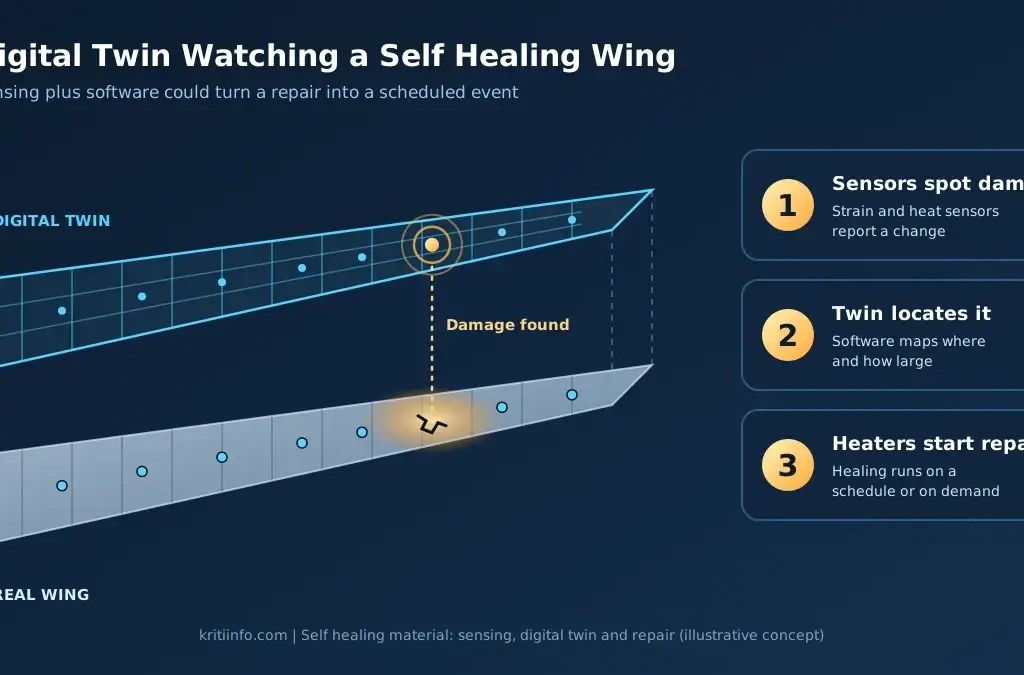
Two cautions apply. This is heat triggered, so it is not fully autonomous. To become autonomous it needs a sensor that detects damage and switches on the heaters. And not every heat based system is gentle. A Texas A&M plastic called ATSP heals, but needs temperatures between about 160 and 280 degrees Celsius.
Real World Example 3: Self Healing Car Paint
You may already own a self healing material without knowing it. Infiniti introduced Scratch Shield clear coat on 2008 models, and Nissan later used it more widely. The clear coat is soft and elastic, so light scratches gradually smooth out, especially with warmth. Nissan describes it as healing the clear coat, not the colour layer beneath. A scratch that reaches the colour coat will not heal.
Owner forums report mixed experiences, and one automotive guide says the clear coat hardens over roughly five to six years, reducing the effect. So view it as a manufacturer claim that works for fine swirl marks, not as a miracle finish.
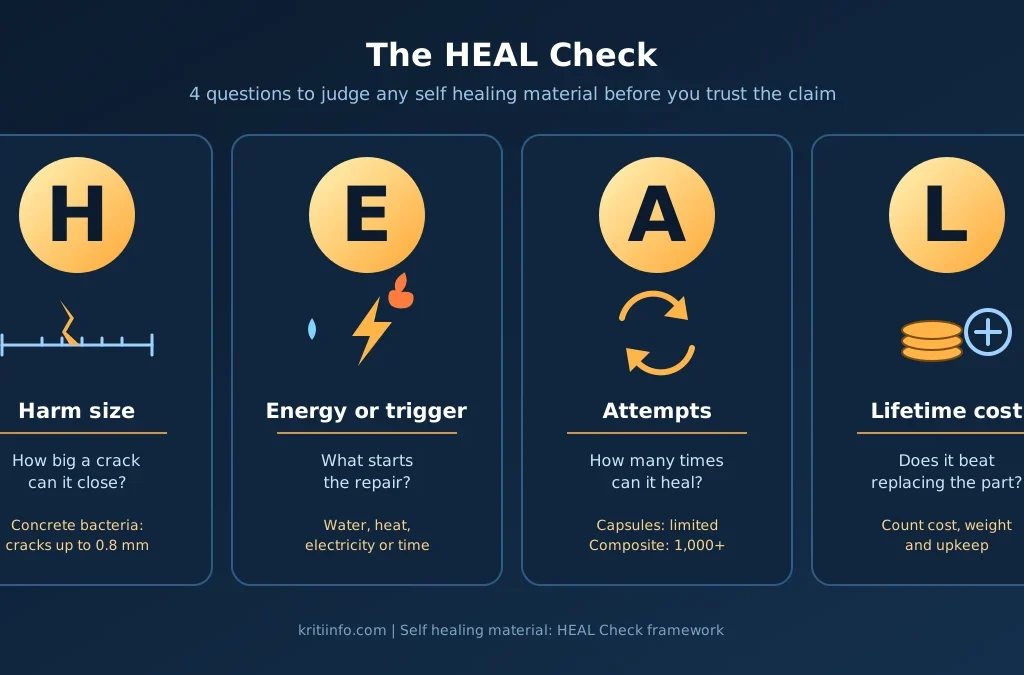
The HEAL Check: Judge Any Self Healing Material in 4 Questions
This simple test is an original framework created for this article. Use it on any product, press release or research story.
- H: Harm size. What is the largest damage it can repair? Concrete bacteria: cracks to 0.8 mm. Car paint: light scratches in the clear coat only.
- E: Energy or trigger. What starts healing? Water, heat, electricity or time? Free triggers such as water and time suit remote structures. Heat suits parts you can reach.
- A: Attempts. How many repairs can it do? Capsules offer limited repairs per spot. The NC State composite healed more than 1,000 times.
- L: Lifetime cost. Does extra cost, weight or maintenance beat simply replacing the part?
Illustrative scenario (hypothetical, not a real project): A manager of a coastal footbridge wants fewer repair closures. Cracks of 0.3 mm are expected, rain is constant and replacement would be disruptive. Using HEAL, a water triggered concrete looks promising on Harm and Energy. The manager must still ask for field evidence on Attempts and a lifetime cost comparison before buying.
Self Healing Material vs Conventional Material
The advantages are real. Parts can last longer, inspections and repairs drop, and hard to reach components, such as those inside wings or underground, gain a safety margin. Less replacement also means less waste.
The limits are equally real. Most systems repair small damage only. Many repair once or lose strength with each repair. Cost can be higher at the start. And much of the evidence is still from the laboratory, as the concrete demonstrations show.
3 Myths About Self Healing Material
- “It heals like skin, whatever the injury.” No. Current systems close cracks and scratches, not large breaks.
- “It heals forever.” No. Even the best composite result shows slowly falling toughness.
- “It is already everywhere.” Not yet. Car paint exists, concrete is being demonstrated, and most other systems remain research.
What Comes Next for Self Healing Material
A February 2026 review in RSC Advances describes progress in self healing for flexible electronics, wearables, sensors and energy storage, where longer device life cuts waste. Researchers in aerospace also see artificial intelligence and digital twins, which are virtual copies of real parts, becoming central to deciding when and where to trigger repairs. That pairing of sensing, software and healing could turn a repair into a scheduled event rather than a surprise.
To go deeper, read our guide to advanced materials transforming industry, see how AI for scientific research speeds up discovery, and explore the Na ion battery.
FAQs About Self Healing Material
1. What is a self healing material? It is a material built to repair its own damage, fully or partly, using reversible bonds or stored healing agents.
2. Is self healing concrete real? Yes, in the lab and in demonstration projects. TU Delft showed sealing of cracks up to 0.8 mm. Field proof of extra healing is still limited.
3. How many times can a self healing material heal? It depends on the type. Capsule systems heal limited times per spot. A 2026 heat triggered composite healed over 1,000 times.
4. Does self healing car paint work? It can smooth light scratches in the clear coat, but not scratches that reach the colour layer, and the effect may fade as the coating ages.
5. Will my phone screen heal itself? Research covers flexible electronics and wearables, but a self mending phone screen is not a mainstream product today.
6. Is a self healing material more expensive? Often yes at first. The right test is lifetime cost, including fewer repairs and replacements.