
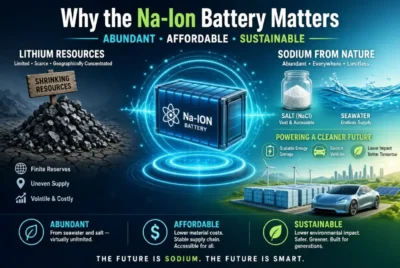
A Battery Bet That Started in the Cold
On 5 February 2026, at an event in Yakeshi, Inner Mongolia, Changan Automobile and CATL unveiled what they called the world’s first mass production passenger car powered by sodium ion batteries. CATL says it is set to reach the market by mid 2026.
That is a bold move. Sodium ion batteries have been studied in laboratories since the early 1980s, yet the International Energy Agency (IEA) reports that in 2025 their global production was less than 1% of lithium ion output. One of the biggest names in batteries is now putting this quiet underdog on the road.
So one question hangs in the air: could an ordinary element found abundantly in nature help reshape the future of energy storage?
Sodium sits in common salt. It makes up about 2.3% of Earth’s crust, while lithium is about 0.002%, according to a 2025 peer reviewed review published by the Royal Society of Chemistry. The Na ion battery matters now because lithium prices doubled over the past year (though they remain around 70% below their 2022 peak, says the IEA), the world needs more storage for solar and wind, and cold weather still defeats many batteries.
But “abundant” does not simply mean “better.” Let us follow the evidence.
Table of Contents
What Is a Na Ion Battery?
“Na” is the chemical symbol for sodium. A Na ion battery, also called a sodium ion battery, stores energy by moving sodium ions between two electrodes. It follows the same basic idea as a lithium ion battery, so existing factories can often be adapted to make it.
One point trips up many beginners. A commercial sodium ion battery is not a container of metallic sodium. Sodium travels as charged particles called ions, stored inside electrode materials. The negative electrode is usually hard carbon. Sodium metal as an electrode is mostly a research topic, and the same review notes it raises safety concerns.
How It Works, Step by Step
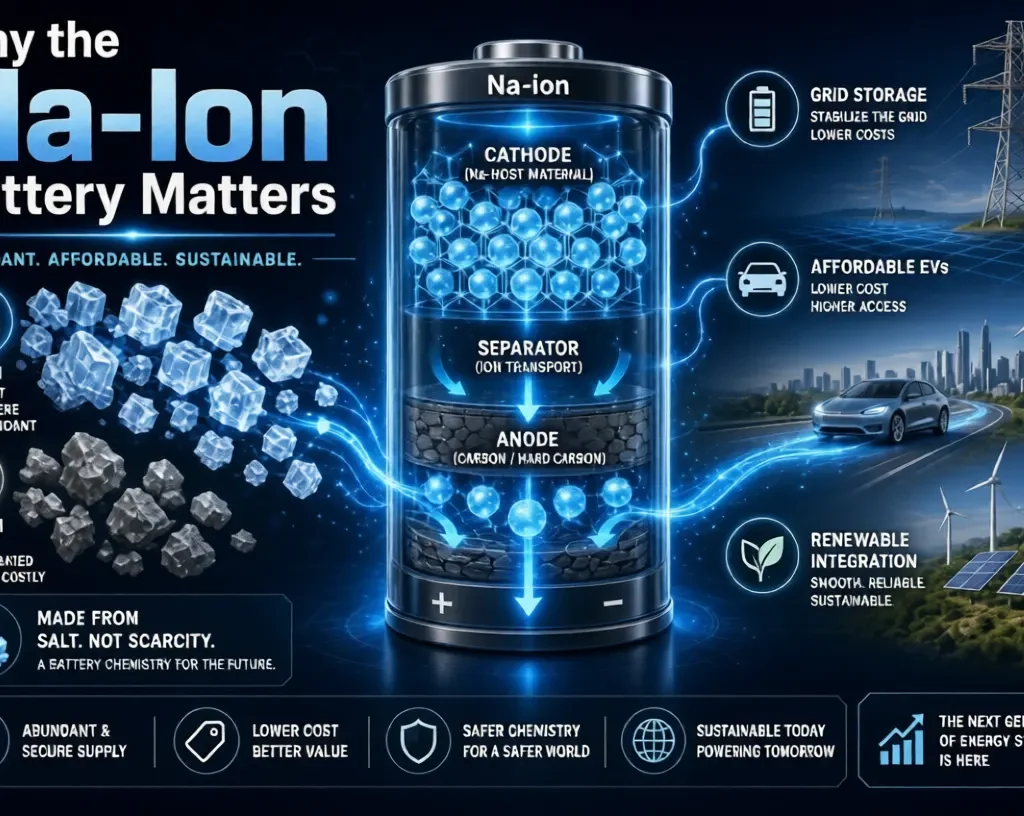
A cell has five main parts: the cathode (positive electrode), the anode (negative electrode, usually hard carbon), the electrolyte (liquid that lets ions travel), the separator (thin barrier that stops the electrodes touching), and the external circuit (the wire and device that use the energy).
Think of two hotels joined by a shuttle bus. The cathode is one hotel, the anode is the other, and sodium ions are the guests.
- Charging: outside power pushes the guests from the cathode hotel to the anode hotel. Electrons cannot ride the bus, so they travel through the external wire.
- Storing: the ions rest in the anode. That is stored energy.
- Discharging: the guests head back, and electrons flow through your device doing useful work.
- Repeating: each round trip slightly wears the materials, which is why battery life is counted in cycles.
A sodium ion is larger and heavier than a lithium ion and moves more slowly inside solids, one root cause of lower energy density. Sodium also cannot use ordinary graphite for the anode, so hard carbon takes its place.
Sodium Ion vs Lithium Ion: A Fair Comparison
| Dimension | Na ion battery | Lithium ion (LFP and NMC) |
|---|---|---|
| Raw materials | Sodium is abundant, but cathodes closest to market still use nickel and manganese (IEA, 2026). | Lithium needs mining and refining and has seen price swings. LFP uses no nickel or cobalt. |
| Energy density (cell) | Up to about 175 Wh/kg in the best mass production cells (CATL, Feb 2026). | LFP up to about 205 Wh/kg. NMC above 250 Wh/kg (IEA). |
| Practical range | Up to about 350 km for an average SUV (IEA estimate). | About 400 to 600 km on average. |
| Cost and manufacturing | Not yet cheaper than LFP in most uses. Cost effective in very cold climates (IEA). | LFP packs were over 40% cheaper than NMC in 2025 (IEA). Mature supply chains. |
| Cold performance | CATL reports over 90% capacity at minus 40 °C (company claim). The review found 50 to 70% retention below minus 20 °C. | The review found 30 to 50% below minus 20 °C. LFP struggles most (IEA). |
| Safety | CATL reports no smoke or fire in crush, drill and saw tests (company claim). The review says thermal runaway is still possible. | Depends on chemistry and design. |
| Life, charging, recycling | Over 4,000 cycles reported for some cells (review). Recycling models are unclear (IEA). | Long track record and a large recycling industry. |
| Best fit | Cold regions, small cars, urban vans, two and three wheelers, forklifts, stationary storage (IEA). | Long range EVs. LFP holds over 90% of stationary storage installs (IEA). |
Read the numbers carefully. The 175 Wh/kg figure is a manufacturer number for a cell, not a whole pack. The IEA range figures describe complete vehicles. CATL also states the Changan car will exceed 400 km, but that is a company claim awaiting independent testing for a different vehicle than the IEA’s average SUV. Never mix these.
Where Can a Na Ion Battery Help?
Instead of asking “which battery wins?”, ask four questions about the job: How far? How cold? How big? How often? Sodium ion looks strongest when trips are short or medium, winters are harsh, space is flexible, and cycling is daily.
Solar, wind and grid balancing. Weight and volume matter less on the ground, so lower energy density hurts less. But LFP already dominates stationary storage, so sodium must beat it on price. The first sodium ion storage system dates to 2019 in China (IEA), and large scale proof is thin.
Small EVs and urban vans. The IEA expects a good fit for small range cars and light commercial vehicles. Long highway range is out of reach for now.
Two and three wheelers. The IEA names them as suitable, since low cost and light weight matter. Most evidence comes from China, and public price data is scarce.
Cold climates, industry and backup power. Better low temperature behaviour can reduce the need for costly thermal management (review), and forklifts are among the IEA’s named uses. But the review says gaps remain in thermal safety studies and scaling, and field results can differ from lab tests.
India’s angle. The IEA’s Global EV Outlook 2026 projects emerging economies, led by Southeast Asia, India and Latin America, rising from about 6% of global EV battery deployment in 2025 to about 15% by 2035 under stated policies. That is a scenario for EV batteries in general, not a sodium forecast. Reliance Industries acquired UK sodium ion developer Faradion for an enterprise value of £100 million and said it would use the technology at a planned Jamnagar giga factory, which is a statement of intent. The IEA also notes nearly all sodium ion capacity, and over 95% of announced 2030 capacity, is in China. Any Indian advantage must be built, not assumed.
An Illustrative Example: A Solar Community
Illustrative scenario. This is a teaching example, not a real project and not research data. No figures are used.
Imagine a small community with rooftop solar. At noon the panels make more power than anyone needs, and by evening demand rises as the sun falls. A battery bank can store the noon surplus and release it later.
An LFP system is compact and proven. A Na ion battery system would take more space for the same energy, but if the site has land to spare and cold winters, the extra room matters little and the cold performance matters a lot. If the site is hot with limited space, LFP may fit better. If lithium prices spike, sodium gains appeal.
Expert style interpretation. The right battery depends on the job, not on which technology is newest. Space, climate, budget, safety rules and supplier support decide the winner.
Three Common Misconceptions
1. “Sodium ion will immediately replace lithium ion.” No. Sodium ion cell capacity is just over 1% of lithium ion capacity, and announced 2030 projects equal only about 7% of committed lithium ion capacity (IEA). The latest LFP still leads on energy density, maturity and cost.
2. “Abundant sodium makes every sodium battery cheaper.” Not automatically. The IEA notes the hard carbon anode supply chain is poorly developed, and lithium is not yet expensive enough for sodium to undercut LFP in most uses.
3. “A different chemistry is completely safe and harmless.” No. The review describes thermal runaway risks in sodium cells, the leading chemistries rely on nickel and manganese, and recycling lower value chemistries needs new business models (IEA).
A Documented Milestone: The Cold Test
The challenge. Cold is brutal for batteries. Liquid electrolytes thicken and ions slow down, so power and range fall (review).
The response. CATL, which says it began sodium ion research in 2016 and tested nearly 300,000 cells, introduced its Naxtra cell. At the February 2026 launch it reported over 90% capacity at minus 40 °C and nearly triple the discharge power of equivalent LFP at minus 30 °C. The IEA repeats the 90% figure, citing CATL.
What remains uncertain. These are manufacturer results. Mass production cars have no years of independent winter data yet. And the US company Natron Energy has shut down, the IEA notes, showing how hard it is to build a competitive sodium ion supply chain. Will the cold advantage survive real roads, real winters and real ageing? That is the question to watch.
Conclusion: Partner First, Replacement Maybe
A Na ion battery is best seen as a complementary technology today. It may win specific jobs, especially in the cold, in small vehicles and in some storage, while lithium ion keeps long range and most grid work. The IEA even highlights hybrid packs that combine both.
Its future depends on energy density gains, lithium prices, manufacturing scale, supply chains and real world results.
Five facts to remember:
- Sodium is far more abundant in Earth’s crust than lithium.
- The best mass production sodium cells reach about 175 Wh/kg, below LFP and NMC.
- Cold performance is the clearest advantage, though much data comes from manufacturers.
- Production was under 1% of lithium ion output in 2025.
- “Abundant” does not mean “cheaper” or “harmless.”
One question to discuss: if your city had to pick one battery for its next solar farm, would you choose the newest chemistry or the most proven one, and why?
One practical action: before trusting any battery claim, check whether the figure is for a cell or a full pack, whether it is a lab result or a product, and who verified it.
Frequently Asked Questions
1. What is a Na ion battery? It is another name for a sodium ion battery. It stores energy by moving sodium ions between a cathode and an anode through an electrolyte.
2. How does a sodium ion battery work? Charging pushes sodium ions to the anode while electrons travel through the external circuit. Discharging reverses the journey, and the electrons power your device.
3. Is a sodium ion battery better than a lithium ion battery? Not universally. Sodium ion does better in the cold and avoids lithium. Lithium ion, especially LFP, currently leads on energy density, maturity and cost in most uses.
4. Can sodium ion batteries power electric vehicles? Yes. A sodium ion powered car reached China’s roads in late 2023, and CATL and Changan announced a mass production passenger car in February 2026. The IEA expects the best fit in small range cars and urban vans.
5. Are sodium ion batteries safer? Some manufacturer tests report strong results, but the research literature says thermal runaway is still possible. Safety depends on cell design, not only chemistry.
6. What are the main limitations of sodium ion batteries? Lower energy density, an immature supply chain, manufacturing concentrated in China, and limited long term field evidence.
7. What role could a Na ion battery play in India’s energy future? Possibly in storage, two and three wheelers and supply diversification, but evidence is early. Reliance’s Faradion purchase signals interest. Real impact depends on manufacturing scale and cost.