

It starts like any ordinary sore throat. A mild fever, a tired child, some pain while swallowing. Most families would wait a day or two.
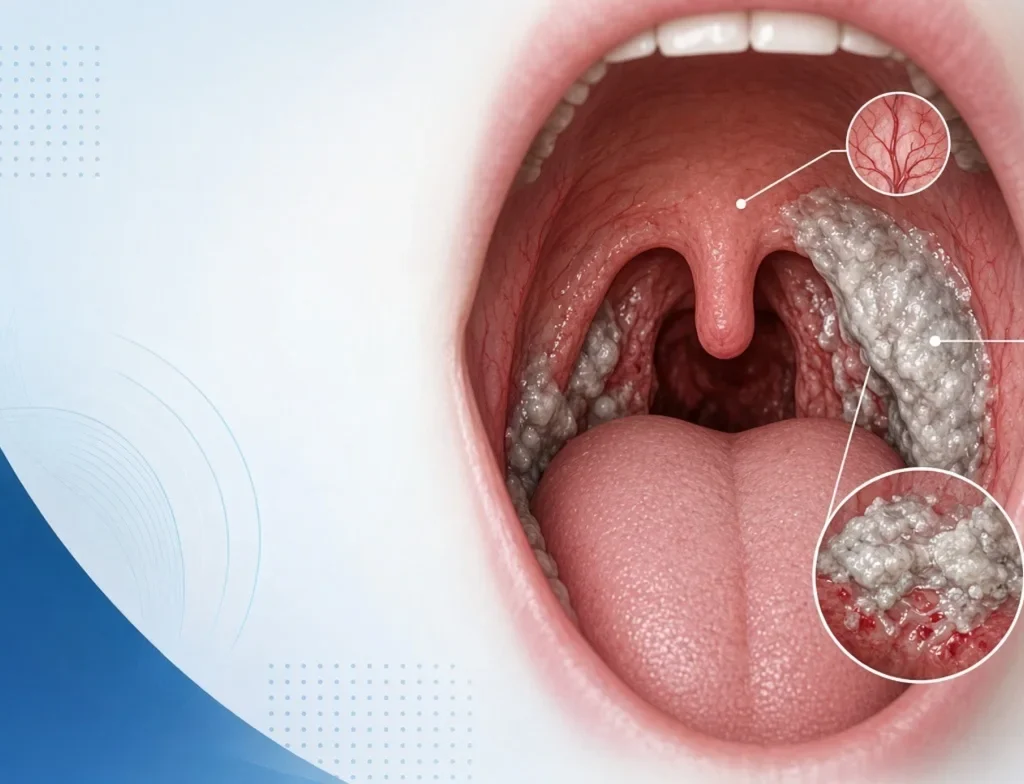
With diphtheria, those two days matter. The World Health Organization (WHO) explains that within two to three days of infection, dead tissue in the airway can form a thick grey coating over the nose, tonsils and throat. Breathing and swallowing become hard. Meanwhile, a toxin made by the bacteria can travel through the body and damage the heart and nerves.
Here is the twist. Diphtheria is one of the diseases we know how to stop. A safe vaccine exists. Yet WHO reports that outbreaks are happening more often because too many people are under vaccinated. This article explains diphtheria in plain words: how it spreads, how to spot it, how doctors treat it, and what you can do next.
Table of Contents
7 Quick Facts About Diphtheria
- It is caused by toxin making bacteria, mainly Corynebacterium diphtheriae.
- It spreads through droplets when an infected person coughs or sneezes.
- Symptoms usually begin 2 to 5 days after exposure.
- A thick grey coating in the throat is its hallmark sign.
- The toxin can harm the heart, nerves and kidneys.
- Early treatment with antitoxin and antibiotics greatly lowers the risk of death.
- Vaccination, including booster doses, is the best protection.
What Causes Diphtheria and How Does It Spread?
The bacteria make a poison called diphtheria toxin. The infection mostly affects the nose and throat, and less often the skin.
The bacteria pass from person to person through respiratory droplets. Some people carry the bacteria without any symptoms and can still infect others, which is why the infection can move quietly through a community.
WHO notes that risk rises when vaccination coverage falls, when health services are disrupted by conflict or disasters, and in overcrowded places with poor hygiene.
Symptoms and Warning Signs
Typical early symptoms include a sore throat, fever, swollen glands in the neck and weakness. The CDC calls the thick grey coating, known as a pseudomembrane, the hallmark feature. It can block the airway.
Get emergency medical help immediately if you or your child has:
- Difficulty breathing or swallowing
- A thick grey coating in the throat
- A swollen neck along with sore throat and fever
- Any of these symptoms after contact with a diphtheria patient
Skin diphtheria looks different. It can cause slow healing sores or ulcers, and the CDC says it rarely leads to severe disease.
Complications. The CDC lists airway blockage as a deadly complication. If the toxin reaches the blood, it can also cause heart muscle damage, nerve damage and kidney failure. Even with treatment, about 1 in 10 people with respiratory diphtheria die, according to the CDC.
Diphtheria vs Strep Throat: How They Differ
Both cause a painful throat, so they are easy to confuse at home. Only an examination and a swab test can tell them apart.
| Diphtheria | Strep throat | |
|---|---|---|
| Cause | Toxin making diphtheria bacteria | Group A Streptococcus bacteria |
| Throat appearance | Thick grey coating that can spread and block the airway | Red, swollen tonsils, sometimes white patches or streaks of pus |
| Other signs | Neck swelling, weakness, risk to heart and nerves | Sudden sore throat, painful swallowing, fever, tiny red spots on the roof of the mouth |
| Vaccine | Yes | No |
| Testing | Lab testing of throat or nose swabs | Rapid strep test or throat culture |
| Seriousness | Can become life threatening through toxin damage | Usually milder, but complications can occur |
The key lesson: a white or grey patch on the throat does not tell you which infection you have. Never guess. Get tested.
How Is Diphtheria Diagnosed and Treated?
Doctors confirm diphtheria with laboratory tests on swabs from the throat or nose. WHO advises testing promptly and starting treatment as soon as possible, because early care lowers the risk of complications and death.
Treatment usually combines diphtheria antitoxin, which neutralises toxin still circulating in the blood, with antibiotics, which stop the bacteria from multiplying and spreading. WHO also warns that some strains resist commonly used antibiotics, which is another reason treatment must be supervised by doctors.
Close contacts are usually given preventive antibiotics, and their vaccination status is checked. Anyone who recovers should still be vaccinated afterwards.
Please do not self medicate. Antibiotics and antitoxin must be chosen and given by a medical team.
Vaccination: The Strongest Shield
The diphtheria vaccine is made from an inactivated toxin, so it trains the body to neutralise the poison. It is usually given combined with tetanus and other vaccines. WHO calls it safe and effective and says it may cause mild side effects. It recommends three primary doses followed by three boosters, because protection needs to be sustained over time.
India’s schedule. According to India’s Ministry of Health and Family Welfare Universal Immunisation Programme, as summarised by the Press Information Bureau in March 2026:
- Pentavalent vaccine (includes diphtheria) at 6, 10 and 14 weeks
- DPT first booster at 16 to 24 months
- DPT second booster at 5 to 6 years
- Td vaccine (tetanus and adult diphtheria) at 10 years and at 16 years
- Td doses for pregnant women
These vaccines are provided free through the programme. Check your child’s card against this list.
A Simple Prevention Framework: Check, Boost, Act
Check. Look at your family’s vaccination records. Include teenagers and adults, not just babies.
Boost. If any dose or booster is missing, ask a doctor or local health centre how to catch up. Do not restart; ask where to continue.
Act. If someone develops a severe sore throat with breathing or swallowing trouble, seek care at once. If you were exposed to a confirmed case, contact a doctor or the local health department without delay.
Illustrative scenario (not a real case). Imagine a school informs parents that a classmate has been diagnosed with diphtheria. A parent checks the vaccination card and finds the child’s school age booster is missing. She calls the child’s doctor the same day. Following WHO’s contact guidance, the doctor reviews exposure, checks vaccination status and decides on preventive antibiotics and a vaccine dose where needed. The family watches for symptoms and returns immediately if any appear. Quick, ordinary steps are what work.
Reading the Numbers Correctly
WHO says that in 2025 an estimated 85% of infants worldwide received three doses of diphtheria containing vaccine. That sounds strong. But it also means 15%, nearly 20 million infants, had no or incomplete coverage.
Two more WHO figures add context. Only 83 countries include all three recommended boosters in their national programmes, and 42 have none.
How to interpret this: a high global average can hide local gaps. Outbreaks occur where children and adults are unprotected, even if national or global figures look healthy.
Death rates need care too. WHO says around 30% of unvaccinated people may die without proper treatment, while the CDC says up to half may die without treatment and about 1 in 10 with it. Settings and data differ, but the message is the same: untreated cases are extremely dangerous.
Advantages and Limitations of Prevention
Advantages
- Vaccination protects the individual and helps protect the community
- WHO says combination vaccines prevented over 90% of cases between 1980 and 2000
Limitations
- Protection needs several doses and boosters over time
- Gaps in coverage let bacteria circulate
- Some strains resist common antibiotics, so treatment still needs expert care
Myth Corrected: “Diphtheria Is a Disease of the Past”
Many people believe it vanished long ago. The evidence says otherwise. WHO states that no WHO region is completely free from diphtheria. Western Australia’s health service noted in May 2026 that cases had returned in parts of Australia after being very rare. The disease stays quiet only while vaccination stays high.
What Should You Do Next?
- Check every family member’s vaccination records this week and ask your doctor about missing boosters, including Td.
- Seek emergency care for breathing trouble, swallowing trouble or a grey throat coating.
- After contact with a diphtheria patient, call a doctor or health authority promptly.
- Never self treat a severe sore throat.
Conclusion
Diphtheria is rare in many places, but it has not disappeared. It spreads quietly and can be deadly, yet it is preventable. The most powerful tools are ordinary ones: a complete vaccination record, on time boosters and quick medical care when warning signs appear. Check your records today.
Frequently Asked Questions
1. Can adults get diphtheria? Yes. Anyone who is not immune can get it. WHO says all non immune people, whether unvaccinated or under vaccinated, are at risk, which is why boosters matter.
2. Is the diphtheria vaccine safe? WHO describes it as safe and effective. Mild side effects can occur.
3. How long until symptoms appear? Usually 2 to 5 days after exposure, according to WHO and the CDC.
4. Can someone spread diphtheria without feeling ill? Yes. WHO says some people carry and transmit the bacteria without symptoms.
5. Does recovering from diphtheria make me immune? Not reliably. WHO advises that anyone who has had diphtheria should be vaccinated after the acute illness.
6. Can I treat a sore throat at home to avoid diphtheria? Home care cannot rule out diphtheria. If you have breathing or swallowing difficulty, a grey throat coating or exposure to a case, see a doctor immediately.