
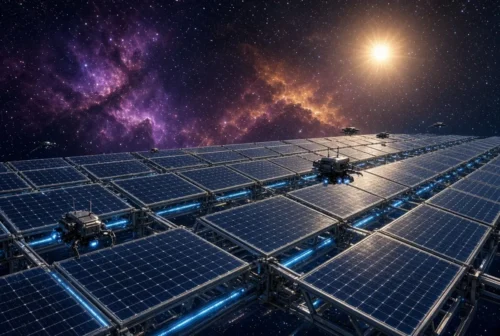
Imagine looking up at midnight and realizing your city is running on pure sunlight.
High above the clouds, bathed in perpetual day, a massive array of mirrors and photovoltaic sheets floats in absolute silence. It never experiences cloud cover, rain, or night. It collects raw solar radiation around the clock, transforms it into an invisible electromagnetic beam, and sends it directly into the regional power grid below.
This sounds like pure science fiction, yet space agencies, defense laboratories, and university researchers have spent decades studying this exact concept: Space-Based Solar Power (SBSP).
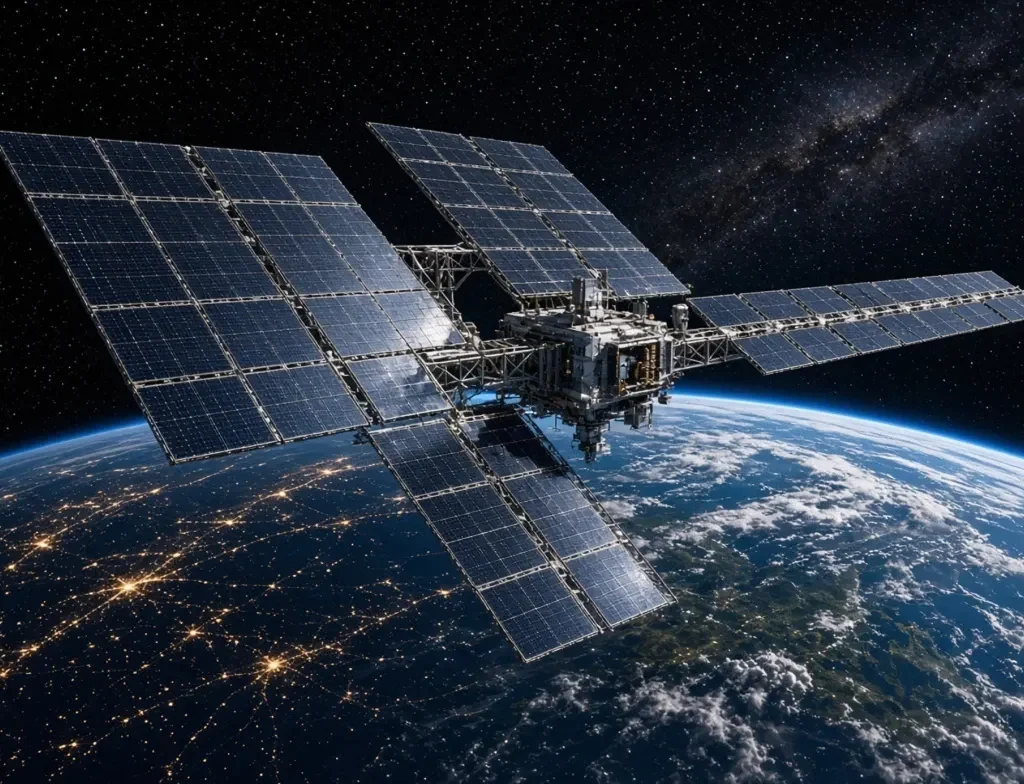
At the heart of the concept sits the orbital space solar panel. While terrestrial solar farms sleep through the night, a collector in orbit could theoretically harvest energy almost continuously.
Yet beneath this promise lies a fierce engineering puzzle involving orbital mechanics, microwave physics, and billions of dollars in infrastructure. In recent years, one name has dominated every conversation about cheap access to orbit: Elon Musk.
Does Musk hold the missing key to harvesting clean energy from orbit, or do the harsh laws of physics make this grand project an expensive dead end?
Table of Contents
What Is a Space Solar Panel?
At its simplest, a space solar panel is a solar electricity collector deployed outside Earth’s atmosphere.
On your roof, a conventional solar panel faces three unavoidable constraints: nightfall, atmospheric filtering, and bad weather. Even in sunny desert regions, Earth’s atmosphere reflects and absorbs a notable portion of incoming solar energy.
In orbit, those constraints disappear. Sunlight is roughly 30% more intense in near-Earth space than at the surface, and an array stationed in the right orbit stays bathed in sunlight nearly 24 hours a day.
+------------------------------------+
| 1. Orbital Collection              |
| Space solar panels collect         |
| continuous, unfiltered sunlight.   |
+-----------------+------------------+
                  |
                  v
+------------------------------------+
| 2. Conversion                      |
| Electricity converts to wireless   |
| microwaves or laser frequencies.   |
+-----------------+------------------+
                  |
                  v
+------------------------------------+
| 3. Earth Reception                 |
| Ground rectenna captures beam      |
| and converts it to AC power.       |
+------------------------------------+
The system operates across three fundamental stages:
- Orbital collection: Massive lightweight solar arrays generate continuous direct-current (DC) electricity in orbit.
- Frequency conversion: The system converts that electricity into wireless electromagnetic waves, typically low-intensity microwaves (around 2.45 GHz or 5.8 GHz) or concentrated laser beams.
- Ground reception: A specialized receiving antenna on Earth, known as a rectenna, catches the incoming beam and converts it directly back into electricity for the grid.
Elon Musk’s Possible Connection
Whenever someone discusses launching massive structures into orbit, SpaceX inevitably enters the room. SpaceX pioneered reusable rockets, lowering the price of entering low Earth orbit with the Falcon 9 and Falcon Heavy. Their heavy-lift vehicle, Starship, aims to slash payload delivery costs even further.
Because launch costs have historically been the single largest roadblock to space-based solar power, many assume Elon Musk must be secretly working on an orbital power station.
The verified reality is quite the opposite.
Elon Musk has repeatedly expressed direct skepticism regarding space-based solar power for Earth. During multiple public appearances and tech conferences, Musk labeled the concept inefficient compared to ground-based solar paired with battery storage. His reasoning rests on basic thermodynamic losses:
- You convert sunlight to electricity in space.
- You convert that electricity into a microwave or laser beam.
- You shoot that beam through Earth’s atmosphere, losing energy along the way.
- You collect the beam on a ground station and convert it back to electricity.
Musk’s core argument has always been that building a solar farm directly on Earth—eliminating launch risks, space radiation, and double conversion losses—is vastly cheaper and simpler.
However, SpaceX’s real connection to this field remains indirect yet critical: SpaceX builds the transport infrastructure. If space solar power ever becomes economically viable, it will likely happen using reusable launch systems like Starship, regardless of Musk’s personal philosophical reservations about the concept.
The Technology That Could Change Energy
To understand how radical this technology is, compare the three main ways we harness solar energy:
| Category | Rooftop Solar Panel | Terrestrial Solar Farm | Space Solar Panel System |
| Availability | 4 to 8 peak hours/day | 6 to 9 peak hours/day | Up to 24 hours/day |
| Weather Dependency | Highly vulnerable to clouds & rain | Vulnerable to seasons & weather | Immune to weather |
| Infrastructure Cost | Low | Moderate | Extremely High |
| Grid Complexity | Localized distributed storage needed | Regional transmission lines needed | Massive ground rectennas needed |
| Maintenance | Cheap and straightforward | Standard maintenance crews | Complex robotic orbital servicing |
A Hypothetical Scenario: The 1-Gigawatt Orbital Station
Label: Illustrative Engineering Scenario
Consider an orbital solar station designed to deliver 1 gigawatt (GW) of continuous baseload electricity to the surface—enough to power a city of roughly 750,000 homes.
To deliver 1 GW after transmission losses, the orbital collector would need a surface area spanning roughly 2 to 4 square kilometers. That equates to thousands of metric tons of structural trusses, photovoltaic modules, and steering mechanisms floating in space.
Assembly would require dozens, perhaps hundreds, of automated rocket launches. Specialized robots would fit modules together like a giant orbital puzzle. Once aligned, the array would lock onto a ground rectenna spanning several square kilometers in a rural area, beaming down power night and day without interruption.
The Numbers Behind the Promise
The historical barrier to this dream has always been raw economics:
- Launch Costs: Throughout the late 20th century, launching a kilogram of payload on NASA’s Space Shuttle cost roughly $54,000. At that rate, lifting a 10,000-ton solar power satellite would cost more than $500 billion just for freight.
- The SpaceX Shift: Reusable Falcon 9 launches dropped commercial rates closer to $2,000 to $2,500 per kilogram. If next-generation heavy-lift vehicles reach projected long-term targets of $100 to $200 per kilogram, orbital construction shifts from an absolute impossibility to an aggressive financial bet.
- Transmission Efficiency: In 2023, the California Institute of Technology (Caltech) conducted the Space Solar Power Demonstrator (SSPD-1) mission. Their MAPLE instrument successfully demonstrated that wireless power could be focused, steered, and detected in orbit, sending measurable signals back to Earth. However, the end-to-end electrical efficiency of microwave power transfer remains relatively low in practical tests, often hovering well below 20% to 30% from orbital DC generation to terrestrial grid input.
Historical Launch Cost per Kilogram:
Space Shuttle (c. 1980s-2000s): $54,000 / kg  ========================
Falcon 9 (Current Commercial):  $2,500 / kg   ==
Projected Heavy Lift Target:    $200 / kg     =
Advantages and Limitations
Like any advanced engineering proposition, space solar power offers massive potential along with stark logistical hurdles.
Advantages
- Continuous Baseload Power: Unlike wind and surface solar, space power is not intermittent. It can run day and night, reducing the need for massive battery banks on the ground.
- Zero Atmospheric Interference: Orbital arrays sit above cloud cover, atmospheric haze, seasonal variations, and dust storms.
- Rapid Energy Re-routing: A single geostationary solar station could theoretically shift its transmission beam between different regional ground stations, directing emergency power to disaster zones or shifting peak demands across time zones.
Limitations
- Orbital Debris Risk: A square-kilometer structure in low or medium Earth orbit presents a giant target for micrometeorites and space junk.
- Thermal Management: Space panels generate heat. On Earth, surrounding air cools panels through convection. In the vacuum of space, dissipating excess heat requires heavy radiative cooling systems.
- Land Use for Rectennas: While the beamed microwave density can be kept low enough to avoid frying birds, catching a wide beam requires a ground station covering many square kilometers.
- Capital Risk: A failure during launch or assembly puts billions of dollars of hardware at risk before a single watt reaches the grid.
The Biggest Misconception
The most widespread misunderstanding is the belief that space solar power provides “free, unlimited electricity once the panels are in orbit.”
People often assume the main challenge is simply sending an array into space and flipping a switch. In truth, wireless power beaming is not a magical cable.
Because electromagnetic waves spread out over long distances (diffraction), a beam sent from geostationary orbit (35,786 kilometers up) naturally widens. By the time it reaches Earth, the beam spans several kilometers across.
Building and maintaining the massive ground stations, dealing with high system conversion losses, and funding complex robotic maintenance missions mean that the electricity generated would be far more expensive per kilowatt-hour than modern ground-based alternatives for the foreseeable future.
A Practical Framework for Judging the Future
When evaluating future announcements regarding orbital clean energy, measure them against these five realistic benchmarks:
- Technical Feasibility: Has the project demonstrated end-to-end power transfer at scale, or just computer models and short-range bench tests?
- Total Cost per Kilowatt-Hour (LCOE): Does the levelized cost of energy compete realistically with ground-based solar paired with battery storage?
- Transmission Efficiency: What percentage of harvested solar energy actually enters the terrestrial grid after double conversion and atmospheric transit?
- Environmental and Orbital Safety: Can the array survive space debris, and does the high-frequency microwave transmission interfere with civil communications and aviation?
- Commercial Scalability: Can the hardware be mass-manufactured, rapidly launched, and assembled by autonomous robotics without constant human servicing?
Real-World Applications and the Road Ahead
Space solar power is moving along a clear path from speculative concept to early prototype testing:
- Laboratory Tests & Orbital Demos: Caltech’s SSPD-1 mission proved that wireless microwave steering works in orbit without mechanical moving parts. Japan’s space agency (JAXA) has conducted ground-based high-power microwave transmissions over hundreds of meters.
- Proposed Agency Programs: The European Space Agency (ESA) established the Solaris initiative to study the technical and political feasibility of space-based solar power, aiming to decide on a full development program before the end of the decade. Meanwhile, the UK government has funded private consortia exploring orbital power demonstrations.
- Deep Space and Lunar Missions: The earliest practical application of space solar panels may not be powering Earth at all. Instead, it could power crewed lunar bases during the two-week lunar night or beam energy directly to rovers exploring dark polar craters.
The concept of a continuous, clean energy beam from space remains one of humanity’s most ambitious clean energy ideas. Elon Musk’s reusable launch systems may eventually provide the heavy-lifting power needed to make construction physically possible, even while Musk himself remains skeptical of the underlying business model.
Space solar power is neither an impossible fantasy nor an imminent miracle. It is an intricate engineering challenge governed by strict laws of physics and economics. Until launch costs drop by another order of magnitude and transmission efficiencies climb significantly, ground solar panels and grid storage remain humanity’s fastest route to clean power.
Yet as launch infrastructure scales and orbital robotics mature, the idea of tapping the sun beyond our atmosphere may transform from an eccentric dream into a vital pillar of humanity’s off-world future.
Frequently Asked Questions
1. What is a Space Solar Panel?
A space solar panel is a photovoltaic collector stationed in Earth orbit that captures unfiltered sunlight outside the atmosphere and generates continuous electricity.
2. How could space solar power transmit electricity to Earth?
The orbital system converts harvested DC electricity into low-intensity microwave or laser beams. These beams travel down through the atmosphere to a wide ground antenna (rectenna), which converts the waves back into conventional AC electricity for the power grid.
3. What connection does Elon Musk have with this technology?
Elon Musk has no official space solar panel project and has publicly criticized the concept as inefficient compared to ground solar paired with batteries. However, SpaceX’s reusable rockets (such as Falcon Heavy and Starship) provide the heavy-lift capacity that researchers rely on to make future orbital construction feasible.
4. Is space-based solar power commercially practical today?
No. High hardware manufacturing costs, significant wireless transmission losses, and the sheer expense of orbital assembly make space-based solar power far more expensive per kilowatt-hour than conventional ground-based renewable energy today.
5. Could Space Solar Panels become a major clean energy source?
It is possible in the long term, particularly if launch costs fall below $100 per kilogram and microwave conversion efficiency improves. In the shorter term, the technology is more likely to serve niche uses, such as powering lunar exploration bases, orbital stations, or remote military and disaster zones.