
Can a chemical reaction help build the very substance that makes the reaction faster?
It sounds like a loop with no beginning. Yet chemists have suspected for decades that nature allows it. In 1953, the physicist Frederick Charles Frank proposed that such a loop could turn a tiny imbalance between two mirror image molecules into a huge one. It took until 1995 for a laboratory reaction to show it.
On 7 October 2026, the Royal Swedish Academy of Sciences honoured the scientists behind that story. Henri B. Kagan and Kenso Soai won the Nobel Prize in Chemistry “for the discovery of non-linear effects and autocatalysis in asymmetric organic synthesis.”
This article explains autocatalysis in plain English, shows how it works, and separates solid evidence from big claims.
Table of Contents
What Is Autocatalysis?
A catalyst speeds up a reaction without being used up. Autocatalysis adds a twist. The catalyst is a product of the reaction itself.
At the start, almost no product exists, so the reaction crawls. As product builds up, it speeds up the reaction, which makes even more product. Then the ingredients run low and the reaction slows down.
Chemists call these autocatalytic reactions. Plot the amount of product against time and you get an S shaped curve: a slow start, a sudden surge, then a flat finish. This is a core idea in chemical kinetics, the study of reaction rates.
How a Reaction Helps Make More of Itself
A classic teaching example is the reaction between permanganate and oxalate in acid. The mixture is deep purple. For a while, almost nothing seems to happen. Then the colour fades quickly. The reason is manganese(II), a product that speeds up the very reaction that forms it.
Compare that with a simple picture: a photocopier that also builds more photocopiers. This is only an analogy for teaching. The permanganate reaction is real, measured chemistry.
A five step method to spot autocatalysis
- Name the product. Which substance appears as the reaction runs?
- Run the seed test. Add a pinch of that product at the start. If the slow beginning disappears, the product is helping.
- Check the curve. Look for a delay, a surge, and a plateau.
- Find the brake. Something always limits growth, usually the supply of reactants.
- Ask how. Work out how the product speeds up the reaction at the molecular level.
Autocatalysis Versus Ordinary Catalysis
| Feature | Ordinary catalysis | Autocatalysis |
|---|---|---|
| Source of catalyst | Added from outside | Made by the reaction |
| Speed at the start | Fast, if catalyst is present | Slow, then accelerating |
| Rate curve | Steady decline as reactants fall | S shaped |
| Effect of adding product | Usually none | Often removes the delay |
| Main risk | Catalyst poisoning | Runaway speed up |
How is it different from positive feedback? Positive feedback is the broad idea that an output boosts the process that made it. Autocatalysis is one chemical version, where the output is the catalyst. Heat from a reaction that speeds the reaction is feedback too, but the heat is not a catalyst.
The Mystery of Life’s Chemical Beginnings
Many molecules come in two mirror image forms, like left and right hands. The two forms look alike but can behave very differently. The Nobel announcement coverage gave the example of carvone: one form smells of mint, the other of caraway.
Living things mostly use one hand. Our proteins are built from left handed amino acids, for instance. Yet ordinary reactions that start from non handed ingredients usually make an equal mix of both forms. So how did life end up with a preference?
Frank’s idea was simple. Suppose a molecule helps make more copies of its own hand while holding back the opposite hand. Then a tiny, random excess of one hand can snowball.
This is why autocatalysis keeps appearing in discussions of the origin of life and molecular self replication. A system that copies itself needs a way to grow, and autocatalysis is a natural engine for that.
Real Scientific Examples
Kagan and nonlinear effects. In 1986, Kagan described three different asymmetric reactions where the product showed a surprising pattern. When he mixed left and right handed forms of a catalyst, the product ended up more lopsided than the catalyst itself. That is a nonlinear effect: the output does not rise in a straight line with the input. Chemists now use this behaviour to learn about what a catalyst is really doing.
Soai and the reaction that copies its own hand. Through patient trial and error with many molecules, Soai found a pyrimidyl alcohol that could create itself. In 1995 he reported a reaction in which this alcohol catalyses its own formation, and it favours one mirror image. The Nobel announcement called the Soai reaction one of the most spectacular chemical experiments ever conducted.
Where this is used. The prize committee said the work has been decisive for chemists who design reactions to make medicines. Nonlinear effects also help researchers test mechanisms. Autocatalysis matters in safety work too, because a process that speeds itself up needs careful control.
The Soai reaction itself is a laboratory model, not a factory process. It uses reagents that react with air and water, so it is far from a realistic early Earth.
What the Evidence Tells Us
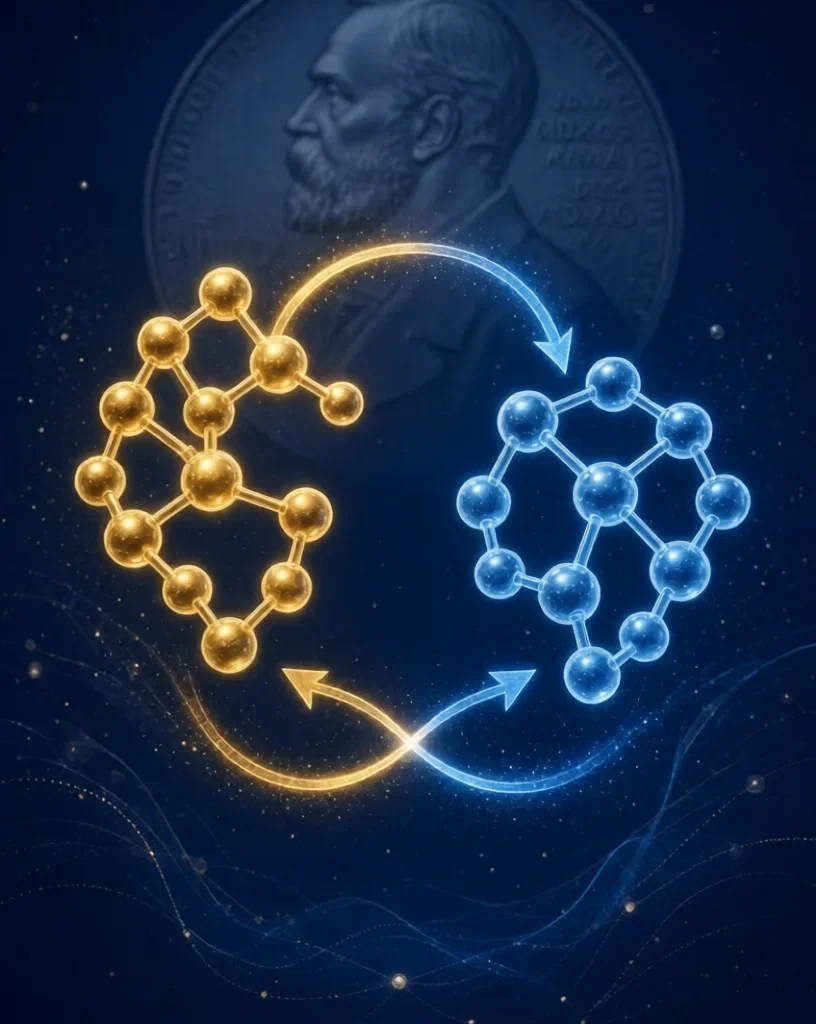
Published work from Soai’s group, in a 2003 report, describes starting with an almost imperceptible imbalance, about 0.00005 percent enantiomeric excess, and reaching more than 99.5 percent after repeated rounds. In plain terms, that is roughly five extra molecules of one hand in ten million, growing into near total dominance.
What this means: an autocatalytic loop can act as an amplifier. A hidden bias, even one caused by chance, can become visible and dominant.
What it does not mean: it does not show that life began this way. The reaction needs special ingredients. Scientists also still debate the exact mechanism. A review from the University of Groningen discusses proposals involving clusters of the product molecules, including tetramers, acting as the real catalyst.
Benefits, Limits, and Misconceptions
Advantages. Autocatalysis can amplify a tiny difference. It gives chemists a clean model for symmetry breaking and a test case for ideas about how chemical order can arise.
Limitations and risks. Known examples are rare and sensitive to conditions. Self accelerating reactions can run away if not managed. Big questions remain, including how such loops could have worked in a messy prebiotic world.
Misconception 1: “Autocatalysis creates something from nothing.” No. It needs ingredients and usually a small starting seed. It follows the laws of conservation like every other reaction.
Misconception 2: “The Soai reaction explains the origin of life.” It offers a working model for how handedness can be amplified. It does not prove how life began.
Misconception 3: “Autocatalysis is just catalysis.” The key difference is that the catalyst is made by the reaction, which gives the S shaped behaviour.
Is Autocatalysis Connected to the 2026 Nobel Prize in Chemistry?
Yes, and this is verified. The official Nobel Prize press release, dated 7 October 2026, names Kagan and Soai and cites their discovery of nonlinear effects and autocatalysis in asymmetric organic synthesis.
It helps to separate three things:
- The 2026 announcement: the prize to Kagan and Soai.
- Earlier discoveries: Frank’s 1953 theory, Kagan’s 1986 nonlinear effects, and Soai’s 1995 reaction.
- Independent research: other work on autocatalysis, such as studies of self copying molecules, which is related but not the subject of this prize.
Note that the prize concerns asymmetric autocatalysis, a specific and powerful case, rather than the whole field.
Frequently Asked Questions
1. What is autocatalysis in simple words? It is a reaction whose product speeds up the reaction itself, so the process accelerates as it goes.
2. Who won the 2026 Nobel Prize in Chemistry? Henri B. Kagan and Kenso Soai, announced on 7 October 2026.
3. What is the Soai reaction? A reaction in which a product molecule catalyses its own formation and favours one mirror image, reported in 1995.
4. What are nonlinear effects? They occur when the lopsidedness of the product does not match that of the catalyst in a straight line. Kagan described them in 1986.
5. Does autocatalysis explain how life began? It is an important idea in origin of life research, but it is not proof. The Soai reaction is a model, not a recreation of early Earth.
6. Is autocatalysis dangerous? It can be, if a self accelerating reaction is not controlled. Good process design manages this.
7. Where can I learn more? Start with the Nobel Prize popular information page, then read the scientific background document listed below.
Conclusion
Autocatalysis is chemistry with a built in amplifier. A product helps make more product, and a whisper of difference becomes a shout. The 2026 Nobel Prize recognises how Kagan and Soai turned an old puzzle about handedness into experiments you can run. The big question about life’s beginnings is still open, but the way we ask it just got sharper.