
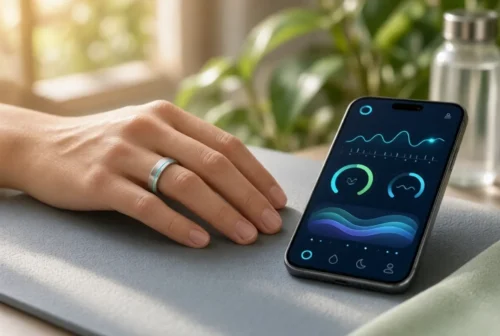
The Ring That Notices More
Illustrative scenario, not a real event.
Maya believed she slept well. Eight hours in bed, no alarm drama, no morning headache. Then her Smart Ring app showed something odd. Her resting heart rate had crept upward for five nights in a row, and her recovery score had slipped quietly downhill.
She felt fine. The ring disagreed.
So she did what a curious person does. She looked at her week. Late coffee, a work deadline, a warm bedroom, two skipped walks. The ring had not diagnosed anything. It had simply pointed at a pattern she was too busy to see.
That is the real promise of a Smart Ring. It does not replace a doctor, and it does not read your mind. It watches small signals while you sleep and helps you ask better questions about your own habits.
Table of Contents
What Is a Smart Ring?
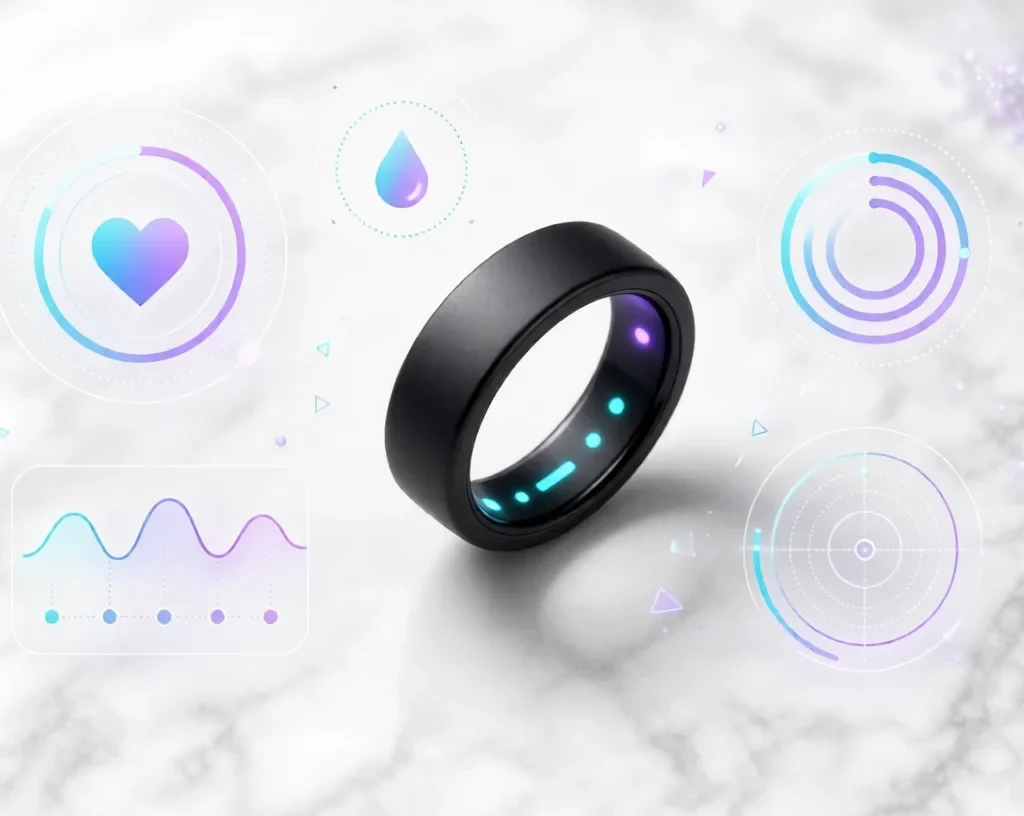
A Smart Ring is a small wearable computer worn on a finger. Inside the band sit tiny sensors, a battery, and a Bluetooth chip that sends data to your phone.
The sensors do most of the work:
- Optical sensors shine infrared light into the skin and measure how much returns. Each heartbeat changes blood volume slightly, and that change reveals your pulse. The technique is called photoplethysmography.
- A motion sensor tracks movement, which helps estimate sleep, wake time, and activity.
- A temperature sensor reads skin temperature, which is useful for spotting changes from your own normal.
One independent research paper describes a popular ring as a waterproof 4 gram device with a triaxial accelerometer and gyroscope, two infrared optical pulse sensors, and a temperature sensor (Chee et al., 2021). Your phone app then turns raw signals into scores using algorithms. Those algorithms are the part to question, and we will return to them.
How Does It Track Your Health?
Most rings estimate a similar set of measures:
- Sleep duration and stages. Light, deep, and REM sleep are estimated, not directly observed.
- Resting heart rate. Your lowest steady pulse, usually during sleep.
- Heart rate variability (HRV). The small timing differences between heartbeats. It often shifts with stress, illness, alcohol, and training load.
- Activity. Steps, movement, and workouts.
- Temperature trends. Changes relative to your personal average, not an exact body temperature.
Features differ by brand and model, so always check the maker’s documentation. And remember one rule: these are wellness estimates, not medical diagnoses.
Smart Ring vs Smartwatch
Neither device wins for everyone. Here is a practical comparison. Details vary by model, so verify before buying.
| Criteria | Smart Ring | Smartwatch |
|---|---|---|
| Comfort for sleep | Usually small and unobtrusive | Can feel bulky at night |
| Battery life | Often several days | Often one to a few days |
| Display | None, you use the app | Screen with alerts and apps |
| Exercise tracking | Good for basics, less detail | Stronger, with GPS and live stats on many models |
| Sleep monitoring | A main strength | Good, but you must wear it to bed |
| Cost | Moderate to high | Wide range |
| Subscription | Some brands charge monthly fees | Usually optional |
| Everyday convenience | Quiet and discreet | Interactive and feature rich |
A simple way to choose: if you want calm, passive sleep and recovery tracking, a Smart Ring suits you. If you want notifications, maps, and workout screens, a smartwatch fits better. Some people wear both.
The Powerful Benefits of Smart Ring Technology
- Sleep awareness. Seeing your sleep as data makes habits visible.
- Recovery trends. Over weeks, you learn how training, stress, and rest affect you.
- Habit feedback. You can test small changes, like an earlier dinner, and watch what follows.
- Comfort and convenience. Many people forget they are wearing one, which means more consistent data.
- Pattern recognition. A sustained change from your own baseline may prompt you to look closer.
Notice the careful wording. These are helpful wellness insights. They are not the same as medically validated detection of disease.
The Limitations Nobody Should Ignore
- Accuracy varies between brands, models, and software versions.
- People differ. Skin tone, finger size, tattoos, cold hands, and health conditions can affect readings.
- Fit matters. A loose or wrong sized ring can weaken the optical signal.
- Charging and fees. A dead ring records nothing, and some features need a subscription.
- Privacy. Sleep and heart data are personal. Read the privacy policy before you sign up.
- Needless worry. Normal ups and downs can look alarming on a chart.
A Practical Framework for Using a Smart Ring
- Establish a personal baseline. Wear it for two to four weeks before judging anything.
- Watch trends, not single nights. One bad score is noise. A week of change is a signal.
- Connect data to life. Compare readings with sleep timing, exercise, stress, caffeine, and alcohol.
- Know the limits. Check what the maker says the device can and cannot measure.
- Seek medical advice when symptoms or persistent concerns appear, whatever the app says.
A Real World Example
Illustrative example, not a real person.
Arjun, a 34 year old office worker, notices four poor sleep nights and a resting heart rate that sits higher than his usual range. He does not search for scary conditions. He follows the framework instead.
He checks his week. He has been working late, drinking coffee after lunch, and skipping his evening walk. He moves coffee to the morning, sets a bedtime, and walks again. Over ten days, his numbers drift back toward his baseline.
Had they stayed off, or had he felt unwell, the sensible next step would be a conversation with a doctor, using his ring trends as notes rather than as a diagnosis.
What the Data Really Means
It helps to separate four ideas:
- Direct measurement: the raw signal, such as light reflected from your finger.
- Algorithm estimate: a score built from that signal, such as sleep stages or readiness.
- Correlation: two things moving together, like late caffeine and worse sleep.
- Medical proof: a clinical test interpreted by a qualified professional.
Smart rings mostly live in the second and third categories.
Independent research shows why. In a laboratory study of 53 healthy adolescents aged 15 to 19, researchers compared an Oura ring with polysomnography, the clinical standard for sleep testing. The ring underestimated total sleep time by about 33 to 47 minutes and overestimated time awake after sleep onset by about 31 to 46 minutes, depending on the condition tested. Sleep or wake classification accuracy was between 0.88 and 0.89, but the authors concluded that sleep staging needs improvement (Chee et al., 2021).
An earlier single night laboratory study of the same brand found that total sleep time, sleep onset time, and time awake were not significantly different from polysomnography, though the authors called the results promising and said further validation was needed (de Zambotti et al., 2019).
Limits matter here. These studies tested one brand, mainly young and healthy participants, in lab settings, and on earlier device versions. They cannot speak for every ring, every age group, or people with sleep disorders.
On regulation, the US FDA’s January 2026 General Wellness guidance explains that low risk wellness products fall under enforcement discretion, and that inclusion does not establish that a product is safe or effective for its intended use. In plain terms, a wellness label is not a clinical stamp.
Common Myths About Smart Rings
Myth: A Smart Ring can diagnose every health problem. Reality: It gives wellness estimates. Diagnosis needs clinical testing.
Myth: A high readiness score means you are healthy. Reality: The score reflects a few signals and a company algorithm. You can feel unwell with a high score, or fine with a low one.
Myth: All smart rings are equally accurate. Reality: Sensors, fit, and software differ, and validation studies cover specific devices only.
Myth: A tracker can replace a doctor. Reality: It can support a conversation, not replace one.
What Should You Check Before Buying?
- Comfort and sizing. Use the maker’s sizing kit if offered.
- Phone compatibility. Confirm iOS or Android support.
- Features you need. Not every ring offers every metric.
- Validation. Look for independent studies, not only company claims.
- Privacy policy. Check what data is stored, shared, and deletable.
- Data export. Can you download your own records?
- Total cost. Include subscription fees over two years.
- Warranty and returns. Test it for a few weeks before the window closes.
Conclusion: Use the Technology Wisely
A Smart Ring can be a quiet teacher. It turns nights of sleep into patterns you can learn from. But patterns are not verdicts. Meaningful decisions still need context, sound judgement, and medical advice when something feels wrong.
Your next step is simple. Pick a baseline period, watch your trends, change one habit at a time, and talk to a professional if worry persists. For more evidence based health technology guides, keep exploring kritiinfo.com.
FAQs
1. Can a Smart Ring detect illness? It can show changes from your normal, such as a higher resting heart rate. That may be a prompt to rest or check in with a doctor. It cannot confirm any condition.
2. How accurate is a Smart Ring for sleep? It depends on the model. Independent studies on one brand show decent sleep versus wake detection but weaker sleep stage estimates. See section 9.
3. Is a Smart Ring better than a smartwatch? Not always. Rings suit discreet sleep and recovery tracking. Watches suit screens, notifications, and detailed workouts.
4. Do I need a subscription? Some brands charge a monthly fee for full features. Check the cost before you buy.
5. How long before I see useful trends? Give it two to four weeks to build your personal baseline.
6. Can a Smart Ring replace a doctor’s advice? No. Use it for awareness, and see a professional for symptoms or ongoing concerns.
7. Is my data private? It depends on the company. Read the privacy policy and look for deletion and export options.