
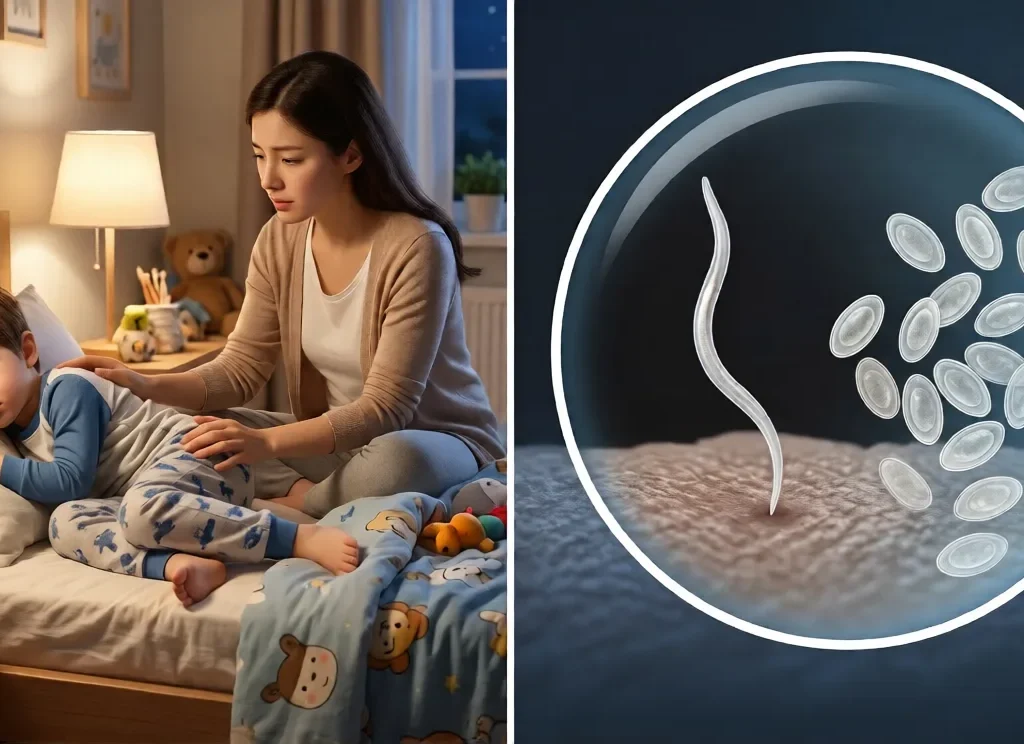
It is 2 a.m. Meera’s mother hears a small sound from the next room. Her seven year old daughter is awake again. She is wriggling and scratching, close to tears.
This is the third night in a row. By day, Meera is tired in class and cranky with her brother. Her mother wonders: dirty clothes? A skin allergy? Did I miss something?
On the fourth night, she gently shines a torch. She sees a tiny white thread, and it moves.
The doctor’s first words are kind: “This is very common. It is not your fault.” The cause is pinworms.
Pinworms are small gut worms. They are common in children, easy to treat, and nothing to do with a “dirty” home. This guide shows how they spread, how to confirm them, how to treat them safely and how to stop them returning.
Table of Contents
7 Quick Facts About Pinworms
- A pinworm is about the size of a staple.
- Night itching around the bottom is the main sign.
- Many people have no symptoms.
- A clear tape test, done in the morning, is the usual check.
- Medicine kills worms, not eggs.
- Eggs can live up to 2 weeks outside the body.
- Handwashing is the best daily protection.
What Are Pinworms?
Pinworms are tiny parasites. A parasite is a living thing that lives inside another living thing and feeds from it. The scientific name is Enterobius vermicularis. In some places people call them threadworms.
On average, a single pinworm is about the size of a staple. It is thin and white, and it lives in the lower gut, called the intestine.
Children touch many things and put fingers in their mouths. The CDC says infection is most common in school age and preschool age children. Parents and carers can catch it too.
How Do Children Get Pinworms?
Think of it as a loop with six steps:
- A child swallows pinworm eggs. They are too small to see.
- The eggs hatch in the gut. The young worms take about 1 to 2 months to grow up, says the NHS.
- At night, a grown female worm comes out near the anus to lay eggs. This causes itching.
- The child scratches. Eggs stick to fingers and under nails.
- The eggs spread to toys, clothes, towels, bedding and surfaces.
- Someone touches those things, then touches their mouth. The loop starts again.
Because the loop does not stop on its own, anyone in the family can get pinworms again and again.
Warning Signs Parents Should Never Ignore
Surprisingly, the CDC says symptoms are usually mild, and some people have none. A child can have pinworms and look completely well.
Common signs:
- Itching around the anus, often worse at night
- Restless sleep and waking up
- Feeling cranky or tired in the day
- Tiny white threads seen near the bottom at night or in the toilet
In girls, the worms can sometimes move to the genital area and cause itching or soreness there.
Less common signs listed by the NHS include weight loss, bedwetting and sore skin around the bottom.
Rare problems: The CDC notes appendicitis has been linked to pinworms in rare cases. Most tummy aches and mood changes have other causes.
How to Confirm a Pinworm Infection
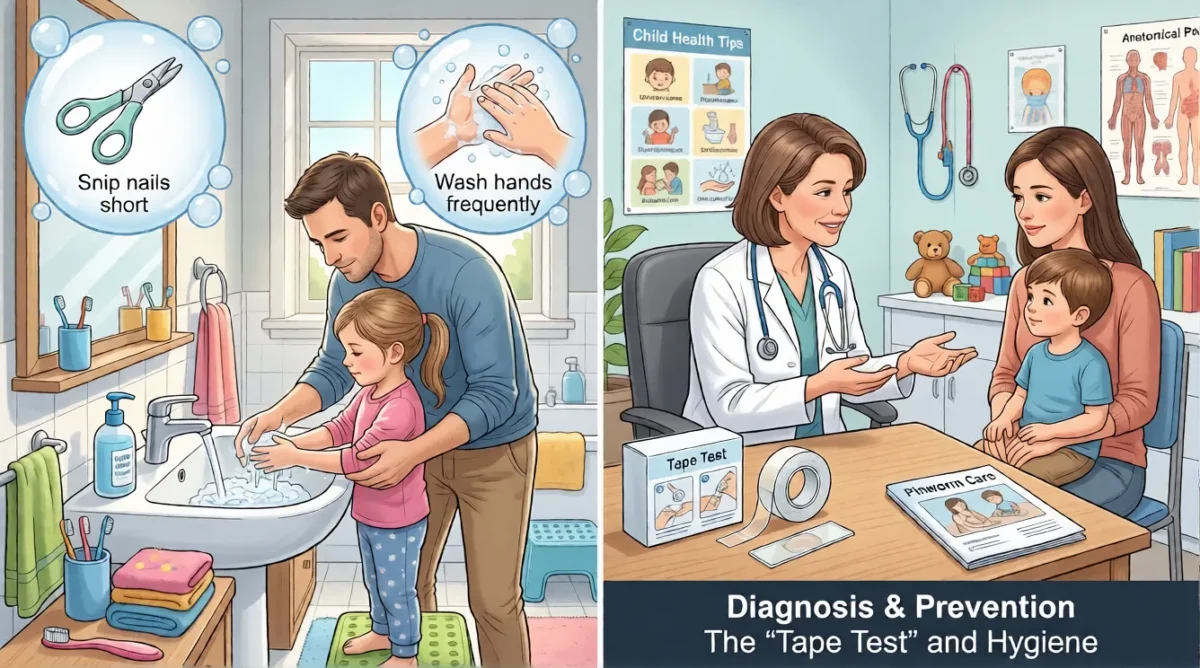
The most common test is the clear tape test. Here is how it works:
- Do it first thing in the morning, before toilet or bath.
- Press the sticky side of clear tape gently on the skin around the anus.
- Place the tape in a clean bag for the doctor. You may be asked to repeat it on a few mornings.
Why morning? Female worms lay eggs at night, so eggs are still on the skin when the child wakes. Stool samples often miss them.
Some doctors start treatment when worms or clear symptoms are seen. Either way, speak to a doctor or pharmacist. Self diagnosis is unreliable because many things make a bottom itch (see the table below).
Safe and Effective Treatment
Three medicines are commonly used: mebendazole, albendazole and pyrantel pamoate. The CDC clinical overview says mebendazole and albendazole are prescription medicines, and pyrantel pamoate is sold without prescription in the US. Rules differ by country, so ask a doctor or pharmacist.
The two dose idea. The medicines kill worms but not eggs. That is why a second dose is usually given about two weeks after the first. It catches worms that hatched after the first dose.
Treating the household. The CDC advises treating all household members if more than one person is infected or it keeps returning. The NHS advises treating everyone over 2 in the home, even without symptoms. Your doctor will guide you.
Special groups need extra care:
- Children under 2 years: see a doctor or pharmacist before giving anything.
- Pregnant or breastfeeding people: ask a doctor first. The CDC says treatment in pregnancy needs care and may be delayed until the third trimester.
- People with other health conditions: ask first.
Never guess a dose. Doses depend on age, weight and the medicine. Follow your doctor’s or pharmacist’s advice.
Practical Ways to Prevent Reinfection
Medicine clears the worms. Hygiene clears the eggs. You need both. Try this routine, called 3H: Hands, Hygiene, Home.
Hands
- Wash hands with soap after using the toilet.
- Wash hands before eating.
- Keep fingernails short and clean.
- Avoid nail biting and finger sucking.
Hygiene 5. Take a bath or shower every morning. 6. Change underwear daily, and wear underwear at night.
Home 7. Wash nightwear, towels and bedding often. The HSE says 60°C kills pinworm eggs, but check the care label first. 8. Do not shake bedding or clothes, so eggs do not float onto other surfaces. 9. Clean toilets, taps and other touched surfaces. Vacuum and wipe dust with a damp cloth. 10. Keep going as long as your doctor says. The NHS suggests 2 weeks with medicine, or 6 weeks without medicine.
What the Numbers Mean for Parents
- Up to 2 weeks: how long eggs can live outside the body.
- 2 weeks: the usual gap before the second dose.
- 1 to 2 months: how long swallowed eggs take to grow into adult worms.
What does this mean? One missed handwash can restart the loop, and eggs on a towel can stay alive for days. The second dose and two weeks of careful cleaning are not extras. They match the worm’s own clock.
The CDC also says pinworm is the most common worm infection in the United States. Being common is good news: doctors know exactly what to do.
Pinworms vs Other Causes of Itching
This table shows clues. It cannot replace a doctor’s check.
| Cause | Typical itch | Timing | Helpful clues |
|---|---|---|---|
| Pinworm infection | Around the anus, sometimes the vagina | Worse at night | Tiny white threads seen; others in the family itch too |
| Skin irritation | Red, sore patch | Often after a new soap, wipe or long wet period | Improves when the trigger is removed |
| Eczema | Dry, rough, scaly patches | Comes and goes, any time of day | Patches often on elbows, knees or other body parts; allergies in family |
| Tight or rough clothing | Itch or redness where fabric rubs | Worse in hot weather or after sweating | Eases quickly when clothes are changed |
For red sore skin in the nappy area, see our guide on diaper rash.
A Real World Family Example
This is a fictional example, not a real patient story.
Rohan, 6, keeps waking at night to scratch. His mother checks with a torch and sees a white thread. She calls the doctor, who asks for a morning tape test and confirms pinworms.
The family follows the treatment plan, including a second dose after two weeks. The doctor advises treating other family members too. At home, everyone washes hands before meals, Rohan’s nails are trimmed, and his bedding is washed hot, not shaken. After two weeks, the itching is gone and sleep is normal.
Lessons: Notice the pattern. Get advice early. Treat and clean together. Keep going for the full time. No one was blamed.
How Families and Schools Can Reduce Spread
- Schools can set handwashing times before snacks and after toilet breaks.
- Teachers can remind the whole class to keep nails short, without naming anyone.
- The NHS says children with threadworms need not stay off school or nursery.
Advantages and Limits
| Tool | Advantage | Limit |
|---|---|---|
| Tape test | Finds eggs directly | Needs early morning care; can miss eggs |
| Medicine | Kills adult worms fast | Does not kill eggs; needs a second dose |
| Hygiene | Removes eggs and protects everyone | Needs steady effort for weeks |
Common Myths Parents Should Stop Believing
Myth: Only children with poor hygiene get pinworms. Fact: Anyone can, even in very clean homes.
Myth: Only children can get pinworms. Fact: Adults can too, especially carers.
Myth: Worms always show up in stool. Fact: Often they do not.
Myth: One dose of medicine always solves it. Fact: Eggs survive, so a second dose is usually needed.
Myth: Treating the child alone is enough. Fact: Others may carry eggs, so everyone may need treatment.
Myth: Pinworms mean a child is dirty. Fact: It means a child swallowed eggs, which is easy to do. Never a reason for shame.
What Parents Should Do Next
- Watch for night itching, restless sleep and white threads.
- Call a doctor or pharmacist. Do not guess.
- Ask if a tape test is right.
- Follow the treatment plan, including any second dose.
- Ask whether the whole family needs treatment.
- Keep up the 3H routine for the full time advised.
- Return to the doctor if itching persists or comes back. The HSE suggests seeing a GP if signs remain one month after treatment.
See a doctor promptly if:
- Your child is under 2, or you are pregnant or breastfeeding
- There is strong belly pain, especially with fever or vomiting
- The skin around the bottom is very red, swollen or oozing
- A girl has pain when passing urine or an unusual discharge
- Your child is losing weight
If your child also has hard stools or tummy pain, read our guide on constipation in children. For babies, see common infant problems.
Frequently Asked Questions
1. Are pinworms dangerous for children? Usually not. They are annoying but mild. Problems such as skin infection from scratching are uncommon.
2. How do children get pinworms? By swallowing eggs from fingers, toys, bedding or other touched surfaces.
3. Can parents catch pinworms from their children? Yes. Parents and carers are often affected, so everyone should wash hands.
4. Can pinworms disappear without treatment? Not reliably. New eggs keep being swallowed, so treatment plus hygiene is the safer path.
5. How long does treatment take? Usually two doses two weeks apart, plus hygiene steps for 2 weeks (6 weeks without medicine), says the NHS.
6. Why do pinworms return after treatment? Medicine does not kill eggs. New eggs swallowed from hands or surfaces can start the loop again.
7. Can children attend school with pinworms? Yes. The NHS says there is no need to stay off school or nursery.
8. Can pinworms affect girls’ genital areas? Sometimes the worms move there and cause itching or soreness. See a doctor if this happens.
9. How can parents identify pinworms at night? Check gently with a torch while your child sleeps. Then do the morning tape test if advised.
10. When should parents consult a doctor? If itching lasts more than a few nights, the child is under 2, you are pregnant, or any warning sign above appears.
Conclusion: A Healthier Childhood Starts with Awareness
Pinworms are common, treatable and not a mark of a “dirty” child or a careless family. You can break the loop with the right medicine, clean hands and a few weeks of steady habits.
Next time your child scratches at night, you will know whom to call.
Medical disclaimer: This article is for education only. It does not replace professional medical advice, diagnosis or treatment. Always speak to a qualified doctor or pharmacist about your child’s health.