
It is 2 a.m. A six week old baby who normally feeds well has been crying for an hour. Her fists are clenched, her face is red, and nothing her parents try seems to work. Is it gas? Hunger? Colic? Or something that cannot wait until morning?
Almost every parent faces a moment like this. Most common infant problems are harmless and pass with time, but a few need a doctor quickly, and in a tiny baby the two can look alike. This guide shows you how to tell the difference, using guidance from the NHS, NICE and the World Health Organization.
Table of Contents
The 4 Step Infant Health Check
Use this routine whenever common infant problems worry you. It is an educational aid, not a diagnosis, and it never replaces a medical assessment.
The 4 Step Infant Health Check: Observe, Compare, Assess, Act
- Observe. Notice feeding, crying, breathing, temperature, sleep and wet diapers.
- Compare. What differs from your baby’s usual pattern? Your sense that something is “off” counts as information.
- Assess. Check the warning signs below and weigh your baby’s age. Age changes everything.
- Act. Choose home care, a call to your doctor, or emergency help.
Example A (illustrative). A three month old spits up a little milk after feeds but stays comfortable, feeds well and is gaining weight. Nothing has changed this week and no warning signs appear. The action is calm home care: hold her upright after feeds, burp her, and mention it at the next check up.
Example B (illustrative). A seven week old feels warm, reads 38.2°C under the arm, is unusually sleepy and feeds poorly. The same four steps give a very different answer, because a fever in a baby under 3 months can signal a serious infection. The action is a medical assessment now, not a wait and see night.
Never judge one symptom alone. Judge age, pattern and the combination of signs.
Warning Signs Parents Must Never Ignore
Fever in a baby under 3 months is much more likely to come from a serious infection than fever in an older child, which is why NHS guidance treats it as urgent even when the baby looks well.
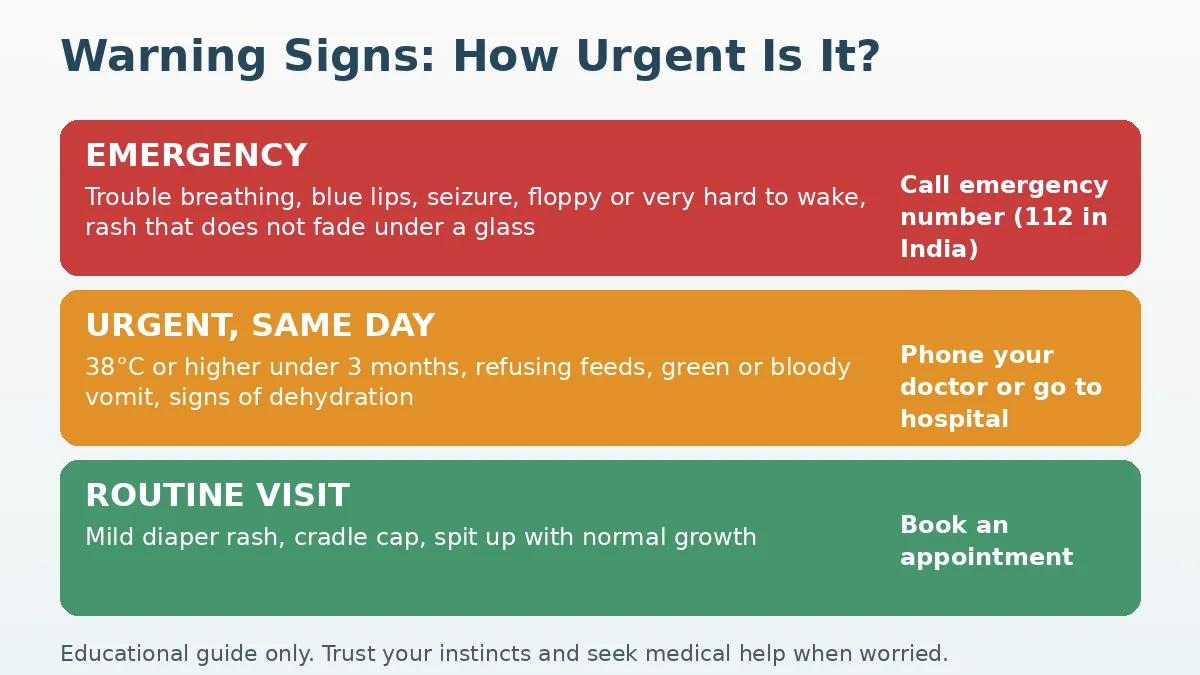
Emergency, urgent and routine warning signs in babies
| Level | What you see | What to do |
|---|---|---|
| Emergency | Difficulty breathing, pauses in breathing, blue or grey lips; a seizure; a floppy, unresponsive or very hard to wake baby; a rash that does not fade under a pressed glass; a weak or high pitched cry unlike their normal cry | Call your local emergency number now (112 in India) or go to the nearest emergency department |
| Urgent, same day | Temperature of 38°C or higher under 3 months; 39°C or higher at 3 to 6 months; refusing feeds; green or yellow vomit; blood in vomit or stool; persistent vomiting; signs of dehydration; fever lasting more than 5 days | Phone your doctor or paediatric service immediately, or go to hospital |
| Routine visit | Spit up with normal growth, mild diaper rash, cradle cap, colic like crying that settles when held | Book an appointment or mention it at the next check up |
Use a digital thermometer under the arm. Fever can follow vaccines, but phone your doctor rather than guess. Do not give fever medicine to a baby under 3 months unless a doctor tells you to, and never delay care to try a home remedy.
Seven Common Infant Problems and the Smart Way to Handle Each
1. Colic and crying: comfort first
Colic means frequent, intense crying in an otherwise healthy baby. The NHS says it affects about 1 in 5 babies and usually settles by 3 or 4 months. The cause is unknown, and immature digestion or sensitivity to milk proteins are suspected.
Safe steps: hold your baby, burp during and after feeds, keep her upright while feeding, check the latch or bottle flow, and use a calm room.
Avoid: untested remedies. NHS Wales notes there is little evidence for spinal manipulation or cranial osteopathy. If crying is overwhelming you, place your baby safely in the cot and step away for a few minutes. Never shake a baby.
Get help: a weak or high pitched cry, crying with fever or green vomit, poor weight gain, or colic like crying after 4 months.
2. Reflux and spit up: watch the weight
Many babies bring up milk because the muscle at the base of the food pipe is still maturing. According to the NHS, a baby who is happy, healthy and gaining weight does not usually need a doctor, and reflux often improves by about age 1.
Safe steps: feed calmly, burp, and hold your baby upright after feeds.
Avoid: raising the head of the cot, side sleeping, or changing formula without medical advice. Babies should sleep flat on their back.
Get help: green or yellow vomit, blood, feed refusal, poor weight gain, reflux that starts after 6 months, or reflux that continues beyond age 1.
3. Diarrhoea, constipation and dehydration: protect fluids
Babies have small fluid reserves, so vomiting or diarrhoea can dry them out quickly. The NHS lists a sunken soft spot, sunken eyes, few or no tears, fewer wet diapers, and drowsiness or irritability as signs.
Safe steps: keep breastfeeding or giving formula in small, frequent amounts. Ask a pharmacist or doctor about oral rehydration solution (ORS), which the WHO calls a proven life saving treatment.
Avoid: watering down formula, fruit juice, fizzy drinks, and anti diarrhoea medicines, which are not recommended for babies.
Get help: the same factsheet says dehydrated babies under 6 months need medical treatment, as do babies vomiting for more than 24 hours. Constipation means hard, dry stools with straining. Check with a doctor before giving any laxative.
4. Diaper rash and cradle cap: keep skin dry
The NHS explains that diaper rash comes from moisture, friction and irritants such as fragranced wipes, and sometimes thrush.
Safe steps: change diapers often, allow diaper free time, clean gently with water, and use a thin layer of barrier cream.
Avoid: talcum powder and antiseptics, as advised by the Royal Children’s Hospital Melbourne.
Get help: a rash that is severe, spotty, not better within a week, or paired with fever or poor feeding. Cradle cap, yellowish scaly scalp patches, is usually harmless. Ask a pharmacist if it spreads or
5. Fever: age decides the response
Fever is the body’s response to infection, and most are viral. Under 3 months, 38°C or higher needs medical assessment. At 3 to 6 months, the NHS threshold is 39°C or higher, and any baby with fever over 5 days should be seen. Offer extra feeds and dress your baby lightly.
Avoid: assuming teething, a cold, or vaccination explains it before checking the warning signs above.
6. Teething: drooling, not fever
Teething can cause drooling, gum chewing, fussiness and disturbed sleep. The NHS says there is no evidence that it causes diarrhoea or fever, and a BMJ review concluded that fever above 38°C is very unlikely to be caused by teething.
Safe steps: offer a clean, cool teething ring or rub the gums gently with a clean finger. Treat fever or diarrhoea as separate problems.
7. Blocked nose, coughs and sleep: watch the breathing
Most colds are mild. Babies breathe mainly through the nose, so congestion can make feeding noisy and slow. Rapid breathing, ribs pulling in, grunting, blue lips, or being too breathless to feed are emergency signs. Do not give cough or cold medicines to a baby unless a doctor advises them. For sleep, newborn patterns are irregular and normal. Place your baby on the back on a flat, firm surface.
Why Common Infant Problems Look Different in Babies
The same symptom can mean different things because infants are still developing. The gut valve is immature, so milk travels backward easily. The immune system is still learning, so a tiny baby may not show infection the way an adult does, which is why drowsiness and poor feeding matter as much as fever. The skin barrier is thinner and loses water faster. Small stomachs mean frequent feeds, so one missed feed matters more. Sleep cycles are short and noisy, so grunts and twitches are often normal. This is general physiology, not a diagnosis for your baby.
Common Infant Problems: Normal or Concerning?
| Situation | Usually normal | Concerning |
|---|---|---|
| Crying | Peaks in the evening, eases when held, feeds well | Weak or high pitched cry, crying with fever, cannot be settled |
| Spit up | Small amounts, comfortable baby, gaining weight | Green, yellow or bloody, weight loss, refuses feeds |
| Diaper irritation | Mild redness that improves in days | Blisters, spots, spreading, no improvement in a week |
| Sleepiness | Sleepy newborn who wakes for feeds | Hard to wake, floppy, feeds poorly |
Four Misconceptions About Common Infant Problems
“Every crying baby has colic.” Crying also comes from hunger, tiredness, discomfort and illness, and early crying normally peaks between about 2 weeks and 4 months.
“Teething explains fever and diarrhoea.” Evidence does not support it. Check for another cause.
“All spit up is dangerous.” Most is harmless when the baby is comfortable and growing. The warning signs are what matter, not the spit up itself.
“Home remedies are always safe.” Honey, for example, must not be given to babies under 12 months because of the risk of infant botulism.
What the Numbers Say
The WHO reports that diarrhoeal disease was responsible for the deaths of 370,000 children under 5 worldwide in 2019, and that exclusive breastfeeding for the first 6 months and ORS treatment are key protections. A WHO and UNICEF statement found that hand washing with soap reduces diarrhoeal disease by over 40 per cent. These are global figures, so they do not predict what will happen to any one baby. They show that dehydration is the real danger and that simple steps work.
Benefits and Limits of Reading About Infant Health
Understanding common infant problems helps you spot warning signs earlier, speak clearly with your doctor, avoid unsafe remedies, and parent with less panic. But symptoms overlap, babies cannot tell you what hurts, and no article can diagnose your child. When you are worried, ask a qualified professional.
Frequently Asked Questions About Common Infant Problems
1. What are the most common infant problems in the first year? Colic, reflux and spit up, diaper rash, feeding difficulties, constipation or diarrhoea, colds, and fever are the most common.
2. When should I worry about my baby’s crying? Worry if the cry is weak or high pitched, differs from the usual cry, comes with fever, vomiting or poor feeding, or does not settle.
3. Is frequent spit up normal? Often yes, if your baby is comfortable, feeding well and gaining weight. See a doctor for green or bloody vomit or weight loss.
4. How can I recognise dehydration? Look for fewer wet diapers, a sunken soft spot, sunken eyes, few tears, drowsiness or irritability. Seek urgent help if you see them.
5. What should I do if my baby has a fever? Measure under the arm. Under 3 months with 38°C or higher means medical assessment now. Older babies need advice depending on age, duration and behaviour.
6. When does diaper rash need a doctor? When it is severe, spotty, not improving within a week, or your baby seems unwell.
7. Can I use home remedies? Only simple comfort measures. Ask a doctor or pharmacist before any medicine, herbal product or remedy, and never give honey under 12 months.
Conclusion: Calm, Attentive Parenting
Most common infant problems are manageable, and your daily observations are your best tool. Watch for changes from your baby’s normal, keep feeds, hygiene and routine check ups on schedule, avoid unverified remedies, and seek help promptly when a warning sign appears. Trust your instincts, because you know your baby best.
Medical disclaimer: This article is educational and does not replace professional medical advice, diagnosis or treatment. It has not been medically reviewed. Always consult a qualified healthcare professional about your baby’s health.