
Ask a room of managers which companies will lead their industry in ten years, and most will name today’s giants. Business history says that is a risky guess. When a market changes shape, leadership often changes hands.
So here is the question that matters: can your business recognise tomorrow’s markets before your competitors do? Understanding Future Markets is no longer a task for strategy consultants alone. It is part of every manager’s job.
Table of Contents
What Are Future Markets?
Future Markets are emerging, expanding or transforming areas of demand where customers, technology and economics are changing together.
Three kinds exist:
- Emerging: the market barely exists yet.
- Expanding: a small market is growing fast.
- Transforming: an old market survives, but the way it earns money changes.
One clarification: this article is about business opportunity. It has nothing to do with financial futures contracts traded on exchanges.
Trend or structural change?
A trend fades. A structural change stays. Use three questions to tell them apart:
- Does it change what customers need, or only what they talk about?
- Does it permanently change costs, such as cheaper batteries or cheaper computing?
- Is serious money flowing in from several different kinds of players, not just one?
If you answer yes to all three, treat it as structural.
The Forces Behind Future Markets
Eight forces keep appearing across industries. What matters is what each one does to your decisions.
- AI and automation lower the cost of knowledge work. Threat: routine services lose their price advantage. Opportunity: new services that were too expensive before.
- Demographics change who buys. Ageing societies need healthcare, accessibility and financial products. Young, urban populations drive mobile first services.
- Climate and the green economy reshape energy, transport, buildings and packaging.
- Digital business models replace ownership with subscriptions, platforms and pay per use.
- Healthcare innovation moves care from hospitals to homes and from treatment to prevention.
- Supply chains and geopolitics reward companies that can produce closer to customers.
- New technologies and sustainable products create industries that did not exist a decade ago.
- Income growth and urbanisation turn millions of first time buyers into consumers every year.
Now let us see what the data says about Future Markets.
What the Data Really Tells Managers
Electric mobility. The International Energy Agency reports that electric car sales topped 20 million in 2025, about 25% of all new cars sold. Yet sales fell about 8% in the first quarter of 2026 after policy changes in China and the United States, and the IEA still forecasts around 23 million for the full year.
What this means: a real structural market can still have bad quarters, especially when subsidies change. Plan for bumps, not straight lines. The limitation: forecasts are not facts, and they shift with fuel prices and policy.
Jobs and skills. The World Economic Forum’s Future of Jobs Report 2025 expects 170 million jobs created and 92 million displaced by 2030, a net gain of 78 million. That is churn equal to 22% of today’s formal jobs.
What this means: the headline is not “jobs vanish” but “jobs move.” The catch is that these numbers come from employer surveys across 55 economies, so they reflect expectations, not certainty. Use them to plan reskilling, not to predict individual roles.
Ageing. The UN projects the world population will grow from 8.2 billion in 2024 to about 10.3 billion in the mid 2080s, while people aged 65 and over will outnumber children under 18 by the late 2070s. People aged 80 and above are projected to outnumber infants by the mid 2030s.
What this means: this is the most predictable Future Market of all. Demographics move slowly, so planning ahead is realistic. The limitation: national patterns differ widely, so a global average is only a starting point.
Traditional Markets vs Future Markets
| Factor | Traditional market | Future market |
|---|---|---|
| Customer expectation | Reliable product at fair price | Personalised, fast, responsible |
| Technology | Supports operations | Defines the offer |
| Competition | Known rivals | Unknown entrants from other industries |
| Investment | Predictable, asset heavy | Staged, evidence based |
| Sustainability | Compliance cost | Source of advantage |
| Business model | Sell units | Sell outcomes, access, data |
| Management style | Control and efficiency | Experiment and learning |
Stop: forecasting from last year’s numbers alone, and measuring only today’s customers. Start: talking to people who do not buy from you, and running small experiments. Rethink: who your real competitor is. It may not be in your industry at all.
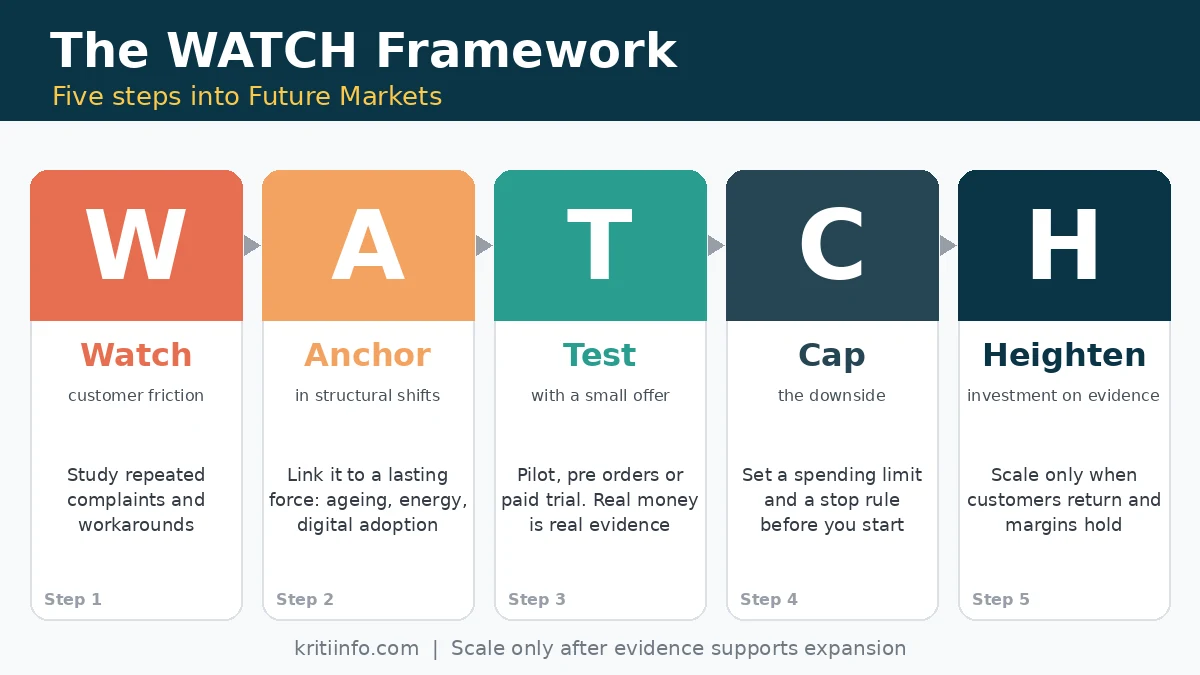
The WATCH Framework: Five Steps into Future Markets
An original, practical method for finding and entering Future Markets.
W: Watch customer friction. Look for repeated complaints, workarounds and unmet needs. Spend time where customers struggle, not where they praise you.
A: Anchor in structural shifts. Connect that friction to a force such as ageing, energy costs or digital adoption. If no lasting force sits behind it, it is probably a fad.
T: Test with a small offer. Do not build first. Sell a pilot, take pre orders or run a paid trial. Real money is stronger evidence than survey enthusiasm.
C: Cap the downside. Set a spending limit and a clear stop rule in advance, such as “if fewer than 30 paying customers in 90 days, we stop or change course.” Decide this before emotions get involved.
H: Heighten investment on evidence. Scale only when customers return, margins hold and delivery works. Growth should follow proof.
The Thriller: Kodak, Fujifilm and a Vanishing Market
The setup. In December 1975, Kodak engineer Steven Sasson built the first working digital camera inside the company’s own labs. It weighed about eight pounds. Kodak patented the work and later put real money into digital products. (A popular story says managers dismissed the invention at once. That version is widely repeated but hard to verify, so treat it as legend.)
The threat. Photographic film demand peaked around the turn of the century, then fell as digital photography spread. Both Kodak and its great rival Fujifilm faced the loss of their core business.
The decision. Fujifilm’s leader, Shigetaka Komori, launched a restructuring plan called Vision 75 in 2004. By reports, it closed film plants, cut thousands of jobs and redirected research toward markets that could use the same underlying chemistry. Fujifilm moved into healthcare, materials and cosmetics, including the Astalift skincare line built on its antioxidant and collagen know how.
Kodak’s path. Kodak also tried to diversify. It bought Sterling Drug for $5.1 billion in 1988, but that move ended with piecemeal sales six years later, as reported by Forrester citing The Economist.
The outcome. On 19 January 2012, Kodak filed for Chapter 11 bankruptcy protection, listing about $5.1 billion in assets against $6.75 billion in debt. Fujifilm survived as a diversified company across healthcare, imaging and materials.
Lessons (our interpretation, not documented fact):
- Having the invention is not enough. Kodak was early, yet still lost.
- Fujifilm asked a better question: not “how do we protect film?” but “what are we truly good at underneath the film?”
- Early movers need cash and time. Fujifilm acted while it could still afford to learn.
- Adjacent markets that use your existing strengths are safer than distant ones.
Komori tells his own account in his book, Innovating Out of Crisis.
Three Realistic Examples (Hypothetical)
These are illustrative scenarios, not real companies.
1. Regional dairy cooperative (agriculture). Watching customers, it notices urban buyers struggling to find fresh, traceable products. It anchors this in urbanisation and rising incomes, then tests a small subscription service in one city with paid pre orders. It caps spending and expands only after repeat orders hold.
2. Neighbourhood pharmacy chain (healthcare). Pharmacists see elderly customers struggling with repeat prescriptions. It tests home delivery and medicine reminders in two branches, tracks repeat use and complaints, then scales if the numbers support it.
3. Auto component maker (manufacturing). An engine parts supplier sees its main product shrinking over the long term. Instead of betting everything, it tests one cooling component for electric vehicles with a single customer. Revenue is small, but it learns what customers need before investing in a factory.
The Misconception: “Being First in Future Markets Guarantees Success”
It does not. Kodak made the first digital camera and still failed as a company. Success depends on timing, customer trust, execution and money discipline. Arriving too early means paying to educate the market while others copy your lessons cheaply. Arriving at the right moment with a workable model beats arriving first with a good idea.
How Different People Can Use This
- Startups: hunt for friction that large firms ignore because it is too small for them.
- Small businesses: enter through one niche, one city or one customer group, not the whole market.
- Established companies: run a separate small team for new markets, protected from quarterly pressure of the core business.
- Managers: hold regular sessions where the team studies customers outside your current base.
- Entrepreneurs: sell a manual version of your product before you automate it.
- Professionals: build skills in data use, AI tools and a field with ageing or energy demand.
Advantages and Limitations
Advantages of entering Future Markets: new customers, higher growth potential, stronger brand position, innovation culture and less dependence on a shrinking core.
Limitations: uncertain demand, heavy investment, regulation, technology risk, weak infrastructure, new competitors and unpredictable returns. Not every emerging market becomes a good business. Many never do.
Frequently Asked Questions
1. What are Future Markets? Areas of emerging or transforming demand shaped by shifts in technology, population, climate and income. They are about business opportunity, not financial futures contracts.
2. Why do they matter for managers? Because leadership in an old market does not carry over automatically into Future Markets. Managers who spot change early can reposition while they still have money and talent.
3. Which industries may offer big Future Markets opportunities? Clean energy and electric mobility, healthcare and elder care, AI enabled services, sustainable materials, and digital finance. Opportunity depends on your local market and strengths.
4. How can small businesses find Future Markets? Start with your own customers’ repeated complaints. Look at what is growing in nearby cities, then test one small offer before expanding.
5. What risks should entrepreneurs consider? Weak demand, long payback periods, changing rules, dependence on subsidies and larger competitors copying you. Set a spending cap before you begin.
6. How can managers prepare for disruption? Track a few reliable data sources, run small experiments, train teams in new skills and review strategy at least twice a year.
7. How do I decide whether one of the Future Markets is worth entering? Check four things: paying customers in a pilot, a structural force behind demand, margins that can work at scale, and a risk you can afford to lose.
What to Do Next
The future belongs not simply to businesses that predict change, but to those that understand it, prepare for it and act intelligently. A simple plan:
- This week: list five customer complaints you hear repeatedly.
- This month: pick one Future Markets opportunity and check it against the three structural questions.
- Next 90 days: run one small paid test with a spending cap and a stop rule.
- Ongoing: follow reliable sources such as the IEA, the World Economic Forum and the UN, and build one future skill.
- Every six months: review your strategy honestly.
Future Markets reward curiosity backed by discipline. Start small, learn quickly and scale only on evidence.