
In August 2007, researchers at Rensselaer Polytechnic Institute in New York showed an energy storage device that could be mistaken for a sheet of black paper. It was thin, bendable and mostly cellulose, the material in newsprint and lunch bags.
In 2022, Swiss researchers at Empa printed a strip of paper, added a few drops of water, and watched it switch on. Two such cells ran the display of a small alarm clock.
Both results are real and published. Can something as ordinary as paper help power the electronics around us?
The honest answer is yes for some tiny jobs, and not yet for big ones. This guide explains how a paper battery works, what the evidence shows, and how to spot hype.
Table of Contents
What Is a Paper Battery?
A paper battery is an energy storage device built on a paper or cellulose base. The paper supports the electrodes, which take in and release charge, and the electrolyte, which lets charged particles called ions move between them.
Why paper? It is light, cheap, flexible and porous. Its tiny channels soak up liquids and hold printed inks. It also comes from a renewable material.
Paper based energy devices are not all the same:
- Paper battery: paper is the base or separator inside a complete cell.
- Cellulose supported battery: cellulose fibres hold ordinary battery materials together.
- Printed battery: layers are printed with inks on paper, plastic or another base.
- Paper supercapacitor: charge gathers on electrode surfaces. It charges and releases fast but holds less total energy.
How a Paper Battery Works
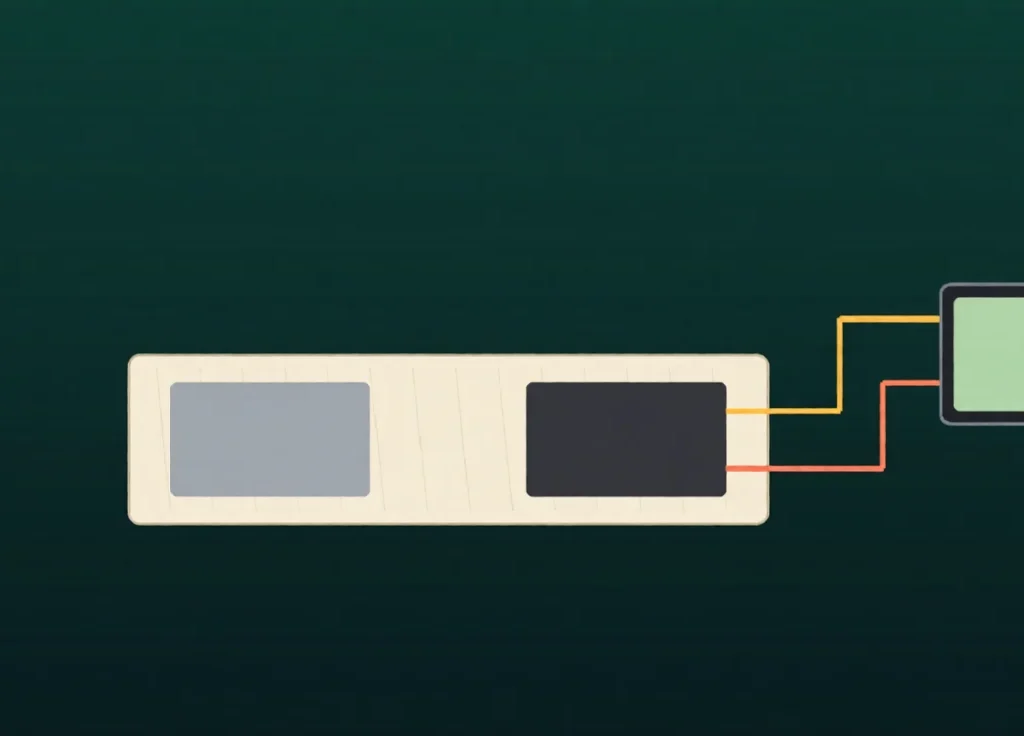
Think of paper as a sponge between two rooms. Electrons cannot cross it, but ions in liquid can.
- Separation. Paper keeps the electrodes apart so they cannot short circuit.
- Activation. In the Empa design, salt sits in the paper. Water dissolves it and creates an ion pathway.
- Release. Zinc at the negative end gives up electrons. They travel through the outside circuit and power the device.
- Balance. Ions move through the paper to balance the charge, while a graphite air electrode completes the reaction.
A battery stores energy chemically and releases it as the reaction runs. A supercapacitor releases stored charge almost instantly.
Materials Behind the Technology
- Cellulose fibres: the porous, flexible skeleton.
- Conductive materials: carbon nanotubes, graphite or silver nanowires. A Stanford team coated ordinary paper with nanotube and silver ink and reached a sheet resistance as low as 1 ohm per square.
- Electrolytes: salt water in the Empa battery. The 2007 Rensselaer device used a water free ionic liquid, which helped it tolerate extreme temperatures.
A lab prototype proves a principle. A product must last, survive humidity, pass safety tests and be made in millions cheaply. In 2007 the Rensselaer team said the materials were cheap but low cost mass production did not yet exist. In 2022 the Empa authors still called printing biodegradable batteries an important scientific challenge.
Comparison: Paper Battery and Its Rivals
No option wins on every factor. Figures come from the studies cited below. Other entries are general characteristics.
| Factor | Lithium ion | Alkaline | Paper battery | Paper supercapacitor |
|---|---|---|---|---|
| Weight | Light for its energy | Moderate | Very light | Very light |
| Flexibility | Mostly rigid | Rigid | High | High |
| Energy storage | High | Moderate | Low in most designs | Low |
| Charging | Rechargeable | Not rechargeable | Single use or rechargeable | Very fast |
| Cost | Mature supply chain | Low | Unproven at scale | Unproven at scale |
| Environment | Mining, recycling issues | Disposal waste | Depends on every part | Depends on every part |
| Durability | Hundreds to thousands of cycles | One use | Moisture, drying issues | Over 40,000 cycles in one lab study |
| Availability | Everywhere | Everywhere | Lab and prototype | Lab and prototype |
Real World Applications
- Smart labels. Benefit: printable power for tags. Needs: very low power. Limit: small output. Status: a stated Empa target.
- Disposable medical tests. Benefit: stays inactive until a liquid sample arrives. Needs: safe materials. Limit: drying out. Status: prototype stage.
- Wearable sensors. Benefit: light and bendable. Needs: steady supply near skin. Limit: low capacity, sweat. Status: future possibility.
- Environmental monitors. Benefit: sensors that can degrade in place. Needs: weather resistance. Limit: moisture. Status: proposed by researchers.
- Low power Internet of Things devices. Benefit: a brief charge, then hours of sensing. Needs: reliable bursts. Limit: small storage. Status: expected, not shown at scale.
- Printed electronics and education. Benefit: batteries printed beside circuits, cheap classroom demonstrations. Needs: stable inks. Limit: manufacturing control, short life. Status: lab demonstrations only.
Three Illustrative Examples
Example A: Smart food package. A tag on a sealed tray uses a tiny paper power source to log temperature. It must stay cheap.
Example B: Disposable medical sensor. A test strip adds a drop of sample, which activates the cell and powers a small display. The battery is thrown away after one test.
Example C: Remote environmental sensor. A soil sensor sits in a field nobody visits. A briefly charged cellulose supercapacitor could power occasional readings.
What the Data Really Say
- Energy. The Stanford paper supercapacitor reached 30 to 47 watt hours per kilogram counting only nanotube mass, but 7.5 when all parts were counted. A 2010 US Department of Energy chart put supercapacitors at 0 to 8 and lithium ion at 42 to 180. Honestly counted, it sits far below lithium ion.
- Voltage and power. One Empa cell gave 1.2 volts and a peak power of 150 microwatts per square centimetre. That runs a small display, not a phone.
- Cycles. The Stanford supercapacitor passed 40,000 cycles. The Empa battery is single use.
- Moisture. The Empa cell weakened after about an hour as the paper dried. Two more drops held 0.5 volts for over another hour.
- Disposal. An Empa paper supercapacitor disintegrated within two months in soil, leaving a few carbon particles.
I found no reliable public cost data, so none is quoted.
For consumers: expect labels and test strips first, not longer phone life. For investors: a lab figure is not a product specification. Look for pilot production, unit cost, independent testing and humidity data.
Advantages and Limitations
Advantages: light, flexible, printable, cheap and renewable base material, possibly easier disposal, suited to low power devices.
Limitations: low energy in most designs, moisture sensitivity, short life in some uses, hard to scale, unclear recycling, almost no commercial availability.
Green materials do not make the whole battery harmless. The 2007 Rensselaer device worked as a lithium ion battery and used carbon nanotubes. A product is only as green as its least green part.
Six Common Misconceptions
- “It will replace lithium ion.” No. Energy storage is its weak point.
- “Every paper battery is biodegradable.” No. It depends on every component.
- “Paper makes electricity.” No. Paper is a support. Electrodes and chemistry do the work.
- “It can power a phone for days.” No. Research cells run clocks and sensors.
- “It already dominates.” No. The studies cited here are laboratory work.
- “All are rechargeable.” No. The Empa battery is single use. Supercapacitors and some hybrids recharge.
The Next Five to Ten Years
The likeliest first uses are low power, disposable devices: labels, test strips and simple sensors. Watch for stable inks, moisture protection, printing at scale, safer materials and clear disposal routes. I would not expect paper to compete with lithium ion in phones or cars in this period. That is an assessment, not a dated forecast.
A Five Question Test for Any New Battery
- How much energy can it store? Ask for watt hours and whole device weight.
- How long can it operate? Ask for run time at a stated load, plus shelf life.
- How many cycles can it survive? Ask if it recharges and how much capacity remains.
- What is the real footprint? Count every part, the factory and disposal.
- Can it be made cheaply at scale? Ask for pilot production and unit cost.
If a claim skips two or more of these, be careful. To learn more, read the original papers below and check the units.
Conclusion
A paper battery will not replace the cell in your phone. But for disposable, low power jobs it is a serious research direction backed by real experiments, from Rensselaer in 2007 to Empa in 2022. Judge it by evidence, not slogans.
Frequently Asked Questions
What is a paper battery? An energy storage device built on a paper or cellulose base.
How does a paper battery work? Paper separates the electrodes and carries ions. In the Empa design, water dissolves salt in the paper and zinc releases electrons.
Is a paper battery rechargeable? It depends on the design. The Empa battery is single use. Paper supercapacitors and some hybrids recharge.
Are paper batteries biodegradable? Only if every part is. Empa’s zinc and paper design aims for that, but nanotubes or lithium may not degrade.
Can a paper battery power a smartphone? No. Demonstrated cells run clocks and small sensors.
What is the difference between a paper battery and a lithium ion battery? Lithium ion stores far more energy and is widely sold. A paper battery is lighter and flexible but mostly experimental.
Where are paper batteries used? Proposed for smart labels, disposable diagnostics and sensors. I found no verified mass market product.
What is the future of paper battery technology? Likely niche, low power, disposable uses, if cost, moisture and scaling are solved.