
A healthier future starts with understanding
Childhood obesity is not simply a matter of a child eating too much or moving too little. Biology, family circumstances, food environments, sleep, stress and access to health care all play a part. The right response is not blame. It is early, kind and practical support.
The scale is significant. The World Health Organization (WHO) estimates that in 2024, 400 million children and adolescents aged 5 to 19 were overweight worldwide, including 170 million living with obesity. An estimated 35 million children under five were also overweight. WHO reports that overweight prevalence among 5 to 19 year olds rose from 8% in 1990 to 20% in 2024; the figures appeared in its September 2026 update.
In India, the National Family Health Survey 2019 to 2021 found that 3.4% of children under five were overweight by its weight-for-height measure, compared with 2.1% in NFHS-4. This is an under-five indicator, not a measure of obesity among all school-age children and teenagers.
Table of Contents
What childhood obesity means
A child’s body changes rapidly during growth. A bathroom scale cannot tell the whole story, and adult BMI cut-offs should not be used to judge a child. Childhood obesity is assessed with growth references designed for children, not by applying adult standards to a younger body.
How clinicians assess childhood obesity
Health professionals commonly use body mass index (BMI), calculated from weight and height, and compare the result with age- and sex-specific reference charts. For children aged 5 to 19, WHO uses BMI-for-age. For children under five, WHO uses weight-for-height standards. The reference is important because expected body proportions change as children grow and develop.
A single measurement is only a snapshot. A clinician looks at the child’s pattern over time, height growth, age, development, medical history, family history and overall health. A steady change across several visits may be more informative than one reading. Measurements should be taken correctly and interpreted with an appropriate chart. A BMI result is a screening tool, not a complete diagnosis on its own.
Why one number is not enough
Parents sometimes compare a child with a sibling, cousin or classmate. That comparison can be misleading. Children grow at different rates, and puberty can change height, muscle and body composition. A teenager who is developing quickly may have a different growth pattern from a younger child of the same height.
For this reason, do not rely on an adult BMI calculator, a social-media chart or comments about appearance to decide whether a child has childhood obesity. Ask a paediatrician or qualified health professional to explain the growth chart in plain language. The conversation should focus on health, sleep, energy, strength, confidence and development rather than making a child feel judged.
A useful question at a routine appointment is: “How is my child’s growth changing over time, and what should our family do next?” This opens the door to practical, age-appropriate guidance.
Why does it happen?
There is rarely one explanation for childhood obesity. It usually develops through several influences that interact over time. Genes and biology can affect appetite, fullness, metabolism and how the body stores energy. These inherited influences can increase susceptibility, but they do not determine a child’s future and they are not a reason to give up.
Food availability and family routines
Children eat within the choices available at home, school and nearby shops. Frequent sugary drinks, oversized snack portions and highly processed foods can make balanced eating more difficult, especially when fruit, vegetables and other nourishing foods are less affordable or convenient. Advertising, packaging, peer habits and busy family schedules also shape what children ask for and what adults can provide. This is why childhood obesity cannot be explained simply by saying that a child eats too much.
Activity depends on the environment
Schoolwork, long commutes, limited playgrounds, unsafe roads, extreme weather and lack of affordable sports facilities can reduce active time. Screen entertainment is not automatically harmful, but long uninterrupted sitting can replace walking, cycling, games and outdoor play. Some children also avoid sport because of bullying, embarrassment or a lack of activities that suit their abilities.
Sleep, stress and medical factors
Irregular bedtimes, late-night screens and poor sleep can affect energy, mood and appetite. Stress at home or school may also influence eating patterns and willingness to be active. A child who is anxious, lonely or teased may withdraw from activities that previously brought enjoyment.
Certain hormonal or genetic conditions and some medicines can affect weight. These are not the cause in most children, but a health professional should review symptoms and treatment history rather than assuming every case has the same explanation.
WHO describes childhood obesity as a condition shaped by biological, behavioural, social and environmental factors. The practical lesson is important: children do not control food prices, marketing, school timetables, neighbourhood safety or family resources. A helpful plan changes the surroundings and routines that adults can influence, while giving the child encouragement and a voice in decisions.
Families can start by noticing patterns without blaming anyone. Ask: What drinks are usually available? Is there a safe place to play? Does the child sleep well? Are school or travel demands leaving enough time to move? Are there emotional or medical concerns that need attention? Better questions lead to better solutions.
Why early support matters
Early support for childhood obesity is important because health, growth and emotional well-being develop together. Excess body fat can increase the likelihood of high blood pressure, unhealthy cholesterol levels, insulin resistance and type 2 diabetes. Some children may also experience sleep apnoea, joint discomfort, fatty liver disease or difficulty taking part in physical activity. These are possible risks, not a prediction that every child will develop them.
Physical health is only one part of the picture
A health professional can help identify concerns before they become harder to manage. They may review growth measurements, blood pressure, sleep, family history and symptoms. Tests are considered according to the child’s age, growth pattern and individual risk. Not every child needs the same investigations or treatment.
The impact can extend beyond physical health. Low energy, poor sleep or discomfort during activity may make school, play and sport more difficult. Some children also experience social exclusion or avoid activities because they expect unkind comments. Early support can help families address these difficulties before they become entrenched.
Protect confidence and emotional health
Children may face teasing, exclusion from games, insensitive comments or pressure to follow restrictive diets. Repeated criticism can damage confidence and make a child avoid exercise, school activities or health appointments. A child who feels ashamed may hide food, skip meals or stop talking about concerns. These responses can make family support more difficult.
The right approach to childhood obesity is respectful and practical. Avoid labels such as “lazy”, “greedy” or “fat”. Do not discuss a child’s weight in front of classmates, relatives or siblings as a joke. Praise effort, curiosity, stamina, sleep routines and willingness to try new activities. If bullying occurs, involve the school and ask for a plan that protects the child’s dignity.
Parents can also look at related health topics. Our guide to warning signs of hypertension in children explains why blood pressure deserves attention during childhood. Our article on the relationship between obesity and type 2 diabetes explains one important metabolic risk. These conditions may be associated with excess weight, but they are not inevitable for every child.
The purpose of early care is not to make a child look a certain way. It is to support healthy development, physical functioning, emotional safety and a better quality of life. Family-based support works best when the child feels included rather than singled out.
Practical habits that help the whole family
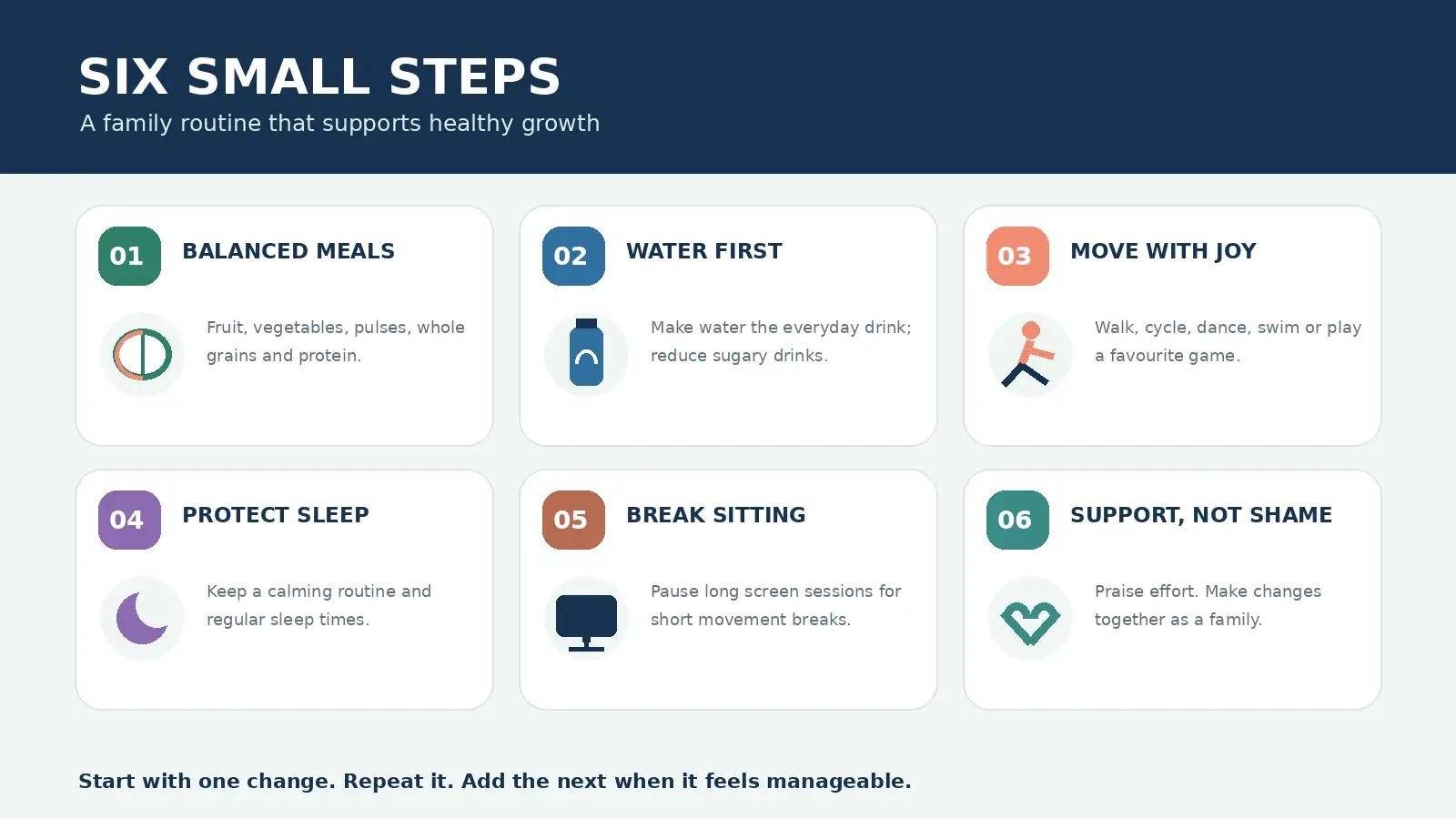
The goal is better health, energy, sleep and confidence. Do not put a child on a strict weight-loss diet unless a qualified paediatric team has designed and is monitoring the plan.
1. Make meals balanced. Offer vegetables or fruit, whole grains and pulses, and suitable protein such as beans, lentils, eggs, fish, yoghurt or lean meat. Use familiar foods and realistic portions. Healthy meals need not be expensive.
2. Make water the usual drink. Keep water available and reduce routine sugary drinks, packaged juices, energy drinks and sweet tea. Occasional treats need not become forbidden foods; focus on everyday patterns.
3. Build movement into the day. For ages 6 to 17, the CDC recommends at least 60 minutes of moderate-to-vigorous activity daily. Walking, cycling, dancing, swimming, football and active games count. Children aged 3 to 5 should have active play throughout the day. Start at the child’s level and build gradually.
4. Break up long sitting periods. Encourage movement breaks between homework or screen sessions. Protect time for safe outdoor play and avoid screens during meals when possible.
5. Protect sleep. Keep regular bedtimes and wake times. A calm routine and charging phones outside the bedroom can help teenagers and younger children. Ask a clinician about persistent snoring or daytime sleepiness.
6. Make it a family project. Parents can model healthy routines. Plan meals together, walk after dinner and celebrate effort rather than weight. Do not single out one child while everyone else keeps the old routine.
A real-world example: small changes, shared effort
Consider a fictional example. Rohan is 12 and spends most evenings sitting after school. He often drinks a sweetened beverage with snacks, sleeps late and rarely plays outside. He has started avoiding sports because classmates make comments about his body. His parents are worried, but they do not want him to feel that something is wrong with him.
The family begins with a paediatric appointment. The clinician reviews Rohan’s growth chart, asks about sleep and activity, checks his general health and discusses whether any further assessment is needed. The appointment does not begin with a crash diet or a target weight. Instead, the family agrees on a few realistic habits that everyone can practise.
The family changes the routine, not the child
They make water the usual drink with weekday meals and keep a simple after-school snack ready. Rohan chooses an activity he enjoys: badminton with a cousin twice a week. On other days, the family takes a short walk after dinner and gradually makes it longer when the routine feels comfortable. His parents also agree to put phones away during dinner and keep a more regular bedtime.
The adults make changes too. They stop buying large quantities of sweetened drinks for the home, plan a few meals together and avoid commenting on Rohan’s body. His parents speak to the school about the teasing and ask that physical education activities are welcoming rather than humiliating. Rohan is invited to help choose the next family activity, so he has a say in the plan.
Look beyond the weighing scale
After several weeks, the family reviews what is working. They notice whether Rohan is sleeping more regularly, joining activities more willingly and feeling better supported. They do not weigh him every day or treat a number on the scale as the only sign of progress. Any clinical measurements remain part of professional follow-up.
This example is fictional and does not predict the same result for every family. It illustrates a central principle of childhood obesity care: combine professional guidance with small changes that are realistic, supportive and shared. When adults improve the family environment, children do not have to carry the responsibility alone.
When to seek professional help
Arrange a paediatric review if you are concerned about a child’s growth curve, rapid or unexplained weight change, breathing during sleep, persistent snoring, joint pain, unusual thirst or urination, ongoing tiredness, low mood, bullying or distress around food. Routine child-health visits are also a good time to ask whether growth is following an expected pattern. You do not need to wait until a child has symptoms before seeking advice.
What a paediatric assessment may include
A clinician may measure height and weight, calculate BMI and compare it with an age- and sex-specific growth reference. They may ask about eating patterns, physical activity, sleep, medicines, medical history, family history and emotional well-being. Blood pressure may be checked. Blood tests or referral to a dietitian, paediatrician or other specialist may be appropriate depending on age, symptoms and risk factors. The decision should be individual rather than based on a single number.
If a child is living with childhood obesity, ask the clinician to explain what the growth chart shows, which health risks need attention and what kind of follow-up is appropriate. Some children need only regular monitoring and practical family guidance; others may benefit from structured support from a multidisciplinary team.
What WHO’s 2026 guidance recommends
In October 2026, WHO published its first global integrated guidance for managing obesity in children and adolescents. It recommends structured support involving healthy eating, physical activity and behaviour-change approaches, with care adapted to each child’s needs and family circumstances. These approaches can be delivered individually or as part of a combined programme.
For children under ten, WHO does not recommend weight-loss medicines, bariatric surgery or weight-loss devices as routine treatment. For adolescents aged 10 to 19, approved medicines may be considered only in specific circumstances, after a structured and supervised programme has not achieved the desired results. Surgery is reserved for carefully selected adolescents with severe obesity under strict specialist conditions. These are specialist medical decisions, not options for self-treatment.
Never give a child an adult weight-loss medicine, slimming tea, supplement, appetite suppressant or restrictive diet without medical advice. “Detox” products and online weight-loss promises are not substitutes for paediatric care. Rapid dieting can interfere with nutrition, growth and a child’s relationship with food.
Ask the clinician to agree on a realistic follow-up schedule. Useful questions include: What does the growth chart show? Are any tests necessary? Which family habits should we work on first? Should we see a dietitian or specialist? How can we support the child’s mental health and manage teasing? What signs should prompt an earlier appointment?
For more detail, consult WHO’s 2026 integrated guideline for children under 10 and WHO’s 2026 integrated guideline for adolescents.
If a child has severe breathing difficulty, chest pain, fainting or another urgent symptom, seek emergency medical care rather than waiting for a routine appointment.
Frequently asked questions
Is childhood obesity always caused by overeating?
No. Food intake is one factor. Biology, sleep, medicines, stress, family circumstances and the wider environment also matter.
Can a child simply grow out of it?
Puberty changes body proportions, but parents should not assume a concern will disappear. A clinician can track growth and recommend support.
Should I weigh my child every day?
Daily home weighing is usually unhelpful and can increase anxiety. Let a health professional decide how often measurements are needed and discuss them privately.
How much exercise should a teenager get?
For ages 6 to 17, the CDC recommends at least 60 minutes of moderate-to-vigorous activity each day. It can come from enjoyable activities, not only organised sport.
The most useful next step
Do not begin with a lecture, punishment or crash diet. Begin with a respectful conversation and, when needed, a routine health appointment. Childhood obesity is complex, but families can make progress by choosing practical changes that are safe, repeatable and suitable for the child’s age.
Try a simple seven-day family reset. Choose one drink habit, one movement habit and one sleep habit rather than changing everything at once. Keep water easy to reach. Plan a walk, dance session, cycling trip or game that the child enjoys. Set a consistent time to wind down before bed. Invite the child to help choose the activity and the meal. At the end of the week, discuss what felt easy and what needs adjusting.
Keep the focus on actions, not blame. A child can help prepare vegetables, carry a shopping list, choose a playground game or plan a weekend walk. Parents can make the same changes and show that healthy routines belong to everyone. When a family faces cost, time or safety barriers, choose the smallest realistic step and ask schools or local health services what support is available.
Progress is not measured only by weight. Better sleep, more energy, improved confidence, enjoyable movement and calmer family meals are meaningful signs that routines are becoming healthier. Clinical growth measurements should be reviewed privately with a qualified professional.
The goal is not perfection. It is a supportive environment in which children can grow, learn and feel respected.
Health note: This article is for general education and does not replace an individual assessment by a qualified paediatric health professional.