
Introduction: One Decision Can Change Everything
Early Career:At 11:45 PM on a quiet Sunday, Priya sat in front of two open email drafts.
One offer came from a high-profile corporate marketing agency in Mumbai. The starting salary was impressive, the office stood in a gleaming glass tower, and her family was already celebrating. The second offer was from a mid-sized logistics technology firm. The pay was 30% lower, the office was modest, and the title sounded plain: Junior Operations Associate.
Her parents urged her to take the first role. Prestige felt safe. Yet during her interviews, Priya noticed a quiet warning sign. The corporate agency spoke endlessly about perks, but current employees looked exhausted and admitted that newcomers rarely handled strategic work for their first two years. At the logistics firm, the founders invited her into a live product meeting, showed her their supply chain software, and outlined a steep learning curve with immediate project ownership.
Priya felt torn between instant validation and future skill acquisition. Under immense pressure, she declined the flashy agency and accepted the operations post. Her friends thought she made an unforced error.
Two years later, the corporate agency suffered massive layoffs as client ad budgets shrank. Meanwhile, Priya had mastered operational data analytics, managed automated warehouse pilots, and stepped into an operations lead role earning double her initial salary.
Priya’s story is a composite illustration of a dilemma facing thousands of graduates every year. Your early career decisions rarely arrive with guaranteed outcomes. Instead, they present a trade-off between superficial status and deep capability. Knowing how to weigh these choices marks the difference between stagnation and sustained professional momentum.
Table of Contents
Why Early Career Decisions Matter
A common misconception is that your first job fixes your professional destiny forever. In practical terms, career paths are no longer linear ladders; they are dynamic scaffolding. However, early career decisions carry outsized weight because they establish your fundamental working habits, professional reputation, and learning trajectory.

Initial workplace experiences shape your professional life across six core areas:
- Skill Architecture: The tools, communication patterns, and technical methods you absorb in your initial jobs become your baseline standard of work.
- Professional Confidence: Solving hard challenges early builds psychological resilience, whereas repetitive environments can produce learned helplessness.
- Financial Independence: Early earnings allow you to build an emergency fund, reducing personal anxiety and giving you leverage to make bolder future moves.
- Network Quality: The managers and peers you collaborate with today become the project leads, founders, and department heads who refer you tomorrow.
- Work Satisfaction: Early alignment with meaningful projects prevents early burnout and cynicism.
- Long-Term Direction: Your initial steps signal your problem-solving capabilities to the wider market, influencing the quality of opportunities that follow.
Understand Yourself Before Choosing a Career
Effective career planning starts with clear self-awareness rather than market trends. Most people pick paths based on family suggestions or peer comparison, completely skipping honest self-examination.
To build an accurate personal profile, evaluate six distinct dimensions:
- Natural Strengths: What complex tasks feel effortless to you but challenging to others? (e.g., breaking down quantitative problems, mediating conflict).
- Genuine Interests: What topics or questions do you willingly read about during your spare time without external pressure?
- Academic Abilities: Where have you proven your capacity to learn and synthesize demanding theoretical material?
- Practical Skills: What demonstrable tools or methodologies can you operate right now (e.g., SQL, financial modeling, technical writing)?
- Working Preferences: Do you do your best work inside structured corporate environments, or do you thrive in ambiguous, fast-moving environments?
- Real-World Responsibilities: What are your immediate financial obligations, family dependencies, or location limitations?
A Practical Self-Assessment Example
Take an engineer who enjoys data analysis but dislikes customer conflict. If she accepts a client-facing technical sales role simply because it pays an attractive commission, she will likely experience rapid burnout. Conversely, directing her analytical aptitude toward supply chain logistics or business intelligence matches her preference for deep, quiet problem-solving with steady market demand.
Passion Versus Practicality
One common piece of career advice is to “follow your passion.” While well-intended, blind passion without market demand often results in underemployment and financial stress. Conversely, selecting a career solely for starting compensation frequently leads to disengagement and early exhaustion.
+-----------------------------------------------------------------------------+
| Passion-Only Approach                 Practicality-Only Approach            |
| - High initial enthusiasm             - Immediate financial stability       |
| - Vulnerable to low market demand     - Risk of disengagement and cynicism |
| - High risk of personal burnout       - Slower long-term skill acquisition  |
+-----------------------------------------------------------------------------+
                                       |
                                       v
                    Balanced Sweet Spot: Sustainable Career
                    - Meaningful work aligned with personal interest
                    - Market-validated demand and fair compensation
                    - Room for compounding skill acquisition
A realistic approach is to treat passion as an output of competence rather than an absolute prerequisite. As you develop rare, valuable skills that solve urgent organizational problems, your autonomy, compensation, and workplace enjoyment naturally increase.
A Powerful Framework for Career Selection
To make structured, reliable decisions, use the D.R.E.C.D. framework: Discover, Research, Evaluate, Check, and Decide.

1. Discover
Identify your existing strengths and non-negotiable boundaries. Write down your top three technical proficiencies, your communication style, and your baseline monthly financial requirements.
2. Research
Investigate structural industry dynamics. Examine verified labour publications like the World Economic Forum Future of Jobs Report or national databases like India’s National Career Service. Look beyond job titles to study daily work routines and five-year retention rates.
3. Evaluate
Compare your top choices across compensation, stability, culture, and learning curve. Assess whether an opportunity provides transferable skills that will remain relevant if market conditions shift.
4. Check (Experiment)
Test hypotheses before making multi-year commitments. Pursue short internships, complete portfolio-grade open-source projects, shadow working professionals, or enroll in focused, hands-on certification modules.
5. Decide
Commit to a focused path for 12 to 18 months. Set clear review checkpoints to measure skill acquisition, peer feedback, and personal engagement.
How to Evaluate Career Opportunities
When comparing early career offers, evaluate total career equity rather than just base pay. Career equity consists of the knowledge, networks, and brand reputation you take with you when you leave.
The following comparison table presents an illustrative evaluation matrix across common entry pathways:
| Evaluation Criteria | High-Growth Tech/Product | Corporate Management Trainee | Specialized Professional Services (Legal/Audit) | Public Sector / Civil Services |
| Personal Interest Fit | High (for builders) | Moderate to High | High (for analytical thinkers) | High (for public-service minded) |
| Initial Compensation | Moderate to High | High | Moderate | Fixed / Regulated |
| Daily Learning Curve | High | High | Very High | Moderate |
| Job Stability | Variable | High | High | Very High |
| Automation Resilience | Moderate to High | Moderate | Moderate | High |
| Work-Life Balance | Variable | Moderate | Demanding | Predictable |
| Illustrative Score (out of 10) | 8.5 | 8.0 | 7.8 | 7.5 |
(Note: Scores and ratings above are illustrative examples for structured comparison and do not represent verified statutory employment statistics.)
Common Career Selection Mistakes
Even talented candidates stumble into predictable missteps when launching their careers:
- Chasing Title Over Learning: An inflated title at a stagnant firm offers far less value than working as a junior contributor under an exceptional mentor.
- Succumbing to Herd Mentality: Choosing software engineering, investment banking, or civil services solely because peers are doing so leads to mismatched abilities.
- Ignoring Technical Adaptability: Assuming a formal university degree guarantees lifetime employability without continuous self-directed upskilling.
- Confusing Compensation with Culture: Prioritizing an extra 10% in salary while joining a toxic team that destroys mental stamina.
An Illustrative Real-World Example
Consider two university graduates, Rahul and Sneha, who completed their business degrees in the same year.
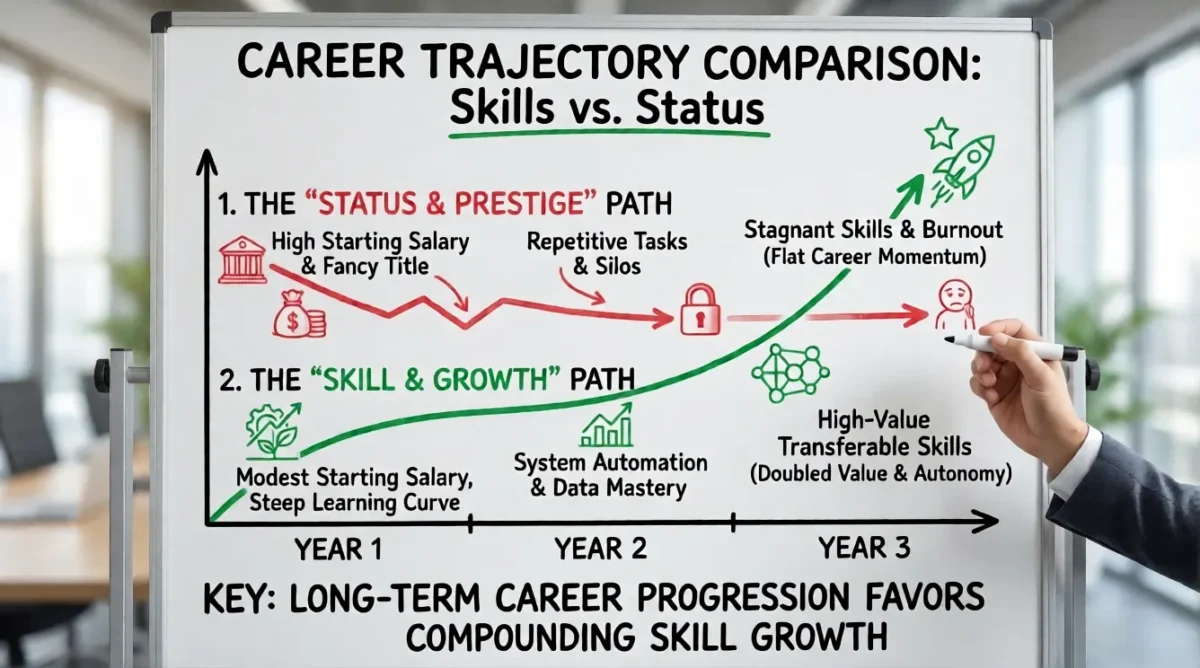
Rahul accepted a role at a well-known retail brand solely because it offered an impressive starting salary. His daily responsibilities consisted of generating repetitive spreadsheet reports using legacy enterprise software. He received no formal training, and his team operated in silos. After three years, Rahul found his skills dated, making it difficult to transition to modern, tech-enabled firms.
Sneha selected an entry-level position at a mid-market manufacturing firm undergoing digital transformation. Her base compensation was lower, but her position required her to learn enterprise resource planning (ERP) systems, coordinate across production teams, and master business intelligence tools. By year three, Sneha possessed in-demand expertise in modern supply-chain automation, allowing her to step into an operations consultancy role at a substantial salary premium.
The important distinction is that Sneha prioritized compounding skills over short-term compensation. Her deliberate investment in modern workflows gave her long-term career mobility.
The Future of Work and Career Planning
The modern workplace is evolving rapidly under artificial intelligence, cloud automation, and changing labor models. According to publications from the International Labour Organization (ILO), technological disruptions will transform task compositions across virtually all sectors rather than simply eliminating entire occupations.
From an employer’s perspective, technical tools will continue to evolve, but foundational human abilities remain indispensable:
- Structured Problem Solving: The ability to deconstruct ambiguous business challenges into clear, actionable steps.
- Interpersonal Communication: Writing clearly, listening attentively, and aligning cross-functional teams toward common objectives.
- Continuous Learning: Rapidly absorbing and applying new software, workflows, and analytical tools.
The long-term implication is clear: building an adaptable, complementary skill set is your best insurance policy against workplace disruption.
Advantages and Limitations of Early Career Planning
Planning ahead provides clarity, saves time, and prevents aimless job hopping. It helps you focus on building valuable skills rather than reacting to short-term pressures.
However, planning has natural limits:
- Evolving Personal Interests: What you enjoy at age twenty-one might not fulfill you at twenty-eight.
- Macroeconomic Volatility: Market downturns, restructuring, and changing trade conditions can disrupt hiring in specific sectors.
- Unplanned Opportunities: Rigid adherence to a five-year plan can blind you to promising, unexpected ventures.
A realistic approach is to treat career plans as dynamic working drafts. Plan your direction with care, but remain flexible enough to pivot when real-world evidence demands it.
What Should You Do Next? A 30-Day Action Plan
If you feel overwhelmed by career choices, break the process into manageable weekly milestones:
+-----------------------------------------------------------------------------+
| Week 1: Audit Strengths & Values                                            |
| - List top 5 skills, 3 areas of interest, and core financial baselines.     |
+-----------------------------------------------------------------------------+
                                       |
                                       v
+-----------------------------------------------------------------------------+
| Week 2: Deep Industry Research                                              |
| - Identify 3 sectors with growing demand; study 10 job descriptions each.   |
+-----------------------------------------------------------------------------+
                                       |
                                       v
+-----------------------------------------------------------------------------+
| Week 3: Conduct Informational Interviews                                    |
| - Connect with 3 mid-level professionals to learn about their daily work.    |
+-----------------------------------------------------------------------------+
                                       |
                                       v
+-----------------------------------------------------------------------------+
| Week 4: Build a Concrete Project or Target Application                      |
| - Produce a real-world work sample or tailor your resume for 3 roles.        |
+-----------------------------------------------------------------------------+
Conclusion: Choose a Direction, Keep Growing
Building a fulfilling early career is not about making one flawless, permanent decision on graduation day. It is an iterative journey of choosing a smart direction, developing rare skills, gathering real feedback, and adapting as you grow. Focus on learning over superficial prestige, build genuine relationships, and treat every role as an opportunity to expand your capabilities.
Frequently Asked Questions
1. Why is early career planning important?
Structured early career planning helps you build marketable skills, avoid stagnant roles, and develop the professional confidence needed for long-term growth.
2. How should a student choose the right career?
Start by identifying your natural strengths, interests, and financial needs. Then research growing industries, conduct informational interviews, and test options through internships or independent projects.
3. Should passion or salary influence career selection more?
Neither should be pursued in isolation. A practical strategy targets areas where your baseline abilities intersect with market demand, allowing financial stability and genuine job satisfaction to reinforce each other over time.
4. Is it too late to change an early career decision?
No. Early career paths are flexible. The foundational skills you build in communication, project management, and data literacy transfer readily across different industries.
5. How can someone identify their professional strengths?
Review past academic, extracurricular, and workplace accomplishments. Identify tasks where you routinely deliver quality results with ease, and ask trusted mentors or peers for candid feedback.
6. What skills are important for long-term career growth?
Alongside domain-specific technical skills, employers value core durable skills: structured problem-solving, active listening, clear written communication, and rapid self-directed learning.
7. Does the first job determine future success?
No. While a well-chosen first job accelerates your learning curve, continuous skill acquisition and adaptability matter far more over a multi-decade career.
8. How can young professionals prepare for changing job markets?
Stay curious, cultivate technical and digital literacy, track emerging industry workflows, and build an adaptable portfolio of transferable problem-solving skills.